Saturday, May 14, 2016

Schlumbergera seedling no. 005

The plants will just not give me a break. The latest "fuck you" from the plants came from my Schlumbergera 'Caribbean Dancer,' seed parent to all of the Schlumbergera seedlings that have bloomed so far. I've had the plant since December 2008, and the photos I have of it vary wildly in quality, but I'm sure you'll get the idea anyway.

Top to bottom: November 2009, May 2010, November 2013, November 2015.

and now May 2016:


And I don't expect that the existing branch is going to remain for very long.

The decline was quick: it takes eight and a half years to grow a plant out that big, but they only need a week to disintegrate. I don't know what I did. It's been in the same location, receiving the same light, in the same pot, getting watered in exactly the same way and at the same times, for at least the last four or five years.

People occasionally say to me things like, oh, it must be wonderful to have so many plants, to be surrounded by all that LIFE and GROWTH and BEAUTY all the time. It's never actually felt that way to me, but people say it. Lately, though, it actually has been feeling like I'm surrounded by death, disease, and ugliness all the time, and it's right there in my house so I can't even get away from it. Just in the last three months:


I had a gigantic and lovely variegated Beaucarnea recurvata, which spent last summer outside and grew rampantly. It was amazing. Then I brought it in for the winter and it spent several months continuously defoliating, because (I eventually learned) its roots had all rotted out, probably because I'd up-potted it before moving it outside, and so it got thrown out in mid-January.

Before the 'Caribbean Dancer,' the salmon-peach NOID (likely pollen parent for all/most of the seedlings) suddenly shriveled and turned red. Nothing dropped off: it just kept getting more and more slumped and shriveled, and then the fruits started drying up and falling off. Threw it out at the end of April, when it finally became clear to me that the reason I hadn't seen any new growth was because the plant was in fact genuinely dead.


My surviving Eriobotrya japonica has always had a problem with spider mites to some degree or another, but they'd stayed more or less manageable, enough that I figured it was worth holding on to and just spraying with soapy water from time to time or whatever. And then at about the same time it had finally gotten large enough to start branching, the mite population exploded and I was like, do I really want to be fighting spider mites for the rest of my life? So it was gone in late January.

The Yucca guatemalensis in the plant room, multiple pots of a yellow-margined version I've had since 2001, had gotten scale in 2013 or 2014, I can't even remember which, and after trying to get rid of the scale with rubbing alcohol and various other things, I finally just cut the heads clear off and made them start over. Which worked! Kind of! As of last fall, they'd resprouted and grown enough new leaves to reach the point of kind of looking like plants again, and, well, you know how this story has to end so I'm not even going to bother finishing the sentence. (February or March, I can't remember)

An Aloe variegata from May 2008, and a Sansevieria hargesiana from May 2010, both given to me by friends from my days back at Garden Web, had both quietly been letting their roots rot away below the soil without saying anything. I'm trying to reroot both of them, on the grounds that even though I don't feel like it now, I may someday be happy that I did it anyway, but it feels pointless and I'm not necessarily going to stick with it long enough to recover the plants. (late March / early April)

Both specimens of my Columnea orientandina are falling apart all of a sudden; one is probably too dry, but the other one I have no idea what its problem is.

Every remaining division I had from an Agave victoriae-reginae I bought in April 2010 turned out to have scale and had to be thrown away. (mid- to late March)

The Murraya paniculata seedling (previously) has thrips, which makes a 1) new species with a problem, 2) new genus with a problem, and 3) new area of the house confirmed to have thrips. (late April?)

And those are just the high points. (Low points? Main points.)

I've talked before about the Texas Effect and how it's not necessarily a huge deal for things to be going badly with the plant collection, since any plant collection this size is going to have good things and bad things happening at the same time and mostly they cancel out. Well, they're not cancelling out anymore. The 'Caribbean Dancer' collapse is the last straw. I haven't figured out what "last straw" means, precisely, but . . . something. There will be changes.

Anyway. So there's also a Schlumbergera seedling to name today.


Obviously I don't feel like putting a ton of effort into the naming process at the moment. My first thought was Last Straw, but I had left a note for myself earlier that the previously-considered Circus Peanut would work well for this one, it being a lighter orange than most. So I'll say Circus Peanut. But my heart isn't in it.


Thursday, May 12, 2016

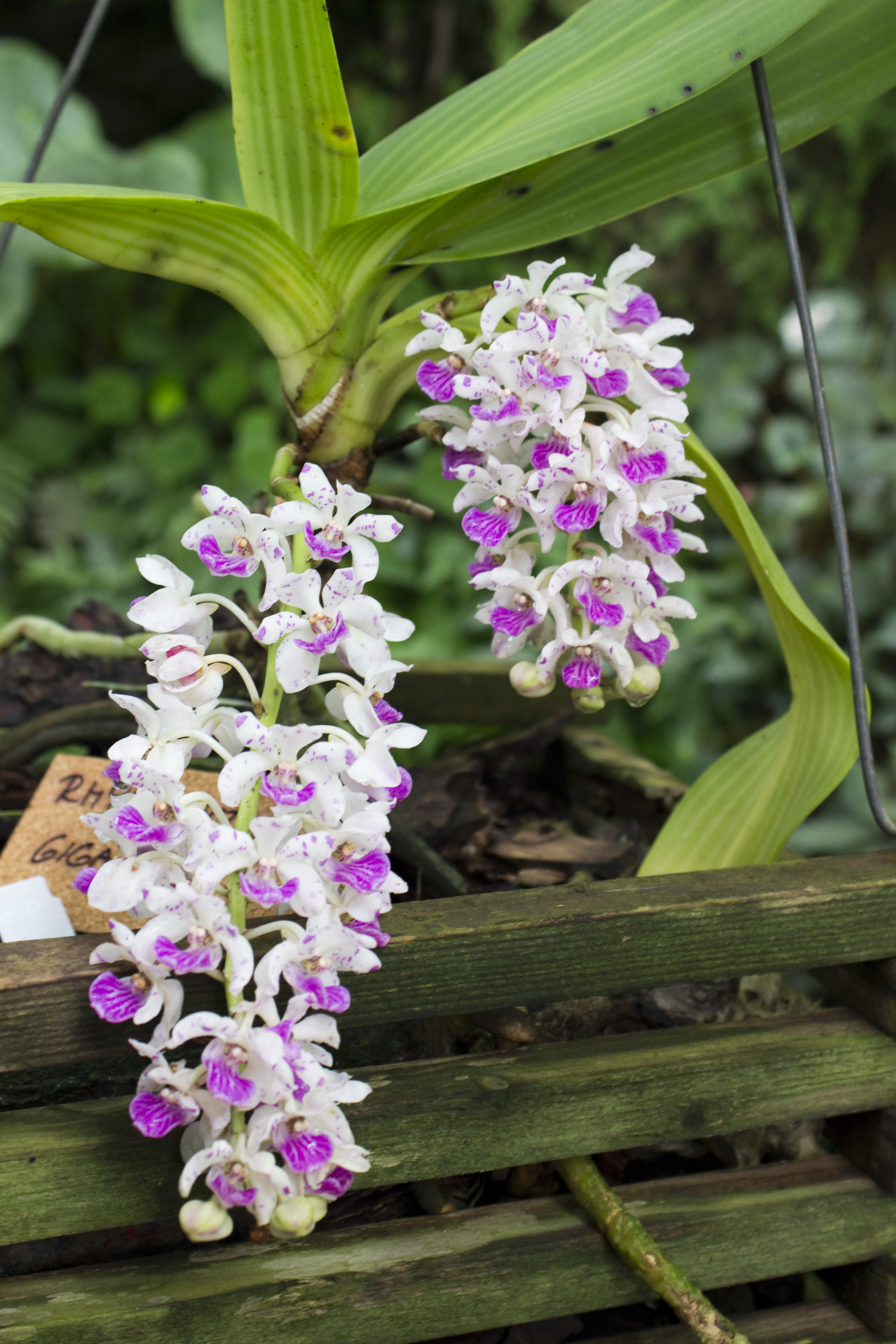
Pretty picture: Rhynchostylis gigantea 'Orange Star'

So, most pictures I found on-line of Rhynchostylis gigantea show white flowers with varying amounts of magenta or purple, in the form of dots, blotches, and labella. Except when they're solid purple, magenta, or white. And there is also a variety, R. gigantea var. vivaphandhul, which is apparently orange and pink. And, well, 'Orange Star' is apparently also pink sometimes, despite the name,1 and now I'm adding my photos of this pale pink/coral bloom.


Which all sort of raises the question: can you call any old orchid a Rhynchostylis gigantea and get away with it? As far as that goes, I'm not confident that I could prove, in like a court of law or something, that I myself am not merely an uncommon clone of Rhynchostylis gigantea. Maybe the entire world is just one Rhynchostylis gigantea after another, all the way down.

(Or not.)

As strange as it is to have a species that can bloom in so many different patterns and so many different colors, the ID is apparently legit: it's just a species with a very large natural range2 and lots of different clones available. They're also, as the name would suggest, and the linked photos earlier will attest, capable of becoming very large, though this particular specimen was small, maybe a foot / 0.3 meters in diameter at most. Bloom spikes can have hundreds of individual flowers on them, and of course there can be several bloom spikes to a plant.


They're also supposed to be strongly, sweetly fragrant; it's apparently incredible. I don't remember noticing any smell from this plant at the show, though. So I've seen a specimen of an enormous plant that grows huge, many-flowered, highly fragrant spikes of white/magenta/pink/purple/orange flowers, without getting any of the actual experience of seeing an enormous plant with huge, many-flowered, highly-fragrant spikes of white/magenta/pink/purple/orange flowers.

-

1 In fact, I wasn't able to find a photo of 'Orange Star' that I would call orange; the orangest photos I saw were of var. vivaphandhul. Why did someone name this pink-flowering plant "Orange Star" when it is not orange?
Ah. There I go again, expecting orchid names to make sense. I should know this by now.
2 Wikipedia: "Myanmar, Thailand, Malaysia, Laos, Cambodia, Vietnam, Hainan China, Borneo, Bangladesh and the Philippines"


Tuesday, May 10, 2016

Schlumbergera seedling no. 090

Wait. Didn't I just name this one? I guess I didn't. *sigh*

The good news, if you want to think of it as good news, is that after this one, there are only three Schlumbergera seedling posts left, and then we can once again get our boredom from pink Anthuriums, as nature intended, instead of orange Schlumbergeras.


Anyway. This one looks an awful lot like 028A Phil Collen, 092A Sparky, and 102A Michonne. Perhaps we could save some time by just looking at the previously considered names for those three and picking one?


Well. 028A Phil Collen was always Phil Collen; no other names were even considered. So he's no help. And I didn't like the original set of choices for 102A Michonne,1 so I free-associated my way into picking a different one and then edited the post after the fact to make it look like it had been under consideration all along. But there is still Lola, which I really wanted to use for 092A Sparky because of the color. Sparky's color is essentially identical to this seedling's color, so: is there any compelling reason not to go ahead and just name this one Lola?


Can't think of one. Ergo: Lola!

-

1 (Judith, Gamma Ray, Shipbuilding, Tokyo, Glass Heart, Easter Island, Rapa Nui, Hegahega, and Casino)


Monday, May 9, 2016

Unfinished business: Gasteria bicolor (?)

So. I got some seeds from one or more Gasteria bicolor plants in I think November 2012. I sowed them, several germinated and grew, and then they kept growing. Not all that unexpected so far, but in the first post, I noted that it was possible that the seeds were hybrids -- the original plants were identified as Gasteria bicolor, and sure looked like Gasteria bicolor to me, but I didn't know who the pollen parent was (the seed parents didn't belong to me, and the person they did belong to didn't know).

I also said that there was a good chance I'd never find out whether they were hybrids or not, because my track record with Gasterias was that I usually overwatered them.

And now, roughly four years after acquiring the seeds, I can say that it sure looks to me like they're hybrids. I didn't overwater them (yet), is one indication they're not G. bicolor. Another is that they're all at least a little different from one another. Sometimes a lot different.

Some of them look more or less like the species, or barely lighter than the species:


I'm pretty sure the top seedling is in a 4" / 10 cm pot, and the bottom one is in a 3" / 7.5 cm pot.

But a third plant is very short, small, and dark, and offsets heavily:

(3" / 7.5 cm pot)

And another is a lighter green, with thinner leaves.

(4" / 10 cm pot)

So I guess at least some of the blooms had been pollinated by something that wasn't Gasteria bicolor. So far, I kind of like the last one best, at least as far as color, but it's not an offsetter so it may not be propagatable.

Also so far: no scale detected on any of them. Doesn't mean scale aren't there,1, but I haven't seen them. Considering that my Gasterworthias and Gasteraloes have had an easier time in general with the scale than the Haworthias and Aloes, I'm sort of inclined to think/hope that maybe Gasteria genes make plants less palatable to the scale. In any case, I'm hoping to be able to keep a seedling or two as long-term residents, which will be easier to do if the scale leaves them alone.

I've gotten a similar result from a different set of seeds (which I will leave unidentified in the interest of building mystery) recently, but in that case there's much more variation among the offspring, which makes much less sense: it was a self-pollination from a plant which, up until pretty recently, I had been confident was a species. The seedlings are cool, and one of very few things the plant collection has done lately to make me happy.2 I'll show you toward the end of May.

-

1 (It could just be that by their bumpy and spotty nature, Gasterias provide better camouflage for scale than related plants in othere genera.)
2 (
Veeeerrrry few. Like, possibly the only.)


Sunday, May 8, 2016

Schlumbergera seedling no. 098

Schlumbergera seedlings don't usually need "practice blooms" like Anthurium seedlings do; for the most part, the first flower is like the later flowers will be, and I don't need to do a lot of guessing about what they might wind up doing later on. So although 098A only made the one flower this year, odds are pretty good that the slightly stretched-out shape, with the petals divided into a front half and a back half, will be seen in future blooms.


The problem, of course, is that there's always the possibility that this one will be an exception, and will do something substantially different next year. So I need a name that gestures non-comittally in the direction of the slightly odd shape, without actually promising a slightly odd shape. To that end, I'm going to dispense with the categories and try to come up with a name the old-fashioned way: by looking at a thing, then choosing words to describe the thing.

So when I look at this flower, what is it that comes to mind exactly? Well, the back half of the petals sort of brings to mind a ballerina's tutu. They're not ordinarily hunter orange, granted. But maybe that's useful. Hunting Tutu, or something along those lines?

The extended, tightly-packed anthers and stigma sort of evoke a chameleon, or frog -- one of those animals that shoots out a long, sticky-tipped tongue to catch and eat insects. Chameleons are rarely orange, though, and searches for orange frogs mostly turned up depressing Wikipedia entries about extinct or nearly extinct amphibians, which were actually mostly yellow anyway. There are some orange or red-orange poison dart frogs, though, and they do shoot their tongues out to catch insects --


-- so . . . maybe a name that has something to do with poison dart frogs? But what? (Also, a warning: searching for anything having to do with poison dart frogs will reveal a surprisingly large and robust poison-dart-frog hobbyist community. Very easy to get sucked in and lose an hour.) For all the information about the frogs, it was difficult to find a straightforward list of species with photos.1

The best option I could come up with, frogwise, was a relatively common (?) species, Phyllobates terribilis, the orange form of which is called "Orange Terribilis" in the frog trade. Though I expect to find out eventually that Latin is forbidden by whatever authority recognizes and approves cultivar names, it's possible that English/Latin is acceptable. And in any case I cannot afford to get sucked into any more poison dart frog sites, lest I start wanting some.2

So that's two possibilities. What would be a third? Well, it's kind of cheating, because most Schlumbergera flowers have it to some degree or another, but 098A has that windswept, petals-thrown-back thing going on, at least in these pictures. So what's orange and white and blows in the wind? Well, amazingly, Wikipedia has a list of flags organized by color, and it contains exactly one orange-and-white flag: that of Fukushima Prefecture, Japan.

Yeah. That Fukushima.

So that's kind of emotionally fraught. The people of Fukushima are, of course, not responsible for the earthquake and tsunami, but the fact remains that people get irrational about radiation,3 and "Fukushima" basically means "radiation" now to a lot of people, so it would probably not work out well commercially, however it was intended.

Further pursuit of orange flags found a site that claimed that Salt Lake City, Utah, was providing blaze orange flags for pedestrians at crosswalks, to wave around while they cross and give them greater visibility to drivers. Which seemed like it would eventually wind up being counterproductive.4 Other cities have tried the idea, with mixed results -- Seattle didn't notice it made a difference, and couldn't evaluate certain locations because people kept stealing the flags; almost nobody used them in Berkeley, California (only 2%), and many of the people who did use them stole them (Ref.) -- and I can't tell whether SLC is still using them or not. In any case, I'm thinking that instead of Fukushima, I'll go with Pedestrian as the flag-related name option, even though most cities seem to be going with yellow flags instead of orange.


So that's three. This post is feeling kind of long already, so maybe it's time to stop and pick one.

Pedestrian kind of works -- it's also maybe a subtle dig at 098A being just another orange bloom, by way of the "undistinguished; ordinary" meaning of "pedestrian." And it's also a common, familiar word. That all also makes it a less exciting choice, though.

Hunting Tutu is . . . well, I wish I had a way to just show you the mental image I have of this, because it is delightful. (This is the closest I could find via search, though I was picturing a different material: something heavier and more opaque, that would hold up longer in a game-hunting situation.) But it's also maybe a little too pointedly weird.5

Orange Terribilis has the Latin problem, and I've been trying not to use the bloom color in the names.6 It's also longer than the others.

I suppose I could roll the last two together into Terribilis Tutu. But that's awful.

Or is it?

Yeah. It's awful. Pretty sure. But so what then?

I don't know. I'd planned for this post to go up on 8 May, and it's already 6 PM on 7 May, and I still have a lot of watering to do, so I should just pick something. So . . . I guess if I'm being honest with myself, of the three and a half options here, I'm feeling the most drawn to Hunting Tutu, as in, "Larry gathered his knife, rifle, and hunting tutu."7 Not really altogether happy with it, but I have to choose something, and I'm too wiped out right now (long day, long story; everything's fine, though) to try to generate additional options. So there it is.

-

1 Some of the problem may be that many of the species have multiple color forms. As with plants, people tend to be more interested in the pretty colors than in getting the names right, and the world of poison dart frog hobbyists isn't immune to taxonomic upheaval either. So one can kind of understand why species names wouldn't be foremost on everybody's minds. Still doesn't excuse the lack of reference galleries.
2 Though I do wonder how good they'd be at handling thrips. The "poison" part wouldn't even necessarily be a problem, since they're not necessarily poisonous -- it looks from a quick skim like wild-collected frogs are knock-you-dead poisonous if eaten or handled, but they lose their toxicity one to three years after collection, and captive-bred frogs aren't toxic at all. I mean, Sheba would still be a concern, and I really doubt the conditions in the house are suitable for their long-term survival anyway. One only has just so much money for buying frog corpses. But the thrips situation has me thinking further and further outside the box, especially now that it's spread to the Schlumbergeras. And it's not like I haven't considered frog-administered services before. (This is my million-dollar idea, I can feel it. I just have to get the details right. . . .)
3 By which I mean that there's very little understanding of how widespread radiation actually is, and how much radiation it takes for something to be dangerous. This xkcd image illustrates both pretty well.
4 If you get drivers expecting to see pedestrians carrying flags, then don't you make the pedestrians who aren't carrying flags harder to see, and more likely to be hit?
5 Oh! Speaking of pointedly weird / tutus! I ran across this video from the Cincinnati Ballet a few days ago and thought of you. There's a quick moment at 0:46 that makes me laugh every time, and the stretch from 1:04 to 1:50 is pretty good too:


6 Perhaps it would be more accurate to say I've been trying not to use common color words in the names: "red," "orange," "pink," that sort of thing. 064A Rose Hoses, 022A Sad Tomato, 055A Pumpkin Festival, 082A Strawberry Madeleine, 208A Raspberry Possum, 058B Buff Orpington, and 103A Ginger Beer could all count as me directly naming a color in the seedling name.
7 And emphatically not in the sense of "Larry looked around. The Archbishop was nearby; he could feel it. But which direction? And why was he hunting Tutu in the first place?"


Saturday, May 7, 2016

Pretty picture: Paphiopedilum primulinum

This one looked awfully familiar to me -- surely I've seen this small yellow paph some other year? -- but technically, this is the first time we've seen this species at the show:


I wasn't wrong to find it familiar, though; it's the pollen parent for two previous hybrids, 2012's Paphiopedilum Prim-N-Proper (seed parent Paphiopedilum praestans), which doesn't look that much like Paph. primulinum, and 2013's Paphiopedilum Pinocchio (seed parent Paphiopedilum glaucophyllum), which looks almost exactly like Paph. primulinum.

Most of the photos that turn up in on-line searches for this species show greener blooms than my photo does, but this bright yellow isn't unprecedented, either. And even this is a little greenish.


Thursday, May 5, 2016

Schlumbergera seedling 092

Seedling 092 isn't terribly special. It's maybe more of a red-orange than orange, but even so, we've seen this before.


However, it did do one thing I've never seen before: as it was winding down for the year, it produced this flower:


I don't know exactly what went wrong here, but I'm fascinated by it, because it went wrong in a very specific-seeming way. It's sort of like, it built the base and the tip of a flower, but left out the whole middle? I bet there's a really interesting sciencey explanation for what happened here, and I bet I never find out what it is.

*sigh*

So. The shape of the later, deformed bloom, with all the little stamens spraying out in different directions, makes me think of sparks from metal-grinding (e.g.). Even though it's not what the plant's normally going to produce, I feel like the fact that it's done it once means I can consider Sparky.

For color, I'm feeling drawn to bringing Kimchi back again. No particular reason; just seems right.

Recently, during a what-things-are-orange brainstorming session, I remembered the movie Run Lola Run (original German title: Lola rennt), starring Franka Potente as the titular Lola. In the movie, she has bright orange/red hair --


-- which may not be an exact color match for the bloom, but it's damn close.


And I really liked the movie. So, the pop cultural slot will be filled by Lola.

(I think I'll just skip the previously-considered category this time; I'm already considering Kimchi again, and none of the other previouslies look good to me today.)

Finally, in the "whatever" category: the very long list of words I mentioned some time ago is still a work in progress (though in the month and a half since I started working on it, I've managed to evaluate 186,000 words -- only 51,000 left to go!), and I'm pretty sure it's going to need considerable tweaking before it's a good way to get name suggestions. I mean, best case scenario, I'm figuring it'll mostly be useful for the 2016-17 crop, not the one I'm currently trying to name. But as a test run, let's see what happens if I allow myself to sort of free-associate off of whatever words the list hands me, and change parts of speech when necessary.

From 45 random word-pairs, I got 23 that I could shoehorn into making any kind of sense, though in one case I had to ask Google for help.1 I cut those 23 down to the three that I found most appealing: Mostly Harmless (the title of a book by Douglas Adams), Everybody's Different (which I like mostly for the irony2), and Where'd You Last See It, which is one of those Culture-Ship names that are always tempting but too long to be practical. The one that I decided to use for the "whatever" slot is Everybody's Different.


So, to recap, we have Sparky, Kimchi, Lola, and Everybody's Different.

I'll drop Kimchi, because I feel like it wants an oranger seedling. And Everybody's Different works well enough, but I really like Sparky and Lola.

Choosing between Sparky and Lola was sort of agonizing, because I like them both a lot, but in the end, I'm going with Sparky. The odds are good that I'll see another Lola-colored bloom before I see another Sparky-shaped one, after all.

-

1 Names (in bold), and original word pair (italics):
• Vicariously Burly (burly vicariously)
• Dick Control (control dick)
• Caller ID (call telling)
• Weeping Tendencies (tendency weepy)
• Lever of Immortality (immortality lever)
• Aristocrats (maybe aristocrat)
• Accidentally Employable (employable accident)
• Panpipes (piped finger)
• Magician's Dove (theatrical dove)
• Nonzero (number infinitesimal)
• Everybody's Different (different everybody)
• Wastewater Treatment (separates detritus)
• Where'd You Last See It (identify point)
• If Both (both conditional)
• Sacrament of Pills (pharmacy sacrament)
• Growing Family (family grow)
• Confidential Help (confide help)
• Better Brains (synapses better)
• Bowling League (together league)
• Feel, Play, Love (play feel)
• Mostly Harmless (harmlessly most)
• Computer Ranch (farmer technical)
• Mice as Much (from the Google results for "nearly mice;" appears to be a text-recognition error that returns "nearly mice as" for "nearly twice as" in multiple scanned documents. Original word pair was "near mice.")
2 I mean, sure, technically the Schlumbergera seedlings are all different from one another, but I'd be hard pressed to describe any meaningful difference between, for example, 033 Clueless and 035A Patito. It's more appropriate for this particular seedling, because of the deformed bloom.


Tuesday, May 3, 2016

Unfinished Business: Aglaonema seedling

It's been a long time since I mentioned it, but I did get an Aglaonema to grow from a self-produced seed once. I got berries (almost certainly self-pollinated) from a plant in late 2011, and the first had germinated by March 2012. By October 2012, I'd gotten three seedlings, though one never did very well and eventually died, and a second one developed what looked like a ring spot virus so I threw it out. The third one, though, is now four years old and multi-stemmed:


It isn't an amazing-looking plant. I don't especially like this particular variety of Aglaonema (which I've seen identified as 'Marianne' and 'Maria,' probably a few other names too -- it's an old cultivar). Didn't really need more of them. On the other hand, being grown from seed gives it some novelty value.

Had the option been open to me, I would be an Aglaonema breeder instead of an Anthurium / Schlumbergera breeder, because I like the genus generally, and I have a lot of them,1 but this particular variety doesn't do much for me. Sadly, although my ags bloom just fine, usually in spooky unison no matter where they live in the house,2 and the spadices develop bumpy bits that look for all the world like tiny developing berries, nothing ever comes of it: the developing berries dry up and die, and then that's it until the next mass blooming.

I saw something on-line a long time ago that said the plants need really high humidity while berries develop, so that could be the problem, though 1) it's not like we have low humidity in the house, and 2) I don't have a way to increase it, so if that's the hitch then I guess this is the only Aglaonema I'm going to grow from seed. Once, I tried enclosing a bloom in a plastic bag along with a damp paper towel; it didn't help.

If only they could decide to bloom in the summer, I could put them all outside and they'd have all the humidity they could ever want. But no. So ag-breeding is something I only get to do in my dreams. Maybe someday.

-

1 Mostly NOIDs, but my best guesses for names are: 'Maria,' 'Stripes,' 'Sparkling Sarah,' 'Peacock,' 'Diamond Bay,' 'Gold Dust,' 'Brilliant,' 'Cory,' 'Jewel of India,' 'Jubilee,' 'Silverado,' 'Red Gold,' 'Silver Queen,' and 'Emerald Bay.' When I say I like the genus generally, I'm not fucking around: I really like the genus. The white-stemmed cvv. ('Peacock,' 'Brilliant,' 'Cory,' 'Sparkling Sarah') are particularly great.
2 And not even at the same times of year necessarily: historically it's been mostly January and/or October, depending on the year, but for some reason this year they've all decided to go in April as well.