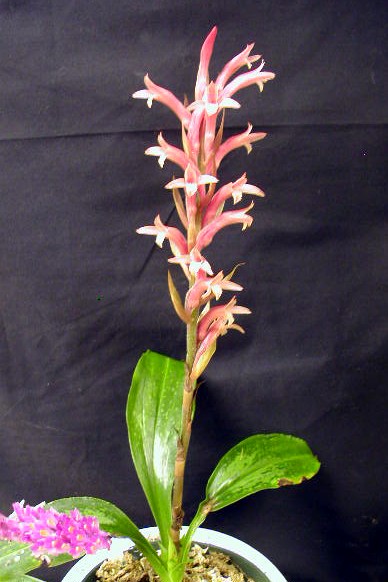
A notable historical fact about Phragmipediums (abbreviated "Phrag" by those in the trade, or people who would just prefer not to type out Phragmipedium, which is most everybody) is that one species, P. besseae, has only been known since 1981, when it was found in Peru by Elizabeth Locke Besse. It's unusual among Phrags for its flower color, which is a strong orange to salmon, and there are a few yellow or cream-colored specimens out there too. Naturally, once word got out about the existence of the new species, orchid collectors immediately descended on the site and took everything they could get their hands on. The trade of wild-collected plants is now banned, but it all happened fast enough that some populations were wiped out completely, either by overcollection or by habitat destruction.
This is all pretty obviously not a good thing for the local ecosystem (P. besseae is found along the eastern slope of the Andes in Peru, Columbia and Ecuador, so it's probably technically several ecosystems, not just one), but it's more ambiguous for P. besseae specifically. One could argue that it was doomed by development sooner or later, and the collectors saved the species from extinction. I mean, I probably wouldn't argue that, but now that P. besseae is part of the orchid trade and being used in hybridization, it's indisputably a hell of a lot less likely to go extinct than it was when nobody knew about it.
Of course the best option would have been for collectors to get specimens for breeding without taking so many that they wiped out the species in the wild, but that would have depended on everybody being restrained, rational, and co-operative. Which is unlikely.
In site-related news, I have a couple other orchid pictures from elsewhere that may or may not show up in the next month and a half, but this is the last of the Wallace's Orchid Show photos from 2010. I remind readers that the 2011 show is March 12 and 13 at the Wallace's Garden Center in Bettendorf, IA, and I'll be there on the 12th (or at least that's the plan at the moment), should anybody want to try to meet up there. E-mail if you're interested.
Sunday, January 23, 2011
Pretty picture: Phragmipedium besseae D'Alessandro

Wednesday, January 5, 2011
Pretty picture: Potinara Samantha Duncan 'Orange Tart'
This is a pretty awesome flower that I expect to clash horribly with the current color scheme. (Blogger preview shows your post and photos as they will appear on the blog, except that it shows your text on a white background. So I don't know how the blue and orange are going to go together, but I expect it to be bad.)
Long-time readers will probably be able to guess that I like this particular flower, since I'm a fan of the Cattleya Alliance flowers in general, and Potinara in particular, plus it's orange and I like orange. So if you guessed that, pat yourself on the back.
The parentage is Sophrolaeliocattleya (Slc.) Little Precious x Potinara (Pot.) Hawaiian Prominence. Doesn't mean much to me, but maybe it does to you. 
We're getting close to the end of the photos from the Wallace's Orchid Show last March: there's only one left. After that, I'm not sure what happens. I haven't heard anything yet about whether Wallace's is going to have another show this year (last year was, I gather, kind of an experiment), but it's been nice for me personally to have regular posts planned throughout the year where I could basically just point and say ZOMG look flowerz r pretty and go on to the next post, so I kinda hope they do. We'll see.
Sunday, December 26, 2010
Pretty picture: Vuylstekeara Melissa Brianne 'Shady Lady'
Boxing Day, at long last. In reality, there are a couple more weeks of Christmas-related events and music, but in my mind, Boxing Day is when stores and advertisements stop playing Christmas music, and the poinsettias get thrown out, and the Schlumbergeras get put on clearance if they're going to be, and the whole world just returns to normal after three months of force-feeding me red-and-green glittery holiday cheer. So Boxing Day is, like, the most wonderful day of the year to me. Hope everyone else is enjoying it too.
Oh! Speaking of force-fed glitter -- you know those spray-painted poinsettias, that have blue bracts, or purple, or whatever, usually liberally sprinkled with glitter besides? I saw green ones this year. Seriously. Someone went to the trouble of growing up a bunch of poinsettias, kept them under darkness for the prescribed number of hours per day so they would flower and their bracts would turn red (or possibly white: it's hard to tell for sure), and then spray-painted the bracts green. The color they would have been anyway.
A line of some sort has been crossed, here.
But anyway. None of this is the point of the post; there is an orchid to be looked at. I don't have a lot to say about it, but I like the color. Comment or don't.

Meanwhile, all kinds of things have happened over the last week -- lots of random blooming going on, just like last year (also, also, also). Winter is a curiously eventful season for indoor gardening.1 So I spent a lot of the hiatus writing posts in advance, and therefore haven't really had a winter break yet, but I will, eventually.
-
1 (Especially by comparison to outdoor. At least in Iowa it is.)
Friday, December 17, 2010
Pretty picture: Prosthechea cochleata
This has also been called Encyclia cochleata, which is what the file name on the photo says and what the tag on the plant at the show said. Encyclia still outnumbers Prosthechea by two to one on Google, but it's a new plant to me, and I figure as long as I'm learning a new name, I may as well make it the right one.
One of the common names is "clamshell orchid," from the appearance of the petal at the "top." It's actually sort of the bottom of the flower, though: P. cochleata flowers are upside down, developmentally speaking. Usually, an orchid flower's labellum, or lip, is an enlarged petal which serves as a landing platform for insects, like the "slipper" of a Paphiopedilum. In P. cochleata, the labellum hangs over the rest of the flower like a hood instead, but it's still the labellum. Hence, upside-down.
Whether or not the labellum looks like a clamshell is a matter of opinion, I guess: I'm not impressed with the resemblance myself, and would prefer "octopus orchid." But they still don't consult me before giving plants common names, so clamshell (or sometimes "cockle-shell") it is.
Supposedly the flowers smell like lemon/citrus; I don't remember there being a smell when I took the picture, but I wasn't thinking about that at the time, either.
A version of this plant is native to Southern Florida: it has three anthers, instead of the usual one, and is self-fertile. It's also, unfortunately, endangered, which is what happens when you're an orchid trying to coexist with the five and a half million people in the greater Miami metropolitan region.
The usual one-anthered version is the National Flower of Belize, but is found throughout Central America, Columbia, Venezuela, and the West Indies, and is consequently in much less danger of extinction.
P. cochleata has also been crossed with another orchid to produce the hybrid Prosyclia Green Hornet: different sites give different parentages for Green Hornet, but I'm inclined to go with P. cochleata x Encyclia trulla. Green Hornet is very similar to P. cochleata, but the flowers are bigger.
Supposedly they're fairly easy, as orchids go. I don't know whether that's true, but if I see one for sale and have the money, I may very well buy one to try. There's some sound-seeming advice about their care here.
-
1 The opening credits for "CSI: Miami" are set to the song "Won't Get Fooled Again," by The Who. The song starts off with a long, drawn-out, overenthusiastic YEAAAAAAAAAAAAAAAAHHHHHH!!!!! that's fairly over the top all on its own, but comes off as being even more over the top when it follows, as it usually does, a scene involving David Caruso, who is usually trying to be dramatic by putting on his sunglasses and pausing a lot, but they don't give him very interesting lines to end scenes on, so the drama tends to fall flat. Adding a YEAAAAAAAAAAAAAAAAHHHHHH!!!!! after someone says something relatively uninteresting, or something interesting that falls flat, turned into a minor internet meme.
This explanation really wasn't worth the joke, and in fact the joke probably wasn't even funny: I suspect it only seemed funny because I'm in a strange mood at the moment.
Sunday, December 5, 2010
Pretty picture: Brassolaeliocattleya Darcy-Rose Campbell
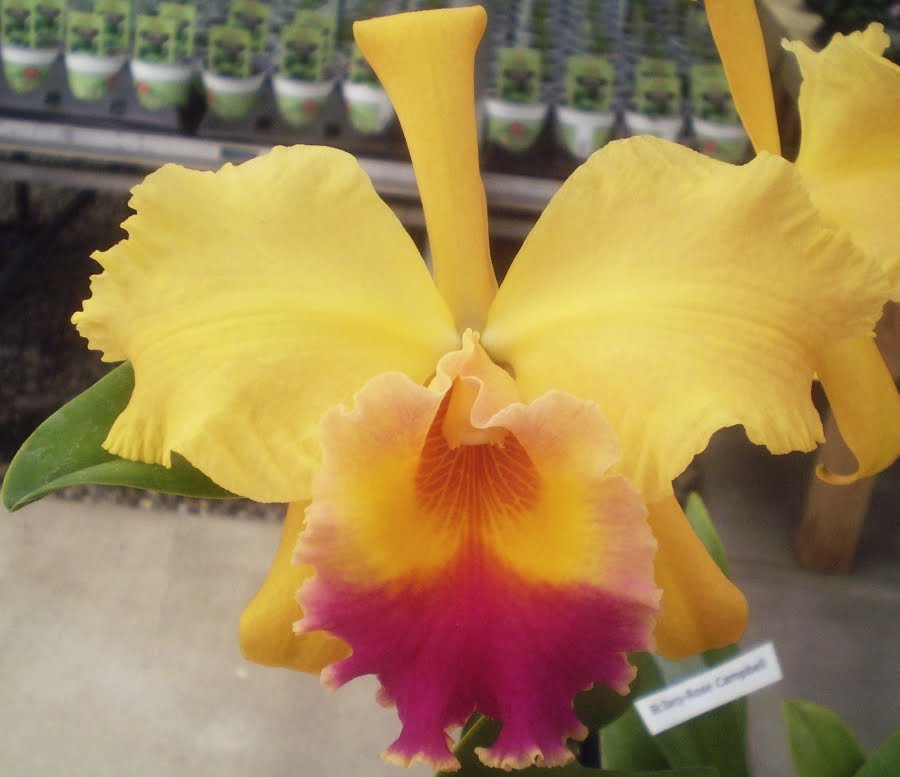
I really thought I had more pictures of non-cattleya-alliance flowers than this in the Wallace's Orchid Show set. I mean, I don't mind if you don't mind, but I went to a certain amount of trouble to avoid repeating genera, yet they're all starting to look the same to me anyway. (The last one, Paph. delenatii 'Santa Barbara' x Sib., is a notable recent exception.)
Looking at this picture, I'm mostly struck by the difference between the (big, wide, frilly) petals and the (narrow, plain) sepals. Usually the breeders try to make them both big and frilly, don't they? Or am I misremembering?
Sunday, November 28, 2010
Pretty picture: Paphiopedilum delenatii 'Santa Barbara' x Sib

I don't have much to say about this one. I couldn't find any information about it on-line, unless you count pictures, and pictures aren't that helpful on their own (except for confirming the name).
When I see lady-slipper-type orchids, I always wonder how they deal with rainfall. I mean, that big, puffy lip ought to get full of water pretty fast, if the plant got hit with a driving rainstorm. Is there a drain somewhere in the bottom, to let water out? Do they only flower during the local dry season, when rain wouldn't happen? Are the flowers exceptionally short-lived, so a flower that filled with rain would probably have been pollinated and dropping petals anyway? Do the sepals and other petals fold over the lip if it rains hard, turning water away like an umbrella?
Wouldn't say this sort of thing keeps me awake at night, but I do wonder about it. Maybe I'll have to keep wondering until I get a paph I can experiment with.
Friday, November 19, 2010
Pretty picture: Laeliocattleya Crownfox Sweetheart 'Paradise'

This is awfully close to what I picture in my head when I talk about the flowers from Cattleya alliance crosses, even if the lip is not all that frilly. I'm especially pleased with the light purple lines down the center of the petals and sepals: it's a nice touch. I'd like this a lot less if the petals and sepals were pure white.
I did Google, but didn't come up with a whole lot of interest about this one. Two sites sell it: one site sells this plant in Canada for $30 Canadian, plus $10-20 shipping; another site sells the same plant in the U.S. for $17.50 plus $10 shipping plus maybe more; it's kind of unclear how the shipping works on the second place. The flower is supposedly very fragrant, but I wouldn't know: this was eight months ago, and I couldn't get close enough to most of the flowers in the show to detect a fragrance.
The parentage is Laeliocattleya Memoria Robert Strait x Cattleya walkeriana; I couldn't find the parentage of Lc. Memoria Robert Strait, though I also didn't look very hard.
Monday, November 8, 2010
Pretty picture: Brassia Spider's Gold 'Elegant' x Ada

Well, you have to give the namers credit for honesty; it's definitely golden, and evocative of spiders. Whether or not it's elegant is subject to personal taste, I suppose, but the name works for me. And the flower does too, though the flowers with long, narrow petals like this only look good to me if there are many of them at once. Just one or two is a little sparse.
I've heard that some of these types, Brassias, Degarmoaras, Miltassias, etc., may be a little easier to grow than some of the others, but I don't actually know anybody personally who's tried them -- that impression is based off of research I did for someone a long time ago who'd received a Miltassia (I think) as a gift. True? Not true? Depends?
Thursday, October 28, 2010
Pretty picture: Laeliocattleya Fire Dance 'Patricia'

I really like this one. Possibly it's the color. Most of the photos from Google show flowers that are more orange and less red than this, but it wouldn't be the first time a particular orchid specimen was different from the way the variety normally looks, due to differences in care or whatever. And the lighting was, as I've noted before, bad that day.
I had this identified as Rhynchosophrocattleya Firedance 'Patricia' originally, and that's still what the file name says, but looking around for information on it, I got hits for Lc. Fire Dance 'Patricia' instead. A lot of the orchids at the show were mislabeled in subtle ways (letters transposed, things spelled as two words instead of one or vice-versa, obsolete names), so this is presumably an example of that, but I don't know which name is wrong in this case. Doesn't really matter, though. It's a pretty flower. Makes me happy to look at it. That's good enough.
Thursday, October 21, 2010
Pretty picture: Epidendrum Moon Valley

Not sure I'm entirely pleased with how these pictures turned out, but I'm not sure why. Perhaps I'm feeling the lack of a wide, whole-plant shot. (Nothing I can do about that now, alas; I have to work with the photos I took in March, and if memory serves, I was feeling a bit rushed that day, because I was worried that the batteries would die on me.)
I have zero direct experience with Epidendrum; we never had them at work. In fact, I think the orchid show at Wallace's that these pictures come from is the only time I've ever seen them in person at all. It's possible that I may have seen hybrids with some Epidendrum ancestry at work; wikiposedly they hybridize with other genera in the Cattleya Alliance.
I'm also nearly positive that I've seen pictures of Epidendrums being grown outdoors, on some blog or another, but I couldn't find it. A few of them are sufficiently cold-tolerant to be grown in the warmer areas of the U.S.
Sunday, October 10, 2010
Pretty picture: Laeliocattleya Gold Digger 'Buttercup'
It's not my favorite color, granted, but it's hard to dislike a Cattleya Alliance flower. 
I Googled to see if I could find anything interesting about this particular plant, but nothing jumped out at me, so I guess that's all you get. 
Tuesday, September 28, 2010
Pretty picture: Dendrobium Rainbow Dance 'Akazukin'

Not the kind of Dendrobiums I'm used to, exactly; the shape seems subtly different in a way that I'm unable to be precise about, and I don't recall ever seeing a Dendrobium with veining like that.
I'm nearly as burned-out on Dendrobiums as Phalaenopsis, because where I used to work, Dendrobiums were the main other thing, besides Phals, we used to get in (it was something like 70% Phals, 20% Dendrobiums, and 10% other), but Dendrobium has one thing going for it that Phalaenopsis doesn't (so far), which is that I've been able to rebloom a Dendrobium. Only barely, granted. (But more than once, which must surely count for something.) But still. Barely is better than not-at-all.
And actually, now that I think of it, my mother, whose track record with indoor plants is . . . I guess the word would be intermittent -- has actually had a Dendrobium for a while and it's done okay. I don't know about reblooming, but with Mom, survival is quite an accomplishment all by itself.
I might quibble with the namers of this particular variety a little bit. Last I knew, it took more than two colors for something to be considered a rainbow. (Even the dehydrated marshmallow rainbows in Lucky Charms have three, and they're made by mentally-challenged leprechauns.) But they're fine flowers, even so.
Tuesday, September 21, 2010
Pretty picture: Phragmipedium Eric Young x wallissii

Phragmipediums are interesting, and I'd be interested in one if I thought I could keep it going, but the advice I found on-line about their care suggests that if I had one, sooner or later I'd let it get too dry, and then it would croak. (Some species naturally live under water for part of the year, said one source. The same source said that as a rule, if you're in doubt about whether to water one, you should.) They are "not for beginners," numerous sites tell me. Fine then. I do appreciate the above flower, though. Weirdly pretty.
Eric Young is a cross of P. besseae var. flavum with P. longifolium, and then this is a cross of Eric Young with wallissii. There are interesting stories to be told about P. besseae in particular (Besseae is the source of the orange coloration in this flower, and kind of a big deal, if you're the sort of person who can find Phragmipediums a big deal.), but you'll have to wait until January (when there's a P. besseae picture scheduled) to read about that. Or Google it up for yourself. It's a depressing story, alas, though I suppose the ending could be worse.
In any case, I'm going on hiatus, and will be back on the 26th (Sunday). See you then.
Thursday, September 9, 2010
Pretty picture: Doritaenopsis Happy Valentine x Phalaenopsis New Eagle

Phalaenopsis1 don't normally do that much for me. Nothing actually wrong with them, but I've seen a lot of them, I've picked up dropped flowers from a lot of them, I've watched quite a few of them die, I've seen a couple produce keiki,2 and by this point I feel like I've pretty much seen everything a Phalaenopsis -- at least the commercially viable ones -- is capable of doing.
This one is not hugely different either, but it's different enough to bother with: I hadn't seen this paint-dipped effect before. Don't know that I particularly like it, but I hadn't seen it before.
It's sort of terrible, by the way, to be an orchid snob already when I've only ever owned seven orchids, two of which are dead.3 I feel like I should have paced myself better, or something.
-
1 I know, this is Doritaenopsis, but the two names are pretty nearly interchangeable, Doritis being a genus of orchids which some taxonomists consider synonymous with Phalaenopsis anyway.
2 As noted in the Phalaenopsis profile, the word keiki is both singular and plural in the original Hawaiian, so it's respectful, if not required, to use it the same way in English. Not everybody does, so one does see "keikis," and in the grand scheme of things the decision of whether to add an "s" to keiki is trivial, but I try to use it in the original Hawaiian way, both out of respect for the culture and because that way I get to write nitpicky footnotes about formation of plurals. And when I get to write nitpicky footnotes, then we all win.
3 In chronological order: Ludisia (R.I.P.), Dendrobium, Dendrobium, Brassolaeliocattleya, Paphiopedilum, Phalaenopsis, Oncidium (R.I.P.). Though to be fair, the Ludisia stuck around for a long time, and only died because of a bad repotting decision, and the Oncidium was unwell to begin with. So.
Tuesday, August 31, 2010
Pretty picture: Cattleya aurantiaca

Not at all what I think of when I think of Cattleya (in fact, some of what I think about when I think about Cattleya are probably not even Cattleyas, at least not pure ones), but it's not uncharming. I still prefer the color of the cross with Lc. Rojo, but as they say, I wouldn't kick this one out of bed for eating crackers.
Though in point of fact, I would kick anybody out of bed for eating crackers, 'cause, dammit, it's a bed. If you have to eat something, you could at least make it something that's not going to splinter into a million pieces and get all ground into the sheets and stuff. If somebody's insisting on eating crackers on a piece of furniture which is clearly not designed with cracker-consumption in mind, and doesn't see how that's a problem, then I don't think we're likely to have that long of a relationship anyway. And who eats crackers as a snack anyway, crackers by themselves? I mean, I do, sometimes, but that's mostly because they require no preparation at all and I'm very, very lazy when it comes to food. But I assume that other people don't sit down with a sleeve of Saltines and start chowing down. And I certainly don't eat just crackers, in bed, with someone I don't know well enough to have had the crackers-in-bed conversation with.
So no. I'd have to be like, um, _________, you're going to have to leave the bed for a little while if you want to eat crackers. And then when you're finished eating the crackers, you should come back and we should maybe have a talk about foods which are and are not appropriate to eat in bed, and maybe we should also talk about exactly where you see this relationship going if you're not going to be respectful of my desire to not be rolled in cracker crumbs against my will.
In any case, I do approve of the flower.
Monday, August 23, 2010
Pretty picture: Masdevallia ignea x constricta

The actual petals and other important parts of Masdevallias are stuck way down in the center of the plant, and are tiny. The sepals, which have become fused together, are the brightly-colored bits with the long "tails."
I think most of the Masdevallias I've seen are less pretty than just odd. I like odd, usually, so that's not really a problem. And the first one I posted about, Masdevallia Prince Charming, I actually think is kind of pretty, too. Everything breaks down with M. ignea x constricta, though, as my brain insists that it's creepy and off-putting. The odd shape, combined with the large numbers of flowers in these pictures, somehow add up to "alien invasion" in my head.
Also the color, let's face it, is not the most appealing.
Maybe if they were edible, and tasted like cheese, it would work for me.
Though I'm not a big fan of cheese either, actually, so maybe not. I don't know.
Masdevallia is another genus I will probably never grow, though I have more hope for Masdevallia than for Miltoniopsis; Masdevallia might be okay in our basement. It's humid and cool, and there are fluorescent lights all over the place, so if I managed to water often enough, I might be able to keep a Masdevallia happy. Not, like, an alien cheese invader Masdevallia, but with some other, more pleasingly-colored hybrid.
Monday, August 16, 2010
Pretty picture: Laeliocattleya Cluster Fire 'Cinnabon'

Can't think of a lot to say about Lc. Cluster Fire 'Cinnabon:' I usually like members of the Cattleya alliance, and I usually like orange flowers (it is a nice color), but this one leaves me a bit cold. I think it's the shape I'm having trouble with: it all looks a little pinched to me. Puckered. Restricted. 
It may be me. It's probably me. I write up these orchid posts in batches, when inspiration strikes (I'm writing this on 2 July 2010.), and this is the fifth post I've written in the last few hours. So possibly the problem is that it just doesn't compare well with August 9th's Miltoniopsis, or with other Cattleya alliance orchids I've seen pictures of today. Maybe I just didn't take very good photos. Maybe I should stop writing orchid posts now before I completely lose it. I dunno.
EDITED TO ADD: Had to move this up a day, because I'm having trouble with the post I'd wanted to post today, and instead of sitting home dutifully working on the problematic post, the husband, Sheba and I all went to Cedar Rapids and I bought plants. But one of the plants is really, really cool.
Monday, August 9, 2010
Pretty picture: Miltoniopsis Morris Chestnut

Miltoniopsis come from Costa Rica, Panama, Peru, Columbia and Ecuador. There's a fair amount of agreement that they're not particularly easy orchids to grow, since they require high humidity (one site said minimum of 55-65% humidity), and the watering appears to be difficult to get right. The flowers are pretty, obviously. I like this one better than the previous Miltoniopsis, but they're all nice, really. Supposedly the flowers have a rose-like fragrance, though it was basically impossible to check fragrances at the orchid show last March -- too hard to get close to the plants, the air was swirling all over the place, there were lots of other people there, quite a few of whom had their own fragrances -- so I can't actually confirm this.
There is no chance I will ever own one of these, though I think they are pretty, because one is never ever supposed to let these dry out. Every plant I own will, sooner or later, get completely dry. I mean, I try to keep them all happy, but I do miss waterings sometimes. This is just a fact, and I accept it. I may be seeing them more often in the stores, though: my ex-job had a couple around not too long ago, and I'd never seen them there previously. Granted, I think that's the only place I've seen them for sale in a regular everyday retail kind of setting (there were vendors at Wallace's selling them, when we visited), but if they were cheap enough and available enough for us to get them, then they have to be cheap enough and available enough that other places could get them too. I'll have to try to check on this rose-like fragrance thing, next time I see one.
Thursday, July 29, 2010
Pretty picture: Stenosarcos Vanguard 'Fireball'

This is an odd one, very unlike what most of us picture when we think of orchids. Stenosarcos Vanguard is a cross of Sarcoglottis speciosus with a Stenorrhynchos species (different sites give different identities: either S. speciosum or S. albidomaculatum). I didn't get a picture of the foliage, and don't even remember seeing it (the displays had a lot of plants all crammed in together, so it's possible I couldn't have seen or photographed it even if I'd tried), but it's sort of pleasantly variegated, as orchids go. The foliage is probably from the Sarcoglottis side of the family; the color and flair of the flowers, such as it is, looks like it comes from Stenorrhynchos. At least that's what I infer from Google Image Searching for about ten minutes.
I couldn't find much hard information on the cross or its two parents: Stenosarcos blooms in winter, with the first flowers appearing in January and lasting until maybe Valentine's Day -- though this particular photo is from late March, so this must not be written in stone. It's said to be a terrestrial orchid, but most of the photos I saw showed it planted in sphagnum moss, so I'm not sure what to think about that. A lot of the websites said it was an easy orchid to grow, but so many sites say that about so many orchids -- particularly if they sell the orchids they're talking about -- that I don't trust that to be the case. So maybe it's an easy to grow terrestrial that blooms in January, and maybe it's a difficult to grow epiphyte that blooms in March.
*sigh* Relying on the internet for information has its drawbacks.
Stenosarcos isn't an exceptionally beautiful flower, as compared to a Potinara or Beallara or something, but it's a type of orchid I haven't seen before. Which is cool enough, I think.
Some prettier (or artier) pictures: (1) (2)
Friday, July 16, 2010
Pretty picture: Laeliocattleya Rojo x Cattleya aurantiaca

The pictures that come up for Laeliocattleya Rojo look an awful lot like this (example), and that same page also lists the parentage of Laeliocattleya Rojo as Cattleya aurantiaca x Laelia milleri. So this is supposedly (Cattleya aurantiaca x Laelia milleri) x Cattleya aurantiaca. I get why one might want to recross with one of the parent species, in general, but I'm confused about why one would want to recross in this specific case, since Lc. Rojo is already such a nice-looking plant. And the cross doesn't even appear to have changed much of anything, at least not to my (admittedly inexpert) eyes.
Pretty, though, in any case. I didn't wind up coveting many of the orchids at the show, but this is one I wouldn't mind having, assuming that I could grow it and have it flower and stuff. I think we're still a ways away from that point. But maybe someday.


 Posts