Showing posts with label animals. Show all posts

Thursday, August 30, 2018

Animal: Ruby-throated hummingbird; Random plant event: Cannas

I got some hummingbird photos I was proud of a few days ago and wanted to show them to you. This one was the best:


But something about this pleased me too (you may not actually be able to see the bird without enlarging the image):


And this felt particularly Iowan:


So there's that. I'm identifying the bird as a ruby-throated hummingbird because it's statistically the most likely: my impression from Wikipedia is that other species of hummingbird can end up in Iowa from time to time, but the ruby-throated hummingbirds are the only ones that do so regularly.

In previous years, I've seen hummingbirds more often than this year, but I think I have an explanation for this now: in previous years, I'm pretty sure they've nested closer to the house, so the Cannas along our fence were the main food source. This year, we outlined the whole property in Canna beds, so there's more nectar available further away from the house than there used to be.

My estimate is that the below crappy photo shows about 60% of this year's Cannas. The tallest ones are about 9 feet / 3 m.


As every year, I spent most of July telling myself, never again so many Cannas, I cannot keep up with the Japanese beetles, it's literally going to kill me, and then come August I'm so happy we have so many and want even more of them next year. The Japanese beetles and hummingbird photos are only going to make that pattern stronger.

Also, while we're here, I got a comment in an old post last May, and mentioned in my response that I'd collected seeds from a burgundy/green-leaved variety of Canna last year, and was growing them out this year. I expected the seedlings would mostly look like the parents, but I've gotten about 50-50 burgundy/green and plain green:


Well. Maybe 40-60.

Didn't scarify first, just threw them into the soil, and potted them up as they germinated. That photo is nearly a month old now, but aside from being a bit larger, and somewhat beat-up from getting knocked over all the time by the wind, they look basically the same now.

And finally, I've gotten one Canna from the original red-flower, green-leaf group that might or might not be a sport. Ordinarily the inflorescences are completely red, like so:


On the weird one, the actual flowers are still solid red, but now there's something yellow:


Some investigation led me to this page, which says that what we ordinarily think of as the "petals" on Canna hybrids are actually modified stamens, or staminodia; the actual petals and sepals are tiny. So I think what I have here is a plant that's producing red staminodia and yellow petals; I'm unclear on which things are the sepals but maybe they're yellow too.

So far, I've only seen this on one inflorescence, so I'm waiting to see whether it does it again before I get all excited, but even if it was some kind of screw-up due to environmental conditions, it's still pretty interesting.


Wednesday, October 14, 2015

Animal: Hyla versicolor or H. chrysoscelis

So last week I had a bad dream. Bees in the attic of a former residence, with honey dripping through a hole in the bathroom ceiling and some tarantula hawks for good measure; the bees part of the dream was almost certainly triggered by this post at Root Simple, which I'd read the morning before the dream. (And the tarantula hawks? My brain's probably been waiting for a good moment to throw some tarantula hawks into a dream since about July, when I started playing Fallout: New Vegas and encountered the cazadores.)

It was bad enough to wake me up,1 and in my bleary early-morning daze, I started the coffeemaker and shuffled downstairs to the bathroom, and there was a . . . thing. Where there was not ordinarily a thing.


I got closer,


and closer,


and there was a miserable-looking frog, covered in dog hair, by the sink.


So I use the toilet and get some paper towels together to grab the frog, to take him (her?) outside, puzzling all the while about how it could possibly have gotten in the basement. The shower drain has a grate on it. The washing machine drain is covered by a mat. The dryer is always closed, so even if the frog had come in through the dryer vent, it couldn't have made it over to the sink. It surely wouldn't have crawled up through the toilet or sink or something. We'd surely notice if it hopped into the house while the door was open. Nothing made any sense. Plus it was sluggish, which made me think it had been in the house for a long time, starving, which made the whole thing even weirder. Got it outside, set it down, apologized, and went back in the house. So there was a whole animals-in-bathrooms theme going that morning, is the point.

The husband and I eventually figured out that the frog had probably come in the house by riding on one of the plants I brought in from outside, most likely the variegated Beaucarnea recurvata, which looked like this in early July2 --

pot diameter: 8 inches (20 cm)

-- and I just hadn't noticed it when I brought it in because I was more focused on getting all the plants in before it got cold than I was on examining them for hitchhikers. After coming in the house, it probably jumped out of the Beaucarnea, found itself near the top of the stairs, and went down toward the warmth and humidity, getting covered in dog hair along the way.

Or something like that, in any case. Maybe it was the big Euphorbia instead of the Beaucarnea -- I've seen frogs riding on Euphorbias before. (I was figuring the Beaucarnea because its top is big enough to accommodate a smallish frog, and it would have been hard to look in the top accidentally, plus it's been more or less at the top of the stairs ever since they came inside.3 But whatever.)

That would have been the end of the story, but there was a nice coda the following morning when I took Sheba out: I was collecting some Portulaca seeds near where I'd dropped the frog off, and something moved. I turned my head, and saw this:


I know that wouldn't have to be the same frog, but it was, literally, like six inches from where I'd put one down twenty-four hours earlier, so I figured probably. And then when I was adjusting the color on the photo, I noticed that the one in the picture had a wad of wet dog hair across its thigh, between the two yellow spots. So. Maybe hanging around to say hey, thanks.

Or else asking for assistance with the dog hair, which if that was the case then I guess s/he was pretty disappointed.

So now I'm thinking I have a business opportunity: an eco-friendly service for cleaning up pet hair in homes. When you sign up for the service, which I'm thinking of calling "Anura Maid," a customer service representative drives over, has you sign a liability waiver for Salmonella-related illness, and dumps a box full of frogs (I'm thinking like one frog per three square feet of floor space) into some central location, like a living room or kitchen. Three days later, we come and pick up all the frogs we can find (any that we can't find are yours, free to keep!), return them to headquarters, wash them off, feed them a few mealworms, and send them back out again. For a modest additional fee, one frog in every ten could be wearing a little maid's outfit. Obviously they'd double as exterminators.

The only part I haven't quite figured out is the re-collection process, which would be pretty labor-intensive unless I can come up with a way to call them all back to a central location. There's no such thing as a frog-whistle, though there are mating calls. Would they necessarily come back if they heard a mating call, though? Any time of the year? And how long would that take them? People might be less inclined to use the service if they knew we had to play high-volume frog mating calls for eight hours at the end, after all. And also there'd have to be a whole tadpole-production facility for replacements, which might get expensive. I don't know how much people would be willing to pay to have a box full of frogs dumped in their houses, but it's probably best to keep the price point as low as possible. What do you think? Worth a Kickstarter?

-

1 You know you've hit adulthood when you have a dream about an attic full of bees and what wakes you up is not the fear of being stung by the bees, but the fear of how expensive and inconvenient it's going to be to get the hive removed and the damage to the bathroom repaired.
2 And like this in December 2007, when I bought it:

pot diameter: 4 inches (10 cm)

3 Like two weeks ago. I never remember to take into account that if I put them outside, they're going to grow, so there's this long transition period every fall where I'm trying to figure out where they can all go.


Saturday, September 28, 2013

Saturday morning non-domesticated animal pictures

I will get back to Sheba eventually, I promise. But first: a report on the state of the local wildlife.

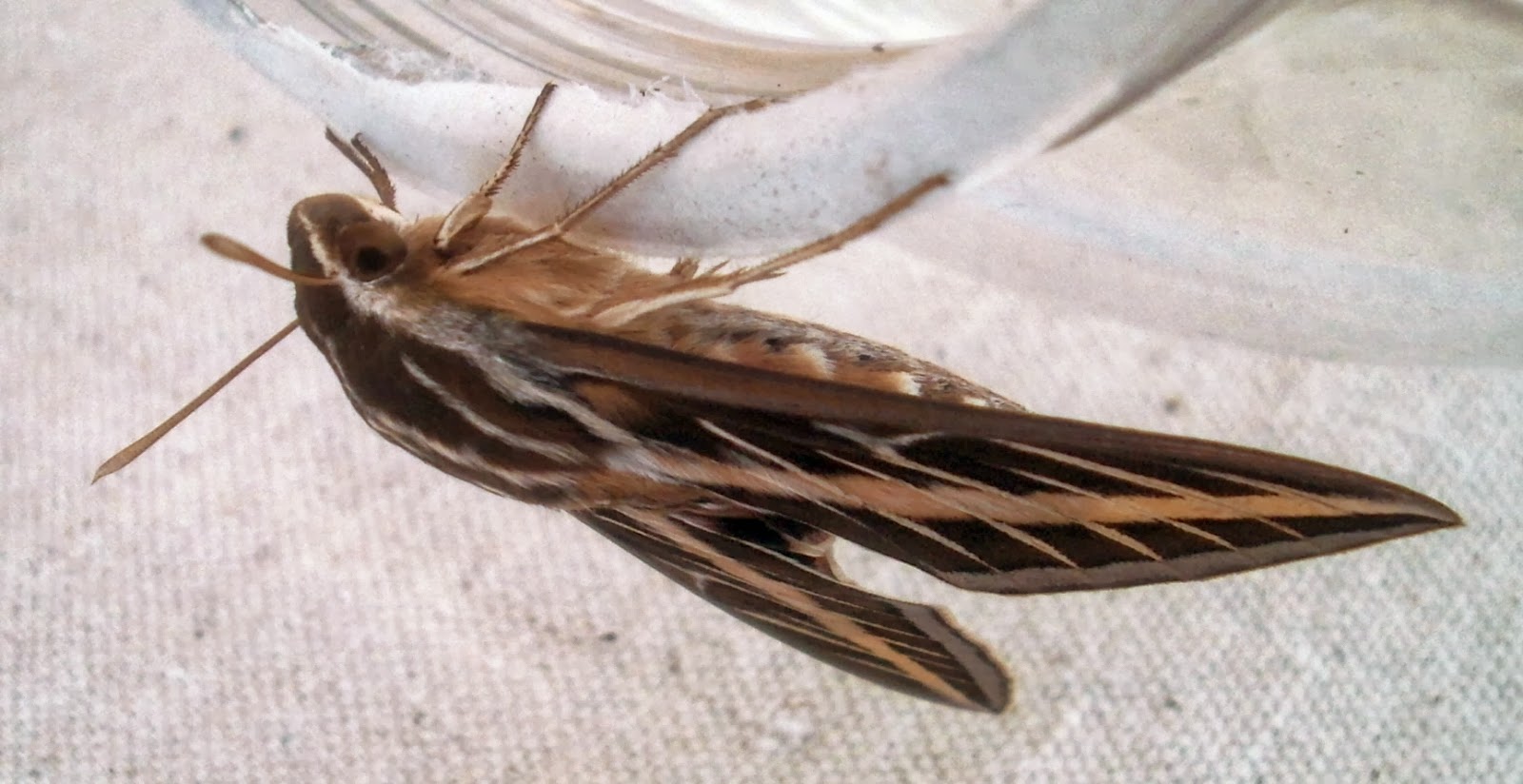
I usually get one hummingbird sighting every year, and that happened earlier this week. It flew away before I could adjust the camera settings, but the pictures would have been shaky blurs photographed from a distance anyway, so you're not missing much. However, I have a picture of a white-lined sphinx moth (Hyles lineata), which hovers in air sort of like a hummingbird and is therefore, to my mind, every bit as good as a hummingbird.


This particular individual was hiding in one of the plants on a day when I had to bring them in for the night, and then I got to chase it around the plant room, kitchen, and living room for what felt like a very long time, before I managed to catch it and take it outside. It then hung on the mouth of the container for quite a while, having exhausted itself trying to fly through windows and clear plastic walls for fifteen minutes. Which meant I got some more or less decent pictures.


The green tree frogs (Hyla versicolor) continue to appear all over the property; 2013 is definitely the Year of the Green Tree Frog.1 There was also, briefly, a pickerel frog (Rana palustris), who lived in the Portulaca / Tagetes bed for about a week and then moved on.

Rana palustris.

There is also a strong case to be made for 2013 as the Year of the Wasp,2 the Year of the Caterpillar, or the Year of the Black Bees, but the frogs feel a lot more noteworthy. Or at least a lot more suddenly abundant, at least.

And yes, this is the same species as the solid-green frogs in the earlier posts. They can apparently choose to be solid green or gray-and-green. So that whole spiel from Kermit about how hard it is to be green: bullshit. He could just be gray, if green is so tough. What a whiner.

It's also been a good year for jumping spiders, though surprisingly light on any other spiders. Usually by this point in the year, I've seen a few black and yellow garden spiders (Argiope aurantia), but this year there's nothing.

Arachnophobes should start scrolling down really quickly . . . NOW.


RAWWWWRRRR!

(Oh, it's over here? Okay then.) RAWWWWRRRR!

This is the most adorable spider I have ever seen. It's even better in the full-size version.

-----ARACHNOPHOBES STOP-----

I've seen a few butterflies around, though most wouldn't stay still long enough for pictures, and it hasn't been anything very interesting. Mostly blues this year. The dill we planted failed to attract any swallowtail caterpillars, and very few butterflies of any kind, which was disappointing, though it may be that the cool, wet early summer depressed the numbers of butterflies in general.

I think this is a pearl crescent butterfly (Phyciodes tharos), though there are so many small orange and brown butterflies out there that I'm not confident about it. The plant is Haworthia limifolia var. ubomboensis.

I did manage to get a couple pictures of one swallowtail, though, at the ex-job.

Female eastern black swallowtail (Papilio polyxenes)? Plant is some Echinacea variety; I didn't check the tag.


Great year for bees, though. Lately I've been seeing mostly bumblebees, but I've seen at least four different species of bee over the course of the summer, and I'm probably forgetting a few.


Probably the less said about caterpillars, the better, but there is one that I thought was interesting. I found it on the Portulaca in early July.


I spent a long time at What's That Bug?, looking through their butterfly and moth caterpillar archives, but didn't see many pictures that were substantially similar, and the few that were similar were for caterpillars not actually found in Iowa. So I have no idea. (I considered submitting the photos to WTB, but they sounded kind of swamped with submissions already, and it's not like this is an emergency or anything.) But it's kind of cool-looking, as caterpillars go.


Finally, yes, there are grasshoppers (most likely the differential grasshopper, Melanoplus differentialis) around as well. They seem to be particularly fond of the Swiss chard (Beta vulgaris ssp. cicla 'Bright Lights'). Which is good, I guess. I mean, something ought to be. We tried sauteeing it with some other greens, early in the summer. It wasn't terrible, but it didn't leave us with any particular desire to do it again. So we designated it an ornamental and haven't touched it since. And it's doing a great job being ornamental.

-

1 Why? Well, it was an unusually wet spring, which I'd think would have to be good for frogs. There's also been some habitat disruption in the area -- some kind of pond or sewage lagoon or something got filled in. Though I don't think that was this year. I'm pretty hazy about the details.
It could be helping, too, that when the rain stopped falling in early August, we let the grass go dormant and stopped mowing. In previous years, we have watered parts of it instead. And I think we've always mowed, until this year. Which if you think about it has some implications for the frog population. (CUT TO: Miss Piggy, crying "KERMIEEEEE!!!!!!" as she sinks to her knees.)
2 To a disturbing degree: there is often a crowd of them gathered on the light fixture above our front door. As we don't use the front door very often, this hasn't been dangerous yet, but it's unsettling, like driving past a convenience store and seeing a crowd of high-school boys loitering in its parking lot. There are also a lot of wasps between the back door of the house and the garage during the day. Again, they've never actually attacked us, but surely it's only a matter of time before I come whipping around the corner of the house with a huge plant and upset somebody. And they've even shown up in the house once, which was a fun day.
That said, if you can observe them at a remove, like in photographs or something, they're kind of neat. Though that's true of a lot of things.


Tuesday, September 17, 2013

Unfinished business: Episcia-eating caterpillars

I am pleased to report that there has been a breakthrough in the whole camera-uploading-photos-to-dumb-locations business. The overall situation is still not great, alas, but that much has been settled, and this gives us hope for the future. Except where it comes to the scale-and-caterpillar part of the future, because my optimism has limits.

I do, at least, now have pictures of one of the caterpillars. (Not sure how many there were total, but it was in the neighborhood of ten.)


I'm getting used to a new monitor, so I'm not sure what kind of color fidelity I'm going to end up with -- how do people use LCD monitors? If you sit up slightly straighter, the whole screen changes color. Am I just going to have to get used to sitting very still? -- but you can surely get the general idea from this; it's not like my color fidelity has ever been very good in the first place.


As far as I can tell from the pictures, the caterpillars are more or less colorless on their own; they turn green when they eat green things.

It has not escaped my attention that the caterpillars bear a passing resemblance to the ones I found in the potter wasp nests, back in July. I mean, I don't think they're the exact same species, but they're roughly the same size and seem to have a similar overall shape, so it's possible that they're in the same family. As if I could feel any worse about the whole potter wasp thing.

Anyway. This is what they do to Episicas:


Or at least mostly what they do to Episcias. They also leave droppings (called frass) around, some of which get stuck in the hair on the leaves. So even the leaves they leave intact wind up looking worse.

Because caterpillars are frassholes.


Saturday, August 24, 2013

Saturday morning frog pictures

So a month ago, when I posted pictures of a frog I happened to see in the Ananas comosus 'Mongo,' I said I thought the frog in question was only passing through, since it wasn't there the following day. Since then, I've seen some identical-looking frogs hanging around the yard, on a few occasions, so maybe we do have a permanent resident.

Mostly I've seen them (or him, or her) when I had to move plants in and out a lot, due to cooler weather. Went to pick up one of the big Euphorbia trigonas and was met with this, right at eye level:


Good job on the camouflage, there, buddy. (The color match actually was pretty impressive in person.) I picked up the frog and put it in the marigolds, and continued moving plants inside, and then some minutes later ran into it again on a different plant: it seemed to be slowly making its way toward the house. And then the following night, it was on the cactus cart, right next to the house, and I caught it and relocated it.

A few nights later, I realized why it kept trying to get to the house: I saw it sitting on one of the basement windows, in the process of chewing up a moth it had just caught. The husband had seen it at the same window on other occasions, so apparently it migrates to the basement window every night to feed itself, sleeps in the plants when our lights go out, then gets up in the morning and does its frog business, whatever that is, until it's time to head back to the window. So I'm not seeing it in the same places, but it probably is the same frog.

It's also not necessarily just one frog. One day in the last month, I saw a frog among my houseplants, and then a short time later saw one sitting on a Canna, across the yard:


A determined frog could probably have crossed the yard and climbed the Canna between sightings, but I'm guessing they were different ones. So we possibly have a whole frog resort area going on. Certainly sounded like it, earlier this summer.


Wednesday, August 21, 2013

The Black Bees

I mentioned in June that I've been watching very intently for honeybees this year. I'm not doing it for any particular reason; I've just been curious, what with all the talk of colony collapse disorder, about whether honeybees visit the yard, and if so how many, and so forth.

For a very long time, the closest I got was the bee-mimic fly (picture at the end of the above link). At some point in the last couple weeks, I finally saw my first honeybee. Which is much, much longer than I was expecting to have to wait.

It's entirely possible that the long wait to see one has a lot more to do with what we've chosen to plant here, and not much of anything to do with how they're doing overall. (However: I saw one yesterday on a marigold that didn't fly away when I approached it. I didn't sit there and poke at it or anything, but it didn't strike me as healthy.) In any case, because I've been watching so closely, I can report that the tiny bees and hoverflies from the June post have now given way to a different group of pollinators. The bee-mimic flies are still occasional visitors. The husband poured more concrete a week or two back and butterflies were really into that, and a few have stuck around for the marigolds. I see bumblebees here and there, though they're small: not the bumblebees I remember as a kid.

But then there are the black bees. So many black bees.


I don't know what species they are; Google has led me to a number of websites, but there are many, many kinds of bees. A carpenter bee of some kind seems most probable -- many of them are the right color and approximately the right size -- but I have very little confidence in that guess. I've never seen the black bees before this year, either, as far as I can remember, which is weird. (Also weird: the green metallic bees I saw four years ago are entirely absent this year.)


I'm very fond of them, whatever they are. In the mornings when I take Sheba out, the black bees are reliably all over the marigolds and Portulacas, even on the cloudy mornings when most of the Portulacas don't open.


I haven't bothered to take many pictures of them on the marigolds, because they're all business with the marigolds: land, nectar and/or pollen, fly away to next flower. With the Portulacas, they actually crawl down into the flowers a ways, and get all tangled in the stamens and such.


I doubt that bees experience "fun" in the way people (or even dogs) do, but they really do look like they're having fun: I can't help wanting to anthropomorphize.


They manage to collect an impressive amount of pollen. I know bees have "pollen baskets" on their legs for this exact purpose, but I can't figure out how they work to hold the pollen in. I mean, pollen is small, and the bees fly around a lot: how do they hold on to it? How do they get it back off again later?


I don't know if they sting; the husband said that he was out with Sheba a few days ago, and that he thought she'd caught one in her mouth, but she didn't seem to be in pain or anything, so if she did catch one, it apparently didn't sting her. They've never bothered me either, but then, I don't give them any reason to.


This is all just encouraging me to get even more intense with the Portulacas next year, of course. I kind of understand why they're not more widely planted -- most of the flowers that are open in the morning have closed up by the early afternoon, and the leaves and closed buds aren't particularly attractive.


But the flowers are so nice when they are open, and they're so easy to grow, that it kind of makes up for the afternoons. And anyway, pollinators dig 'em. My hands are tied. We're just going to have to plant some every year. Have to.


Saturday, August 3, 2013

Saturday morning frog pictures

Ha ha! This picture isn't of Sheba either! Will there ever be a Saturday Sheba picture again? WILL THERE?

Yes, actually. Most likely. But there are other animals around now. You know how it is.

The frog here is in the Ananas comosus 'Mongo.' The plant is now large enough to be sort of menacing, but I suppose that makes it a better home: harder for other animals to get in.


I'm not 100% on the ID, but my guess is that we're looking at another Hyla versicolor, or eastern gray treefrog. The other likely possibility is Cope's gray treefrog, H. chrysoscelis, which is so similar that the two species were considered a single one for a long time. Their ranges mostly overlap (eastern half of the U.S., though H. chrysoscelis is absent from the southeast corner of the continent -- basically Tennessee and North Carolina, and all points south, have only H. versicolor). The difference I find most interesting about the two of them is that apparently they differ in chromosome number: H. chrysoscelis is diploid, and H. versicolor is tetraploid.


Whichever it is, it only lived there for one day. It was a little disturbed by me photographing it, as you can see from its posture above, and I suspect most of our frog visitors are only passing through in the first place. Presumably it moved on to wetter pastures.


Saturday, July 27, 2013

Saturday morning buffalo picture

I know, I know, you were expecting Sheba. This is sort of (barely) Sheba-relevant, though.

I really enjoy riding around on side roads and gravel roads. I like the lack of traffic, and having the option to jump out of the car and take a bunch of pictures of a weed on the side of the road when the spirit moves me, but also it's just more interesting. There are more things to look at, you're a lot closer to them than you are on the highway, and you have more time to check them out because you're not going by them as quickly.

We haven't done much of this lately, because when we bought the house, we lost our main excuse for doing it. Also there are only so many roads in the area, and we'd already been on most of them, so there weren't many left over, and part of the fun is getting to see new things.

But a few weeks ago,1 the husband and I got another chance to do some back-road wandering. We'd both cleared our schedules for the day, because we had a thing to do about an hour south of home and didn't know how long it was going to take. Also the weather was nice,2 so after we were done, we took the opportunity to try to locate some new roads on the trip back.

And we did! Found about 30 miles of brand-new (to us) gravel, which was pretty exciting on its own, but then at one point, we wound up on . . . well, not quite a ridge, but it was a lot higher than any of the surrounding area. Maybe an unusually large hill? In any case, it was neat, and I was taking some photos of the view . . .

This photo benefits a great deal from being viewed full-size.
Also: remember this the next time someone describes Iowa as flat and boring. Admittedly some of it is, but it's a lot more varied than people know.

. . . when the husband rolled the car forward a little and suddenly there was a BUFFALO.


Several buffalo, actually, but only one of them was in a good position for photos.

This wasn't the first buffalo we've seen in Iowa or anything; we'd also run into some somewhere north of Cedar Rapids, about five years ago. But they're uncommon. At one point during the 80s, I remember being told that buffalo were the meat of the future, that they were so much lower in cholesterol than beef, and tasted great, and so on and so forth. Twenty-five years later, it's pretty clear that reality isn't going to catch up with the hype (ditto for ostriches, which were promoted the same way, at around the same time, and which we've only encountered once in our travels, also north of Cedar Rapids), but apparently some people are still raising them anyway.

So this was neat. Plus we could just sit there and watch it for a while.

Sheba took a while to notice the buffalo (she is sometimes a little slow to pick up), but once she did, she freaked the hell out. Growling and barking and whatnot, which initially seemed silly, but the more I thought about it, the more I realized that no, that's reasonable: they're huge, we have no reason to think that Sheba's ever seen one before, and they do have some menace to them. I mean, it wasn't being aggressive or anything, but just the horns, the face and, well, the size.


The buffalo did not appear to feel threatened in any way by Sheba, but it did, as you see above, look up from what it was doing so see what all the commotion was. The husband and I felt bad about disturbing it, so we left shortly after Sheba started going bonkers. Still pretty cool, though. I realized while writing this post that I kind of . . . forget, sometimes, that buffalo didn't actually go extinct.

-

1 (Same trip as this and this.)
2 I am pleased with this summer's weather so far; I don't know if we've been consistently cooler than the historical average this year, but we've been consistently cooler than the last few years, at least.
Last summer at about this time, you'll remember, I was pretty miserable. This year . . . well, the official high temperatures for Iowa City on 23 and 24 July were 79F/26C and 77F/25C, and the forecast as I write this is for a solid week of temperatures at or below 82F/28C. Our forecast high for today, Saturday, is 70F/21C. In Iowa. In late July and early August. Even taking into account that the NWS always predicts a few degrees cooler than reality winds up being, to even be thinking about temperatures below 95F/35C at this time of year is incredible.
EDITED TO ADD: The NWS is now predicting a low temperature of **49F/9C** for us tonight. 49. In July. What.