I just really like lady-slipper orchids, I guess. Or at least this year I do. If only I could, you know, grow them.

Hanne Popow is a cross of Phrag. besseae and Phrag. schlimii, and is apparently a really popular phrag, because Google finds people talking about it all over the place.
As frustrating as my experiences with Paphiopedilum have been, it sounds like Phragmipediums are even worse; the people on this orchid-growing forum are unanimously agreed that phrags like to drop perfectly good flowers for no particular reason. (Not, technically, no reason -- the explanation given at the link is that plants have an upper limit on how many blooms they're willing/able to maintain at once, so once that number is reached, the plant starts to drop the oldest flowers, even if they're still otherwise functional.) I can only imagine how frustrating that must be.
Tuesday, September 13, 2011
Pretty picture: Phragmipedium Hanne Popow

Sunday, September 11, 2011
Random plant event: Aeschynanthus radicans

It takes a while, granted, but one can propagate Aeschynanthus from individual leaves. My A. speciosus was originally from individual leaves we propagated long ago at work, and I have at least one A. radicans leaf that's rooted and producing new growth now too, so I'm thinking maybe it's a general characteristic of the genus. This particular leaf didn't even take that long (about 3 1/2 months), though as you can see, the others in this pot are taking longer, and there's another pot of leaves where nothing's happened yet, so it's just one leaf out of I think eight. But still.
If you go looking for information about how to propagate Aeschynanthus, almost nobody says anything about this: virtually everyone says stem tip cuttings, and nothing more. (A few sites also suggest seeds or layering.) While it's probably true that stem cuttings will start faster and produce a fuller looking plant sooner than leaves, it's still neat that leaves are an option.
I ran into the website of the North Star African Violet Council Twin Cities (surely "Twin Cities' African Violet Council" wasn't taken already?) while looking around the internet for more on this, and they say that Streptocarpus, Chirita, Saintpaulia, and Petrocosmeas are typically propagated from single leaves. Nautilocalyx are also supposed to be easy to root from leaves, which I'll have to try at some point with my N. forgetii.
The genera of gesneriads that don't propagate well from leaves include Episcia (though I've done it, last summer), Columnea, Nematanthus, some Sinningias, and Codonanthe, according to Jon Dixon, the source being quoted by the NSAVCTC. (I'm condensing the list, so if you're interested, head over to the site and read their post.)
Weirdly, I've had better luck at home with Aeschynanthus and Episcia leaf propagation than I've had with Saintpaulia, even though African violets are supposed to be much easier. I don't have any trouble getting African violet leaves to root, but they stop there -- they don't go on to grow new leaves. When we tried doing this at the ex-job, on the other hand, they propagated fine. Sometimes they even propagated when we didn't intend them to. So obviously I'm missing something.

But anyway. There isn't necessarily a lot of practical application for this method, but now you know it can happen.
Saturday, September 10, 2011
Saturday morning Sheba and/or Nina picture
Had a minor Nina-related scare on Monday morning: I'd collected some crickets for Nina while outside with Sheba, because they're all just hanging around out there in the back yard and why not,1 but then when I went to dump them into her terrarium, Nina was nowhere to be found. Which is unusual, early in the day -- she's almost always out in the open, "sunning" herself.
So I rattled the plants around a bit, hoping to see or hear her, but I didn't, and that went on long enough that I had actually convinced myself that she was probably dead, so I started cutting back the Pellionia to find the body. (I was less sad about this than you might think: I figure she's almost certainly outlived her natural life expectancy, and has had a relatively cushy, if spatially constricted, life for the last two and a half years, so even if it hasn't been everything she might have dreamed, I think I've still done right by Nina. At bare minimum, it has to beat death by pesticide or death by freezing, which were her two options if I hadn't brought her home.)

That went on for a really long time, but eventually I pulled back a branch and she bolted for the opposite side of the tank. So she's still alive. And now I have a bunch of Pellionia cuttings and have no idea what to do with them.
-
1 I acknowledge that there are some reasons why using free-range crickets might be a bad idea (parasites, e.g.), but have decided those are risks I'm willing to take.
Friday, September 9, 2011
Random plant event: Cordyline fruticosa
My huge green Cordyline fruticosa should have died this summer. I got fed up with it last winter -- no matter how far from all the other plants, no matter how careful I am to wash down the leaves when watering, no matter how cool and moist the environment, it still always gets spider mites, every winter, and I've gotten sick of dealing with them. So this spring, I put it outside.
The goal wasn't necessarily to kill it. I just wanted to get it away from the other plants, so the mites wouldn't spread. It had spent a summer outside before, so I figured it could handle it. On the other hand, there was something a little passive-aggressive about my method: I didn't try to gradually acclimate it to the new conditions. I just shoved it out there and let it fend for itself. Then I "forgot" to water it, even though we weren't getting very much rain. It responded the way you'd expect: first it sunburned, then it (partly) defoliated, and by mid-August I was ready to throw it out.
So we moved it to the back yard (there's a pile where we're dumping plant-related waste, soil, lawn clippings, etc. It's not quite a compost pile, because we're not trying to manage it like a compost pile, but we do expect it to break down into soil eventually.), but then for whatever reason it didn't get dumped. And since it was closer to the garden hose, it got watered when I thought of it.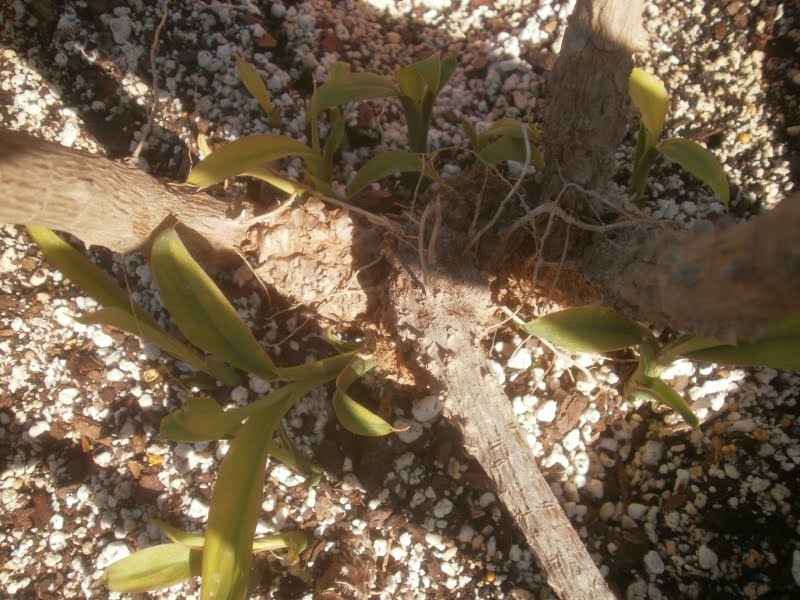
And then the damn plant started to grow new shoots from its base. Apparently it had been living off the stored water and starch in the swollen rhizome at its base all summer because I wasn't watering it properly. Then we got some rain besides, so suddenly it's ready to grow again.

And I guess it'll get the chance. I get frustrated with C. fruticosa because of the spider mites (I gave up on the other Cordylines at the end of June), but I really like it otherwise, and if it's just the one plant, and it's growing lots of new stems at once . . . well, I'm not made of stone. I've cut back the old stems, and the Cordyline can stay for another year, as long as it behaves itself. No doubt I'll regret this decision next February, but it's not like I have to kill it now or I forever lose the chance, right?
Thursday, September 8, 2011
Next Time You Buy Madonna Flowers, Remember This
Actually somewhat less diva-ish than I would have expected from Madonna. Maybe she's mellowing. (Plus I think she's also turning into Romy, from Romy and Michelle's High School Reunion -- check out the way she pronounces "loathe.")
(Via)
Question for the Hive Mind: Clivia miniata
So I've had this Clivia miniata 'Aztec Gold' for a long time now (since August 2008), and I like it. It's never flowered, but that's okay: I like it well enough as a foliage plant. I mean, I'm a little disappointed, sure, because it had flowers when I bought it, and they lasted about five minutes once I got it home so I never had a chance to get a halfway decent photograph of them and now I've been waiting for over three years to see flowers again but No! It is fine! I like it as a foliage plant! I swear!
But it's also been very strange a few times. There was one spell a couple summers ago when I noticed black gunk on the leaves, so I went to wipe it off with a wet paper towel, and it turned the towel the most brilliant shade of yellow. And the black gunk was -- when I checked the plant more closely -- down in the spaces between leaves, making it more or less impossible to clean up. I never found out what was happening, but it's happened again at least once and doesn't appear to be harming the plant, so I've accepted it as part of the cost of growing a Clivia, or at least this particular Clivia, and I don't worry about it anymore.

But now we have a new thing. Gone is the mysterious black/yellow substance, and instead I saw a strange new dead thing in the middle of the plant, at the end of July. It's since dried up, and once dry it pulled out easily enough, but I don't know what it was. It was too short and too thick to be a leaf, plus it was dying as soon as it appeared: could it have been a flower that aborted development? And if so, why'd it stop? If not, what was it, then? And as long as I'm asking questions: what was the black/yellow stuff?
Wednesday, September 7, 2011
Pretty picture: Epidendrum Neon Valley

I don't think I like Epidendrums, when it comes right down to it. I mean, I try, and sometimes I think, oh, that's a nice color combination or whatever, but they just don't do it for me. Give me a few large flowers (Paphiopedilum, Cattleya) instead of a huge cloud of tiny flowers (Oncidium, Epidendrum) any day.
Not saying you have to agree. Just personal preference. I'd make an exception for fragrant flowers, but I haven't run into any straight Epidendrums that were fragrant either. At least not fragrant enough that I noticed.
Tuesday, September 6, 2011
Random plant event: Agave lophantha offset
I'm pretty sure this is the first time I've had an Agave offset for me indoors. One of the A. victoriae-reginaes has lots of offsets, but I think they were all present when I first got the plant, so I don't get credit for them. But this one is definitely new, and definitely all happened while the plant was in the house. 
It's inconvenient timing: the A. lophanthas are close enough to one another now, and the marginal spines sharp enough, that they've been scratching one another's leaves and leaving scars. Adding a new plant into the mix, that can't be moved further away from the others, is not going to help the situation. Still, though, I'm happy if the Agaves are happy.


 Posts
Posts