Showing posts with label Saintpaulia. Show all posts

Tuesday, May 6, 2014

[Exceptionally] Pretty pictures: transmitted light -- Part LIII

Having one of those spells where I'm not having any trouble coming up with things to write about, but I'm never happy with the results. Also, as previously mentioned, the Anthuriums are the only plants here that are doing much of anything at the moment. Consequently, we're digging into the transmitted light photos, because that's what the transmitted light photos are for.

By way of observing how old these pictures are: of the six plants photographed for this set that I owned at one time or another (Dracaena, Iresine, Senecio, Chlorophytum, Saintpaulia, Peperomia), only two remain (Dracaena, Chlorophytum).

(The previous transmitted light posts can be found here.)


Dracaena deremensis 'Janet Craig Compacta.'

Never my favorite plant, and this photo is boring besides, but I'm appreciating it a lot more these days than I used to. No rot, no scale (knock wood), no defoliation. It just sits there, quietly, and photosynthesizes, like plants are supposed to do.


Iresine herbstii 'Blazin' Rose.'

One of the plants I used to own but no longer do. The main reason for this is that it just grew too fast and needed too much light. The coup de grâce happened when spider mites started bothering it, and I decided it was just too much work to keep around any longer. Not necessarily a terrible plant, and it does photograph well occasionally, but I couldn't say I miss having it around. (Indeed, this is the first time I've even thought about I. herbstii in at least a couple years.)
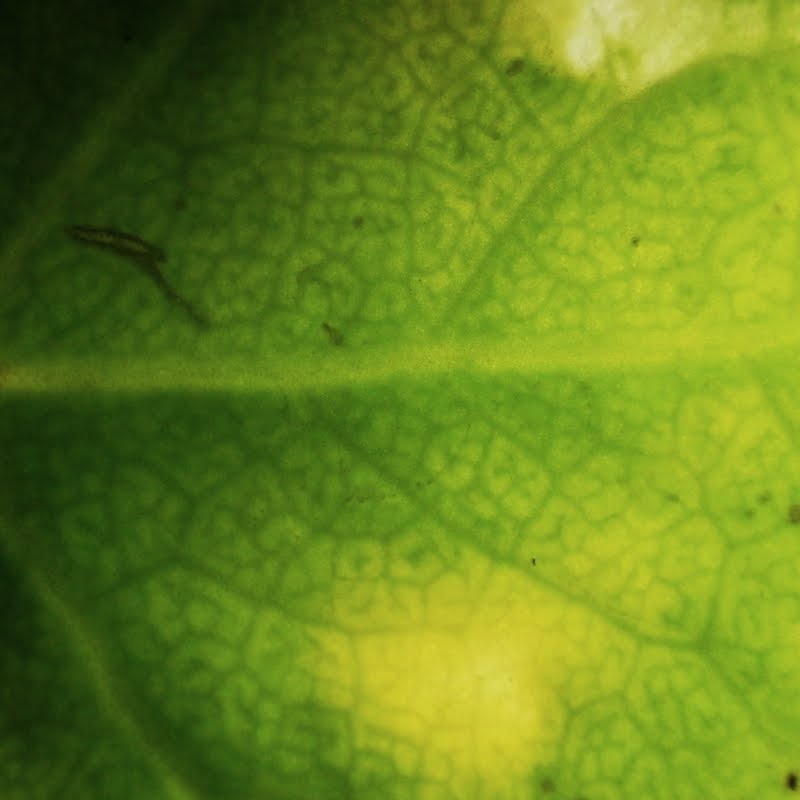

Senecio macroglossus.

Another one that's no longer around. I miss it . . . slightly. It had some nice qualities. It wasn't a good plant for me to be trying to grow, though, for three main reasons. One, it needed more light than I could give it. Two, it was forever tangling itself in the wire shelving I use, which did the plant no serious harm but was frustrating when watering time came around. Three, it needed a lot of grooming -- leaves were always dying but remaining attached to the stem, which made it difficult to groom. And it always needed to be groomed.

It'd be interesting to look at sometime with the microscope, though. You can see some weird stuff happening in there with the veins just from this picture.


Chlorophytum x 'Fire Flash,' dead leaf.

This picture is dramatic, but I think not good. Not the plant's fault, though. The plant is great.


Malva neglecta.

One of Iowa's less objectionable invasive weeds.


Saintpaulia ionantha NOID, petal.

The third plant I no longer own. I like African violets well enough to want to grow them, but not well enough to change the way I care for my plants to make growing them possible. By the time the last of the Saintpaulias went in the garbage, I was pretty exasperated with the genus, and I think I could live the rest of my life quite happily without ever trying to grow another.


Hibiscus moscheutos 'Dave Fleming,' petal.

I'm not particularly into the H. moscheutos varieties I've seen so far, and I don't know why. I mean, they seem like the sort of thing I would like. I like H. rosa-sinensis fine (I don't grow it, because overwintering always seems to be a problem, but I like them to look at.), and it's not that I have a problem with winter-hardy Hibiscus, because I think H. syriacus 'Blue Satin' is great. H. moscheutos is just too extreme for me, in some way I can't articulate. I don't see them very often around here, either. I mean, I see them for sale, just not usually planted. Though I suppose some of that is because I only recognize them when they're blooming, and for a lot of the year, they're not blooming.


Peperomia caperata.

The last of the plants I no longer grow, and the one I would be most likely to try again if I thought there was a chance of success. The problem with P. caperata was always watering. The 14-day cycle most of the plant collection is on is a bit too long for P. caperata, and if I tried to keep them wet longer by moving them to a larger pot, they'd rot. Irreconcilable differences. If I ever do find a way to deal with the watering differently, I will probably try this one again.


Ipomoea NOID, petals.

Say what you will about Ipomoeas (I. nil, I. purpurea, I. tricolor, and so on), but the flowers really are quite lovely even if the plants are weedy.


Musa 'Zebrina Rojo.' (possibly Ensete 'Zebrina Rojo.')

I probably took more photos of 'Zebrina Rojo' than necessary. (Previously: XLVIII, XLIV. And I think there's another photo in the transmitted light reserves.)


Saturday, November 5, 2011

Rumble Among the Jungle, Match 6.1

Results for match 5.2:

Phalaenopsis cvv. did give Schlumbergera cvv. a fight, but they couldn't quite get the votes needed to defeat them. (One wonders whether the results would have been different were we not in the middle of Schlumbergera-blooming season.) The final vote was 74 to 62.

Schlumbergera has to turn around and do battle again right away, this time against Saintpaulia cvv. If Schlumbergera loses, I guess they can use the excuse that it was tired from battling Phalaenopsis, and would have won if it'd just had a chance to rest.

Have at it. Choose carefully.

Match 6.1
Saintpaulia cvv. (African violet) vs. Schlumbergera cvv. (holiday/Thanksgiving/Christmas cactus)

Saintpaulia cvv.
Top row, L-R: NOID, assorted NOIDs, NOID.
Middle row, L-R: NOID, NOID, NOID.
Bottom row, L-R: 'Harmony's Red Star,' 'Mellow Magic' close-up, NOID.


Center and top left: Schlumbergera 'Caribbean Dancer;' others are NOID.


Monday, October 31, 2011

Rumble Among the Jungle, Match 5.1

Results of match 4.5:

Well, the good news (for me) is that the Spathiphyllums' reign of terror is over: Echeveria et al. beat spaths by 76 to 54. The bad news (for me) is that I think I'd actually have preferred Spathiphyllum to win this time, given the alternative. (Echeverias are fine, but they don't grow that well for me indoors -- not enough light.) Oh well.

And now we're ready to start round 5. Only seven more matches remaining before we have a winner. . . .

Match 5.1
Saintpaulia cvv. (African violet) vs. Philodendron hederaceum cvv. (heart-leaf philodendron)

Saintpaulia cvv.
Top row, L-R: NOID, assorted NOIDs, NOID.
Middle row, L-R: NOID, NOID, NOID.
Bottom row, L-R: 'Harmony's Red Star,' 'Mellow Magic' close-up, NOID.


Clockwise from top left: Philodendron hederaceum 'Brasil,' P. hederaceum micans, NOID, P. hederaceum 'Aureum' or something similar, species, P. hederaceum 'Frilly Philly.'


Sunday, October 23, 2011

Rumble Among the Jungle, Match 4.1

Since we're more than a month into the RATJ now, I'm going to just assume everybody has read the rules instead of copying and pasting them into the posts over and over.

Final numbers for matches 3.9 and 3.10:

In match 3.9, Spathiphyllum surprises me once again, by defeating a plant I see as obviously superior. This is apparently going to be a thing with me and Spathiphyllum. The margin of victory was slim: Spathiphyllum beat Aeschynanthus spp. by 62 to 54.

The first poll for match 3.10 was glitchy, for unknown reasons, so some people couldn't vote in it. I replaced it with a new poll that worked properly, but there were then two sets of votes to count. The glitchy poll gave Echeveria et al. 14 votes and Chlorophytum comosum 7; when added to the results of the more functional poll (43 and 49, respectively), we get Echeveria et al. winning over Chlorophytum comosum by 57 to 56. This is perhaps close enough to warrant a do-over, but that would screw up the posting schedule, so I'm not gonna.

As we are now in round 4, I'm slowing down the votes yet again and only posting one match per day. Partly, this is because it's more dramatic this way (after three rounds of selection, the plants that have gotten here ought to be pretty good fighters), but also I have to: now that we're down to a small fraction of the original field, the three-day wait for the final tallies means that about half of round 3 is still collecting votes while we begin round 4. (By round 6, the semifinals, I'll have to start skipping days between matches.)

Match 4.1
Clivia miniata cvv. vs. Saintpaulia cvv. (African violet)

Top: Clivia miniata. (Picture by Guérin Nicolas at Wikimedia Commons.) Bottom: NOID cv.


Saintpaulia cvv.
Top row, L-R: NOID, assorted NOIDs, NOID.
Middle row, L-R: NOID, NOID, NOID.
Bottom row, L-R: 'Harmony's Red Star,' 'Mellow Magic' close-up, NOID.


Saturday, October 15, 2011

Rumble Among the Jungle, Matches 3.1 and 3.2

Rules and Stuff
1) It's probably possible to vote more than once per poll, but please don't. If I believe that someone is voting repeatedly, I will throw out those results, repost the poll, and seriously question that person's priorities.
2) If you want to link to a poll on Twitter / Facebook / your blog / whatever and encourage your friends to come and pump up the support for your favorite plants, you are encouraged to do so.
3) You are also encouraged to leave comments on Rumble posts, if so moved.
4) All photos will enlarge if opened in a separate window/tab.
5) You can choose which plant is "best" according to whatever criteria you decide for yourself. My personal process is a bit convoluted.1
6) All polls will be open for three days.


Results for matches 2.17 to 2.20:

In match 2.17, Dionaea muscipula made a good effort against Aeschynanthus cvv., but faded early, letting Aeschynanthus accumulate a slight lead. Which then turned into a bigger lead. Dionaea loses, 48 to 64.
Match 2.18 was a bit more complicated -- this was another one where the contestants swapped the lead back and forth a number of times before settling on a winner. In the end, Aechmea fasciata just didn't quite have what it took, falling to Spathiphyllum cvv. by 54 to 61.

Aeschynanthus cvv. goes up against Spathiphyllum cvv. in match 3.9. Voting begins on 19 October.

Pilea involucrata 'Norfolk' didn't really stand a chance against Chlorophytum comosum, in match 2.19: it lost 36 to 78.
In match 2.20, Echeveria cvv. (and relatives) absolutely beat the tar out of Kalanchoe luciae / thyrsiflora, winning 91 to 23. This is the second time that Echeveria et al. have gotten more than 75% of the vote; the only other competitor to do so thus far has been Saintpaulia cvv. This may mean that Echeveria is a serious contender for the championship, but it could also mean that it got some exceptionally wimpy opponents. Time will tell.

Chlorophytum comosum will try to break Echeveria's winning streak on 19 October, in match 3.9.

We are now ready to begin the third-round voting. I'm slowing things down a little and only posting two matches per day during round 3. I'll slow down even further (to one match per day) once we start round 4, about a week from now.

Match 3.1
Clivia miniata cvv. vs. Cryptanthus cvv. (earth star)

Top: Clivia miniata. (Picture by Guérin Nicolas at Wikimedia Commons.) Bottom: NOID cv.


Clockwise from top left: C. 'Elaine,' C. 'Black Mystic,' NOID, NOID, NOID.


Match 3.2
Saintpaulia cvv. (African violet) vs. Epipremnum aureum cvv. (pothos)

Saintpaulia cvv.
Top row, L-R: NOID, assorted NOIDs, NOID.
Middle row, L-R: NOID, NOID, NOID.
Bottom row, L-R: 'Harmony's Red Star,' 'Mellow Magic' close-up, NOID.


Clockwise from top left: Epipremnum aureum 'Neon,' 'Marble Queen,' 'N'Joy,' trained on a totem.


-

1 I'm deciding according to a hypothetical situation in which all of my houseplants are gone, as are all the other houseplants of the world, except for one producer/supplier/retailer. Said person is offering to restock me with one or the other of the plants in question but refuses to give me both. Which one would I choose?


Friday, October 7, 2011

Rumble Among the Jungle, Matches 2.1-2.4

Rules and Stuff
1) It's probably possible to vote more than once per poll, but please don't. If I believe that someone is voting repeatedly, I will throw out those results, repost the poll, and seriously question that person's priorities.
2) If you want to link to a poll on Twitter / Facebook / your blog / whatever and encourage your friends to come and pump up the support for your favorite plants, you are encouraged to do so.
3) You are also encouraged to leave comments on Rumble posts, if so moved.
4) All photos will enlarge if opened in a separate window/tab.
5) You can choose which plant is "best" according to whatever criteria you decide for yourself. My personal process is a bit convoluted.1
6) All polls will be open for three days.


Results for matches 1.49-1.52:

In match 1.49, you bastards chose Adenium obesum over Episcia cvv., by a margin of 73 to 44, in what I am forced to conclude was a horribly misguided attempt to upset me. WELL IT DIDN'T WORK! I'M FINE! NOT UPSET AT ALL!2
Match 1.50 was quite close, a lot closer than I expected it would be, but in the end, Zamioculcas zamiifolia scraped together a victory over Alocasia amazonica 'Polly.' The score was 63 to 49.

Adenium and Zamioculcas will throw down in match 2.25, on 13 October.

Ficus benjamina cvv. defeated Begonia rex-cultorum in match 1.51, by a score of 70 to 44.
Finally, match 1.52 looked for a while like it was going to be a blowout -- Haworthia cvv. was at one point getting nearly 81% of the vote against Asplenium nidus / A. antiquum -- but some Asplenium supporters showed up at the last minute and reduced Haworthia's lead. Haworthia still wins, though, 80 to 39.
Ficus benjamina cvv. and Haworthia cvv. go up against one another on 13 October as well, in match 2.26.

And now, we begin round two.

Match 2.1
Clivia miniata cvv. vs. small hybrid Vriesea cvv.

Top: Clivia miniata. (Picture by Guérin Nicolas at Wikimedia Commons.) Bottom: NOID cv.


(All unidentified Vriesea hybrids.)


Match 2.2
Cryptanthus cvv. (earth star) vs. Tradescantia pallida (purple heart)

Clockwise from top left: C. 'Elaine,' C. 'Black Mystic,' NOID, NOID, NOID.


(Both T. pallida.)


Match 2.3
Saintpaulia cvv. (African violet) vs. Echinopsis spp.

Saintpaulia cvv.
Top row, L-R: NOID, assorted NOIDs, NOID.
Middle row, L-R: NOID, NOID, NOID.
Bottom row, L-R: 'Harmony's Red Star,' 'Mellow Magic' close-up, NOID.


Unidentified Echinopsis sp. Probably.


Match 2.4
Epipremnum aureum cvv. (pothos) vs. Crassula ovata/argentea/arborescens (jade plants)

Clockwise from top left: Epipremnum aureum 'Neon,' 'Marble Queen,' 'N'Joy,' trained on a totem.


Clockwise from top left: variegated Crassula ovata, C. ovata 'Gollum,' C. arborescens var. undulatifolia, C. ovata.


-

1 I'm deciding according to a hypothetical situation in which all of my houseplants are gone, as are all the other houseplants of the world, except for one producer/supplier/retailer. Said person is offering to restock me with one or the other of the plants in question but refuses to give me both. Which one would I choose?
2 (*sob*)


Thursday, September 22, 2011

Rumble Among the Jungle, Matches 1.5-1.8

Rules and Stuff
1) It's probably possible to vote more than once per poll, but please don't. If I believe that someone is voting repeatedly, I will throw out those results, repost the poll, and seriously question that person's priorities.
2) If you want to link to a poll on Twitter / Facebook / your blog / whatever and encourage your friends to come and pump up the support for your favorite plants, you are encouraged to do so.
3) You are also encouraged to leave comments on Rumble posts, if so moved.
4) All photos will enlarge if opened in a separate window/tab.
5) You can choose which plant is "best" according to whatever criteria you decide for yourself. My personal process is a bit convoluted.1
6) All polls will be open for three days.

Match 1.5
Saintpaulia cvv. (African violet) vs. Hemigraphis exotica (purple waffle plant)

Saintpaulia cvv.
Top row, L-R: NOID, assorted NOIDs, NOID.
Middle row, L-R: NOID, NOID, NOID.
Bottom row, L-R: 'Harmony's Red Star,' 'Mellow Magic' close-up, NOID.


Hemigraphis exotica, species.


Match 1.6
Cyclamen persicum (florists' cyclamen) vs. Echinopsis spp.

Assorted NOID Cyclamen persicums.


Unidentified Echinopsis sp. Probably.


Match 1.7
Pachypodium spp. (Madagascar palm) vs. Epipremnum aureum cvv. (pothos)

L-R: P. lamerei, close-up of P. lamerei trunk, NOID.


Clockwise from top left: Epipremnum aureum 'Neon,' 'Marble Queen,' 'N'Joy,' trained on a totem.


Match 1.8
Scindapsus pictus (satin pothos) vs. Crassula ovata/argentea/arborescens (jade plants)

(All Scindapsus pictus, possibly different cvv.)


Clockwise from top left: variegated Crassula ovata, C. ovata 'Gollum,' C. arborescens var. undulatifolia, C. ovata.


-

1 I'm deciding according to a hypothetical situation in which all of my houseplants are gone, as are all the other houseplants of the world, except for one producer/supplier/retailer. Said person is offering to restock me with one or the other of the plants in question but refuses to give me both. Which one would I choose?


Sunday, September 11, 2011

Random plant event: Aeschynanthus radicans


It takes a while, granted, but one can propagate Aeschynanthus from individual leaves. My A. speciosus was originally from individual leaves we propagated long ago at work, and I have at least one A. radicans leaf that's rooted and producing new growth now too, so I'm thinking maybe it's a general characteristic of the genus. This particular leaf didn't even take that long (about 3 1/2 months), though as you can see, the others in this pot are taking longer, and there's another pot of leaves where nothing's happened yet, so it's just one leaf out of I think eight. But still.

If you go looking for information about how to propagate Aeschynanthus, almost nobody says anything about this: virtually everyone says stem tip cuttings, and nothing more. (A few sites also suggest seeds or layering.) While it's probably true that stem cuttings will start faster and produce a fuller looking plant sooner than leaves, it's still neat that leaves are an option.

I ran into the website of the North Star African Violet Council Twin Cities (surely "Twin Cities' African Violet Council" wasn't taken already?) while looking around the internet for more on this, and they say that Streptocarpus, Chirita, Saintpaulia, and Petrocosmeas are typically propagated from single leaves. Nautilocalyx are also supposed to be easy to root from leaves, which I'll have to try at some point with my N. forgetii.

Nautilocalyx forgetii.

The genera of gesneriads that don't propagate well from leaves include Episcia (though I've done it, last summer), Columnea, Nematanthus, some Sinningias, and Codonanthe, according to Jon Dixon, the source being quoted by the NSAVCTC. (I'm condensing the list, so if you're interested, head over to the site and read their post.)

Weirdly, I've had better luck at home with Aeschynanthus and Episcia leaf propagation than I've had with Saintpaulia, even though African violets are supposed to be much easier. I don't have any trouble getting African violet leaves to root, but they stop there -- they don't go on to grow new leaves. When we tried doing this at the ex-job, on the other hand, they propagated fine. Sometimes they even propagated when we didn't intend them to. So obviously I'm missing something.

This leaf, for example, fell under a table and rooted in the soil all on its own.

But anyway. There isn't necessarily a lot of practical application for this method, but now you know it can happen.


Thursday, June 23, 2011

Question for the Hive Mind: Is it cyclamen mites?

How does everyone feel about an afternoon post that isn't related to Lady Gaga?

I said on Monday that I've been having some weird things going on with my Saintpaulias, and suspected cyclamen mites. It's possible that I'm so anxious to get rid of the Saintpaulias -- and I am highly motivated either to make them shape up or to make them go away -- that I'm leaping to the worst possible conclusion, though. It's not like I have first-hand experience with cyclamen mites.

So I present the readership with the best images of the situation I was able to get. They're still not very clear, but I'm working from the assumption that people who have experienced African violet problems first-hand will recognize what's going on even if they're not the best pictures.

So. Photos will enlarge considerably if opened in a separate window.

New leaves are various combinations of cupped, stunted, and twisted.

Scarred leaf in the lower right; new leaves slightly wavy/twisted.

Stunted and twisted leaves, mildew or something resembling mildew, widespread tan scarring on one leaf.

I should also mention that one of my plants did a thing where the growing tip, and all the developing leaves, seemed to die all at once last winter, leaving a bare little nub surrounded by old leaves. This isn't necessarily related, but since I don't know what's related and what's not, I'll mention it. (Apologies for not having a photo; I thought of it too late in the post-writing process.)

-

Care history, if necessary:

Affected plants have been at least 65F/18C the whole time, save for possible occasional brief blasts of colder air last winter when they were in the plant room (they were sort of close to a door, though they were far from any windows or drafts, and there were other plants between them and the door). They were moved a while ago to the living room, which is perhaps still colder than they'd like, but it's 72-74F/22-23C in there around the clock, as far as I'm aware.

Light in the plant room was mainly supplied by a desk lamp with a compact fluorescent bulb in it, though they were on a metal table, and got some indirect and a little bit of direct sunlight on days when we had sunlight. In the living room, they're on shelves in front of a large, unobstructed east window.

I have changed the soil since noticing the problem, but when it started, I was still growing them in the soil they were in when I bought them. (Not to bias the opinions, but one expert suggested by e-mail that the soil was the likely cause for the one that dropped all the new leaves and left nubs.)

I'm not great at keeping them watered, at least not considering what they'd prefer. They do dry out pretty regularly, and always have. They never stand in water for long periods of time, though I do water them from the bottom by standing them in saucers for short periods. I have been able to keep one plant going and blooming for two and a half years, though, with similar treatment, so it can't be too far from what they'd like.

I've used different fertilizers at different times; 14-14-14 Osmocote w/o trace elements for the first couple months, then 24-8-16 Miracle Gro with trace elements for the last four months. The problems started at about the point where I began using the Miracle Gro (Februaryish), though I think that's coincidental: the long-lived, established plant hasn't shown any changes since I switched fertilizers.

Humidity level is higher than the average home, but variable enough that I can't provide actual percentages. Air circulation in both locations has been fairly strong (ceiling fans).

I have never seen bugs of any kind on them, and I at least know what mealybugs and aphids look like on African violets.


Monday, June 20, 2011

List: Houseplants Which Bloom More or Less Continuously

There aren't very many plants which will actually bloom year-round, but there are a few, and there are even more than that with long bloom periods that might as well be continuous bloomers. As always, whether or not you actually see continuous blooming from one of these plants in your home is going to depend on whether or not you're providing the care it needs.

It's a short list this time, because honestly, I had a lot of trouble coming up with much. (It's a valuable characteristic because not many plants have it.) So by all means, if you know of another plant that belongs on the list that I haven't included, leave a note in the comments.

Abutilon cvv. (pictured: 'Bella Pink') have their flaws, but reluctance to bloom isn't one of them. I have three of the 'Bella' series, and 'Bella Pink' is rarely without at least one bloom, 'Bella Vanilla' flowers nearly as often, and I haven't seen a flower out of 'Bella Red' in months and months. Don't know why.

We had Acalypha reptans most of the time when I worked at the garden center -- it wasn't an incredibly strong seller -- and I didn't like it very much, because it was messy, but I don't remember seeing them without flowers very often.

Anthurium cvv. (shown: NOID) I have personally had a single Anthurium plant in bloom for two years straight before. This is at least partly because Anthurium flowers are very long lived: two to three months, on many varieties.

I haven't personally grown a Bougainvillea (shown: NOID) indoors ever, but I'm told that they can bloom continuously in at least some circumstances, and people do grow them indoors, so I think they technically count.

Euphorbia milii (shown: NOID) does seem to go through occasional brief rest periods for me, but that might have more to do with our weather than with day length. Certainly it blooms a lot of the time even if it does take breaks occasionally.

Hoya lacunosa blooming happens in waves for me: it produces a bunch of flowers about a week after a watering, then takes a break for a week, then flowers again. It's the only Hoya I have that's actually been willing to flower for me, but does so really easily.

Justicia scheidweileri (also still known as Porphyrocoma pohliana and a few other things) seems to be blooming much harder for me now that the days are longer, but it's at least had visible bracts, if not the actual flowers, for most of the last year. It did take a short break in the winter.

Murraya paniculata is another wave-type bloomer, with flower buds appearing in huge numbers about a week after a watering, then opening, drying up, and falling off a few days later. The smell can sometimes be intense. This photo shows only the one flower, but this particular plant can easily produce 50 at a time; I'd apparently caught it at a bad moment.

My personal Saintpaulias (shown: NOID) -- with one exception -- are all ungrateful assholes who haven't bloomed in about four months now, and seem determined to make me furious with them. (The exception is a plant I've had for a long time, which has truly never been completely without flowers in at least a couple years.) See below for theories. But other people, not me, get them to bloom all the time.

Spathiphyllum cvv. (shown: NOID) do have something of a bloom season (roughly February to October), but in good conditions, they can form blooms at any time.


The only two on this list that I haven't tried to grow are the Acalypha and the Bougainvillea, so I can't really speak to how easy or difficult they might be. Of the others, my three recommends would be Anthurium cvv., Euphorbia milii, and Hoya lacunosa, with Abutilon as an honorable mention.1

Anthurium cvv. and I have been friends for a very long time now. I grow mine in a large, east-facing window, so they get morning sun, though the light is somewhat filtered by other plants. Soil choice is very important -- the plant in the photo above was killed by a badly-timed repotting into soil that was too heavy. (I recommend cutting a regular, good potting mix about 50-50 with coarse, unchopped sphagnum, though smaller plants in smaller pots can usually be potted into unamended potting mix.) It's been my experience that keeping them too wet is more likely to be fatal than letting them get too dry, though in an appropriate potting mix you have more leeway than you'd think. A lot of people say they need high humidity and warmth; I haven't found humidity to be that critical with the varieties I have, but temperature is still important -- mine are at about 70-75F / 21-24C, round the clock. They'll bloom without much fertilizer, but blooms are larger and more abundant when they're well-fed. Flowers are unscented.

I had my Euphorbia milii for over a year before figuring out how to convince it to bloom: it turned out to need more fertilizer and light than I was giving it. They're a little more difficult than the average succulent Euphorbia, in that they prefer to be a little wetter than you'd expect, but they're very tolerant of low humidity and fairly resistant to pests. (Mealybugs are always a problem.) The sap is poisonous, as is the case for most/all succulent Euphorbias: definitely avoid contact with eyes, keep away from children/pets, the usual drill. Flowers are unscented.

Hoya lacunosa isn't much to look at, but it flowers freely in bright light (mine didn't start to bloom until I had it almost touching a pair of fluorescent shop lights -- the leaves began to yellow and everything -- but once started, it's never really stopped, even though I moved it away from the shop lights ages ago), if kept well-fed. Some direct sun helps. The flowers have a strong pleasant scent, which to me smells like a florist's display case.

For the traditional anti-recommend, I'm torn between Saintpaulia and Bougainvillea, but I think I have to go with Saintpaulia.

Bougainvillea I mostly dislike because they get big and awkward to move around, plus they have large, sharp thorns. This is why I've never tried to grow one.

Saintpaulia and I, on the other hand, have tried over and over, and with a single exception, it's never gone well. Usually I wind up underwatering at some point and they die, but currently I think the problem might be cyclamen mites. All but one of my Saintpaulias stopped blooming a few months ago; several have been producing stunted, curled or twisted leaves; and one of the ones with the twisted leaves also has weird tan patches on the newest leaves. This could be an indication of cold damage, which a couple people have suggested to me by e-mail, and they were in the (cold) plant room all winter so that's plausible, but I moved all of them into the (warmer) living room a few weeks ago, and they're acting the same or getting worse. I'll try to get some photos up sometime this week, in hopes that someone can confirm or rule out the cyclamen mite theory.

This is not typical of most people's experiences with African violets, and it wasn't typical of my experiences until about February, but I'm finding it very hard to come up with anything nice to say about them at the moment.

Not pictured:
  • Begonia cvv. (wax begonias, maybe also Rieger begonias and non-stop begonias)? I saw wax begonias mentioned as constant bloomers on a website or two while I was writing this; I don't know if it's actually true when they're grown indoors.
  • Brugmansia cvv. (reader suggestion)
  • Codonanthe cvv. (some cvv.) (reader suggestion)
  • Columnea cvv. (some cvv.) (reader suggestion)
  • Episcia cvv., at least some cvv. (flame violet) My Episcia 'Coco' has been in nearly-constant bloom since I got it last summer. It's been under artificial light, so it's possible it's confused about what time of the year it is. None of my other Episcias are anywhere near as consistent as 'Coco' is, though.
  • Fuchsia cvv. (reader suggestion)
  • Hibiscus rosa-sinensis cvv. (tropical hibiscus) The ones we overwintered in the greenhouse at work were more or less constant bloomers, though they did slow down considerably in the winter. I'm presently finding it tough to say anything nice about Hibiscus as well. I almost decided not to try to overwinter them last year, because they'd gotten spider mites bad the year before, but I went ahead and saved them anyway. They didn't get mites, but large sections of both plants died; I should have gone with my first impulse and chucked them.
  • Hoya bella (reader suggestion)
  • Impatiens cvv. (some cvv.) (reader suggestion)
  • Kohleria cvv. (some? all?) Long bloom period but not, strictly speaking, ever-blooming. (reader suggestion)
  • Mammillaria rhodantha (reader suggestion)
  • Mandevilla cvv. Another one that bloomed continuously in the greenhouse at work, but might or might not in the home. They're so prone to spider mites that I would never bring one into my house on purpose, though.
  • Osmanthus fragrans (sweet olive) (reader suggestion)
  • Oxalis cvv. (some cvv.)? Another one I saw on websites but have no direct personal experience with. I know for certain that not all Oxalis varieties bloom continuously.
  • Pelargonium cvv. (geranium) Another one that bloomed continuously in the work greenhouse. I think most people either throw them out in the fall or bring them in and let them go dormant, so I'm not sure how practical of a suggestion this is, but it's at least technically feasible.
  • Psychopsis cvv. (an orchid) (reader suggestion)
  • Rosa cvv. (miniature roses) (reader suggestion)
  • Streptocarpus cvv. (cape primrose) If grown under artificial light. (reader suggestion)
-

1 Abutilon only gets an honorable mention because they're not without their difficulties. My plants, all three varieties, are extremely messy, dropping leaves and spent flowers more or less constantly, which is annoying. They grow fast enough to replace the leaves they're dropping, but still. They're also inclined to flop over, to an obnoxious degree: I could probably fix this by keeping a fan on them, or staking the stems, but for whatever reason(s), I haven't done that. I also haven't pruned them the way I should -- I don't know what way one should prune Abutilons, but whatever it is, I know I haven't done it -- which means they're floppy, asymmetrical plants that would accumulate a pile of debris underneath them if I didn't move them to water every 7-14 days. (Instead, they leave a trail of debris from the basement, where I keep them, up the stairs and into the plant room.)
They also are extremely intolerant of drought, prone to whitefly, do poorly in heat, and need bright light and a lot of fertilizer in order to bloom, so they're not the easiest plants. For all their flaws, though, they're still one of the best fits for the category, because they really will bloom year-round.
Around here, not all establishments carry Abutilons, and those that do tend to have only the 'Bella' types, and they're only available in the spring at the start of the outdoor gardening season, but it might be different where you live. They can also be ordered on-line from a number of different places, if you're looking for something variegated or whatever.