Showing posts with label Hibiscus. Show all posts

Tuesday, May 6, 2014

[Exceptionally] Pretty pictures: transmitted light -- Part LIII

Having one of those spells where I'm not having any trouble coming up with things to write about, but I'm never happy with the results. Also, as previously mentioned, the Anthuriums are the only plants here that are doing much of anything at the moment. Consequently, we're digging into the transmitted light photos, because that's what the transmitted light photos are for.

By way of observing how old these pictures are: of the six plants photographed for this set that I owned at one time or another (Dracaena, Iresine, Senecio, Chlorophytum, Saintpaulia, Peperomia), only two remain (Dracaena, Chlorophytum).

(The previous transmitted light posts can be found here.)


Dracaena deremensis 'Janet Craig Compacta.'

Never my favorite plant, and this photo is boring besides, but I'm appreciating it a lot more these days than I used to. No rot, no scale (knock wood), no defoliation. It just sits there, quietly, and photosynthesizes, like plants are supposed to do.


Iresine herbstii 'Blazin' Rose.'

One of the plants I used to own but no longer do. The main reason for this is that it just grew too fast and needed too much light. The coup de grĂ¢ce happened when spider mites started bothering it, and I decided it was just too much work to keep around any longer. Not necessarily a terrible plant, and it does photograph well occasionally, but I couldn't say I miss having it around. (Indeed, this is the first time I've even thought about I. herbstii in at least a couple years.)
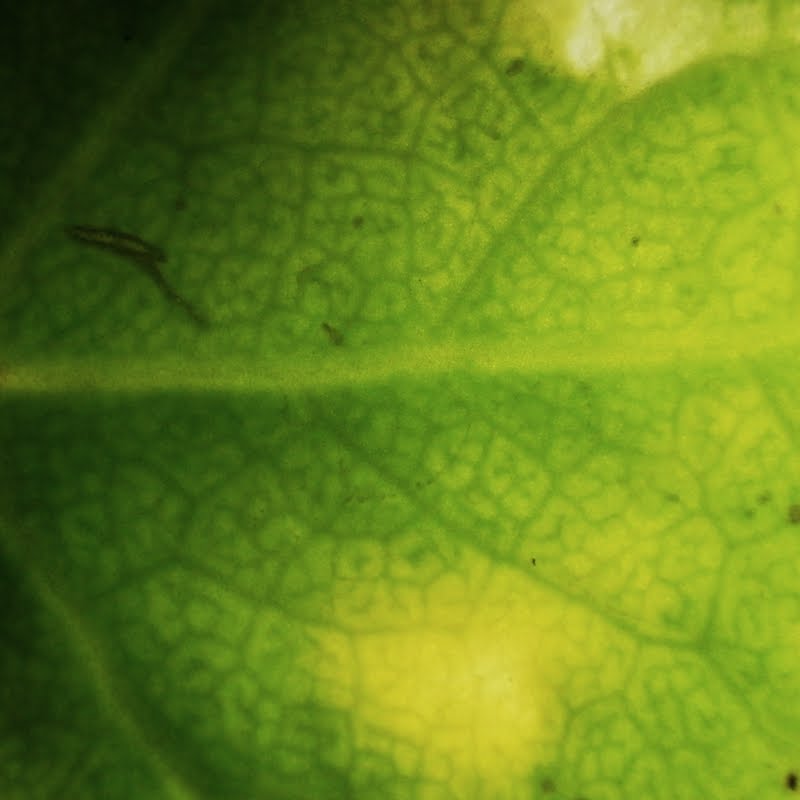

Senecio macroglossus.

Another one that's no longer around. I miss it . . . slightly. It had some nice qualities. It wasn't a good plant for me to be trying to grow, though, for three main reasons. One, it needed more light than I could give it. Two, it was forever tangling itself in the wire shelving I use, which did the plant no serious harm but was frustrating when watering time came around. Three, it needed a lot of grooming -- leaves were always dying but remaining attached to the stem, which made it difficult to groom. And it always needed to be groomed.

It'd be interesting to look at sometime with the microscope, though. You can see some weird stuff happening in there with the veins just from this picture.


Chlorophytum x 'Fire Flash,' dead leaf.

This picture is dramatic, but I think not good. Not the plant's fault, though. The plant is great.


Malva neglecta.

One of Iowa's less objectionable invasive weeds.


Saintpaulia ionantha NOID, petal.

The third plant I no longer own. I like African violets well enough to want to grow them, but not well enough to change the way I care for my plants to make growing them possible. By the time the last of the Saintpaulias went in the garbage, I was pretty exasperated with the genus, and I think I could live the rest of my life quite happily without ever trying to grow another.


Hibiscus moscheutos 'Dave Fleming,' petal.

I'm not particularly into the H. moscheutos varieties I've seen so far, and I don't know why. I mean, they seem like the sort of thing I would like. I like H. rosa-sinensis fine (I don't grow it, because overwintering always seems to be a problem, but I like them to look at.), and it's not that I have a problem with winter-hardy Hibiscus, because I think H. syriacus 'Blue Satin' is great. H. moscheutos is just too extreme for me, in some way I can't articulate. I don't see them very often around here, either. I mean, I see them for sale, just not usually planted. Though I suppose some of that is because I only recognize them when they're blooming, and for a lot of the year, they're not blooming.


Peperomia caperata.

The last of the plants I no longer grow, and the one I would be most likely to try again if I thought there was a chance of success. The problem with P. caperata was always watering. The 14-day cycle most of the plant collection is on is a bit too long for P. caperata, and if I tried to keep them wet longer by moving them to a larger pot, they'd rot. Irreconcilable differences. If I ever do find a way to deal with the watering differently, I will probably try this one again.


Ipomoea NOID, petals.

Say what you will about Ipomoeas (I. nil, I. purpurea, I. tricolor, and so on), but the flowers really are quite lovely even if the plants are weedy.


Musa 'Zebrina Rojo.' (possibly Ensete 'Zebrina Rojo.')

I probably took more photos of 'Zebrina Rojo' than necessary. (Previously: XLVIII, XLIV. And I think there's another photo in the transmitted light reserves.)


Tuesday, August 13, 2013

Pretty picture: Hibiscus 'Heartthrob'


Not a lot to say about this one; it was at the ex-job, and I noticed it partly because hardy Hibiscus flowers are very difficult to ignore, and partly because I'd already been noticing them around in people's yards as we rode into Iowa City.

There's also not a lot to say because I've been heavily preoccupied by dental matters since Saturday. Saw somebody yesterday, and apparently the pain I've been feeling doesn't indicate anything particularly wrong and isn't something that requires any kind of intervention by a dentist. So everything's fine. It was still hard to convince myself to calm down, though, after spending a whole weekend on red alert over it. Dental problems have a way of seizing one's attention.


Tuesday, November 13, 2012

List: Houseplants That Have Red Flowers

The usual disclaimers apply, but let's run through them again just to make sure we're all on the same page:

1) This is not an exhaustive list of red-flowering houseplants; I'm not sure it's even possible to come up with an exhaustive list of red-flowering houseplants. And if it were possible, it probably wouldn't be desirable. This is plenty long as it is.

2) Also, many of the plants on the list are available in multiple cultivars, not all of which necessarily bloom red.

3) I'm approaching these lists from an interior-decorating standpoint, not a botanical one. If the plant has showy red bracts with tiny yellow true flowers, I'm counting it as a red-bloomer, because that's how most people would think of it.

4) As there are no sharp dividing lines between "red," "orange," "pink," and "purple," you may disagree with me about the redness of some of the flowers mentioned here. Which if it's all the same to you, I'm going to see that as more your problem than it is mine.

5) In some cases, I'm going wholly or partly by the results from Google image search for the plants in question. Since people sometimes post misidentified pictures, there is a small chance that some of the plants listed, especially more obscure plants, may be included in error.


Aeschynanthus lobbianus.

Clerodendrum x speciosum. (C. splendens x C. thomsoniae)

Cyclamen persicum NOID.

Episcia 'Silver Skies.'

Hatiora (formerly Rhipsalidopsis) NOID.

Hibiscus rosa-sinensis.

Kalanchoe blossfeldiana NOID.

Neoregelia 'Maria.'

Parodia microsperma. Some other Parodias have red flowers as well, though yellow is more typical.

Tillandsia ionantha. Some other Tillandsias have either red flowers (T. funckiana, T. latifolia) or red bracts (T. juncea, T. abdita, T. vinalesensis, T. boliviensis, T. tenuifolia, T. brachycaulos, T. queroensis, T. leonamiana).

This is a tough list to do recommends / anti-recommends for: for all of these, I either have 1) no experience, 2) exclusively bad experiences, or 3) very mixed experiences. If forced to come up with something, though, I would reluctantly recommend Aeschynanthus, Episcia, and Neoregelia.

My personal experience with Aeschynanthus lobbianus was mostly negative, but I don't think it was the plant's fault: I should have kept up better with the watering. Other Aeschynanthus species have done well for me, enough so that I'd feel comfortable recommending them to other people. The main obstacles to cultivation are light (they need at least bright indirect light, and I'd highly recommend at least some direct sun) and temperature (always above 60F/16C).

I enjoy Episcias, but varieties either tend to do really well for me ('Coco,' 'Suomi,' several NOIDs, 'Faded Jade,' 'Raspberry Parade') or really poorly ('Pink Acajou,' 'Kempenfest,' 'Burning Embers'), without much of a middle ground. 'Silver Skies' is one of the good ones, though it's a bit slower than the others, and stays smaller. Main obstacles to cultivation: temperature (always at least 60F/16C), water (don't let them dry out to the point of wilting) and humidity (higher is better).

I was a huge fan of Neoregelia at one point a few years back; I've cooled off on them somewhat since then, for various reasons, but they're perfectly fine plants if you have the space for them and don't mind getting caught on their sharp marginal spines occasionally. Biggest obstacle: light (at least bright indirect, with some direct sun strongly recommended).

For the anti-recommend, I guess I'll go with Hibiscus, though Cyclamen and Kalanchoe were really close. They all can be grown indoors successfully, but none are particularly well-suited to it. Cyclamen goes in and out of dormancy at erratic intervals and is easily overwatered as a result; Kalanchoe virtually always goes downhill once purchased, because it needs extremely bright light.

Hibiscus has both problems: it defoliates in the winter, to a greater or lesser degree depending on how it's treated, and it's very difficult to rebloom in the house if you don't have a lot of light. (Though it's easier than Kalanchoe.) Hibiscus has one problem that the other two don't, though, which is that they're incredibly appealing to pests. At work, we were always wrestling with spider mites, whitefly, and aphids; I've also had spider mites on plants at home. Hibiscus are gorgeous, obviously, but it's just not worth the hassle to bring them inside for the winter. People with huge windows or small plant collections might find Hibiscus more rewarding than I do.


Not pictured:

  • Some Abutilon cvv.
  • Acalypha reptans. (pinkish-red)
  • Acalypha wilkesiana. (not particularly ornamental; pink-red; small)
  • Some Adenium cvv.
  • Some Aechmea spp./cvv. (bracts)
  • Ananas comosus. (bracts; pink-red; true flowers are blue-purple)
  • Some Anthurium hybrids are true red.
  • Ascocenda Sweet Pea 'Ruby.' (pinkish red)
  • Austrocylindropuntia subulata. (variable, ranges from orange-red to pink; usually closer to pink)
  • Some Begonia cvv. (usually more pink or pink-red, though Reigers, wax, and tuberous begonias can all have true red flowers)
  • Some Billbergia spp./cvv. have flower stalks with red bracts, though pink is more common. The true flowers are generally some combination of blue, green, and white.
  • Some Bougainvillea cvv.
  • Bryophyllum daigremontianum.
  • Bryophyllum tubiflorum. (orange-red)
  • Calliandra emarginata. (pink-red; possibly not actually a houseplant)
  • A few orchids in the Cattleya alliance produce flowers that are red to some degree or another; two of the more striking examples are Laeliocattleya Rojo x Cattleya aurantiaca (picture) and Lyonara cv. (Schomburgkia undulata x Sophrolaeliocattleya Rojo) (picture)
  • Clerodendrum thomsoniae. (white bracts / red flowers)
  • Some Columnea cvv./spp. might qualify, though usually they're more orange or orange-red than red.
  • Crassula falcata.
  • Dischidia pectinoides. (true red to pink-red; small)
  • Echeveria coccinea (red or orange-red; see post) and some other Echeveria cvv. (They're usually pink or orange-pink with a yellow rim/tip, though.)
  • Epidendrum Max Valley (orange-red) and some other Epidendrum cvv.
  • Some Epiphyllum cvv.
  • Some Euphorbia milii cvv.
  • Some Euphorbia pulcherrima cvv., though I would never recommend that anybody get a Euphorbia pulcherrima.
  • Some Ferocactus spp./cvv.
  • Graptopetalum bellum. (pink-red; I don't know if this is cultivated often enough to count for the list)
  • Graptopetalum pentandrum var. superbum. (also sometimes called G. superbum; brick red at petal tips)
  • Several Guzmania cvv. have red, purple-red, or orange-red bracts.
  • Some Heliconia spp./cvv., though I'm not sure Heliconia should qualify as houseplants.
  • The spathe of Homalomena 'Perma Press' is red (link). It's arguably not a houseplant either (too big), even though I'm growing it as one.
  • Hoya DS-70. (variable: dark red, orange-red, pink, pink-red)
  • Hoya polyneura. (dark red / pink-red / purple-red, with white)
  • Hoya pubicalyx. (dark red)
  • Several Huernia species have red flowers to some degree or another, usually very dark maroon or burgundy. These include: Huernia aspera (dark red), Huernia confusa (dark red), Huernia guttata (dark red), Huernia insigniflora (large red annulus1 on peach petals), Huernia keniensis (flowers are white or pale yellow with a very dark red interior), Huernia leachii (dark red stripes on pale yellow), Huernia oculata (very, very dark red petals around a central bright white circle; I didn't know about it before this post, but now I want one really badly), Huernia piercii (dark red spots on white), Huernia plowesii (dark red annulus with dark red spots elsewhere), Huernia procumbens (dark red), Huernia schneideriana (dark red), Huernia transvaalensis (dark red annulus), Huernia zebrina (usually dark red annulus, plus dark red stripes on yellow petals, but color varies).
  • Justicia carnea (true red) and Justicia spicigera (orange-red). Some Justicia species are grown as houseplants, though I don't know whether J. carnea or J. spicigera are among them to a meaningful degree.
  • Kalanchoe tomentosa flowers are hard to describe. See the pictures at this link.
  • Some (most?) Kohleria cvv.
  • Loropetalum chinensis? (pink-red; uncertain about its suitability as a houseplant)
  • Some Mammillaria spp. have pink-red flowers, though they're typically much closer to pink than to red.
  • Some Mandevilla cvv. (link)
  • Masdevallia schlimii (color varies in photos: brick red, dark orange-red, dark purple-red)
  • Maxillaria tenuifolia maybe barely qualifies as red. (dark red-brown)
  • Some Miltoniopsis cvv., arguably. (tend to be more pink-red or purple-red than true red)
  • Some Musa spp. have some red in their inflorescences, though it isn't usually the main color. Ensete ventricosum has an inflorescence which is primarily dark red.
  • The central leaves of several Neoregelias will flush red at the center when blooming, though the actual flowers are usually lavender or blue-purple.
  • Some Nerium oleander cvv. (pink-red; suitability as a houseplant is questionable)
  • Some orchids in the Oncidium alliance, though there doesn't seem to be a lot of true red: most lean toward either brown or pink. Some of the closer ones: Burrageara Nelly Isler (link; pinkish), Miltassia Charles M. Fitch x Odontocidium Black Beauty link; very dark red), Vuylstekeara Aloha Sparks 'Ruby Eyes' (link; washed-out and orange-red), Wilsonara Lisa Devos (link; brick red and pink), Oncidium Sharry Baby (link; dark red), Miltonidium Bartley Schwartz 'Highlander' (link; dark pink-red)
  • A few Opuntia spp./cvv. flowers are red or orange-red, including O. aciculata and O. bergeriana. O. 'Claude Arno' is a dark violet-red.
  • Pachira aquatica is not likely to bloom indoors, but the flower has yellow reflexed petals with lots of long, white, red-tipped stamens. You wouldn't look at it and say "now there's a red flower," but there's definitely quite a bit of red involved.
  • At least one Pachyphytum sp. or cv. has flowers with dark red interiors, though I don't know which one and it doesn't appear to be typical for the genus.
  • Pachypodium baronii has solid-colored, true red flowers; P. namaquanum has yellow flowers with petals that don't open very wide and are red-brown at the tips. All other Pachypodium spp., including the most commonly-grown ones, have white, yellow, or pink flowers.
  • A few Pachyveria hybrids have flowers that look reddish in pictures, though pink, yellow, and green are more common.
  • Phragmipedium orchids get close to true red once in a while. Closest two I've personally run into were Phragmipedium Sargent Eric 'Timberlane' (pretty true red; a bit orangey) and Phragmipedium Fox Valley 'Fireball' (pretty close to true red, a little pinkish).
  • Pedilanthus tithymaloides. (unlikely to bloom indoors)
  • Some Pelargonium x hortorum cvv. are true red or dark red.
  • Pereskia bleo are either orange-red or red, according to photos; Pereskia flowers are more typically pink/lavender. I don't know P. bleo's suitability for indoor culture, though at least one Pereskia (P. aculeata) does well indoors.
  • A few Phalaenopsis orchids tend toward something like red, though I have yet to see any true red phals.
  • A handful of Philodendrons produce inflorescences with solid red spathes; the most commonly sold is P. 'Moonlight,' but the species P. eichleri also does. The spathes of P. martianum (aka P. cannifolium) are white with a dark red base.
  • A few Pinguicula spp. have true-red flowers, most prominently P. laueana. Maybe also P. caryophyllacea?
  • Some Rhododendron cvv. are brilliant true red, though I would argue that they're not houseplants.
  • Some Saintpaulia cvv. are dark red or pink-red; I have yet to see true red.
  • Salvia elegans.
  • Schefflera actinophylla. (dark red, very unlikely indoors)
  • Several Schlumbergera cvv. are vivdly red.
  • Sedum burrito. (rare; variously pink, coral, or pink-red)
  • Sedum morganianum. (rare; photographs show true red, red-orange, dull red, dark red)
  • Sempervivum cvv./spp. flowers are typically (but not always) dull red or pink-red.
  • Some Sinningia cvv./spp.
  • Most Stapelia flowers involve dark red or dark purple-red somewhere, though it's never a particularly vibrant red, and not very many of the flowers give an overall impression of red. Most notable exceptions: Stapelia cedrimontana is black-red with red and yellow stripes near the center; Stapelia hirsuta has very dark red stripes on a peach background, giving the overall impression of dark red; Stapelia leendertziae -- which I also covet -- is solid dark red or dark purple.
  • Stenorrhynchos speciosum.
  • Stenosarcos Vanguard 'Fireball.' (pink-red)
  • Some Streptocarpus cvv. (pink-red)
  • Stromanthe sanguinea cvv. (red or pink-red; unlikely to happen indoors)
  • Synadenium grantii. (dull dark red, small, unlikely indoors)
  • Many Vriesea hybrids, and some of the species (notably V. splendens) produce inflorescences with red bracts.

As usual, I am totally open to it if readers want to make additional suggestions in the comments.

-

1 The annulus is the raised ring around the center of some stapeliad flowers. One is sort of visible in the first picture on this post.


Wednesday, October 26, 2011

Rumble Among the Jungle, Match 4.4

Results for matches 3.15 and 3.16:

It used to be clear enough who was going to win after the first day or so of voting that I could write most of these posts in advance and then just pop in the actual numbers when the voting ended, but lately I'm having to wait until the very last possible moment to start writing.

Aeonium spp. ended match 3.15 with an 8-vote lead over Tillandsia spp. (air plants), 62 to 54, which surprises me enormously. (I've tried, but just don't see the appeal of Aeoniums.)

Match 3.16 found Calathea cvv. defeating Agave spp. by 60 to 56. They're both nice plants, so I wouldn't have been surprised by either outcome, as long as the vote was close. (If Calathea had clobbered the shit out of Agave, or vice-versa, then I would have been surprised.)

The report for round 3:

Four families were removed from contention: Araucariaceae, Bromeliaceae, Cycadaceae, Polypodiaceae. So it goes.

Still in the competition: Amaryllidaceae (1), Apocynaceae (1), Araceae (4), Asparagaceae (2), Cactaceae (1), Crassulaceae (2), Gesneriaceae (1), Malvaceae (1), Marantaceae (1), Orchidaceae (2).

My prediction skills have improved: I called every match correctly this time except for 3.13. (I thought y'all would go with Adenium obesum instead of Haworthia spp.) So that's a big 94% correct for Mr. Subjunctive.

All three of the plants I'm watching closely (the one I would prefer to see win, and the two I think are most likely to win) made it into round 4 intact.

Speaking of round 4, here's today's match:

Match 4.4
Schlumbergera cvv. (holiday/Thanksgiving/Christmas cactus) vs. Hibiscus rosa-sinensis (tropical hibiscus)

Center and top left: Schlumbergera 'Caribbean Dancer;' others are NOID.


All unidentified cvv. except left center ('Mrs. Jimmy Spangler') and bottom right ('Sunny Wind').


Tuesday, October 18, 2011

Rumble Among the Jungle, Matches 3.7 and 3.8

Rules and Stuff
1) It's probably possible to vote more than once per poll, but please don't. If I believe that someone is voting repeatedly, I will throw out those results, repost the poll, and seriously question that person's priorities.
2) If you want to link to a poll on Twitter / Facebook / your blog / whatever and encourage your friends to come and pump up the support for your favorite plants, you are encouraged to do so.
3) You are also encouraged to leave comments on Rumble posts, if so moved.
4) All photos will enlarge if opened in a separate window/tab.
5) You can choose which plant is "best" according to whatever criteria you decide for yourself. My personal process is a bit convoluted.1
6) All polls will be open for three days.


Results of matches 2.29 to 2.32:

I found match 2.29 to be really strange. I don't know what it is about rosette-forming succulents that y'all get so excited about, but Echeveria and its relatives have been cutting quite a swath on the way to the championship, and now Aeonium's doing it too. Worse, Aeonium's done it to Euphorbia milii, which I think was clearly the superior plant. So I don't like this at all. Final score: 58 to 52.
I don't really agree with the results of 2.30 either, but I expected it: the air plant group of Tillandsias defeated Dieffenbachia cvv. 66 to 43.

Aeonium spp. and Tillandsia spp. clash on 22 October, in match 3.15.

I'm more comfortable with the other pair of matches. In match 2.31, Agave spp. pulled ahead of Hippeastrum cvv., 62 to 48, though things were a little shaky there at the beginning.
Last, Calathea cvv. won match 2.32 over Opuntia spp., 62 to 45.

Match 3.16 will pit Agave against Calathea on 22 October. Something about that seems kind of absurd, but I guess if the universe survived the Agave-Cattleya match, it'll survive this one too.

This concludes the second round. Families leaving the competition in the second round were the Araliaceae, Begoniaceae, Commelinaceae, Compositae, Droseraceae, Euphorbiaceae, Leguminosae, Moraceae, Oxalidaceae, and Urticaceae. Let's give 'em all a hand!

[scattered applause]

The following families still have a (theoretical) chance to claim the championship: Amaryllidaceae (1 competitor remaining), Apocynaceae (2), Araceae (5), Araucariaceae (1), Asparagaceae (8), Bromeliaceae (2), Cactaceae (2), Crassulaceae (2), Cycadaceae (1), Gesneriaceae (2), Malvaceae (1), Marantaceae (1), Orchidaceae (2), Polypodiaceae (1), and Strelitziaceae (1).

My ability to predict the winners improved slightly in the second round: I got 24/32 (75%) correct.

EDITED TO ADD: Forgot to mention that the three plants I'm currently invested in (the two that I think are most likely to win, and the one that I'd most like to see win) made it through the second round intact.

And that's where we are right now. Today's matches:

Match 3.7
Platycerium spp. (staghorn fern) vs. Schlumbergera cvv. (holiday/Thanksgiving/Christmas cactus)

(Unidentified Platycerium spp.)


Center and top left: Schlumbergera 'Caribbean Dancer;' others are NOID.


Match 3.8
Cordyline fruticosa cvv. (ti plant) vs. Hibiscus rosa-sinensis (tropical hibiscus)

Clockwise from top left: Cordyline fruticosa 'Florica,' species, NOID, NOID which might be 'Chocolate Queen,' 'Kiwi.'


All unidentified cvv. except left center ('Mrs. Jimmy Spangler') and bottom right ('Sunny Wind').


-

1 I'm deciding according to a hypothetical situation in which all of my houseplants are gone, as are all the other houseplants of the world, except for one producer/supplier/retailer. Said person is offering to restock me with one or the other of the plants in question but refuses to give me both. Which one would I choose?


Monday, October 10, 2011

Rumble Among the Jungle, Matches 2.13-2.16

Rules and Stuff
1) It's probably possible to vote more than once per poll, but please don't. If I believe that someone is voting repeatedly, I will throw out those results, repost the poll, and seriously question that person's priorities.
2) If you want to link to a poll on Twitter / Facebook / your blog / whatever and encourage your friends to come and pump up the support for your favorite plants, you are encouraged to do so.
3) You are also encouraged to leave comments on Rumble posts, if so moved.
4) All photos will enlarge if opened in a separate window/tab.
5) You can choose which plant is "best" according to whatever criteria you decide for yourself. My personal process is a bit convoluted.1
6) All polls will be open for three days.


The results for matches 1.61 to 1.64 were posted in this morning's post, if you haven't already seen that.

Today's matches:

Match 2.13
Platycerium spp. (staghorn fern) vs. Gynura aurantiaca (purple passion plant)

(Unidentified Platycerium spp.)


(All Gynura aurantiaca.)


Match 2.14
Aloe vera (medicinal aloe, burn plant) vs. Schlumbergera cvv. (holiday/Thanksgiving/Christmas cactus)

(Top: young Aloe vera. Bottom: mature A. vera.)


Center and top left: Schlumbergera 'Caribbean Dancer;' others are NOID.


Match 2.15
Pachira aquatica (money tree) vs. Cordyline fruticosa cvv. (ti plant)

(Pachira aquatica.)


Clockwise from top left: Cordyline fruticosa 'Florica,' species, NOID, NOID which might be 'Chocolate Queen,' 'Kiwi.'


Match 2.16
Mimosa pudica (sensitive plant) vs. Hibiscus rosa-sinensis (tropical hibiscus)

Both Mimosa pudica. Left photo belongs to, and is used with permission from, Liza Wheeler at Good to Grow.


All unidentified cvv. except left center ('Mrs. Jimmy Spangler') and bottom right ('Sunny Wind').


-

1 I'm deciding according to a hypothetical situation in which all of my houseplants are gone, as are all the other houseplants of the world, except for one producer/supplier/retailer. Said person is offering to restock me with one or the other of the plants in question but refuses to give me both. Which one would I choose?


Wednesday, September 28, 2011

Rumble Among the Jungle, Matches 1.29-1.32

Rules and Stuff
1) It's probably possible to vote more than once per poll, but please don't. If I believe that someone is voting repeatedly, I will throw out those results, repost the poll, and seriously question that person's priorities.
2) If you want to link to a poll on Twitter / Facebook / your blog / whatever and encourage your friends to come and pump up the support for your favorite plants, you are encouraged to do so.
3) You are also encouraged to leave comments on Rumble posts, if so moved.
4) All photos will enlarge if opened in a separate window/tab.
5) You can choose which plant is "best" according to whatever criteria you decide for yourself. My personal process is a bit convoluted.1
6) All polls will be open for three days.


Results for matches 1.13 to 1.16

The bracket selection was more or less random,2 so very similar plants occasionally wound up in competition with one another during the first round. Two such pairings happened in this batch, but y'all appear to have had no difficulty choosing one over the other. Interestingly, the vote proportions wound up being eerily similar for each of the four contests in this set, with the winner getting about 67% of the vote in each case.

Match 1.13 saw Ficus maclellandii beating Schefflera elegantissima easily, 71 to 34, despite both plants having a narrow/pointy/treelike thing going on. I guess this means that some of you have tried to grow S. elegantissima.
In match 1.14, the votes were similar, in favor of Strelitzia nicolai and S. reginae over Guzmania cvv., 69 to 37.

Ficus maclellandii and Strelitzia nicolai/reginae both advance to match 2.7, where they will face off against one another. That won't be posted until October 8, which hopefully will be enough time for me to decide which one to vote for.

Match 1.15 was the other one where I thought maybe the combatants were maybe too similar, both being pretty common vining plants, but you guys chose Philodendron hederaceum cvv. over Syngonium podophyllum cvv. by, again, about a two to one margin (68 to 37).
And finally, in match 1.16, Dracaena fragrans cvv. handily defeated Saxifraga stolonifera, 71 to 36. Except not handily, because they don't have hands. Rootily. Leafily. Something like that.

Philodendron hederaceum cvv. will face Dracaena fragrans cvv. on October 8, in match 2.8, which will also be a difficult one for me to vote on. Maybe I should just not vote that day.

But there are votes to be cast today, so have at 'em:

Match 1.29
Pachira aquatica (money tree) vs. Pilosocereus pachycladus

(Pachira aquatica.)


(Pilosocereus pachycladus.)


Match 1.30
Cordyline fruticosa cvv. (ti plant) vs. Euphorbia lactea cvv.

Clockwise from top left: Cordyline fruticosa 'Florica,' species, NOID, NOID which might be 'Chocolate Queen,' 'Kiwi.'


Clockwise from left: Euphorbia lactea, Euphorbia lactea crest grafted onto a E. drupifera base, crested E. lactea.


Match 1.31
Ravenea rivularis (majesty palm) vs. Mimosa pudica (sensitive plant)

(Both Ravenea rivularis.)


Both Mimosa pudica. Left photo belongs to, and is used with permission from, Liza Wheeler at Good to Grow.


Match 1.32
Hibiscus rosa-sinensis (tropical hibiscus) vs. Dracaena sanderiana (lucky bamboo, ribbon plant)

All unidentified cvv. except left center ('Mrs. Jimmy Spangler') and bottom right ('Sunny Wind').


(Dracaena sanderiana, variegated cv.)


-

1 I'm deciding according to a hypothetical situation in which all of my houseplants are gone, as are all the other houseplants of the world, except for one producer/supplier/retailer. Said person is offering to restock me with one or the other of the plants in question but refuses to give me both. Which one would I choose?
2 (I had a list of plants in Excel, created a column of random numbers next to it, then sorted according to the random numbers. I swapped a few plants around after that, if it looked like two plants that would be very popular were facing off against one another in the first round, so the end result is not strictly random, but it's pretty close.)


Tuesday, October 19, 2010

Open Letter to Pierson's Flower Shop and Greenhouses

ADDED 1/9/12: I found out today, more than a year after this post first went up, that a day after it went live here at PATSP, most of it was duplicated at Yelp.com as a one-star review.

I not the person who posted it to Yelp as a review. I don't recognize the name of the person who did. They did not ask permission to do it. I would not have given permission had I been asked. I've asked Yelp if the above is sufficient grounds to have the review taken down, and we'll see what they say.

It also happens that most of the criticisms I have for Pierson's in this post -- though accurate at the time -- have been addressed to some degree or another, which is also part of why it distresses me that this has been allowed to stand as a permanent (or internet-permanent, anyway) evaluation of their business. I wrote it because I was frustrated with them and wanted them to do better, not because I wanted to hang it around their necks forever.

ANOTHER ADDITION 1/11/12: Yelp did remove the review.

ANOTHER ADDITION 1/16/12: My more recent evaluation of Pierson's: The Brick Joke.

- - - - - - - - - - - - - - - - - -

17-18 October 2010

Dear Pierson's Flower Shop and Greenhouses,

I am writing this letter to let you know that I'm going to stop visiting your store at 1800 Ellis Blvd NW in Cedar Rapids, IA, for a while. This isn't over any one particular thing, just a lot of little things that have been going on forever, that I finally got fed up with on a visit to the store last Friday.

It started out looking promising. Your sign out front said houseplants were 50% off, which is usually the only time I can afford to buy any of your plants. So that was exciting. And when I looked around in your tropical greenhouse, I did find something I wanted to buy: you had two different Pedilanthus varieties that I'd never seen in person before. Although they didn't have prices on them (because you almost never have prices on anything), I figured they were probably something I could afford. This is an increasingly rare experience for me, finding a plant I haven't seen before, so I was briefly very pleased with you.


But when I checked the plants closer, I found problems. The stems and leaves were spotted with a gray-white, fuzzy fungus.


I realize you're selling the plant at 50% off, but the plants should still be healthy, no? I mean, this plant couldn't have been there very long; I'd last been there on August 15, and you didn't have them then, so at most it had been in your care two months. You guys are supposed to be in the business of keeping them alive, healthy, and pretty.

So what gives? It took me all of five seconds to figure out what was going on: you stuck Pedilanthus, a genus which is fairly prone to fungus if its leaves get wet, underneath hanging baskets. The baskets get watered, the water drips down, the Pedilanthus gets wet, therefore fungus.

And there was all kinds of stuff like that going on in there, that someone who knows anything about tropical plants should know better than to do. The Dracaenas were defoliating from the bottom: that means they're too wet. The cacti were standing in water, in the shady greenhouse, again, just like they were in May. You may as well not carry cacti at all, if you're going to keep them sopping wet and in the dark. That's the sort of thing I expect from Home Depot, not an independent garden center that's been in business for decades.

This picture is actually from May, but they still looked like this in October. Probably not the same specimens in October that were there in May, obviously.

You have a flat of 4-inch pots by the window that have been taken over by weeds. Whatever the plants in those pots originally were, they're not there anymore: why are the pots still there? You don't need that stuff on the sales floor. Some of your 3-inch tropicals were tangled up in one another so badly that I couldn't have pulled one out to buy even if I'd wanted to. Others of the 3-inch plants were dead because at some point they tipped over and nobody set them upright again, so they couldn't be watered. Five seconds to right a plant is too much effort? You have 4-inch ferns that are down to their last two fronds, and nobody's bothered to pull out the dead fronds. Whiteflies fluttered out when I bumped some of the Hibiscus. (Admittedly not entirely your fault: it's been a bad year for whiteflies in Eastern Iowa. But even so. You're thinking you'll cut the price in half and sucker some customers into taking these plants home? Shame on you.)

Hibiscus rosa-sinensis 'Enlightenment.'

The Brugmansias still have aphids, just as they did in August. Your Cissus rhombifolias and your Columnea hanging baskets were mostly dead, and where they weren't dead they were yellowing. There was a piece of Euphorbia lactea sitting on the table next to the plant; it looked like a customer or someone had knocked it off accidentally, but nobody's bothered to pick it up. And who, exactly, do you think is the market for a $30, bloomed-out, half dead Phalaenopsis? Why would I bother, when I can go to Lowe's and get a healthy one fresh off the truck for $15?

The list goes on and on and on like that. Which, if it had been the first time I saw fungus, or the first time I saw bugs, or if you always got everything right except tagging and pricing the pots, then I'd just assume that you were having a bad day, bad month, bad year. But these things have been going on forever. Eventually, I had an epiphany: y'all don't care about the plants. You might or might not know how to grow them, but it's obviously not a priority. Nor is scheduling enough hours for the employees to clean up the debris and the dead plants. Instead you put everything on sale at half price and hope that the customers will sort things out for you, while you focus your attentions on the poinsettias that just came in, because that's where the money's coming from this winter. And, okay, fine, but your tropical greenhouse currently has problems with overwatering, fungus, and whiteflies. Can you name three things that are especially likely to ruin the sales value of poinsettias, just off the top of your head?

I know you've had a rough last few years: the flood hit you pretty hard, and the economy crashed right as you were re-opening the store, which couldn't have helped. I know it's poinsettia season and the tropicals are not your priority. I know you're an independent garden center and you have a lot of competitors, some of whom can get better wholesale prices than you can. I know you're really more of a florist than a garden center anyway. I know it's expensive to have people on the payroll, especially in the fall when people are mostly not buying garden-related merchandise and there's not a lot of cash coming in. I know you've been in business forever, and you've always done things this way, and it's worked fine for decades so clearly you know what you're doing and if some blogger wants to tell you how to run your business then he can go fuck himself.

Maybe so. But you've lost this particular customer for a solid year or two, all the same.


Tuesday, September 7, 2010

Pretty pictures: Pink

Today we have various thoughts from the plant kingdom about the idea of "pink." In a couple cases, it's maybe more my questionable judgment, and the plant was actually thinking of "purple," but whatever. I had a whole bunch of pictures that I needed to do something with, having just sifted through almost the whole photo backlog, and this sort of post is a really efficient way of getting through a lot of photos in a hurry, even if they're not seasonally-appropriate, as some of these aren't.

Asclepias syriaca flowers in extreme close-up. Some insect life visible if you look closely and/or open the photo full-size in a new window.


Polygonum persicaria. I don't think anybody actually likes this plant, but it's awfully familiar, at least. And technically pink, so it counts.


Lamium NOID. Shortly after taking this picture, I was looked at suspiciously by two women talking to one another over their backyards' fence. I expect that the suspicious looks happen all the time, but I'm not normally in a position to see them, so it was noteworthy.


Cyclamen persicum NOID. I don't see the frilly-edged Cyclamens for sale very often. Not that I necessarily want one. I just think it's interesting what is and isn't popular.


Torenia 'Catalina Pink.' This is arguably more purple than pink, but the tag said it was pink.


Ipomoea NOID. If loving morning glories is wrong, I don't want to be right.


Zinnia 'Profusion Cherry.' I had sort of intended to get some Zinnias this year, or at least some Zinnia seeds. As with all my other outdoor-related plans, that didn't work out.


Cyclamen NOID. This is probably my favorite photo from the batch.


Portulaca grandiflora, second-generation flower. These have not yet taken off like I'd hoped, but considering how late I started them, I suppose I can't be too disappointed. I should still be able to collect enough seeds to try again next year.


Weigela NOID. Came with the house. The husband and I are both kinda meh about it, but it'd be a lot of work to take it out, and neither of us have any ideas for something we'd rather see in that spot, so it stays.


Hibiscus moscheutos 'Dave Fleming,' at the ex-job. I've seen hardy Hibiscus varieties I covet, but this isn't one of them. It's big and bright enough that I find it sort of alarming. Not the sort of Hibiscus you want to run into, walking around the back yard at night.

