Showing posts with label Peperomia. Show all posts

Tuesday, May 6, 2014

[Exceptionally] Pretty pictures: transmitted light -- Part LIII

Having one of those spells where I'm not having any trouble coming up with things to write about, but I'm never happy with the results. Also, as previously mentioned, the Anthuriums are the only plants here that are doing much of anything at the moment. Consequently, we're digging into the transmitted light photos, because that's what the transmitted light photos are for.

By way of observing how old these pictures are: of the six plants photographed for this set that I owned at one time or another (Dracaena, Iresine, Senecio, Chlorophytum, Saintpaulia, Peperomia), only two remain (Dracaena, Chlorophytum).

(The previous transmitted light posts can be found here.)


Dracaena deremensis 'Janet Craig Compacta.'

Never my favorite plant, and this photo is boring besides, but I'm appreciating it a lot more these days than I used to. No rot, no scale (knock wood), no defoliation. It just sits there, quietly, and photosynthesizes, like plants are supposed to do.


Iresine herbstii 'Blazin' Rose.'

One of the plants I used to own but no longer do. The main reason for this is that it just grew too fast and needed too much light. The coup de grĂ¢ce happened when spider mites started bothering it, and I decided it was just too much work to keep around any longer. Not necessarily a terrible plant, and it does photograph well occasionally, but I couldn't say I miss having it around. (Indeed, this is the first time I've even thought about I. herbstii in at least a couple years.)
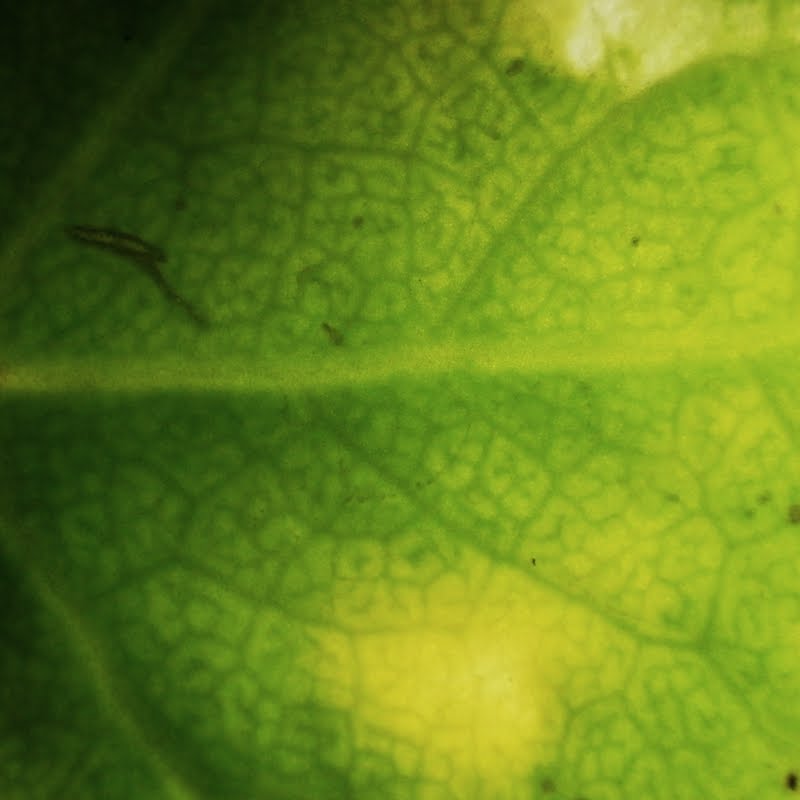

Senecio macroglossus.

Another one that's no longer around. I miss it . . . slightly. It had some nice qualities. It wasn't a good plant for me to be trying to grow, though, for three main reasons. One, it needed more light than I could give it. Two, it was forever tangling itself in the wire shelving I use, which did the plant no serious harm but was frustrating when watering time came around. Three, it needed a lot of grooming -- leaves were always dying but remaining attached to the stem, which made it difficult to groom. And it always needed to be groomed.

It'd be interesting to look at sometime with the microscope, though. You can see some weird stuff happening in there with the veins just from this picture.


Chlorophytum x 'Fire Flash,' dead leaf.

This picture is dramatic, but I think not good. Not the plant's fault, though. The plant is great.


Malva neglecta.

One of Iowa's less objectionable invasive weeds.


Saintpaulia ionantha NOID, petal.

The third plant I no longer own. I like African violets well enough to want to grow them, but not well enough to change the way I care for my plants to make growing them possible. By the time the last of the Saintpaulias went in the garbage, I was pretty exasperated with the genus, and I think I could live the rest of my life quite happily without ever trying to grow another.


Hibiscus moscheutos 'Dave Fleming,' petal.

I'm not particularly into the H. moscheutos varieties I've seen so far, and I don't know why. I mean, they seem like the sort of thing I would like. I like H. rosa-sinensis fine (I don't grow it, because overwintering always seems to be a problem, but I like them to look at.), and it's not that I have a problem with winter-hardy Hibiscus, because I think H. syriacus 'Blue Satin' is great. H. moscheutos is just too extreme for me, in some way I can't articulate. I don't see them very often around here, either. I mean, I see them for sale, just not usually planted. Though I suppose some of that is because I only recognize them when they're blooming, and for a lot of the year, they're not blooming.


Peperomia caperata.

The last of the plants I no longer grow, and the one I would be most likely to try again if I thought there was a chance of success. The problem with P. caperata was always watering. The 14-day cycle most of the plant collection is on is a bit too long for P. caperata, and if I tried to keep them wet longer by moving them to a larger pot, they'd rot. Irreconcilable differences. If I ever do find a way to deal with the watering differently, I will probably try this one again.


Ipomoea NOID, petals.

Say what you will about Ipomoeas (I. nil, I. purpurea, I. tricolor, and so on), but the flowers really are quite lovely even if the plants are weedy.


Musa 'Zebrina Rojo.' (possibly Ensete 'Zebrina Rojo.')

I probably took more photos of 'Zebrina Rojo' than necessary. (Previously: XLVIII, XLIV. And I think there's another photo in the transmitted light reserves.)


Saturday, March 9, 2013

Unfinished business: various

As I predicted, the Cryptbergia seeds (or at least "seeds" -- I'm not sure we ever definitively proved seediness) have all failed, due to some combination of fungus and incompetence. Womp-womp.


Not much else is going on here, really, which I guess makes it a good time to look through the back posts and see if I have any updates about them. All these are from September 2012; turns out there were no posts in October or November that require follow-ups.


Saturday morning Sheba and/or Nina picture, with bonus Question for the Hive Mind (1 Sep 2012)

Nothing ever came of the Canna seed. Not really surprised by this, though. More surprising: the Begonia 'Tiger Kitten' has more or less completely taken over the terrarium. I think this is mostly because it's more drought-tolerant than the Episcia 'Coco' was. (I have a tough time knowing when to water the terrarium, because it's less convenient to actually touch the soil, and every time I open the lid I'm convinced that Nina is going to take that opportunity to jump out and run into the living room, where Sheba will eat her. So I don't open the top very much.) The Peperomia puteolata is still present, as is the Murraya paniculata seedling, but overall, it's kind of a mess. And I sort of wish that the crickets didn't eat the plants so enthusiastically. I mean, I understand: they're crickets. It's what they do. But it's just depressing, with all the dead leaves, holes, ragged edges, and what have you. Perhaps I am not emotionally stable enough to keep anoles in a planted terrarium.


Random plant event: Sansevieria cylindrica (4 Sep 2012)

It's taken a while, but the third leaf is now slightly bigger than the second.

Sansevieria cylindrica.

Come back in late 2016 and I may have a fourth leaf to show you. CAN YOU HANDLE THE EXCITEMENT.1


Random plant event: Rhipsalis NOID (12 September 2012)

The Rhipsalis seedlings are still alive, and are slightly larger than they used to be. This is neither unusual nor unexpected, but it's a thing that happened. I wound up potting all the surviving seedlings into two pots together, because it seemed like they were likely to give me a really sparse, uninteresting plant if I didn't put several of them together, and also because it wasn't clear how many of them were going to survive. (As far as I can recall, though, all the seedlings that made it out of the vermiculite have survived in soil, and possibly I should have just started them in soil to begin with.)


Random plant event: Zamioculcas zamiifolia 'Zamicro' (19 Sep 2012)

I wasn't expecting this, but so far, 'Zamicro' actually has turned out to be easier for me to grow than the species. I suspect that this is not actually about the cultivar so much, and has more to do with these getting better watering and light (the species plants I've started from leaflets also did well in similar conditions, until they were transplanted), but who can really say.


For now, they seem to be happy in their little 4-pack cells, and I'm inclined to leave them there for as long as that seems to be working out. Whenever I do have to transplant, I'm going to take the advice of Steve Lucas at Exotic Rainforest and make an especially sandy and fast-draining soil for them. I am more or less convinced that this Zamioculcas-growing secret I've been missing.

-

1 NO YOU CANNOT HANDLE THE EXCITEMENT.


Saturday, September 1, 2012

Saturday morning Sheba and/or Nina picture, with bonus Question for the Hive Mind

I mentioned in the last Sheba/Nina post that the Ctenanthe burle-marxii I'd planted in there had died and I wasn't sure what I was going to replace it with.


That question has been settled, at least for the moment: I bought a Peperomia puteolata ($3 at the ex-job) to fill that space, and also put in a Canna seed just for the hell of it.

There's no picture of the latter, because it hasn't actually produced any foliage yet. I just made a hole in the seed coat, soaked it in water until I saw a root emerging, and then planted it in the terrarium, so it may or may not work. If it does work, it will either quickly become too large for the space or struggle along without enough light until I take pity on it and kill it. Not sure which way that will go. But I had a ton of seeds from last year that I never got around to starting, so I figured I may as well try that and see how it goes. Nina, I'm sure, would like something in there that's a bit more climbable.

Meanwhile, Nina is shedding her skin again.


That's not as big of an event as I've made it sound -- she does it all the time, actually -- but I don't very often get a picture of it happening. In the above, the fungusy-looking stuff in the upper left is just dead-leaf debris from the Episcia -- I'm pretty sure there's no actual fungus. The brown and green in the upper right is a Begonia 'Tiger Kitten' leaf that the crickets have eaten a hole into. When the picture was taken, Nina had only managed to clear the old skin from her face, though when I looked in again about half an hour later, none of the dead skin was there anymore.

Speaking of skin: Sheba's whole allergy situation is improving, though slowly and incompletely. We could probably be more aggressive about the Benadryl: I've been giving her 25 mg in the morning when I feed her, but she usually doesn't get a second dose. Even so, her right side is basically filled back in completely. Her left side still has some spots, but they're noticeably better than they were two weeks ago, which I suppose is something.

I also have a weed-ID question for your consideration, which may or may not be related to the Sheba-allergy stuff. When the weeds first started to come up this spring, I decided to let a couple of pokeweeds (Phytolacca americana) stay, because I think they're kind of pretty. One of the pokeweeds turned out to be something else: although the young plants looked more or less identical, and both have developed extremely thick stems (maybe 2 inches / 5 cm in diameter?), the leaves on one of them never got any bigger than about 4 inches (10 cm) long, and are narrower than those on P. americana. Also the stem has stayed green, not pink, and the flowers are tiny and white and obviously something completely different. The non-pokeweed also grew much taller (about 12-15 feet / 3.5-4.5 m), as you can see in this picture:


And here's a close-up of the flowers:


I've let it continue to grow, because . . . I don't know. After the drought got to a certain point, I kind of decided that I was happy enough to see anything growing, and I didn't care what it was. Plus I was curious about what it was going to do. The overall plant shape, and the shape of the leaves, resemble some of the Amaranthus species pictures on line, especially A. tuberculatus, A. australis, and A. cannabinus, but none of those are quite a match (maybe the flowers haven't developed enough yet, though). In any case, I'm wondering if anybody knows what this is, and whether or not it, by itself, could be causing Sheba allergy problems. The flowers are fairly small and inconspicuous, so wind-pollination wouldn't be out of the question, right? And if it's wind-pollinated, maybe it could also be allergenic?


Tuesday, April 10, 2012

Another sale/trade preview post

I'd hoped to get this year's sell/trade post up a couple weeks earlier than I did last year (25 April), but it's looking like I'll be lucky to post it at the same time. Deciding which things to offer took a very long time on its own, and then everything had to be photographed, and I spent a day trying to make sense of the USPS's shipping charges from last year, in hopes of coming up with a better approximation for this year, so on and on it goes.

But! I do at least have a few early pictures, which I may as well share, since I don't have much else going on anyway. Prices are still being determined, and obviously I'm selling more than four kinds of plants (about 80, with another 10 that aren't ready yet but will be by the end of the summer -- or at least I hope they will be), and I may as well admit now that these are some of the better-looking plants I have to offer, and they don't all look like this. But as a taste:


Episcia NOID.


Gasteraloe x beguinii.


Hatiora salicornioides.


Nautilocalyx forgetii.


Peperomia pereskiifolia.


Pereskia aculeata var. godseffiana.


Thursday, January 26, 2012

List: PATSP All-Stars

"All-Stars" are those plants for which:

1) I have had at least one specimen, continuously, for at least three years,

2) which is still living,

3) and looks as good as, or better than, it did when first acquired, plus:

4) no specimen has ever had spider mites, scale, mealybugs, thrips, aphids, whitefly, cyclamen mites, or fungus (Fungus gnats are excluded, because fungus gnats don't do enough damage to the plants to count as pests, and it's often difficult to tell what plant they're residing in anyway.),

5) no established specimen has ever gone into an abrupt and irreversible decline (new cuttings/divisions/offsets may still do so, 'cause that's part of the process of getting established), and

6) the plant has been successfully propagated,

7) more than once.

I have something in the neighborhood of 400-450 distinct kinds (species / subspecies / cultivars / hybrids) of plants in the house right now, and I don't have any idea how many other kinds of plants I've attempted to grow in the past, but I figure it has to be at least a couple hundred. Out of all those, a mere nineteen meet the above criteria at the moment.

(NOTE: The pictures which follow are not necessarily of the original plant nor particularly current; even those photos which are of the original plant and current may not impress, because looking better than when the plant originally came to live here is a lower bar to clear for some of the plants than it is for others. Also the Philodendron hederaceum 'Brasil' picture isn't even of my own plant.)

Aloe 'Walmsley's Blue.'

Anthurium 'Gemini.'

Anthurium 'Orange Hot.'

Begonia NOID, rhizomatous type.

Chlorophytum x 'Fire Flash.'

Dracaena fragrans 'Massangeana.'

Gasteraloe x beguinii. (Aloe aristata x Gasteria batesiana)

Nematanthus 'Tropicana.'

Peperomia obtusifolia, variegated.

Philodendron hederaceum, chartreuse version. (Possibly 'Aureum' or 'Lemon-Lime;' I've never had an official cultivar name.)

Philodendron hederaceum 'Brasil' or 'Brazil.'

Philodendron hederaceum micans.

Sedum morganianum.

Sedum rubrotinctum.

Synadenium grantii (green version).

Syngonium podophyllum NOID (possibly 'Neon').

Yucca guatemalensis, gray version.

Yucca guatemalensis, green version.

Yucca guatemalensis, yellow-margined version.


I don't know whether this would be useful information to anybody else, but there it is. Ordinarily with the List posts, I recommend three good ones and warn against one, but these are obviously all recommended, so we'll skip that part.

What are your All-Star plants, according to the above criteria?

-


Honorable mentions:

Honorable mentions are those which meet 6 of the 7 criteria. Depending on their reason for disqualification, some of these may move into the All-Star list eventually.
  • Aechmea fasciata (only one successful propagation)
  • Agave desmettiana (?), variegated (have only had ~1 1/2 years)
  • Agave victoriae-reginae (one's been here 4 1/2 years but never propagated; the other's been propagated more than once but has only been here for 2 years)
  • Aloe NOID, possibly 'Blue Elf' or A. x humilis (have only had 2 years)
  • Anthurium NOID w/ purple flowers (original is not as attractive as when first brought home)
  • Anthurium 'Pandola' (have only had ~2 1/2 years)
  • Begonia NOID cane-type (only one successful propagation)
  • Begonia x 'Erythrophylla' (have only had for 7 months)
  • Breynia disticha 'Roseo-Picta' (has had spider mites)
  • Codonanthe serrulata (have only had for 8 months)
  • Columnea microphylla (have only had for 8 months)
  • Echeveria coccinea (have only had 1 1/2 years)
  • Ficus elastica (has had spider mites)
  • Ficus microcarpa (has had spider mites)
  • Furcraea foetida 'Medio-Picta' (have only had for ~2 1/2 years)
  • Guzmania cv. (original is not attractive)
  • Hatiora salicornioides (has had spider mites)
  • Haworthia attenuata (specimens have abruptly declined)
  • Hoya carnosa 'Chelsea' (only one successful propagation)
  • Hoya carnosa 'Krimson Princess', solid-green revert (have not propagated >1 time)
  • Justicia scheidweileri (have only had 1 1/2 years)
  • Murraya paniculata (only one successful propagation)
  • Nematanthus NOID, orange-yellow flowers (specimens have abruptly declined)
  • Nematanthus NOID, orange flowers (have only had 2 1/2 years)
  • Pandanus veitchii, variegated (specimens have abruptly declined)
  • Peperomia pereskifolia (original plant got chopped back severely for propagation, so it doesn't look as good as it did initially)
  • Philodendron erubescens (?) 'Golden Emerald' (have only had 2 1/2 years)
  • Sansevieria trifasciata 'Hahnii' (have only had about 2 1/2 years)
  • Selenicereus chrysocardium (have had about 2 1/2 years)
  • Solenostemon scutellarioides 'Tilt-a-Whirl' (has only been an official plant for less than one month; have likely owned for less than a year but I'm not actually sure when I got it)
  • Synadenium grantii, red/purple version (have only had for 1 1/2 years)
  • Tradescantia pallida (original plant has been restarted repeatedly, and at the moment does not look better than it did when new)
  • Tradescantia zebrina (original plant is not attractive)
  • Zamioculcas zamiifolia (specimens have abruptly declined)


Thursday, November 10, 2011

Walkaways Part 16: The Walkawayening, plus one new plant

Just assorted plants that were interesting but left on the shelf. This covers at least a couple months, possibly longer: I had a photo-backlog problem for a lot of the summer and fall.

Acalypha wilkesiana 'Beyond Paradise.'

This would actually have been cheap, unlike almost everything else on the list, but I managed to realize before buying it that I had no spot in the house for a fast-growing plant that needed sun. And, you know, once you have that realization, it takes all the fun out of buying the plant.

Aglaonema NOID.

I don't think I've ever met an Aglaonema I didn't like. (I'm not even sure it's possible.) So this one is on the wish list.

Alocasia 'Loco.'

The variety name wasn't on the plant at the store, but that's what I think it is, based on some internet searching. It's become weirdly common here, all at once -- I'd never seen it before a couple months ago, and then suddenly it was everywhere. I passed it up because, you know, Alocasia = spider mites, and also because I kind of think it's ugly, but it's ugly in an interesting way, at least.

Begonia rex-cultorum NOID (possibly 'Fireworks?').

Never of any serious interest -- I don't intend to buy another rex begonia unless/until I have a dedicated terrarium or greenhouse or something to put them in. And even then, I probably won't bother. But pretty.

Calathea 'Corona.'

Way too big, therefore also way too expensive. Also it's not the best specimen (some burnt margins and scars and stuff, if you look close), and it didn't photograph that well either. But I'm getting dangerously close to buying another Calathea, because I've had my C. makoyana for a year and a half and it hasn't died (probably more a matter of luck than skill). I should probably fight that impulse, though if I found a nice Calathea ornata cheap somewhere, I'd have a hard time resisting.

Hoya NOID.

I don't think I've ever seen a Hoya for sale before that was this loaded with blooms. No ID, though. (Any guesses? UPDATE: Lee, in comments, suggests Hoya nummularioides, which looks like a match from the Google image search results. Thanks!) The flowers were very fragrant, though I didn't entirely like the smell.

Hoya NOID, close-up.

Same plant as above, in the hopes that showing a tighter shot of the flowers would lead to more/better ID guesses.

Kalanchoe tigrina?

Of interest primarily because I've been seeing it forever without knowing what, exactly, it is. I still don't know what it is, but at least I've finally come up with a guess. I would never buy it, because of the aforementioned lighting problems and the fact that about 85% of my experiences with genus Kalanchoe have been bad. Mostly because of lighting. I think.

Monstera adansonii.

I'm not particularly into M. adansonii, but this is an impressively large one.

Neoregelia NOID.

Apparently, this particular variety needs an insane amount of light to maintain its color. This is an old picture, but the plants are still for sale: they've just turned green and are nowhere near as interesting now. This is in the ex-job's greenhouse, which seemed plenty bright when I worked there, so supplying enough light for good color indoors must involve banks of 50 kW lasers or something.

Philodendron bipennifolium.

I had a P. bipennifolium once, and it didn't do well, likely due to inadequate light and humidity. (It didn't actually say what the problem was.) I love the leaf shape, so maybe someday I'll be able to try again.

Not with this particular specimen, though. I didn't check the tag, but I'm sure it must have been like $14,000 or something.

Sansevieria trifasciata 'Bantel's Sensation.'

Didn't need to get this, 'cause I have one (it's been up and down and up again, but it's still alive and producing new growth; currently we're on the upswing), but I was impressed with the size. The only adjustments to this photo were cropping and coloring, but I think it looks more like a real Sansevieria trifasciata when vertically compressed:

Sansevieria trifasciata 'Bantel's Sensation,' 328 x 700 px size. (The above is 328 x 1000 px.)


Schefflera actinophylla NOID.

The last plant I passed up is this yellow Schefflera actinophylla at the ex-job. They told me the cultivar name more than once, but I've forgotten, and I couldn't find it on-line. (I found plenty of names under which people are marketing yellow or chartreuse Schefflera actinophyllas, just not the name they were using for this particular plant. I'm pretty sure I'd recognize it if I saw it again.) I like chartreuse/yellow plants, but again, no money, no room, no light. So I left it.

The one plant I have bought since the last new plants post may be an error in judgment:

Peperomia rugosa.

A lot of the appeal was that I didn't know what it was. The stems looked a lot like those of a cane-type Begonia -- thick, watery, a bit translucent -- and the leaves were wrinkly in the manner of Peperomia caperata but thicker and slightly succulent-feeling, like with some Begonias. There was also a hint of Pilea mixed in there, from the deep grooves running the length of the leaf.

Initially, I assumed that it was probably hard to grow, and declined to buy it on those grounds. Then we went back to the same store a week later, and it looked the same, so I thought maybe this was a recommendation, or at least it was maybe less delicate than I'd originally thought. Also, when I bought it, I was kind of hoping it was an unusually exotic and symmetrical-leaved Begonia, even though I knew that was unlikely.

Of course it wasn't a Begonia. I asked at the UBC Indoor Plants forum, and they told me it was a Peperomia rugosa, which turned out to be correct, damn it. I sort of wish I could take it back, but so far, so good -- after thirteen days, it's only dropped a single leaf, so maybe it has more in common with Peperomias like obtusifolia and clusiifolia (which I do okay with) than with argyreia and caperata (not so much). Time will tell.