Showing posts with label walkaways. Show all posts

Saturday, January 19, 2019

Anthurium no. 1332 "Alexis Gabrielle Sherrington"

And then I caught a cold, so there went another week. This year I seem to be catching every single illness that's going around: cross your fingers for me that the flu shot works this year.1

So. Alexis. Alexis is mostly notable for being a color combination that I wouldn't have guessed possible and have never seen before: green and orange.


Which more or less speaks for itself, I think. I mean, I don't have any explanation for it. The seed parent was 0334 Jean Poole, which is red / pink, about as opposite as you can get from green / orange:


So where did the orange and green come from? [shrug] The pollen parent, I suppose. But I don't know which one that was.

As with previous green-blooming seedlings (1419 Maya Douglas, 1720 Mado Lamotte), the intensity of the green fades as the spathe matures. This is the same bloom as the one above, three days later:


Not a huge difference, but it just kept getting fainter from there; by the time it died, it was basically just white. Didn't get a photo of that, though.

The foliage is surprisingly large and abundant, which may not actually be ideal for a flower that blooms green. One does want to be able to see the flower among all the leaves.


Some thrips scarring, too, which isn't ideal. I've seen worse, I suppose. Though thrips damage shows up really well on the spathes, which makes me sad.


I don't know that I'd call it beautiful, but this is the sort of thing I had been hoping for when I started growing out the seedlings. I was never going to see this in a store; it's cool that it exists. I'm actually surprised that it's possible: I don't think I've previously ever had an orange spadix that wasn't accompanied by a red, pink, or orange spathe. What other combinations might be possible that I haven't seen yet? White/purple? Green/purple? White/orange?

The Anthuriums, as I mentioned in the last post, are kind of falling apart on me: I ran out of room to keep expanding, and I haven't been culling the herd on purpose, so I have lots of seedlings in spaces too small for them to fit, and a lot of seedlings that really need to promote to larger pots but can't because there's no space for them. At some point, I do intend to rearrange them all and promote a few and so forth, and when that happens, Alexis is a strong candidate to get promoted to a 6-inch / 15 cm pot, but there's so much competition that I can't promise her anything.

In unrelated news: I happened to be in a houseplant-related establishment this week and saw a Dracaena marginata variety I hadn't seen before: the shape and proportions were the same as any other D. marginata, but the coloration was dark green with a yellow-green stripe down the center, more or less the same as D. reflexa 'Riki,' but on thinner, lighter leaves. I didn't take a picture,2 and I didn't buy it,3 but I still thought it was interesting enough to follow up on.

Best guess as to variety name: 'Ray of Sunshine,' per this, this, and this, though there's a 'Sunray' here that looks like basically the same thing. So much like the same thing, in fact, that I suspect someone's trying to steal someone else's patented plant by changing its name slightly.

-

1 According to the CDC website, the dominant strain this year is influenza A(H1N1)pdm09, the flu that caused the 2009-10 pandemic, which you may remember from all of the You Are Totally Going To Die Of The Flu stories you read that winter. My understanding is that it actually caused milder symptoms in most people than the average seasonal flu, but it also had the ability to infect cells deep in the lungs (normal flu viruses are limited to the nose and throat), and consequently resulted in a higher number of deaths among people under 50 than is typical, which is why the media freaked out so hard about it.
The vaccines available last fall were intended to protect against A/Michigan/45/2015 (H1N1)pdm09-like, so I'm not actually super-worried about getting the flu. It's just that I've gotten everything else, it seems like. Which is remarkable for someone who barely ever leaves the house.
Alarmingly, Wikipedia says that about 33% of people with influenza have no symptoms. (The source is this study, in which healthy volunteers were deliberately infected with the flu.) I wouldn't have imagined that that number could be so high. This is one reason why it's important to get the vaccine even if you "never" get the flu, or you've had it before but it was no big deal: if you get the vaccine, not only are you personally less likely to get the flu, but the people around you are also less likely to get the flu. I'll grant that getting a shot isn't as dramatic or emotionally gratifying as taking a bullet for someone or charging into a burning building to rescue a small child, but getting the flu vaccine every year may in fact save more lives. And we can safely assume that it's considerably more pleasant than either of those options.
2 I didn't have it with me, because the camera gets dust behind the lens so easily that I don't take it anywhere.
3 $25 for three plants in a 6-inch pot, which maybe isn't outrageous, but that's a lot of money to spend on a plant I don't even particularly like, new color variety or no. Show me a Yucca guatemalensis with this coloration and I'd happily pay twice as much, though. Not kidding.

Tuesday, July 15, 2014

Walkaways Part 19

Haven't done one of these posts in a long time, because for the most part, I don't plant-shop anymore. Consequently, this list is 1) short, and 2) old. But I figure I should do something with these photos if I'm going to, and they're all interesting to some degree or another, so here we are.

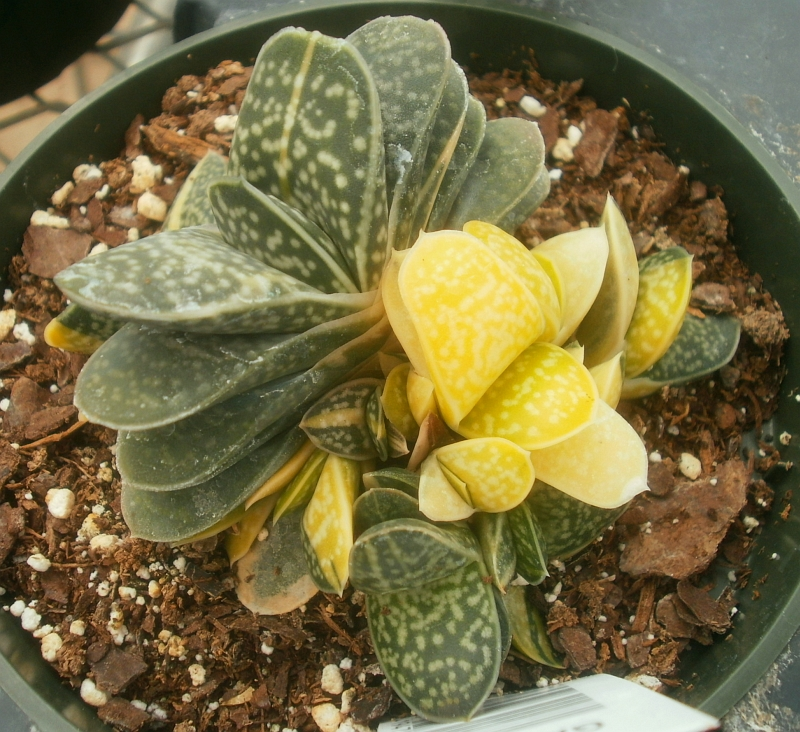
The "most part" link above goes to a post about buying a Huernia and Mangave at Reha's Greenhouses in Wellman, IA on April 7; they also had a noteworthy Gasteria, G. minima variegata:


Why didn't I buy it, too? I don't know. I like Gasterias, but I haven't had great luck with them overall. (Though the seedlings are still doing okay, thanks for asking.) I think it's mostly an overwatering issue.

The other two plants are unusual color/size versions of perfectly ordinary plants, witnessed at Frontier Garden Center (Cedar Rapids, IA) on May 16; unfortunately, Frontier's greenhouse and the time of day combined to turn all the photos orange. I have attempted to correct for this, but I wasn't wholly successful.

The first plant was, I think, a new variety of Dracaena reflexa, though it's possible that it's Dracaena deremensis, and it hardly matters since D. deremensis is officially D. fragrans, so I think we should just all be happy that it's still classifiable as a Dracaena and make a jump to the next paragraph before this one explodes into a fireball --

Whatever species it is, I haven't seen this variety before, and the tag didn't give a variety name. The leaves were shorter than D. deremensis 'Warneckei,' which it otherwise resembles, but not quite as short as D. reflexa leaves usually are, and I've never seen a D. reflexa with this coloration.


I didn't even recognize the last one at first, but I figured it out as soon as I happened to brush along the side of a leaf -- it's my good friend Yucca guatemalensis. The biggest one I have ever seen, to boot. (My best guess from memory and the photo is that it was about 4 feet / 1.2 m in diameter, maybe a little wider near the top.)


I'm not 100% sure that it's a variety I haven't seen before -- I do have a streaky gray cultivar here, the oldest of my plant acquisitions, but the color on the plant at Frontier was a lot more consistent than my plants, with a single, mostly uniform light stripe taking up the middle 50% or so of the leaf. At one time, I would have bought this without blinking an eye (it was even fairly cheap -- I can't read the tag from the photo, but I think it was somewhere between $30 and $40), but it was so huge, and I know I don't have room for a plant this size, so I had to leave it.


Thursday, October 24, 2013

Grab bag

Various recent plant- and fungus-related events:

1. Stapelia gigantea


Everybody else has been posting Stapelia pictures for the last month or so, but my plants have lagged behind for some reason: everybody else was posting flowers when I was just beginning to see buds.

So far, two flowers have opened, and there are another four or five left to go. As to the smell: I can't detect any just standing in the room with them. I can if I get right up next to them and inhale, though. Experiments to determine the minimum number of Stapelia gigantea flowers it takes to be unpleasant in a plant-room-sized room are ongoing; I'll keep you informed about the results.


2. Strelitzia juncea

I've finally obtained some Strelitzia juncea seeds, after a long period of wanting some but not finding any. I began with five seeds, which I planted on 19 September, and I noticed the first sprout on 18 October, which I guess is fairly rapid progress. I'd been warned that they were irregular germinators, and could take a few months to do anything, so I guess this is encouraging.


I'm not even sure why I wanted them in the first place; the existing Strelitzias here (2 S. nicolai, 2 S. reginae) are big and awkward to deal with, and it's not clear that S. juncea can even be grown indoors in the first place. But I'm still going to try.


3. Anthuriums, assorted

The Anthurium "hookeri" spadix is not showing any sign of having self-pollinated. Which is more or less what I was expecting to happen. Or expecting to not happen, I guess. It's still attached to the plant, though, and sometimes they take a while to show any obvious changes, so I haven't entirely given up hope yet.

There are also two new additions to the list of flowering Anthurium seedlings, #26 ("Peaches Christ," whom we've seen on the blog before) and #276 ("Zach Religious"). That's eight seedlings blooming now: 26, 59, 76, 108, 238, 243, 276, and 282. In case you needed some lottery numbers to play or something.1

Peaches' spathe is, so far, the same pink-red as "Bijoux Tuit" and most of the others, and is consequently not that interesting enough to warrant a photo, but the plant as a whole looks good even if the flower's nothing special.

Zach is possibly going to be the most interesting seedling yet; his spathe is a pale peach-pink with a red margin right now.

It's actually kind of unsettlingly close to my skin tone (below and to the left of the spathe), now that I look at the picture.

The color may change -- not only is it normal for developing spathes to get darker in color as they mature, but I'm not sure Zach's going to make it to full bloom. Some of the Anthurium seedlings do a practice inflorescence and then drop it before they make a real one in a different color,2 and there are some indications that Zach might be inclined that way. (Both "Dave Trading" and "Bob Humbug" did this too; maybe it's a guy thing.) In any case, I'm potentially excited about having some variety in color.

"Sal Monella" is both in the process of unrolling the spathe from its first inflorescence and in the process of producing a second bloom. If the second bloom is successful, then Sal would be the first of the seedlings to bloom twice, which makes him potentially valuable for breeding. Also nice: the spathe has remained a solid red red, not the pinkish-red of most of the others. It's not hugely different from the other five that had bloomed previously, but it's different enough to notice and be happy about.

(New inflorescence is just starting to be visible, below and slightly to the left of the one that's opening now.)

EDIT: I finished this post Wednesday morning, then found another two flowers in progress on Wednesday afternoon: #58 ("Betty Larsony") and #245 ("Sawyer Ad"). Sawyer's spathe looks more or less in line with Gemini and most of the other seedlings; Betty might be a little lighter in color but it's hard to tell for sure. In Betty's case, I believe she's trying to apologize. So that makes ten.

And no, I'm not going to blog about it every. Single. Time. one of the Anthurium seedlings produces a flower from now until the end of eternity. But I'm excited. Bear with me.


4. Unknown mushrooms


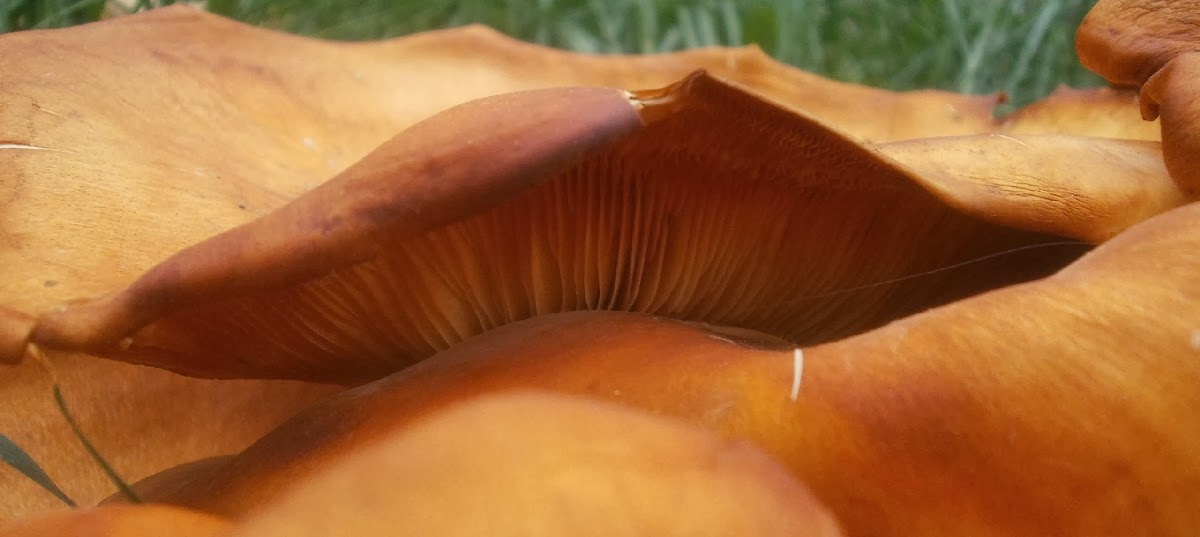
I happened on this group a while back and found the size of the clump impressive enough to photograph. I couldn't make an ID on the species, even with the pictures to go from and my copy of The Pocket Guide to Wild Mushrooms; my best guess is something in the Hypholoma genus but I emphasize that it's a guess.


The closest match in the book was H. capnoides, but the pictures of H. capnoides that come up in Google don't look much like my pictures or those in the book. And considering that the book is explicitly about edible mushrooms, and not all mushrooms are edible, there's every chance it shouldn't contain a photo of this particular mushroom in the first place. So I probably shouldn't even be guessing at an ID in public.


Mushrooms remain neat, though, even if they aren't plants.


5. Artiocarpus heterophyllus


Finally, an oddity at the supermarket: Jackfruit.


One could buy it by weight ($10/lb, which translates to $4.50/kg) or pay $30 (reduced from $35!) and get the entire fruit. (Which suggests that the whole thing was maybe only 4 lb / 1.8 kg to begin with. It sure looked a lot heavier than that, though, so I may be making some bad assumptions.) At those prices, for a fruit I couldn't have even guessed how to begin eating, I wasn't particularly tempted, though the informational sign next to it mentioned seeds, and that got my attention briefly.

-

1 Yes, I am aware that lottery numbers usually don't go that high, and don't usually have you pick eight numbers. But I'm not seriously suggesting that you play the lottery, so it all works out.
2 It's not really practice. But that's what it looks like. (If you object to plant anthropomorphization, what are you even doing here in the first place?)


Tuesday, May 28, 2013

Maybe not entirely missing from retail. . . .

I've been on the lookout this spring for the plants from last fall/winter's Missing From retail series, just to see how absent they really are. For the most part, the plants I said were missing around here still are, but there have been a few sightings.

I guess Cyperus spp. have been around every year and I just wasn't paying attention until this one, because I've seen them in two stores so far, one of which was the ex-job. If they've got them this year, they must have had them in previous years.

Cyperus involucratus 'Baby Tut.'

I've considered buying a Cyperus, though so far I've managed to talk myself out of it, on the grounds that they'll die the first time they dry out. But there's a great "person" possibility for profile-writing, so I might do it anyway, just so I can say I have some actual experience with the plant and write the profile.

I've also seen some Eucomis bulbs, though at Costco, not any of the local garden centers. I'm not sure what that means. I've been very, very close to buying those, too, and the only thing that's stopped me has been that they were initially $12 for 9 plants, and I wasn't sure I wanted nine more of anything, particularly not nine more of a plant that I wasn't sure would be able to grow in the first place.

Costco also had Crinums, I think. Not at all interested in those.

The ex-job has Cobaea scandens seeds.


I don't think I'm particularly interested in Cobaea -- everybody made it sound like more trouble than it's worth, and please note the small print on the package ("10' - 70' tall;" the metric equivalent is 3-21 m) -- but nevertheless, they exist, relatively close by.

There have been plenty of Bougainvilleas around town this year; either they've gotten more popular lately, or I hadn't been paying close enough attention before. I doubt many of the customers buying them are intending to grow them indoors, though. (Ditto for Catharanthus, Pittosporum, Fuchsia, Euonymous, Limonium, Acorus, Acalypha, Pentas, Nicotiana, and Liriope, all of which I've seen at least once this year.)

Shrimp plants (Justicia spp. and a few other genera) are showing up all over the place. They've never been completely absent, but I'm seeing new species and new forms this year. (For example: I saw a topiary standard shrimp plant this year.) Manettia luteo-rubra is showing up a lot more too, for some reason.

I've seen quite a few Dyckias in Iowa this year, mostly D. 'Raspberry Ice,' which I think genuinely is a new thing. I'm pretty sure I would already have fifty of them, if they'd been available in Iowa before this. I haven't bought any, because I'm not entirely sure I can grow them still. The first one I had died more or less immediately, and the second one has both survived for a full year and grown substantially larger, but I still don't feel like we've really reached an understanding.

Dyckia no-name F2 hybrid of 'Burgundy Ice,' as of last September. It's substantially larger than this now.

Faucaria spp. are here and there, though I have zero interest in them. (Too closely related to stuff like Lithops and Fenestraria.) Most of the ones I've seen this year have been at Reha's, in Wellman, IA. Ditto for Gibasis geniculata: they're around, mostly at Reha's, and I have no interest.


Faucaria sp. (pic is from a previous year, though)

And then finally, the ex-job had a couple pots of Russelia equisetiformis the last time I was there. They were much too large to pose a serious temptation, never mind the question of whether Russelia could be successfully overwintered indoors in Iowa, but they're neat-looking plants, even when not in bloom.

Russelia equisetiformis.


Wednesday, February 13, 2013

Walkaway: Euphorbia punicea

At one point, I said that I wanted a Euphorbia punicea, even though I hadn't seen one in person. Now I've seen one in person, and the $70 price tag makes me realize . . . that I can probably wait a few days before I rush out and buy one.


But the overall shape of the plant is really quite nice. And the flowers, individually,1 are great:


If perhaps not entirely in proportion to the rest of the plant.


So perhaps someday. Though I may need a little while longer to get over my poinsettia trauma first, 'cause E. punicea looks pretty similar.2 And Euphorbias have been pissing me off a bit lately, with all their fungus-having,3 so that's another hurdle to be jumped before I ever buy a E. punicea.

I'll just plan on admiring from afar.

-

1 Yes, I know they're not individual flowers, but are instead inflorescences (groups of individual flowers, surrounded by modified leaves called bracts). Nobody likes a pedant, you know.
2 The common name, "Jamaican poinsettia," is a nod to the resemblance, and possibly even to it being a poinsettia relative.
Shockingly, it really is from Jamaica. Common names working the way they do, this is the most surprising origin for a "Jamaican" plant I can imagine.
3 It's looking increasingly like I'm going to just have to dump all the Euphorbia miliis, and possibly also start the Synadeniums over from a single clean cutting of each, if I can find any clean cuttings. Things have gotten desperate enough that I skipped right over the baking soda cure to the chlorothalonil, and the chlorothalonil DIDN'T EVEN HELP. I mean, seriously, if I'm going to court kidney failure for a fungus cure, then it had better goddamn cure the fungus. Instead, you wouldn't even know I'd sprayed anything, to look at some of the plants in question. Seriously tempted to return it to the ex-job for a refund, and I never do that.


Monday, February 11, 2013

Grab Bag

Today, we have a few odds and ends that aren't a big enough deal for their own post, but are nevertheless sort of interesting.

1.


I don't think this is the first peloric Phalaenopsis I've ever seen in person, but it may well be the second. This was at the ex-job.

I can't tell if I like peloric orchids or not. I sort of feel like I ought to, but they make me strangely uncomfortable.


2.


Anthurium seedling # 198 ("Marge Hadron-Coleida") has an unexpected house guest (on the right, in the picture). I didn't plant anything else in there on purpose, and it's too small, so far, to make a definite ID, but my guess is that we're looking at a Murraya paniculata seedling. We'll have a better idea once it starts to grow some real leaves. (These are cotyledons, or "seed leaves.")

I'm not sure what to do about this. The Anthurium seedling is one of the few I've managed to get from my NOID purple-blooming plant, and as such is more valuable to me than the average Anthurium; at the same time, both the other Murrayas I've managed to propagate so far were lost in the Great Purge,1 so a chance to start over with a new Murraya seedling would be nice.

It's possible that both plants would be just fine if I separated them, but I'm nervous enough about it that I'm at least going to wait until I'm sure what the mystery seedling is before I attempt it. And I might not attempt it then, either. And odds are they'll both get scale and have to be thrown out before either one gets big enough to transplant anyway, so probably I'm getting myself nervous over nothing.


3.


I don't talk about Homalomena 'Perma Press' very often on the blog. Mine doesn't look great, though not through any fault of the plant's -- the problem is that it's bigger than the space I can give it, so the leaves aren't able to grow up properly, but instead grow up until they hit the shelf above them, and then sort of randomly snake along in whatever direction looks good. It hasn't helped, either, that 'Perma Press' got tangled up in the Monstera deliciosa one shelf over, so I occasionally ripped leaves when taking it out to water.

That being said, though, it's been surprisingly accepting of its situation so far, and looks better than it has any right to.2 And now that it's started a third growing tip, it might wind up filling in enough to be presentable in the future. Homalomenas have never done that much for me, but if this sort of thing keeps up, I may yet find myself respecting them.


4.


Some kind of miscommunication in the Petal Pigmentation Department, obviously. (Things haven't been the same since Sherri retired.)


5.


I don't know the name of this plant; it wasn't identified. It had a certain Seduminess to it, though, so that's my guess. (If you have reason to think otherwise, leave a comment.) The flowers are obviously not gorgeous or anything, but I kinda like 'em. And they coordinate well with the blog colors at the moment.

-

1 Technically untrue: there is a third, that went in the terrarium when I redid the terrarium planting. It's survived, but not really thrived, and is in the process of being overrun by Begonias, so I don't know that I expect it to last much longer.
2 As of last September:


I don't have an older picture to compare this to, because, I think, I was never certain that the plant was going to last long enough to be worth photographing. But I've had it since April 2009. At the time, it fit into a 4-inch / 10 cm pot; now it's in an 8-inch / 20 cm pot.


Saturday, September 8, 2012

Walkaway: Aechmea 'Little Harv'

This is one of those plants that I would have been super-excited about if I'd encountered it in, say, 2009, when I still had money and space and was collecting plants faster than I ever had before (or ever would again). But it was a solid 3 or 4 feet (0.9-1.2 m) across and cost $50, so there was no way.


These pictures don't match my memory of the colors very well at all; in my memory, the bracts were more violet and less orange, and the leaves were less green and more gray. Google sides with my camera, though, in both cases, so apparently neem fumes have damaged my brain or something.


There was a pup to the side of the main plant (in the first picture, it's barely visible to the left of and slightly behind the parent), which I thought about asking if they'd sell to me. The size thing would eventually be a problem one way or the other, of course. More sensible impulses eventually prevailed. Maybe someday.


Wednesday, May 9, 2012

Walkaway: Streptocarpus NOID

I realized, the other day, that I was about to run out of 3" pots for the Anthurium seedlings. (64 of them presently; there are at least that many more coming up after them, and probably twice that number.) So, when a trip to the Post Office turned into an unplanned trip to Iowa City on Monday, we stopped at the ex-job so I could buy 128 3-inch pots for Anthurium seedlings. Which is neither here nor there, but I mention it as a way of explaining why I was in town and saw this:

I know some of you have seen similar plants before, but this was my first Streptocarpus with a yellow throat, and I was impressed. Sadly, the best angle for getting pictures of the flowers was not the best angle for photographing the plant as a whole.

I didn't buy it because, whatever its positive qualities, it was still a Streptocarpus, and I don't think we'd get along any better now than we have before. But there are positive qualities, certainly.


Wednesday, April 18, 2012

Pretty pictures: Hatiora cvv.

I am becoming increasingly worried that the summer will be over before I get the official sell-trade list together. (This worry may make more sense once you see the post in question.) As a result, I'm announcing a semi-hiatus, which will last until I get that posted. (The "semi-" part is because some orchid posts are already scheduled.)

In appreciation for your patience, here are a couple photos of NOID Hatioras that I didn't buy from the ex-job.


Why not? Well, they were expensive: $10 for a 4" pot. Even if that weren't an issue, though, I don't think I should grow Easter cacti: it doesn't seem to go very well, and even the plants that survive and prosper don't rebloom. So it all seems kind of pointless, even if the flowers are undeniably pretty.


Friday, April 6, 2012

Walkaways Part 18

None of these are quite as unusual as the Tillandsia dyeriana, but I thought they were interesting.

Anthurium 'Sensa.'

(close-up of flowers: new on left, old on right)

Anthurium 'Sensa' is the one I most wanted to buy, which makes little sense, really, since I already have a lot of Anthuriums, including a couple with similar spathe colors. I just have a hard time resisting Anthuriums, I think is the deal. It's still a nice color, though, and Anthuriums are particularly tempting to me now because I'm trying to cross mine and start seedlings, so I see a plant with a newly-emerged flower and all I can think about is all the pollen it's going to be producing, and how desperately I must have said pollen.

Sedum indicum var. yunnanense, crested form

Plant List says that the actual name is Sinocrassula yunnanensis. This didn't do a lot for me, though I suppose I can see how someone might find it interesting. From the internet, I see the main use of S. yunnanensis is as a rock garden plant (they're hardy to zone 7, googlegedly), but I ran into a few pictures of them in containers. They apparently never do much more than this, forming little clumps of rosettes.

Dieffenbachia 'Delilah.'

This picture didn't turn out anywhere near as well as I'd hoped it would. (There's a better one here.)

I probably shouldn't try to grow Dieffenbachias. It's not that I can't: with a few exceptions ('Camouflage,' 'Sterling'), they grow fine for me, as long as I keep them out of direct sun and warm, dry air.

Instead, the problem is that after growing well for a while, they'll reach the point where they're too tall and leggy to fit in their spot, or they're always threatening to fall over, or they just don't look good anymore, and then I have to decide what to do with them. I don't have the patience (or experience) for air-layering, so I've always just cut them back and tried to root the tops. Occasionally this has worked, but usually it doesn't. And the stumps are supposed to resprout: occasionally that has worked, but usually it doesn't. (Some varieties seem to be better about rooting and resprouting than others: 'Tropic Snow' does well, as does a NOID that resembles 'Triumph.') So 'Delilah' is appealing, but I think I'm going to have to wait on getting more dieffs until I've figured out how to air-layer them.

Adromischus maculatus.

I had a bad experience with a plant I think was an Adromischus, a few years ago when the plant obsession was just starting up. It stayed alive, but the new growth was weak and pale and it was obviously not getting enough light, so I gave up on it after about five months. I could probably do better now, because although I don't have southern exposure, I do have artificial lights. Perhaps someday.

Guzmania NOID.

Same plant, from top.

Finally, a Guzmania coloration I haven't seen before, and think is really pretty. No ID tag, though. Of course.

The good news is that Guzmanias are pretty easy to keep alive. The bad news is that their strong will to live means I don't treat mine particularly well, so they're not very big and they've never rebloomed. (I know about the apple trick. I just don't think my plants are strong enough to bloom, so I haven't pushed.) This is a fascinating (to me) variety, though: I really like the white/black/orange combination.


Monday, March 26, 2012

Walkaway: Tillandsia dyeriana

It's occurred to me that there have already been a couple weeks when I probably could have mailed plants out and didn't, even though I wasn't expecting suitable weather for that until end of April / beginning of May. So, I'm trying to get prices set and photos done so we can go ahead and begin with the selling and trading. (You'll know when I'm ready to start mailing stuff out by the cold snap that will hit Iowa.1) I spent the better part of Sunday taking pictures; we'll see how long it takes to get them rotated / cropped / colored / etc.

Anyway. I needed 4-inch grower pots, perlite, and aquatic soil, so I went to Iowa City on Friday, where I saw the most interesting new bromeliad I've seen in quite a while:


Not that the foliage is so fascinating -- as you can (kinda) see, it's basically just a dull green, medium length, medium width kind of deal -- but the inflorescence is pretty striking.

(Particularly striking is how the pure white flowers turn nearly pure black when they die.)

It's apparently not a particularly difficult plant to grow, but I passed it up because it was priced at $20, and I have no positive past Tillandsia experiences,2 so it didn't seem worth it. Not that $20 for a 4-inch pot could ever seem reasonable, but . . . well. You know what it's like; I don't have to explain it to you.

-

1 Not really: you'll know because I'll put up a post about it.
2 I like T. cyanea in theory, and managed to keep one alive for five years, but it never grew very much, it didn't rebloom, it tried to offset a couple times but then the offsets died, and eventually it rotted out and died. My best guess is that it probably wanted more light than it was getting.


Friday, March 9, 2012

Walkaways Part 17

A few interesting plants from the ex-job:

Calliandra emarginata.

They were selling Calliandra emarginata as a bonsai (or at least a bonsish; I don't think they've ever had actual bonsai bonsai), which guarantees that I will never buy it, but it's an interesting plant. No clue what they're like to grow indoors; I don't even have any idea what they're like to grow outdoors.

Kalanchoe 'Fantastic.'

I've had mostly-bad experiences with the Kalanchoe genus in general, and consistently bad experiences with Kalanchoe luciae specifically, in the past, so this wasn't particularly tempting, but it was new (to me), and I can't argue that it's not a cool-looking plant.


I don't know whether this is K. luciae or K. thyrsiflora, and it appears no one else does either: Google results are split about 50/50. The tag, for the record, said K. thyrsiflora, not that that means much.

Loropetalum chinensis.

Loropetalum chinensis is another bons-ish; I include it here mostly because I'd never heard of it before and it's kind of pretty.

Polypodium formosanum var. cristatum.

I intend to try this plant someday. I've had some ups and downs lately with footed ferns (two of my three Davallias have taken a recent hard turn for the worse, over nothing in particular that I can see; one has died as a result), but Phlebodium aureum is one of my favorite plants, and Polypodium grandiceps seems to be working for me so far, so P. formosanum seems worth a try even so.

It's possible that the correct name is Phlebodium formosanum, not Polypodium formosanum; Glasshouse Works gives both names but appears to favor Phlebodium. If that's the case, then I'm even more interested.

Philodendron 'Pink Princess.'

Finally, Philodendron 'Pink Princess.' For most of the last few years, I haven't seen it for sale anywhere around here (I think I saw them at Wallace's once), and now all of a sudden the ex-job has gotten them on two separate shipments, as 6" (shown) and also as 4". It's an interesting-looking plant, but I'm not terribly interested in 'Pink Princess' because it's super expensive, and everything I've heard about it suggests that it's really slow-growing. The two things are probably related.

I don't remember what the ex-job wanted for the 4-inch plants, but it was definitely over $10, maybe something like $15. They paid a lot to get them in, I understand (don't know how much, but I know how they calculate these things, and the retail prices reflect wholesale), but $10 for a 4-inch tropical plant is never going to seem acceptable to me.