Showing posts with label Anthurium seedlings. Show all posts

Tuesday, February 5, 2019

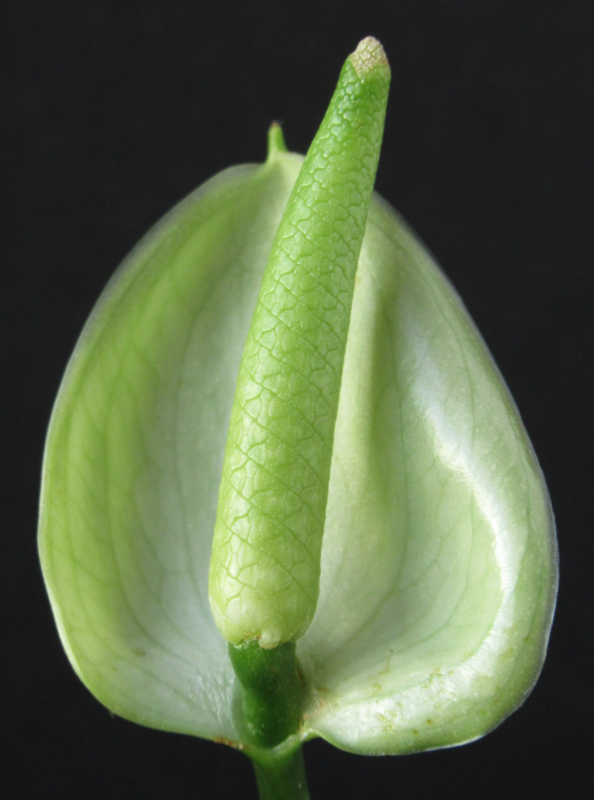
Anthurium no. 1733 "Jayyvon Monroe"

Jayyvon isn't doing anything bizarre that needs explanation like 1332 Alexis Gabrielle Sherrington or 1715 Tyler Linoleum; I'm giving him a post anyway because he's so pretty.


Seed parent is 0108 Deena Sequins, who herself was descended from the NOID purple, so that might explain the color. 'Krypton' could be in the mix somewhere as well: Jayyvon looks a lot like 'Krypton.'

The leaves are decent so far,


and the plant as a whole is a bit leggy (like 0108 Deena Sequins), but some suckering might happen if I up-potted, which would make it look better. So much to do, so little time.


That's kind of all I can say about this one. Sometimes you just have to let the pictures speak for themselves.


Not sure how many Anthurium seedlings are left to write about before we head back into the Schlumbergera posts. At least one.

You can understand why I might not be excited about getting back to the Schlumbergeras, given how long it took to get through them all last year. This year seems to have a more manageable number, though (thirty, so far). Maybe it won't be that bad.


Saturday, January 19, 2019

Anthurium no. 1332 "Alexis Gabrielle Sherrington"

And then I caught a cold, so there went another week. This year I seem to be catching every single illness that's going around: cross your fingers for me that the flu shot works this year.1

So. Alexis. Alexis is mostly notable for being a color combination that I wouldn't have guessed possible and have never seen before: green and orange.


Which more or less speaks for itself, I think. I mean, I don't have any explanation for it. The seed parent was 0334 Jean Poole, which is red / pink, about as opposite as you can get from green / orange:


So where did the orange and green come from? [shrug] The pollen parent, I suppose. But I don't know which one that was.

As with previous green-blooming seedlings (1419 Maya Douglas, 1720 Mado Lamotte), the intensity of the green fades as the spathe matures. This is the same bloom as the one above, three days later:


Not a huge difference, but it just kept getting fainter from there; by the time it died, it was basically just white. Didn't get a photo of that, though.

The foliage is surprisingly large and abundant, which may not actually be ideal for a flower that blooms green. One does want to be able to see the flower among all the leaves.


Some thrips scarring, too, which isn't ideal. I've seen worse, I suppose. Though thrips damage shows up really well on the spathes, which makes me sad.


I don't know that I'd call it beautiful, but this is the sort of thing I had been hoping for when I started growing out the seedlings. I was never going to see this in a store; it's cool that it exists. I'm actually surprised that it's possible: I don't think I've previously ever had an orange spadix that wasn't accompanied by a red, pink, or orange spathe. What other combinations might be possible that I haven't seen yet? White/purple? Green/purple? White/orange?

The Anthuriums, as I mentioned in the last post, are kind of falling apart on me: I ran out of room to keep expanding, and I haven't been culling the herd on purpose, so I have lots of seedlings in spaces too small for them to fit, and a lot of seedlings that really need to promote to larger pots but can't because there's no space for them. At some point, I do intend to rearrange them all and promote a few and so forth, and when that happens, Alexis is a strong candidate to get promoted to a 6-inch / 15 cm pot, but there's so much competition that I can't promise her anything.

In unrelated news: I happened to be in a houseplant-related establishment this week and saw a Dracaena marginata variety I hadn't seen before: the shape and proportions were the same as any other D. marginata, but the coloration was dark green with a yellow-green stripe down the center, more or less the same as D. reflexa 'Riki,' but on thinner, lighter leaves. I didn't take a picture,2 and I didn't buy it,3 but I still thought it was interesting enough to follow up on.

Best guess as to variety name: 'Ray of Sunshine,' per this, this, and this, though there's a 'Sunray' here that looks like basically the same thing. So much like the same thing, in fact, that I suspect someone's trying to steal someone else's patented plant by changing its name slightly.

-

1 According to the CDC website, the dominant strain this year is influenza A(H1N1)pdm09, the flu that caused the 2009-10 pandemic, which you may remember from all of the You Are Totally Going To Die Of The Flu stories you read that winter. My understanding is that it actually caused milder symptoms in most people than the average seasonal flu, but it also had the ability to infect cells deep in the lungs (normal flu viruses are limited to the nose and throat), and consequently resulted in a higher number of deaths among people under 50 than is typical, which is why the media freaked out so hard about it.
The vaccines available last fall were intended to protect against A/Michigan/45/2015 (H1N1)pdm09-like, so I'm not actually super-worried about getting the flu. It's just that I've gotten everything else, it seems like. Which is remarkable for someone who barely ever leaves the house.
Alarmingly, Wikipedia says that about 33% of people with influenza have no symptoms. (The source is this study, in which healthy volunteers were deliberately infected with the flu.) I wouldn't have imagined that that number could be so high. This is one reason why it's important to get the vaccine even if you "never" get the flu, or you've had it before but it was no big deal: if you get the vaccine, not only are you personally less likely to get the flu, but the people around you are also less likely to get the flu. I'll grant that getting a shot isn't as dramatic or emotionally gratifying as taking a bullet for someone or charging into a burning building to rescue a small child, but getting the flu vaccine every year may in fact save more lives. And we can safely assume that it's considerably more pleasant than either of those options.
2 I didn't have it with me, because the camera gets dust behind the lens so easily that I don't take it anywhere.
3 $25 for three plants in a 6-inch pot, which maybe isn't outrageous, but that's a lot of money to spend on a plant I don't even particularly like, new color variety or no. Show me a Yucca guatemalensis with this coloration and I'd happily pay twice as much, though. Not kidding.


Saturday, January 5, 2019

Anthurium no. 1409 "Ramona West"

From time to time, a seedling will do a little fake-out, making me think that I'm getting one kind of bloom and then actually delivering another. 0330 Faye Quinette was one of the first of these, producing a brown bud that became an orange spathe, and 1731 Robyn Millyonz was another (green bud became a beigey spathe), and now we have Ramona. This was the bud:


And here's what I got:


(And just to be clear that the sides really were different, here's a shot as the bud was opening that shows both at once:)


I'm not sure whether this was an intermediate stage in the process or looks green because of backlighting, but either way it's another photo so here you go:


Ramona isn't otherwise remarkable. One of two blooming seedlings from the 0594 Charity Case, the other being 1362 Jaymee Sexton. The foliage isn't terrible, but I'd be happier if the leaves weren't thrips-scarred at all:


And this photo makes the plant look a bit fuller than it actually is, but it's still of decent size, considering the pot (3 in. / 7.5 cm diagonal).


Not sure what to do with Ramona; the green / pink thing is interesting, but perhaps not quite interesting enough to keep. It'd help to make the decision if I knew whether it would do this consistently, but I've been very bad at taking photos of new blooms. (Bad at keeping up with the Anthuriums in general, actually. I think maybe I'm starting to lose interest? The ongoing thrips problem has ruined them for me a little bit.)


Sunday, December 30, 2018

Anthurium no. 1715 "Tyler Linoleum"

So now I'm faced with a sort of problem. It's a completely optional problem, but it's still a problem.

The thing is that there's a completely unreasonable number of unblogged Anthurium seedlings,1 and most of them are not interesting on their own, at all. I could possibly make them interesting by talking about some other, barely related thing and ignoring the seedlings entirely, but that's kind of exhausting to do, particularly if I have to do it dozens of times.

So the plan is to write about the five or six most interesting ones,2 and see how I feel about the others once I'm finished. This will probably take a while, because having a new computer means I can have new games, and playing video games is a lot more fun than blogging about Anthuriums, even interesting Anthuriums.3 But we'll see how things shake out.

In the meantime, right at the moment, we have Anthurium seedling 1715, which is simultaneously one of the weirder, prettier, and more information-rich seedlings in a very long time.


"Pretty" may or may not be obvious from the photo, but Tyler is consistently right on the line between red and orange, which I don't think I've ever seen before. Previously, they've always fallen pretty solidly on one side or another; the in-between color is really striking in person. There's also some green on the back of the spathes, like we've seen with 0330 Faye Quinette (who I suspect of being the pollen parent), which is unusual enough to qualify for "weird."


"Information-rich" comes from the foliage. You may remember that there's been a long-standing puzzle about seedling 0115 ("Erlene Adopter") and her clones (0580 Marsha Marsha Marsha, 0581 Adam All, 0586 Vera Special). All four of them, and none of the other 1500+ seedlings, will periodically and for no obvious reason go yellow at the veins, usually along the minor veins rather than the midrib or other larger veins. Sometimes it's only a couple spots, sometimes it's the whole leaf. It looks like this when it happens:


If I only had one Anthurium and it was doing this, I would assume a nutrient deficiency of some kind, but since I have lots, which are all in the same soil, all getting the same fertilizer at the same strength, etc., and only the ones that are clones of this particular seedling do it, I was thinking maybe it's genetic, or a virus or other disease which the original plant had, so all its clones did too.4

The virus theory's looking less likely now. I have thrips around, and thrips can transmit viruses, so if it were a virus, I should have seen this happen to other seedlings. But it's still only ever been the Erlenes.

And so now we have Tyler, whose seed parent was 0580 Marsha Marsha Marsha, and look at his leaves. Mostly they're fine:


And they don't get gradually worse over time, as far as I can tell. The yellowing happens,


and then it stays. Doesn't reverse itself, doesn't get worse. The below photo is the same leaf, about a month after the above photo:5


I mean, that might look a little worse because of differences in how the photos were taken -- the latter was more strongly backlit than the former -- but if you look, the spots haven't gotten bigger, and except for a couple along the leaf margin at the top left, which possibly just didn't show in the first photo because of reflection off the leaf surface, there aren't any new spots, either.

Occasionally the colors are much more dramatic.


So now the situation is that all the clones of one plant, plus the offspring of one of those clones, does this. Which looks like support for the genetic theory, though the only other surviving seedling from the Erlenes (1727 Mercedes Sulay) has normal green leaves that stay green. And also I don't think any of the Erlenes ever produced a leaf that looked like the one in that last photo: that's pretty extreme.

Tyler would have been a keeper regardless, for the bloom color and suckering, but as the Erlenes are pretty robust plants in general,6 and I'm interested in whether the leaf weirdness will be passed to a third generation, it's really really a keeper. I doubt it has any commercial value: even if it's not sick in some fashion, it looks sick, which surely wouldn't sell terribly well. But I want it around at least until I understand it.

-

1 "Unreasonable" = 35.
2 Definitely 1332 Alexis Gabrielle Sherrington; probably 1409 Ramona West and 1733 Jayyvon Monroe; possibly 0650 Phyllis Deen, 1438 Johnny Cockette, 1716 Tess LeCoil, 1718 Charo Beans DeBarge, and 1767 Constance Waring, depending on whether they still seem interesting to me later.
3 Dishonored 2 is incredible. There could be even more incredible games, I suppose, but my gaming tastes are very specific (single-player; realistic graphics or at least not blocky, pixelated graphics; interesting art; for shooters, I like stealth/nonlethal play as an option, if not the whole point of the game; multiple routes to the same end goal; high replayability), and Dishonored 2 sits exactly in the center of, like, all of them.
I've also recently gotten Prey, Thief (2014), Assassin's Creed, and Cities: Skylines, each of which fits my criteria at least a little bit, so I'm going to have something to entertain myself with between rounds of watering for a very long time. Though apparently the first Assassin's Creed is not great and I was supposed to have started with Assassin's Creed 2. I didn't know.
4 Also, for what it's worth, I have tried adding magnesium to the fertilizer, in the form of Epsom salt (MgSO4), and that had no effect. I don't have element-specific sources of other nutrients to try to add, but the fertilizer I use does contain most of the trace elements plants need: boron, iron, copper, manganese, etc.
5 (31 October 2017 vs. 29 November 2017, for the record.)
6 (with the exception of the ghost mites, to which they seem more susceptible than average)


Friday, September 14, 2018

Anthurium no. 1352 "Queen Bee Luscious"

Queen Bee Luscious is unusually difficult to photograph, because her spathes have a very pronounced saddle shape to them.


Or at least usually they do: the first bloom looked more or less normal. Except for the missing spadix.


As mentioned in the post for 1323 Kayla Stratus, QBL also has a lot of thrips damage, which is really disappointing.


On the positive side, she's produced a lot of blooms under nonideal conditions, and I feel like if the thrips weren't involved and she could consistently remember to make a spadix, I'd think of the inflorescences as "pretty." (As it is, the thought is more potentially pretty.)


The foliage is surprisingly unblemished:


And there's a decent amount of it (at least, there was last November when the photo was taken):


Though the internodal distance is a bit of a problem, as it was with 'Joli,' the seed parent. So I'll keep her, but she could also be doing better.


QBL is one of the seedlings in line to be promoted to a 6-inch pot the next time I have room to do that: maybe she'll handle herself a bit better once that's happened.

Side note about the blog: I'm probably going to have to slow down or stop for a little while after this post, as life has become a bit unmanageable again. Everything is fine; I just can't keep up.


Saturday, September 8, 2018

Anthurium no. 1720 "Mado Lamotte"

I've been teasing a green flower for a few posts now, and it's finally here. This is Mado:

26 November 2017.

Personally I think this is very pretty, though I suppose your feelings about green flowers may vary. Less attractively, the color changes over time, with the spathe getting lighter and lighter and the spadix getting darker and then abruptly changing to white.

29 November 2017.

This isn't the worst thing in the world, I suppose, and I actually like the spadix changing from light green to dark green to white, but I would have been happier if the spathe had held its color better, or gotten darker with age.

8 December 2017.

Also, as you can see, the thrips got to it a bit.

12 December 2017.

But whatever Mado's deficiencies, it's still a green/green. And it's a bit more solid than the previous greenest seedling, 1419 Maya Douglas, from a year ago. Mostly the problem with Maya is that she's only produced one inflorescence, so I don't know what a "normal" Maya Douglas bloom looks like yet.1

Mado hasn't bloomed again either, but it seems like it ought to be only a matter of time: the plant is large and vigorous, and only about two and a half years old, so I'm not worried yet.


And the leaves, individually, are nice. Not any thrips damage that I can see in the photo.


So Mado is a good candidate to get promoted to a 6-inch pot, if and when I can find space for a new group of 6-inch plants. Which may never happen. I don't know. I might wind up discarding some of the existing 6-inch plants, instead of creating new space: a few of them have been annoying me a bit.2

Mado's seed parent was 0234 Ross Koz. Just to refresh your memory, Ross looks like this:


I have no idea what pollen parent could produce green/green offspring from a purple-red / light yellow seed parent. Possibly 0330 Faye Quinette? Faye does make pollen, and there's some green pigment in her spathes. I'm pretty sure I never got pollen from 'Midori,' and in any case I think 'Midori' was already dead by the time Ross would have been pollinated for this seedling. But who knows.

Anyway. Obviously a keeper. Many of the species of Anthurium used for modern hybrids produce green spathes,3 so there's a sense in which it feels like moving backwards to make green blooms on purpose. But I don't care: this one's mine, and I think it's pretty.

The performer Mado Lamotte is from Montreal; I don't know anything about her besides what the Wikipedia article says.

-

1 I think Maya did produce a second bud several months back. It didn't get very far before being aborted, though.
2 (Looking at you, 0083 Carmen Adairya.)
3
A. formosum is pale greenish white to pale lavender, with a light yellow spadix that turns white at maturity.
A. hoffmannii is yellow-green / light yellow.
A. nymphaeifolium is (green or white) / (yellow or pale purple).
A. ravenii is light green / white.

The Anthurium-breeding book also includes photos of some hybrids involving other species, specifically A. cerrocampanense, A. garagaranum, A. lentii, and A. caperatum, without ever describing or photographing the species themselves, though the internet came through with some descriptions:
A. caperatum is pale green / pale green according to this site, though I couldn't find photos.
• The same source says A. cerrocampanense is light green to yellowish green with streaks of dark green or purple, with a green spadix.
A. garagaranum is an obsolete name for A. trilobum, and has pale green / yellow inflorescences. (A. trilobum also seems like it would be a really good species to use if you were trying to introduce some variation in leaf shape: as the name suggests, the leaves are divided into three lobes. (NOTE: aroid.org still considers A. garagaranum the correct name, so it's possible that it's been changed back, or was never officially changed in the first place. Trilobum does a better job of describing the plant, but garagaranum is much more fun to say and type, so I can't decide which name I want to win.)
A. lentii's spathe is green tinged with purple (ref.), and the spadix is purple.


Tuesday, September 4, 2018

Anthurium nos. 1304, 1691, 1480, 1353, and 1167

Another five seedlings today; I really like a couple of them even though they're not doing anything new.

Anthurium no. 1304 "Chanaile Solitaire"

Except for not knowing how to pronounce the name,1 this one is great. The spathes are large and lie more or less flat, and although the spathe color isn't unusual, the spadices are sort of orange when the spathe first opens. Which is a little bit new, though Chanaile's sibling 1224 Perry Watkins appears to have done it first.


The leaves are okay also. More or less free of thrips damage. I'm not a huge fan of the matte(-ish) texture, but I'm willing to trade a lot of qualities if it gets me thrips resistance.


And the new leaves may not be bright red or deep brown like some seedlings, but olive green is still acceptable.


The spathes do have a bit of thrips damage from time to time, but Chanaile is great, taken as a whole. I mean, the orange spadices alone would be interesting; the rest is a bonus.


So we're keeping her.

Chanaile is from sibling group DV (seed parent: NOID red), which also gave us 1299 Sinthia D Meanor.


Anthurium no. 1691 "Madison Hinton"

Madison's inflorescence isn't particularly impressive. I mean, it's fine, initially,


but the spathe flips backwards really severely as it matures, which makes it sort of useless to me. The foliage could be interesting -- it's at least got a very serious texture --


but the plant as a whole isn't doing much for me.


The most interesting thing about Madison is her seed parent: she's the second seedling from 0031 Sylvester to bloom,2 and the first of Sylvester's kids to make orange spathes. Which is something, but it's probably not going to keep her out of the landfill in the long run.


Anthurium no. 1480 "Lady Angelique"

Lady Angelique is another seedling notable more for her origin than anything she's doing on her own: she's another one from 0041 Anna Graham.3


She does have Anna's tendency toward tall, narrow spathes, and I suppose technically they're both pink (though Anna's pink was more interesting), but that's about it. The foliage is kind of distorted; I don't know whether this is from thrips or mechanical damage.


So probably not keeping Lady Angelique around for much longer either. Even if the execution were perfect, she's still just another pink/pink.


Anthurium no. 1353 "Krystal Stone"

Speaking of which.


This is, admittedly, a more photogenic pink than Lady Angelique. And while the leaves have some thrips scarring,


there are at least a lot of them. That's a really full-looking plant, for only a 3-inch (7.6 cm) pot.


Without the thrips damage, this could be worth keeping around. I think I lean toward waiting to see what the second bloom looks like.

Krystal's seed parent was 0273 Wes Coast, whose offspring I discussed in the post for 1356 Regina Cartier. There, I said that although Wes was pink/pink, none of his surviving seedlings had been pink/pink. And now that isn't true anymore.


Anthurium no. 1167 "Lucy Balls"

Finally, there's Lucy, who is the sibling of 1153 Tintim and 1256 Mr. Completely and is actually really nice:


I mean, I suppose "really nice" is debatable. But the color combination pleases me, and the general shape and proportions of the spathe are fine. The leaves and spathes both have some thrips damage,


and the stem is leggier than I'd like,


but it photographs reasonably well, and looks better in person.


There have been similar color combinations before, but when I went looking through the gallery to see which ones they were, I noticed that most (all?) of them have died or been discarded. So I'm inclined to keep Lucy for the sake of completeness, if nothing else.

I also have some more hummingbirds to show you, and don't feel like making a separate post for them, so I'm going to throw them here.

I already had a hummingbird/corn tassels picture, but this one shows off the green iridescence better:


And this was decently in focus so why not:


Finally, on 31 August, I went out with Sheba in the morning and noticed that there were multiple hummingbirds. Which hadn't happened before. After the earlier post, I had spent some time reading about ruby-throated hummingbirds on-line, and one of the things that all the sources emphasized was how territorial they were, so I figured I would only ever get to see one at a time. But on Friday, I'm certain that we had three at once, and I'm even pretty sure there were four. They didn't stand still long enough for good multiple-bird pictures -- mostly it looked like there was a dispute about who owned the Cannas, so they spent most of their time chasing one another away -- but I did get blurry evidence of at least two at the same time.


So now I'm obsessed with hummingbirds.

Less photogenic, but -- I've been surprised by the number of bumblebees this year. We've seen them occasionally in previous years, but this year they're all over the place.


It's surprised me, because I was under the impression that bumblebees barely even recognized red flowers as flowers; I thought they were very particular about blues and purples. I've personally never detected a scent from our Cannas, but maybe there is one? Or maybe I was just misinformed, and bumblebees are happy to take nectar from red flowers? There are lots of species of bumblebee, so maybe the purple-flower thing only applies to some of them. I don't know. In any case, seeing all the bumblebees feels good too.

-

1 Taken from a real (but deceased) performer; I imagine there is probably a video out there somewhere which includes a pronunciation, but it turns out that I don't actually care that much how to pronounce it since I'm probably never going to have to say the name aloud.
2 (The first was Madison's sibling 1685 Betty Bowers.)
3 (The first being 1317 Calpernia Addams.)