Showing posts with label random plant event. Show all posts

Saturday, October 20, 2018

Random plant events: Leuchtenbergia principis, Zamia furfuracea

Everything was going fine, and then it was time to dig up the Cannas and bring them in for the winter. And you've seen the Cannas.1

As of 18 October, direct-weighing on a bathroom scale has given us the approximate figure of 787 lb. (357 kg) of Canna rhizomes brought inside for the winter, and we haven't even dug them all up yet.2 My best guess is that another 200-300 lb. (91-136 kg) remain to be dug up.

Meanwhile, one of the Leuchtenbergia seedlings has decided to bloom, in the basement, under artificial lights. I'm surprised that this is even possible.


The seedling in question was sown on 8 May 2013, so it's about five and a half years old. In some ways that feels like a really long time to wait for a bloom, and in other ways it feels incredibly fast. (It's not as if Leuchtenbergia is known for its speed.)


Also, I purchased four kinds of seeds from seedman.com at the beginning of September. Three of them are sort of disappointing. There's nothing at all going on with Chamaedorea cataractum, and one of the six seeds in that package was rotten when it arrived, so I kind of suspect that was wasted money. A few seeds of Ficus religiosa and Ficus benghalensis have germinated, but they're developing slowly and I'm not optimistic about getting actual plants of either one.3

But the fourth one, Zamia furfuracea, is doing more or less what it's supposed to.


I have germination on eight of the ten seeds so far, and it's only been four or five weeks (the first seed to germinate, photographed below, took 26 days; the package instructions said to allow "several weeks to a few months"), so I'm hopeful about the other two.


Not that the Zamias are much to look at so far. But still. It's something.

I have no idea when I might get back to regular posting again.

-

1 (Well, some of the Cannas. There were a lot of Cannas.)
2 Also, this omits a box with about 35-40 lb. of Cannas that we just gave to a total stranger because he stopped at the house and asked. (He knew we had them because we piled all the cut stalks on the curb, in hopes that the city will eventually take them away for us, and the pile was kind of . . . unmissable, I guess is the word.)
3 Though you never know. I tried F. religiosa once many years ago, and got at least one plant that survived long enough to develop some leaves. It didn't transition to a pot well, probably because I was asking it to go too long between waterings. There's probably a reason people don't normally grow these species indoors anyway; I just thought it might be fun to try. (It hasn't been.)


Tuesday, November 14, 2017

Random plant event: Cyperus alternifolius

This is sort of two random plant events in one, actually. The first is that the Cyperus alternifolius plants in our east window started to bloom about a year ago.


I mean, that photo is from January, but I assume it had been going on for a while before I got around to taking the picture. In any case, I was surprised that the plants would do this indoors, and even though the flowers aren't particularly beautiful, it was interesting.

I was less happy about it by the summer, because the flowers were kind of messy, dropping a fine dust all over the place that might have been pollen and might have been dead bits of the flowers; I couldn't actually figure out what it was from looking at it. Mainly I was just irritated with the dust, because I was having a bit of a ghost mite problem on some of the nearby plants, and the dust made it hard to see whether I had ghost mites or not.

I'd gone in with the paintbrush and kind of randomly brushed flowers around a couple times, just to see what would happen. Nothing changed in any kind of obvious way, so I concluded that my technique or timing or something had been wrong.1 Then at some point this fall, I discovered scale on the Cyperus and dealt with it by cutting down all the leaves. I'd wanted to see what the plants were going to do in the end with the flowers, but stopping a scale infestation is more important.

But then in early November, I noticed these:


So it would appear that at least some of the dust the plants were throwing everywhere was probably made of teeny-tiny seeds. And now we know it can be done.

As far as I can tell, the scale problem is over. At worst, it's been much reduced.

Meanwhile: some of the new camera's photos have already been added to the Schlumbergera gallery post, if anyone cares. 208A Raspberry Possum's new photo is worth checking out, in particular.

-

1 (And in any case Cyperus is so easy to propagate from cuttings that it seemed kinda silly to worry about growing them from seed. It's always interesting to see if that sort of thing is possible, but worthwhile is another matter.)


Thursday, June 22, 2017

Random plant event: Clivia miniata

In October 2007, Wonderful Co-Worker (WCW) gave me a Clivia offset. It looked like this:


I knew it was too small to bloom, but I like Clivia foliage anyway: it didn't matter to me whether it ever got around to producing flowers. And at this point you can probably tell where this post is going, so . . .


I don't know why it decided to bloom this year: it spent the winter near a window in the plant room, and I know cooler temperatures are necessary for Clivias to set buds, so that might be related, but on the other hand, it's been in the same general part of the plant room since we first got the plant room set up, however long ago that was (2010ish?). For several of those years, it lived on the floor in the corner of the room, which was surely cold enough in the winter, but might have been too dark. I don't remember how long ago it was moved up to a shelf, where it gets some direct afternoon sun, but that might have done the trick too.


Or, possibly, the plant was just picking up on the recent, much more Clivia-friendly vibe in the house since February.1


In any case. The plant's only been an actual problem once: it got scale this winter. Hand-wiping the leaves, plus dosing the plant with imidacloprid, seems to have solved that problem. There has also been some thrips damage, which isn't quite a problem, but is still irritating. (The petals are too thick for the thrips to do deep damage, and it's not particularly visible from a moderate distance away, but I'm still not happy about it.)


I've tried to spray the flowers with soapy water and then regular water, once. It didn't completely eliminate the thrips, but it does seem to have helped, a little. I'd do it again, except the rinse cycle snapped a petal off one of the flowers. Not that one petal is that big of a deal, but between that and worrying that I'll wash all the pollen out of the flowers and be unable to pollinate them, I'm probably not going to try it again until the flowers are nearly spent.


Thrips-related disappointment aside, I've been really happy about the flowers. I sincerely do like the foliage for itself, and sincerely don't care all that much about whether the plants flower, but they're lovely, and it's been such a long wait that I rarely even thought about it as a plant that was capable of flowering. So the flowers have been a nice surprise.

They are, alas, not terribly long-lived -- I first noticed the buds on 5 June,


the first flower was open on 7 June, and the first flower started to shrivel and die on 16 June. As I write this, it is 18 June, and there are still three buds on the stalk that have not yet opened, so there should be something still there for another couple weeks, but the blooming process seems to zip by really quickly. Probably I'm just spoiled by the Anthuriums. In any case, having accidentally figured out how to get flowers once, perhaps I won't have to wait a decade for it to happen again.

-

1 May as well do a seedling update while I'm here, I guess. The February batch started with 77 seeds. Some failed to germinate, some germinated but then died, some started, barely, to germinate and then stopped growing. I currently have 64 seedlings from that group, officially (photo below), 61 of which have produced leaves, and I'm thinking the other 3 seeds are going to be thrown out pretty soon.


There were 65 seeds in the May group, and I was getting kind of worried about them toward the beginning of June, because it felt like they were germinating more slowly than the February group did, but I think the problem was that I had unreasonable expectations, not that the seeds germinated more slowly. Looking at the records I have, the February batch was sown on 7 February and potted up on 31 March (52 days later); the May group was sown on 4 May, and 52 days after that would be 25 June. It's totally plausible they'll be potted up by then, or at least that they ought to be.
Of the 65 May seeds, it looks like 61 have germinated, so if the same proportion survives, I should wind up with 51 or 52 plants from the May batch by 12 September. Which is a lot of seedlings, obviously.


Friday, May 19, 2017

Question for the Hive Mind: Hippeastrum NOID

A reader sent me this photo of a bloom stalk on their unidentified Hippeastrum.


That sure looks like the plant is building full-sized leaves under the flower buds. I did an image search that turned up a few sort of similar things, but I didn't find any photos that showed anything quite as large and leaf-like as this. Most of the Hippeastrum photos out there don't show anything remotely leaf-like at all.

So I guess the question for readers is just, what exactly is going on here? I know what it looks like -- it looks like this plant is trying to build a plantlet on its bloom stalk, like it's a Phalaenopsis or Agave or something -- but that's not something Hippeastrum actually does, is it?


Sunday, October 30, 2016

Random plant event: Schlumbergera x buckleyi seedlings

Out of bloom, most commercially available Schlumbergeras look more or less identical.


Approximately rectangular, with a deeply serrated margin. We've all seen it.

(The above photo isn't of my seedlings, but it may as well be; that's what their parents looked like, and that's what they look like too.)

So I was curious about what the seedlings from Schlumbergera x buckleyi were going to look like, since buckleyi has several traits that distinguish it from the others: the notches in the stem segments are very shallow, the margin between the notches are rounded rather than coming to a sharp point, the overall segment shape is narrower (sometimes with a triangular base), and the habit of the plant overall is much less upright than the S. truncata hybrids.

This photo was originally taken to highlight the shape of S. x buckleyi fruits, but it works well enough to show segment shape. For what it may be worth to you, perfectly round, smooth fruit is more the exception than the rule, and a number of my seedlings can make "ribbed" fruits like this, though most of the seedlings that do this make 'em round sometimes and ribbed other times. As far as I've seen, buckleyi fruits are always ribbed.

The 28 buckleyi seedlings I started in March 2015 are now producing mature new growth, and it's pretty easy to tell the difference between a group of them and a group of other seedlings of different age, though some of the buckleyi seedlings overlap the others enough in appearance that I don't know that I could accurately pick out the 10 buckleyi seedlings in a group of 30 seedlings.

Top row, L-R: 261, 263, 270
Second row: 273, 274, 275
Bottom row: 260, 268, 276, 277
(It may help to view the photo full-size.)

As you can see from the picture, they're all making attempts at marginal serrations, similar to x buckleyi, though the shapes vary. 274, 260, and 268 have scalloped (crenate) edges, that make the segments look something like a child's drawing of a cloud; most of the others are half-assing it, putting occasional slight waves in the margin without a sharp indentation. They also mostly take after x buckleyi in having longer, narrower segments than usual.

I haven't investigated whether the drooping habit is inherited or not; most of them are still small enough that they'd be upright even if genetically programmed to droop.

Buckleyi's bloom color is nice --


-- and I will be excited to see whether it transfers to any of the offspring, but they'll have to bud up first, and there's a substantial obstacle in the way of that happening. Buckleyi is exceptionally picky about having long, perfectly dark nights, and will not set buds otherwise. In some years, I've gotten no blooms at all from my two buckleyi plants; last year I got maybe ten flowers overall, mostly in the spring,1 and I had to put the flat on a low shelf in the plant room, remove an artificial light from a couple shelves above, and pile up a bunch of plants in front of the buckleyi to block the light, in order to get even that many.

So far, only three of the buckleyi seedlings have moved into the plant room (#s 256, 271, and 272), and none have tried to bud yet. This doesn't necessarily mean that they're going to be fussy about dark nights too -- only about a third of the seedlings capable of producing a new first bud have done so,2, 3 and it's still very early in the season -- but it's not an encouraging sign, either.

In any case. I don't necessarily like the stem segment shapes from this group of seedlings (though 268, one of the "cloud" ones, is intriguing), but they're distinctive enough that I'll probably be able to tell if x buckleyi was the pollen parent for any of the future batches of seedlings. Which will be nice.

I'm thinking about trying to make deliberate crosses this year, if I can figure out how to identify which are which: I have so many random crosses from last year that I don't even have space to start all of the seeds, much less enough space to pot up all the seedlings that result,4 so I either have to switch to specific, deliberate crosses, or convince the husband to add a second basement.

Finally, I wanted to share this picture of seedling 354, because I was impressed with how much branching it thinks it's going to be doing:


354 is a second-generation seedling (seed parent: 082A Strawberry Madeleine), and the photo was taken when it was about two weeks shy of being a year old.

-

1 Though x buckleyi tends to bloom later in the year than the S. truncata hybrids, and is therefore more deserving of the name "Christmas cactus," they don't have to bloom in late December. The few dated photos I have of mine are from 27 November, 1 December, and 15 February, and I'm pretty sure that my buckleyis were blooming late into the spring last year, after most of the other schlums had stopped. I just wasn't taking their pictures anymore, because by that point I was pretty sick of taking Schlumbergera pictures.
2 By contrast, it seems like all of the seedlings that bloomed in previous years have budded up already; as I write this on 27 October, three have even opened a bloom already: 025A Clownfish, 034A Wahine, and 082A Strawberry Madeleine. Two more (033A Clueless and 057A Pyrotechnic) will have a bloom open by the time you read this.
3 Of some interest, perhaps: one of the second-generation plants (seedling 239) is budding. Its seed parent is 025A Clownfish; I have no idea what the pollen parent was.
4 A very rough headcount of all the Schlumbergera berries suggests that I probably have about 125 ripe berries at the moment. Each berry produces an average of about 80 seedlings (also a pretty rough guess). That means that I have something like 10,000 potential seedlings from ripe berries, on top of the 2000 or so seedlings still in the germination containers.
With the Anthuriums, it's been (somewhat) possible to cross them randomly and start every seed I get (though I'm actually starting to get picky about which seeds I sow and which I let wither on the spadix), because a lot of the seeds fail to germinate, or the seedlings die or are discarded for one reason or another, each individual bloom doesn't produce very many seeds (The record is 121 on a single spadix from 0239 Russ Teanale; average seeds per spadix is closer to 20-25.), and each individual plant doesn't produce that many blooms. None of those apply to Schlumbergera, which virtually all germinate, live forever once germinated whether I pot them up or leave them in the germination containers, produce many seeds per bloom, and bloom several times per season.


Saturday, October 22, 2016

Random plant event: Aechmea 'Del Mar'

Here's something considerably more cheerful than the last post. About once a year, it seems like, some plant takes it upon itself to bloom when I'm not expecting it. The Hatiora salicornioides in 2009, Eucharis in 2010, Clivia and Epiphyllum in 2012, Phalaenopsis in 2014. In most of those cases, that's also the only time they've ever bloomed for me.1

The 2016 surprise bloom is Aechmea 'Del Mar,' a plant I have had since 2008. The original plant died, but it offset, and the offset survived years of frankly-not-great conditions and then decided to grow a flower spike.


This year's bloom looks different from 2008's (specifically: the colors seem a bit less intense), which I attribute to the lower light it's been getting here. It was already in bloom in 2008 when I bought it, so that inflorescence had formed in some tropical Floridian shadehouse, under basically ideal conditions; this one had to work with what light it could get from an east window.2 And not even the full exposure of an east window: it's so big that the only place I can keep it is up near the ceiling. Basically no overhead light at all.

Also shown: Neoregelia 'Ardie' (left), Philodendron 'Golden Emerald' (lower left), Anthurium 'Pandola' (right).

I'm honestly not sure why I was even keeping 'Del Mar' around. The leaves are plain green and of basically no ornamental value. The leaves are edged with marginal spines that are sharp enough to leave marks on me (which then usually itch for a couple hours3), and more often than not, after I move the plant for any reason, I wind up with a few of those spines broken off somewhere in my hands or arms and have to dig them out with tweezers. It was top-heavy and off-balance (at least partly from the side-lighting), and from time to time when I was putting it back on its shelf, it would fall over and dump water out on me. I had no expectation that a rebloom was possible, especially given how long I'd been waiting. In the final tally, I suppose it was just doing too well to throw out. I could justify discarding a plant that was obviously miserable, but aside from dropping the occasional leaf, which I expect all plants to do from time to time, 'Del Mar' never complained. Never really occurred to me that throwing it out was an option, even as I cursed the marginal spines.


It's almost like it knew that in October, we would all be sick of Anthuriums and desperate for anything else to look at.


Other sites allege that the inflorescence can hang around for 5 to 7 months; this seems about right. The 2008 bloom hung around for what seemed like a really, really long time; it could plausibly have been 5 months.

I don't always have the best luck getting bromeliad offsets to root for me, but I expect I'll try doing it again.


Final note: Aechmea 'Del Mar' is, according to its patent, a hybrid of Aechmea fendleri and Aechmea dichlamydea var. trinitensis. The general shape and coloration seems to be from A. dichlamydea, with A. fendleri contributing a smaller size, though 1) genetics doesn't really work like that exactly, and 2) this is speculation based on less than 10 minutes of online searches, so don't hang your hat on it.

-

1 The sole exception from those examples is the Eucharis, which has bloomed several times since 2009, though it doesn't do so on any kind of predictable schedule.
2 I'm not positive that the 2008 bloom received ideal conditions before I bought it; some on-line sites show much darker inflorescences than mine had then, with considerably less white, and a much darker pink. The patent-holder's website shows a 'Del Mar' that looks a lot more like my plant than those, and you'd think the patent holder could keep them straight if anybody could, so it's possible that the other sites have mistaken 'Blue Tango' for 'Del Mar.' Or maybe the cultivar is just that variable.
My plant's inflorescence has developed a heavier pink coloration as it's developed, with the photos from 16 October (last two in this post) showing a much lighter, yellower color than the photos from the 19th. I have no idea what colors it might bear when it fully matures, nor when this might happen. I'm keeping an eye out for the true flowers (the whole colorful show I've photographed so far are just the bracts, the brightly-colored bits meant to attract pollinators to the actual flowers), though I may or may not get pictures of them.
3 Also a problem with plants having similar defenses, like Neoregelia, Yucca, Dyckia, Agave, Pereskia, and Pandanus. I itch a lot on alternate Sundays, which are both Aechmea- and Pandanus-watering days. I've thought about long sleeves, but I think they'd cause more problems than they solve.


Monday, July 4, 2016

Pretty picture: Dendrochilum latifolium / Random plant event: Amorphophallus konjac

Most of the photos of this plant I found on-line show the flowers closer together than on this particular specimen. I don't know if this is significant or not, but it seemed worth noting. The species naturally varies a bit, and D. latifolium has at least two natural varieties (D. latifolium var. latifolium and D. latifolium var. macranthum, so the difference could be genetic, cultural, or both.


Though the individual flowers aren't particularly beautiful, the sheer number of them is striking.


In other news, one of my five Amorphophallus tubers has pushed above the soil line, finally. They're all running very late this year, which makes me either anxious or angry or both, depending on how responsible I feel for the delay.


I've also recently discovered the Amorphophallus offerings at Plant Delights Nursery, and am very tempted by A. henryi and A. ongsakulii in particular. Any readers have experience with either of these?

Failing that, would anyone like to try to reassure me that the rest of my A. konjac (plus one A. bulbiferum) bulbs still intend to do something?


Friday, May 27, 2016

Unfinished business: Polyscias fruticosa

So I told you a while back that the plant collection had done one thing that made me happy during the previous three months or so. This is that thing.1

A quick recap of the Polyscias saga so far:

At the end of last May, both my original Polyscias fruticosa and the plant I started from a cutting of it bloomed. I tried to pollinate the flowers, not knowing if it was self-fertile, and got berries. Started the seeds from those berries on vermiculite in late September. To my surprise, the seeds began to germinate in mid-October, and the first seed leaves were visible in early November.

And then I stopped blogging about them, but they continued to do things. Eventually it started to become a problem to keep the vermiculite moistened, so I potted up the sturdiest-looking eleven seedlings on 12 January.

I hadn't been very optimistic about the seedlings. I've never actually done this before with Polyscias, and it's not like I really need more of them. I thought the best case scenario was that I'd get five or six that I could sell at the consignment store or on Craigslist or something, ideally before they got huge.

Instead, all eleven survived. Here they are on 3 February, looking a little yellow:


In March, with all eleven still intact, it started to become apparent that something unexpected was happening. They were starting to diverge in appearance a little. Young leaves aren't necessarily representative of mature foliage, but it got my attention. 11 March:


By April, it was clear that something was up. As each new leaf appeared, the seedlings weren't all converging on a standard "Polyscias fruticosa" form like I'd expected: instead they were getting more and more distinct from one another in leaf shape, size, amount of branching, etc. And I started to get a little excited. 4 April:


By late April, it was official. Not only were they consistently different in appearance from one another, but they were distinct enough that some of the plants were individually recognizable.

Here are shots of individual leaves2 from the eleven seedlings, arranged in order of decreasing fluffiness.3

Seedling 01

Seedling 04

Seedling 05

Seedling 03

Seedling 08

Seedling 06

Seedling 11

Seedling 07

Seedling 02

Seedling 09

Seedling 10

The appearance of the individual seedlings sort of logically follows from the appearance of the leaves, so I'm not sure I actually need to show you the entire plants, but I guess in the interest of completeness, and because I have comments about a few of them, I may as well. Same order:

Seedling 01

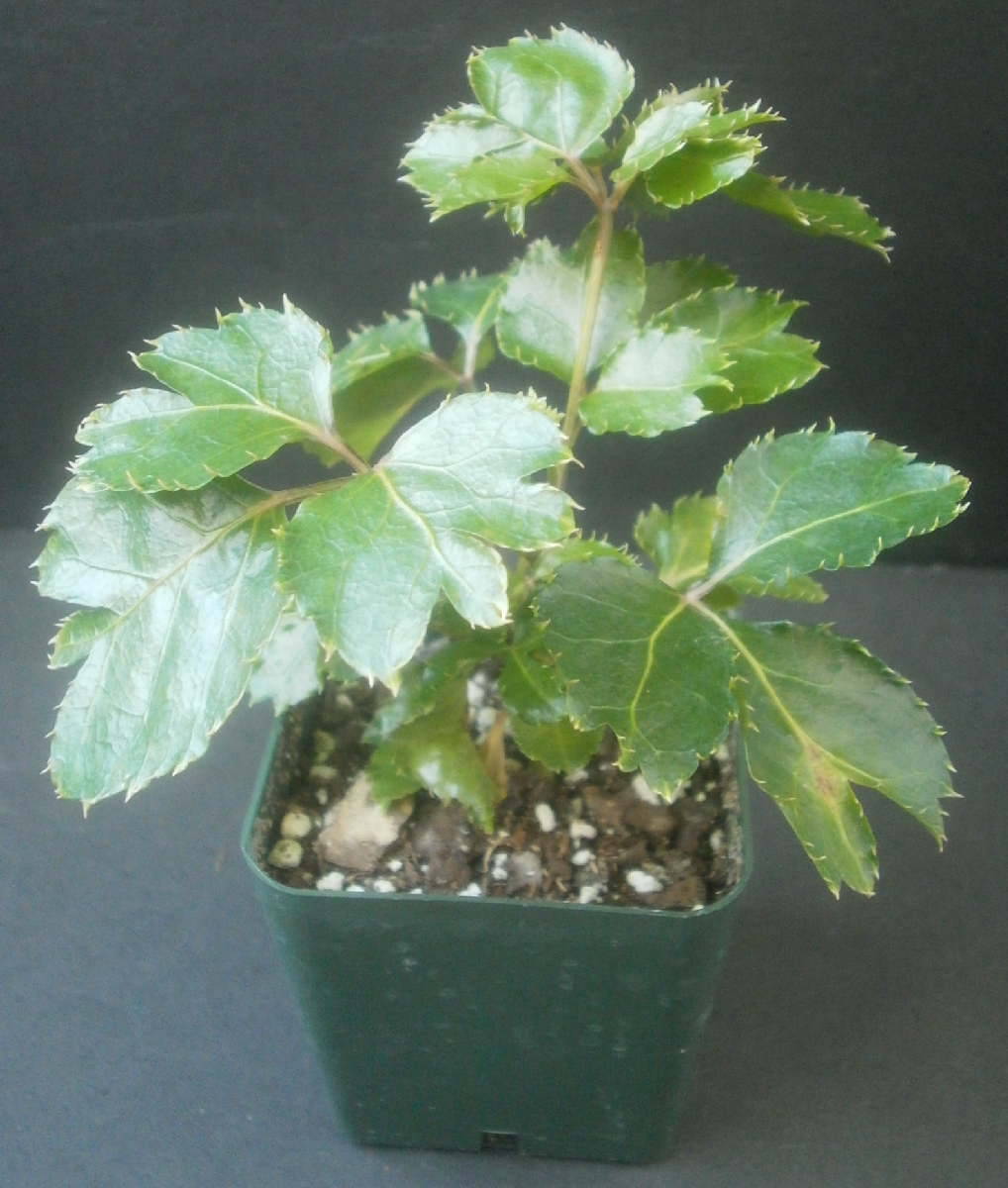
Seedling 01 is a monster. The leaves keep getting bigger and more complicated. It's also one of the taller seedlings, though I realize you can't tell that from the photo very well, because of the angle. The veining is also a lot more prominent than on most of the other seedlings, which doesn't mean a lot, but gives the leaves a sort of striped appearance close-up. Which is sort of attractive.


Seedling 04

Seedling 04 is also producing really substantial, three-dimensional leaves, and since this photo was taken, it's also started to branch. (I think technically you can see the beginnings of the branches in this photo, down low on the stem, but they're more obvious now.)


Seedling 05


Seedling 03


Seedling 08

Seedling 08 is also very distinctive because of how narrow all the leaflets are. I don't find it especially appealing, but I can pick it out of the crowd: 08's the one that looks like a tangled mess. It's possible that it will have some redeeming feature, like being unusually durable or whatever.


Seedling 06


Seedling 11


Seedling 07


Seedling 02

Seedling 02 is either my favorite or second-favorite, along with seedling 01. Doesn't actually look that much like holly, but it nevertheless makes me think of holly.


Seedling 09

It's pulling out of it now, it looks like, but seedling 09 is the only one that's ever seemed to struggle at all; I'm not sure exactly what's wrong with it, but all the leaves suddenly developed yellow-brown spots, more or less evenly-spaced, and the leaf in front, the really yellow one, dropped off. I'm assuming that I overwatered; the spots are plausibly edema.4


Seedling 10

Seedling 10 is very short but also very thick: one of the first seedlings to start branching. The two things appear to be related. It's like there's only so much vertical growth possible, so the ones that branch tend to be short, and the ones that don't branch wind up tall. Which makes sense, though seedling 04 is both tall and branching, so it's maybe not a firm rule.

So . . . how to explain this, then. I'd never had any reason to suspect that my plant was anything other than a regular old Polyscias fruticosa, and yet a wild-type species plant, crossed with itself, shouldn't give offspring this varied, should it?

It's possible that my parent plant is a hybrid -- I don't know for sure that Polyscias species can hybridize with one another, but I don't know that they can't, and there are other species in cultivation,5 so surely someone has tried before. Searching for "polyscias hybrid" turns up pages where both words appear, but the sites all appear to be using "hybrid" interchangeably with "cultivar" or "variety;" there's no "_______ is a hybrid between P. _____ and P. ______" anywhere.

It's also possible that maybe P. fruticosa produces a lot of sports and/or is naturally variable, like Rhynchostylis gigantea, and all of them have the potential to produce variable offspring. In any case, I'm surprised, don't know how this happened, and am finding it kind of a fun puzzle.

As to whether any of them might be special enough to try to propagate on a larger scale, or patent, or whatever, well, it's still really early. They're only eight months old, and haven't even broken my heart yet,6 so let's don't go counting chickens. But I'm really interested in seedlings 01 and 02, especially 02, and I think I can safely assume that they'd propagate true from cuttings, so . . . maybe someday.

-

1 I'm also pleased to be able to report that there have been a couple other things: first, the previously-mentioned Anthurium seedling 0805 Triana Hill has opened a first bloom, and it actually is pleasant, as I had hoped. (Not wildly different from anything we've ever seen before, granted -- very similar to 0097 Colin Ambulance -- but still pretty and unusual.)
Second, the Neofinetia has bloomed again, which is less earthshaking this year than last, but I appreciate it anyway.
2 Whichever leaf was largest and newest, for each seedling.
3 A technical term. I don't have a fluffimeter (fluh-FIM-i-ter; prounouncing it "FLUF-ee-ME-ter" alerts people that you're not a real scientist) here, so I'm estimating from appearance.
(I should probably say approximate decreasing fluffiness.)
4 The spots don't show well in the photo because of the angle I had to shoot from, but I feel confident in ruling out scale or thrips, and the only thing I've seen anywhere that looked at all like this is edema. And the soil was very wet.
It took me a while to trust that the seedlings didn't have to be kept wet all the time; since they were coming from a very damp germination container, I figured they wouldn't be able to dry out at all, so I was watering a lot. Even so, seedling 09 is the only one that ever complained about it, and I've been watering more cautiously and normally since. It's replaced the dropped leaf already, and then some.
5 (The other two used as houseplants are P. guilfoylei, formerly balfouriana, and P. scutellaria; another three or so are commonly cultivated outdoors, according to Wikipedia.)
6 They will. Let's not kid ourselves. The Anthuriums have, the Schlumbergeras have. I suppose the Coffea and Spathiphyllum seedlings haven't done it yet, but only because they can't: I'm not especially emotionally invested in either group.