Showing posts with label Schefflera. Show all posts

Tuesday, March 5, 2013

Ten(-ish) Things I Have Mistaken for Scale

So we're in the fifth week of checking all the plants in the basement weekly (on the east and south sides) or every second week (on the west). I'm not finding many actual pests anymore, for two reasons:

The first reason is that there's just not that much to find anymore, since any plants with obvious, easy to see infestations were already thrown in the trash.1 The second is that I'm not looking as hard, because it's extremely time-consuming and tedious to do, and I'm tired of it.

As a result, almost every scale insect I've seen lately has been a false positive of one kind or another. And there are many kinds. So here is a list of ten things I have managed to mistake for scale in the last five weeks:

1. Scars -- on everything. Oh my god. You've never imagined how many little tan corky spots there are on the leaves, petioles, and stems of your plants until you've had to check each one individually to see whether it rubs off. And of course there's no way to actually remove them, because they're part of the plant, so I wind up checking the same scars over and over, week after week. This is far and away the largest and most irritating category of false positives.

Multiple scars on Epipremnum aureum 'Neon.'

Leaf scar on Manfreda undulata 'Chocolate Chips.'

Not actually sure what this thing on a NOID Cryptanthus is, but I think it's either edema, a scar, or edema that became a scar.

Multiple irregular scars on the back of a Begonia x 'Erythrophylla' leaf.

Scars from thrips (?) on one of the Anthurium seedlings.


2. Dots of dried sap -- they're generally the wrong color to be scale, but the size and shape are close, so they have to get checked out anyway. Arguably a subcategory of scars, though distinct because dried sap rubs off. (Usually.)

Dried sap on Euphorbia trigona.

And on Hoya something. (Sold as H. kentiana, probably actually H. wayetii.)


3. Marginal burn, tip burn -- It doesn't happen a lot, but sometimes when a leaf is burnt in just the right way, the dead spot looks like a scale insect hanging right on the edge or tip of the leaf. Since the actual insects tend to congregate around the spot where the petiole attaches to the leaf, on and along the midrib and other major veins, this isn't terribly confusing, but it happens.

The margin spots on this variegated Yucca guatemalensis didn't make it through the recoloring / cropping process in very good shape, but they're there, along with a more obvious scar in the center of the leaf.


4. Aerial roots -- the shape is often not quite right, but when they're first developing, some aerial roots are small, oval, and tan. Best distinguished from scale by the facts that they don't wipe off and that they're pointy.

Aerial roots on a somewhat unhappy Selenicereus anthonyanus.2

Roots forming on a Stapelia gigantea stem.


5. Dirt -- dirt gets splashed all over when I water, so some of it ends up on the leaves and stems. Because there's no wind in the basement to blow it off, it stays attached. The irregular shape usually gives it away, but some pieces of bark are rounded enough to be momentarily alarming, and vermiculite is about the right color, so this is occasionally a problem.

A tiny fleck of potting mix on an Aglaonema 'Peacock' leaf.

A couple bits of dirt on an Anthurium seedling.


6. The natural coloration of the plant -- some plants just naturally have lots of little bumps or brown spots or whatever. In most of these cases, I've either given up on checking altogether because it's impossible, or the plant got scale a long time ago and has been thrown out. Aerial roots is technically a subdivision of natural coloration, now that I think about it, but it's so common and specific it probably deserves a separate entry anyway.

Close-up of a Ficus microcarpus stem, showing peeling bark, aerial roots, and a bunch of other random stuff.

Some of this Schefflera actinophylla's brown spots, if not all of them, are capable of becoming aerial roots if the air is sufficiently humid, but usually they just expand to form bark.


7. Edema -- again, bumps due to edema are usually irregularly shaped, so I don't have to resort to the squish test, but this has still happened plenty of times.

Surprisingly bad edema on a Billbergia nutans leaf, probably because I moved it into a bigger pot and then set it in front of a cold window.


8. Spiders -- only once, but still.


9. Mineral deposits -- parts of the plants that are in contact with the soil will sometimes get a tan, crusty mineral buildup which can resemble a big infestation of closely-spaced scale. Hatiora salicornioides seems to be especially prone to this, but I also see it on Anthurium quite a lot.

Mineral crust on Hatiora salicornioides.


10. Hallucinations -- and occasionally I just straight-up see things that aren't there. Which is usually a sign that I should take a break.

-

1 The last few scale insects I've found also appeared to be dead already. Or at least they were really, really tired, being flat and dried out and crunchy. One hopes that this has something to do with the imidacloprid.
Although thrips aren't really the focus of the post, for readers who are curious: the thrips are still around, here and there, and when I see them they're generally alive. I'm only finding them in a particular fairly narrow section of the basement shelves, though, and I didn't find any last week, so this is maybe progress. I also got my first thrips photos -- none are very good, but they're an improvement over no photos at all:
The thrips in question was photographed on notebook paper (hence the blue line in the top image), through a tiny magnifying glass lens, if this gives you any sense of the size.
2 I have two Selenicereus anthonyanus plants, one in the basement and one in the plant room, and neither one has ever seemed very happy to be here. Mostly they just don't grow very fast, and the new growth is thin. Likely a light issue, but I don't have any better spots available.
It's weird, because Selenicereus chrysocardium is fine in very similar spots. I don't know what's wrong.


Sunday, January 15, 2012

List: Houseplants Native to the Southern Pacific Ocean

One of the things I did in October / November that led me to the point of burnout by November / December was, I spent a lot of time trying to track down the native ranges for a bunch of different houseplants. This was a lot more complicated than it might sound, because there doesn't seem to be any central authority for these sorts of questions, so I had to refer to multiple sources of information, and different sources occasionally contradict one another, and on occasion it's tough to find any source that will hazard a guess at all, so the whole thing wound up taking a good chunk out of my November and I'm not even confident that the information I gathered is correct. I mean, it should be mostly correct, but there will be occasional errors. So I probably won't be any more error-prone than any other sources, but it may be important to keep in mind that this list, and the others like it, may contain errors, so you shouldn't use it for any work where getting a plant's native range wrong might result in someone's death. For example.

The main source of information, incidentally, was GRIN, which is awkward to use and woefully deficient about certain genera of plants, but which at least tries to provide range information for most of the plants it does cover. I'm mostly using their method of dividing up the globe, as well. GRIN has differing categories for the Southwest Pacific (#45 on the map below) and the South Central Pacific (#44) --

Image credit: GRIN.

-- which I'm combining because I only found two houseplants from the South Central Pacific, so I can't make a South Central post, so I may as well combine Southwest and South Central. What that means is, we're talking about the mess of little islands to the southeast of Papua New Guinea and northeast of Australia, places like Fiji, Vanuatu, Tuvalu, Samoa and American Samoa, the Cook Islands, the Solomon Islands, French Polynesia, New Caledonia, and all those other little places I'd heard of before but never really bothered to locate on a map.1

But now I have! Map from the U.S. Department of Health and Human Services, by way of Voice of America.

This is not a particularly good part of the planet to hunt for possible houseplants; out of a 622-plant list, only 23 (3.7%) come from this part of the globe, and only a handful are exclusive: most were also found in India, China, Indo-China, Indonesia, New Guinea, Australia, or some combination thereof.

Other sources of the information consulted for this list and the ones to follow, in descending order of trustworthiness: Plant List, biodiversityexplorer.org (not linked because I've been unable to connect to it and am unsure if it still exists), general Google searches, Wikipedia, Tropicos,2 and possibly a few other places I can't remember and didn't write down. I've tried to select plants for the photos section that I'm most confident are native to the South Pacific, leaving the ones I'm less certain about for the end of the post.

The whole native-ranges project should be good for another twenty or so posts like this, though obviously the whole globe won't be represented. Very few houseplants come from Siberia, for example.3

Here we go.

Araucaria heterophylla (Norfolk Island pine) is found exclusively on Norfolk Island,4 which is located a bit to the south of most of the other plants on this list. GRIN considers Norfolk Island to be part of Australia, not part of the Southwest Pacific, but Norfolk Island surely has more in common with New Caledonia than it does with Australia, so I'm saying it belongs here.

Breynia disticha (snowbush), green revert of the variegated cv. 'Roseo-Picta.' This one is from New Caledonia and Vanuatu, and nowhere else.

Codiaeum variegatum (croton), variety 'Petra.' Crotons have a broader distribution than Breynia, but it's still centered on the right general area: Indonesia, Papua New Guinea, the Philippines, northeastern Australia (specifically Queensland), plus the Southwest Pacific islands of Fiji and Vanuatu.

Epipremnum aureum (pothos), officially belongs to the South Central Pacific, according to GRIN, because it's native to French Polynesia, which is to the east of most of the other plants under discussion. Close enough, though.

Murraya paniculata (orange jasmine) has a fairly broad range, extending as far west as India, north to China and Taiwan, south through Indonesia, Papua New Guinea and Australia, and east to the Northern Marianas islands in the Northwest Pacific. Also the islands of New Caledonia and Vanuatu, in the Southwest Pacific.

Pandanus veitchii (probably a synonym for P. tectorius? Common name is screw pine). Nobody seems to have a terribly good idea where P. veitchii came from, but GRIN says Indonesia and the Philippines, south through Papua New Guinea into eastern Queensland (NE Australia), then throughout the Pacific Ocean as far north and east as Hawaii. The germane islands for this list are New Caledonia, the Solomon Islands, French Polynesia, and Vanuatu.

Phaius tankervillae (nun orchid) can be found in Fiji and New Caledonia, but also north to China, west to India and Sri Lanka, and south to Australia. The photo isn't of P. tankervillae (it's P. Microburst Octoberfest), and I was unable to locate the parentage information for P. Microburst Octoberfest, but P. tankervillae is the most widely cultivated Phaius, so PMO probably includes tankervillae genes, and as near as I could determine, tankervillae also has one of the larger native ranges, so the odds are that the picture's fairly representative of the species even if it's not actually the species. Especially since it's not a particularly good picture anyway. (It was all I had showing both blooms and foliage.)

Polyscias fruticosa. (ming aralia) Mostly a Southeast Asia species: it's found in Indo-China (Cambodia, Vietnam), northward to China, west to India, and south to Indonesia. Fiji, in the Southwest Pacific, is at the southern tip of its range.

Dizygotheca (now Schefflera) elegantissima (false aralia). Finally another one that's definitely on this list: S. elegantissima is exclusively native to New Caledonia.

Scyphularia pycnocarpa (possum-tail fern) is only found on Fiji.

Now for the recommendations.

I would enthusiastically recommend Pandanus veitchii, because once established they're incredibly easy to grow. (I have lost a couple offsets to unknown causes before, but they're usually easy to establish, too.) Screw pines are too big and prickly to be suitable for everybody, but if you don't mind big and prickly then you should track one down. They don't seem to be bothered by dry air, as far as I can tell they're pretty flexible about watering, I have yet to see any bugs attack them,5 and they'll stay alive in a wide range of light conditions, though some sun is helpful.

Epipremnum aureum and I have had some missteps in the past: specifically, I've lost plants after repotting, more than once, and I'm not sure why. They do well for almost everybody else, though, and I've been doing better with mine for the last couple years. Pothos is likewise fairly flexible about water, light, and humidity, and not overly bothered by any pests.

After those two, it becomes more or less impossible to choose. I adore Auraucaria heterophylla, Breynia disticha, and Murraya paniculata, for differing reasons: Araucaria has been remarkably easy for me, and is one of the plants I've had the longest, though spider mites can occasionally be a problem, and it will do best in a cool, humid, and bright spot without direct sun. Breynia disticha is likewise slightly prone to spider mites, and will drop leaves if allowed to dry out too much, but it's flexible about light, temperature, and humidity, and grows gratifyingly fast. Murraya paniculata will produce lots of small white flowers with a heavy fragrance resembling orange blossoms, which can self-pollinate to form small inedible red fruits. It has no particular pest problems and is very tolerant of indoor conditions, but needs bright light, lots of water, and abundant fertilizer to grow well.

6

The anti-recommend is Codiaeum variegatum, because the anti-recommend is always Codiaeum variegatum. If you get a nice specimen, in a suitable (very bright, warm) spot, that doesn't have spider mites to begin with, and you don't bring home any other plants that might have mites: then you have a shot, but if you bring in other plants very often or buy your plant from a place that has spider mites anywhere on the premises, I can pretty much guarantee that your plant is eventually going to get covered in mites, defoliate, and die. I don't even consider buying Codiaeums anymore, and haven't for years.

Not pictured:
  • Carmona species (fukien tea) are sometimes sold as bonsai specimens. They're native from Northern Australia, northward through Indonesia and Indo-China, up as far as China and Japan. They go as far west as India and Sri Lanka, and as far east as the Solomon Islands. I've never tried growing one (bonsai, even the fakey mass-produced plants sold as bonsai, are always out of my price range), and suspect them of being difficult besides,7 but the foliage has a strange/wonderful astringent smell to it.
  • Castanospermum australe (lucky bean plant) is one of those plants I have yet to see in person, though I keep hearing about them from elsewhere. Their native range is small: just Queensland (NE Australia), New Caledonia, and Vanuatu. I have no idea what they're like as houseplants.
  • I've never grown a Cocos nucifera (coconut palm); we tried sprouting one from a coconut at work once, but nothing happened, and I think we brought one in to sell once as well, but it sold too quickly for me to get much of a feel for how it worked. I understand they're supposed to be fairly difficult, requiring a lot of light, water, and warmth. Their native range is from Indonesia, south and east through Papua New Guinea and the Philippines, Australia, and Vanuatu, though they've been introduced to basically every tropical habitat in the world.
  • Ficus benjamina (ficus tree) can be found on the Solomon Islands, though it has a range extending north as far as China and Taiwan, west as far as India, and south as far as Australia. Like Polyscias fruticosa, they can alarm the unprepared, but are pretty good houseplants for anyone who can give them consistent care.
  • Ficus microcarpa (Chinese banyan). Pretty much the same range as F. benjamina, though its range extends a bit further to the west and north. The significant part of the range for this list are New Caledonia and the Solomon Islands. They're a little less prone to panic defoliation than F. benjamina, though I've had waaaaaaay more trouble with spider mites on my F. microcarpas than I ever dreamed of with my F. benjaminas, so I suppose it's a tradeoff.
  • Several somewhat obscure Hoya species are from the South Pacific as well, according to hoyor.net; the relevant species are H. affinis, attenuata, australis, barrackii, betchei, bicarnata, chlorantha, cominsii, crassior, diptera, dodecatheiflora, filiformis, guppyi, inconspicua, intermedia, limoniaca, marginata, megalantha, naumanii, neocaledonica, neoebudica, pilosa, pubescens, pycnophylla, schneei, trukensis, and vitiensis. I don't know what any of them are like to grow indoors.
  • Polyscias crispata (also P. cumingiana) also comes from the whole Indonesia / Malaysia / Papua New Guinea / Philippines area, plus New Caledonia. I assume its care is similar to that for P. fruticosa, though I've never grown one.
  • Solenostemon scutellarioides (more correctly Plectranthus scutellarioides; less correctly Coleus blumei -- most people just call it coleus) has a wide range from China to India in the north, to the northern coast of Australia in the south, including basically everything in between, as well as the Solomon Islands. It's not difficult indoors exactly, but it wants to be huge, grows really fast, can't dry out for long, and needs a completely unreasonable amount of light. Hard to keep up with; I prefer to treat mine as outdoor plants that just have to come inside occasionally for six-month stretches.
  • Spathoglottis species (ground orchids) are from diverse habitats within the India / China / Australia / South Pacific rectangle that I'm getting tired of typing out. S. plicata can be found in New Caledonia, Samoa, the Solomon Islands, and Tonga. I don't know whether they make good houseplants.

Borderline cases:
  • GRIN basically punted on the question of where Acalypha wilkesiana (beefsteak plant, copperleaf) is from. They think "Oceania," which is the general area we're considering, but it's so widely cultivated that the actual origin is unclear. I've never grown Acalypha wilkesiana, since it looks to me like another fast-growing, sun-needing plant like coleus, and I have enough trouble with coleus.
  • I wasn't sure whether to include Didymochlaena truncatula (mahogany fern) on the list or not, because GRIN says that it's basically from everywhere. All of tropical Africa, including South Africa and Madagascar, the whole India / Indo-China / Indonesia / Philippines area we've been talking about with everything else in this post (including, relevantly, Fiji), Southern Mexico, and most of South and Central America. This seemed . . . implausible. I mean, it's a fern, for fuck's sakes, how is it going to get from South Africa to Fiji? But other sites backed GRIN up on the claim, so I guess it could be true. My personal experience is that it makes a lousy houseplant: it's way too touchy about missed waterings for this particular house, and consequently mine pretty much always looks like crap. I do enjoy saying Didymochlaena, though.
  • Medinilla cvv. is another questionable inclusion; not only do I suspect most Medinillas being grown indoors are probably man-made hybrids, I suspect that almost no Medinillas are being grown indoors. Not for very long, in any case. (They don't even do terribly well in the ex-job's greenhouse.) They seem to be pretty common in Indonesia and the Philippines, and GRIN lists at least one species as being from Fiji.
  • Musa spp. (banana) is another weird case: the genus is generally within the India / China / Australia / South Pacific rectangle, but they're also widely cultivated and naturalized, so they're pretty certain that some Musa species are from the South Pacific, but I didn't care enough to want to sort through the tangle of species and ranges to figure out which. There's also been some hybridizing going on, too, so the question may be moot for some ornamental types. I have mixed feelings about them as houseplants: mine's been less trouble than I was expecting when I bought it, and has done much much better in the last year than it did when it first arrived, but they're still not a plant I'd recommend to people.
  • The natural range of Paphiopedilums (slipper orchids) stretches from northeast India, east and south through Indo-China (Thailand, Laos, Cambodia, Vietnam, etc.), Indonesia, Papua New Guinea, and the Southwestern Pacific, though I don't know specifically which islands. (GRIN was unhelpful on this one.) Virtually all commercially-available paphs are man-made hybrids, though, so this may not be relevant. As for what they're like as houseplants, well, they like to tease me:8 I don't know how they act for other people.
  • Spathiphyllum species (peace lilies) are primarily from Southern Mexico, southward through Central and South America,9 but GRIN swears that there are a few Asian species, and that at least one can be found in the Solomon Islands. This may not be relevant, since I'm pretty sure any peace lilies you can pick up in a store are going to be man-made hybrids anyway, but I suppose it meets the minimum criteria for inclusion, so hey, here it is. They make fine, if generally uninspiring, houseplants.
-

1 Sorry, Pacific Islanders. It's not personal, it's just that there are so many little islands. If it makes you feel any better, I could probably locate some of them correctly now, after doing this post.
2 Tropicos is tricky, because the locations they name are not necessarily locations where the specimens were actually collected, and it took me a while to figure this out. It's frequently unclear whether the location given is the location where the description was published, where the plant was collected, where a cultivated specimen has been grown, etc. Consequently, I tried to use Tropicos only in cases where there was nothing to be found anywhere else. It's possible that this is just me being stupid, and that there's a perfectly clear reference somewhere on Tropicos that will give me exactly the information I want, but it's the least user-friendly of any of the plant reference sources I consulted.
3 I don't think any of the zones on the map actually came up as having zero houseplant species in them, but that's largely because a few genera are ridiculously widespread: for example, Origanum (oregano), Goodyera (a genus of orchids, containing a few tropical species which are sometimes given the common name jewel orchids), and Drosera (sundews) all came up as being present in Siberia. Which no doubt there are species representing all three in Siberia, but these are almost certainly not the species people try to grow indoors.
4 (But it's not a pine.)
5 Though when I had one outside a couple summers ago, something did cut circular bites out of a couple leaves. None of the usual indoor pests seem terribly fond of Pandanus, though.
6 I'd also like to say that I think the difficulty of Polyscias fruticosa is often overstated on-line. Much like Ficus benjamina, it drops leaves when conditions change in ways it doesn't like. People often see this and panic, thinking that the plant is desperately unhappy, so they try to fix it with more water (because watering is the only thing most people know to do with plants), which leads to other problems. But once in a suitable location (normal indoor temperatures, filtered sun or bright indirect light) and given consistent care, they're really not nearly as scary as people think. One caveat: they are somewhat attractive to spider mites. I've never had that problem with my personal plant, but the plants at work sometimes had trouble.
7 They had a tendency to defoliate on us at work; I never figured out what that was about, but they almost always did it before they sold, so then we had a bunch of naked pretend bonsai sitting around.
8 "Look, look, I have roots! Whoops, now I don't! Hey, now I have roots again! Oh, never mind! Hooray, roots! Ha: tricked you!" The most frustrating thing about my paph is not that it's unhappy with me, it's that it won't just fucking die already. I know it wants to; I'd like to see it happen myself, yet it refuses to just give up and do it. If it survives to spring (it probably will), I'm going to mail it off to some nice PATSP reader via contest or something, 'cause this is getting ridiculous.
9 SPOILER: basically everything is from Central and South America. I expected most houseplants would be from Southeast Asia, but no: if it's succulent, it's from South Africa or Northern Mexico, and if it's not, then it's from Central or South America, particularly Brazil. Nobody would even bother growing houseplants, if we lived in a South-America-less alternate universe. That's how big of a deal South America is.


Thursday, November 10, 2011

Walkaways Part 16: The Walkawayening, plus one new plant

Just assorted plants that were interesting but left on the shelf. This covers at least a couple months, possibly longer: I had a photo-backlog problem for a lot of the summer and fall.

Acalypha wilkesiana 'Beyond Paradise.'

This would actually have been cheap, unlike almost everything else on the list, but I managed to realize before buying it that I had no spot in the house for a fast-growing plant that needed sun. And, you know, once you have that realization, it takes all the fun out of buying the plant.

Aglaonema NOID.

I don't think I've ever met an Aglaonema I didn't like. (I'm not even sure it's possible.) So this one is on the wish list.

Alocasia 'Loco.'

The variety name wasn't on the plant at the store, but that's what I think it is, based on some internet searching. It's become weirdly common here, all at once -- I'd never seen it before a couple months ago, and then suddenly it was everywhere. I passed it up because, you know, Alocasia = spider mites, and also because I kind of think it's ugly, but it's ugly in an interesting way, at least.

Begonia rex-cultorum NOID (possibly 'Fireworks?').

Never of any serious interest -- I don't intend to buy another rex begonia unless/until I have a dedicated terrarium or greenhouse or something to put them in. And even then, I probably won't bother. But pretty.

Calathea 'Corona.'

Way too big, therefore also way too expensive. Also it's not the best specimen (some burnt margins and scars and stuff, if you look close), and it didn't photograph that well either. But I'm getting dangerously close to buying another Calathea, because I've had my C. makoyana for a year and a half and it hasn't died (probably more a matter of luck than skill). I should probably fight that impulse, though if I found a nice Calathea ornata cheap somewhere, I'd have a hard time resisting.

Hoya NOID.

I don't think I've ever seen a Hoya for sale before that was this loaded with blooms. No ID, though. (Any guesses? UPDATE: Lee, in comments, suggests Hoya nummularioides, which looks like a match from the Google image search results. Thanks!) The flowers were very fragrant, though I didn't entirely like the smell.

Hoya NOID, close-up.

Same plant as above, in the hopes that showing a tighter shot of the flowers would lead to more/better ID guesses.

Kalanchoe tigrina?

Of interest primarily because I've been seeing it forever without knowing what, exactly, it is. I still don't know what it is, but at least I've finally come up with a guess. I would never buy it, because of the aforementioned lighting problems and the fact that about 85% of my experiences with genus Kalanchoe have been bad. Mostly because of lighting. I think.

Monstera adansonii.

I'm not particularly into M. adansonii, but this is an impressively large one.

Neoregelia NOID.

Apparently, this particular variety needs an insane amount of light to maintain its color. This is an old picture, but the plants are still for sale: they've just turned green and are nowhere near as interesting now. This is in the ex-job's greenhouse, which seemed plenty bright when I worked there, so supplying enough light for good color indoors must involve banks of 50 kW lasers or something.

Philodendron bipennifolium.

I had a P. bipennifolium once, and it didn't do well, likely due to inadequate light and humidity. (It didn't actually say what the problem was.) I love the leaf shape, so maybe someday I'll be able to try again.

Not with this particular specimen, though. I didn't check the tag, but I'm sure it must have been like $14,000 or something.

Sansevieria trifasciata 'Bantel's Sensation.'

Didn't need to get this, 'cause I have one (it's been up and down and up again, but it's still alive and producing new growth; currently we're on the upswing), but I was impressed with the size. The only adjustments to this photo were cropping and coloring, but I think it looks more like a real Sansevieria trifasciata when vertically compressed:

Sansevieria trifasciata 'Bantel's Sensation,' 328 x 700 px size. (The above is 328 x 1000 px.)


Schefflera actinophylla NOID.

The last plant I passed up is this yellow Schefflera actinophylla at the ex-job. They told me the cultivar name more than once, but I've forgotten, and I couldn't find it on-line. (I found plenty of names under which people are marketing yellow or chartreuse Schefflera actinophyllas, just not the name they were using for this particular plant. I'm pretty sure I'd recognize it if I saw it again.) I like chartreuse/yellow plants, but again, no money, no room, no light. So I left it.

The one plant I have bought since the last new plants post may be an error in judgment:

Peperomia rugosa.

A lot of the appeal was that I didn't know what it was. The stems looked a lot like those of a cane-type Begonia -- thick, watery, a bit translucent -- and the leaves were wrinkly in the manner of Peperomia caperata but thicker and slightly succulent-feeling, like with some Begonias. There was also a hint of Pilea mixed in there, from the deep grooves running the length of the leaf.

Initially, I assumed that it was probably hard to grow, and declined to buy it on those grounds. Then we went back to the same store a week later, and it looked the same, so I thought maybe this was a recommendation, or at least it was maybe less delicate than I'd originally thought. Also, when I bought it, I was kind of hoping it was an unusually exotic and symmetrical-leaved Begonia, even though I knew that was unlikely.

Of course it wasn't a Begonia. I asked at the UBC Indoor Plants forum, and they told me it was a Peperomia rugosa, which turned out to be correct, damn it. I sort of wish I could take it back, but so far, so good -- after thirteen days, it's only dropped a single leaf, so maybe it has more in common with Peperomias like obtusifolia and clusiifolia (which I do okay with) than with argyreia and caperata (not so much). Time will tell.


Wednesday, October 12, 2011

Rumble Among the Jungle, Matches 2.21-2.24

Rules and Stuff
1) It's probably possible to vote more than once per poll, but please don't. If I believe that someone is voting repeatedly, I will throw out those results, repost the poll, and seriously question that person's priorities.
2) If you want to link to a poll on Twitter / Facebook / your blog / whatever and encourage your friends to come and pump up the support for your favorite plants, you are encouraged to do so.
3) You are also encouraged to leave comments on Rumble posts, if so moved.
4) All photos will enlarge if opened in a separate window/tab.
5) You can choose which plant is "best" according to whatever criteria you decide for yourself. My personal process is a bit convoluted.1
6) All polls will be open for three days.


Match 2.5 to 2.8 results:

Matches 2.5 and 2.6 weren't particularly surprising. In the first, Dracaena reflexa cvv. defeated Asparagus spp. 76 to 37, which is only logical considering how Asparagus spp. are kind of dicks, with the thorns and everything. (I'm left more mystified than ever as to how Asparagus managed to defeat Cissus rhombifolia and get to the second round at all, though.)
In match 2.6, Aglaonema cvv. beat Oxalis triangularis cvv., 70 to 43, which is likewise pretty much what I expected. (Oxalis made a better showing than I thought it would, but I'm not very objective when it comes to Aglaonemas.)

Dracaena reflexa and Aglaonema go up against one another in match 3.3, which will begin on 16 October.

Matches 2.7 and 2.8, on the other hand, did surprise me quite a bit. Not necessarily the winners (I voted with the victor in both cases), but that neither match was particularly close. They were both pretty tough choices for me.
In match 2.7, Strelitzia nicolai and reginae defeated Ficus maclellandii by 70 to 43. Sad to see Ficus go, but I knew when I started this that most of the plants I liked would not win, so I have only myself to blame.
Finally, Philodendron hederaceum cvv. beat Dracaena fragrans cvv. to a sappy pulp in match 2.8, winning by a score of 82 to 28.

The Strelitzias face Philodendron hederaceum in match 3.4, also beginning 16 October.

And now, today's matches:

Match 2.21
Dendrobium cvv. vs. Beaucarnea recurvata (ponytail palm)

Dendrobium cvv. Right center is 'Karen;' the others are NOIDs.


(Bottom left: Beaucarnea recurvata variegata. Others: B. recurvata.)


Match 2.22
Oncidium alliance orchids (dancing ladies) vs. Polyscias fruticosa (ming aralia)

Left side, top to bottom: Beallara Marfitch 'Howard's Dream,' Oncidium Tsiku Marguerite 'NN #1.'
Center, top to bottom: Vuylstekeara Aloha Sparks 'Ruby Eyes,' Odontocidium Tiger Crow 'Golden Girl,' Wilsonara Lisa Devos.
Right side, top to bottom: Oncidium Saint Dawn Gold, Bakerara Truth 'Silver Chalice.'


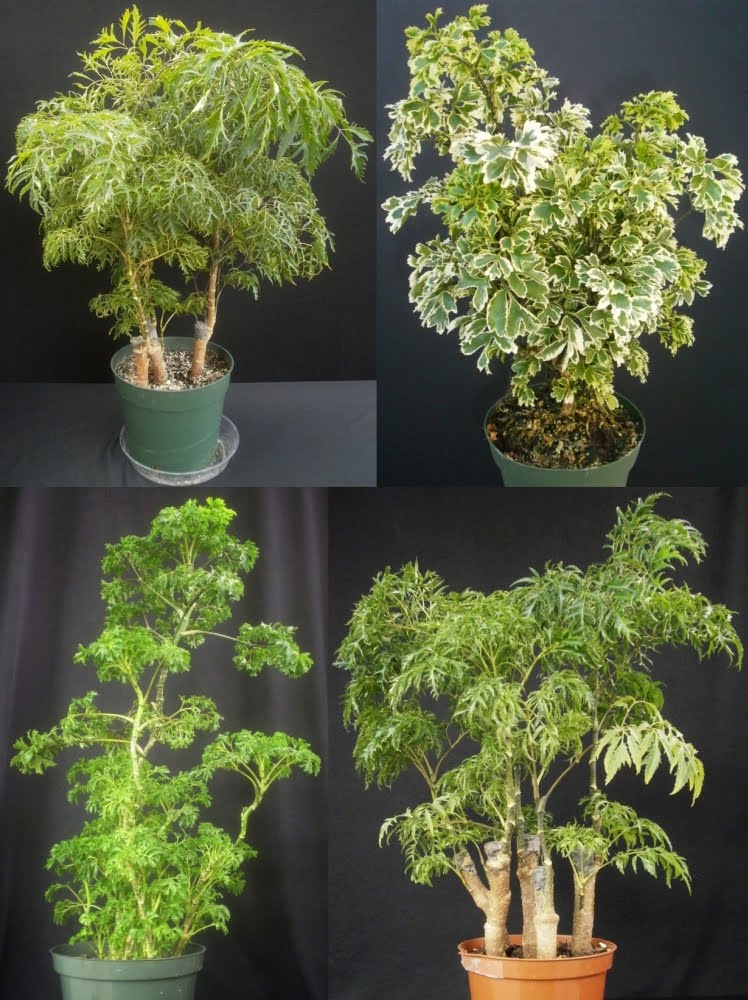
Top left and bottom right: Polyscias fruticosa. Top right: P. fruticosa 'Snowflake.' Bottom left: P. fruticosa 'Elegans.'


Match 2.23
Dracaena deremensis cvv. vs. Schefflera actinophylla / arboricola (umbrella tree)

Clockwise from top left: Dracaena deremensis ''Lemon-Lime,' 'Warneckei' or similar, 'Dorado,' 'Malaika,' 'Janet Craig Compacta.'


Top row, L-R: Schefflera actinophylla, S. actinophylla 'Renegade,' S. arboricola.
Bottom row, L-R: Schefflera actinophylla ('Amate?'), S. arboricola NOID.


Match 2.24
Begonia cvv. (rhizomatous begonias) vs. Sansevieria trifasciata cvv. (snake plant)

Clockwise from top left: Begonia 'Soli-Mutata,' B. 'Erythrophylla,' B. 'Tiger Kitten,' NOID.


Top row, L-R: Sansevieria trifasciata 'Black Coral,' 'Laurentii,' 'Bantel's Sensation.'
Center row, L-R: S. trifasciata NOID, 'Hahnii,' 'Hahnii Pearl Young.'
Bottom row, L-R: S. trifasciata 'Moonglow,' 'Black Gold.'


-

1 I'm deciding according to a hypothetical situation in which all of my houseplants are gone, as are all the other houseplants of the world, except for one producer/supplier/retailer. Said person is offering to restock me with one or the other of the plants in question but refuses to give me both. Which one would I choose?