I couldn't think of a better way to phrase the title. This list is for plants that are either 1) self-pollinating, or 2) easy for an amateur to cross-pollinate. In the first case, you only need a single specimen; in the second, you need two (which will probably have to be of different varieties).
For the main list, I'm restricting myself to plants I have personally gotten actual seeds from, instead of anything that's potentially self-fertile. (At the end, there will be supplemental lists for plants I've not personally been successful with and plants I've not attempted.)
The amount of trouble it takes to get seedlings varies. With some of these, seedlings will just start growing in the pot (or sometimes in a neighboring pot) without any effort on your part. With others, you may have to get lucky on the timing, or perform precise actions at precise times in order to get fruit. When possible, I've linked to other PATSP posts that describe the process in more detail.

Abutilon cvv. (flowering maple)
(shown: 'Bella Pink')
I don't know if
Abutilon cvv. will pollinate themselves or not; I never tried to find out. That said, crossing two different varieties within the 'Bella Mix' group worked pretty reliably for me, back when I still had them,
1 and there's no reason to think other combinations wouldn't work too.
2
A single seed pod has maybe 20-30 seeds in it, if I remember right.
Seedlings are old enough to bloom in about a year, indoors; outdoors they might progress faster.
•
Collecting seeds
•
Germination speed and percentage
•
First flower buds
•
First open flower
•
Multiple flowers
 Aglaonema cvv. (Chinese evergreen)
(shown: 'Maria')
I've definitely gotten fruit from an
Aglaonema cross once, and the seedlings have been doing fine in the basement for a while now.
3 I don't know the parentage; it might have been 'Maria' x self, but I had other
Aglaonemas flowering at around the same time, so it could have been 'Maria' x something else.
It wasn't easy to do; you have to have flowers that are shedding pollen and flowers that are receptive to pollen happening at the same time, and most of the crosses I've attempted have failed.
Often, the flowers emerge, but the spathe remains so tightly wrapped around the spadix that it's not possible to remove or introduce pollen without destroying the flower. This has especially been a problem with 'Brilliant,' which sucks because I would very much like to propagate it. ('Maria' is different in that its spathes tend to open wider and stand away from the spadix.) It's possible that this would be less of a problem if I had higher humidity in the house.
Each fruit contains a single large seed. I have no idea how long it takes to grow a seedling to blooming size, but I'd guess somewhere in the neighborhood of 3-7 years.
•
Developing fruit
•
Ripe fruit
•
Removal of seed from fruit
•
Germination
 Anthurium, flowering hybrids (flamingo flower, peter on a platter, oilcloth flower, tail flower)
(shown: 'Sensa')
I don't think these are self-fertile, though I haven't actually tested that. I have about ten different varieties here, so whenever an inflorescence is shedding pollen, I run around dusting all the other inflorescences just in case, which means I never know who the male parent was for any of the crosses.
Some varieties are easier to cross than others.
4 The main obstacle with
Anthurium is that the flowers are very long-lived, but have very short periods of pollen shedding, and somewhat brief windows for accepting pollen, so it's hard to get the timing right. (This is why when there's pollen to work with, I just try to cross everything: if I waited until the timing worked out to make a particular cross, I'd never have any seedlings at all.)
I've never bothered to try to count how many seeds you can get from a single inflorescence, but working solely from memory, I think the fewest I've gotten is like 3, and the most might be around 25-30.
Starting seeds once they've formed isn't difficult, but it
is more complicated than just opening up the fruit and dumping seeds on some soil.
Plants reach blooming size in three to five years.
•
Cross-pollinating
•
How to start seeds from the berries (also how to start
Schlumbergera)
 Ardisia elliptica (shoebutton tree)
Ardisia elliptica
is self-fertile, and requires no special meddling on the growers' part to produce berries. My plant was a few years old before it produced flowers, and then only about five (three of which produced seeds); however, the species is capable of blooming earlier than that, or more flowers than that, in good conditions. The progression from flower to seeds was pretty slow for me (several months), but germination is very fast (a few days). Each flower only produces one seed.
•
Flowers (not from my personal plant)
•
Unripe berries (not from my personal plant)
•
Ripe berries (not from my personal plant)
•
Removing seeds from berries and how to start them
•
Just-germinated seedlings
•
Very young seedlings
 Chlorophytum 'Fire Flash' (fire flash, green orange, mandarin plant, Sierra Leone lily, fire glory)
My 'Fire Flashes' bloomed two Januarys in a row when I first got them, and haven't bloomed since. This suggests that blooming is related to day length; during the first two years, they were getting only natural light, and since then have been getting natural light supplemented with artificial. Individual flowers only last a day or two, but they don't all open at once, so a flower spike maybe lasts 7-10 days. (It's been a while; I don't remember exactly.)
'Fire Flash' is self-fertile; you only need one plant. Each flower will become a triangular pod containing three rows of seeds, with an average somewhere around 300 seeds per flower spike.
Seed germination requires patience, but not really any special skills. I've gotten the most seedlings by giving up on the seeds and dumping them into potting soil that I used to pot up other plants: seedlings kept coming up for months after that, and they're pretty easy to pull out and pot up separately.
•
Flowers
•
Flower and developing seed pods
•
Seedlings coming up after I gave up on them
Columnea orientandina (no common name?)
I have not yet figured out how to make it happen, but
Columnea orientandina will self-pollinate and form purple fruits occasionally. The fruits contain several tan or brown seeds, which can be removed from the flesh of the fruit, dried overnight on a paper towel, and then sown in vermiculite. Germination is high (about 55 seeds per fruit, the one time I've tried this so far), though I've had trouble keeping seedlings going after transplant. Only about 25% of the seeds I started are still growing; the main cause of death has been getting washed out of the pot, or washed under the soil, during watering. I'm not sure if this is going to be a viable propagation method for me.
•
Flowers, berries, seedlings, overall process
 Hypoestes phyllostachya cvv. (polka dot plant, freckle face)
If allowed to grow unchecked,
Hypoestes will eventually produce leggy stems with smaller and smaller leaves. These stems aren't particularly attractive, which is why people generally keep the plant pruned back, but if you let them grow, they will produce tiny, self-fertile lavender flowers. I've yet to actually
see the seeds, but I know they're there, because seedlings occasionally pop up in neighboring plants' pots.
I do not know: 1) how to collect the seeds before they wind up in a neighboring plant's pot, 2) how many seeds each flower produces (I'd guess one.), or 3) whether plant color comes true from seed. I
have seen a white-spotted plant come from white-spotted parents once, and if memory serves, we used to get pink-spotted strays at work, where most of the plants were pink.
• The
Hypoestes phyllostachya profile contains pictures of the flowers and seedlings.
 Justicia scheidweileri (also Porphyrocoma pohliana, purple shrimp plant, rose pine, South African acanthus)
Flowers are self-fertile, and expel seeds hard enough that they can wind up far from the plant. (I've found seedlings in pots that were 6-7 feet / 1.8-2.1 m away from the parent before.) Seedlings generally transplant successfully, though they often go through a scary wilted period before recovering. I've collected plenty of seeds from the plant's shelf, with a dustpan: they're heart-shaped, rough in texture, and brown. Each actual flower only produces one seed, but a single flower spike can produce about 40 flowers.
Plants from seedlings can be large enough to bloom within a year.
•
Spontaneous seedlings, seeds
•
Seed propulsion (also
Hypoestes phyllostachya)
 Murraya paniculata (orange jasmine, orange jessamine, mock orange5)
Murraya paniculata
is self-fertile, though only a tiny percentage of flowers end up producing fruits, and not all fruits have viable seeds. I've experimented with using a paintbrush to transfer pollen from flower to flower, but it doesn't seem to affect how often pollination succeeds, so I'm kind of stumped.
Each fruit contains a single seed, though two is not unheard of, and zero happens occasionally too, for some reason.
Seeds usually germinate in a month or two for me, if they're going to; I have no idea how typical that is. I start them in soil and water as if there were a plant in the pot: vermiculite hasn't worked.
Cuttings rooted from
Murraya paniculata will bloom pretty much right away (in fact, if they were blooming when you take the cutting, they'll try to bloom while they root, too); I'm not sure if I've seen blooming on plants grown from seed or not.
•
Fruits, seedling
•
Newly-germinated seedling (item 5 in the post)
Rhipsalis NOID (maybe R. rhombea? No common names.)
The tiny white flowers self-pollinate and become small white oval fruits; fruits are ripe when they become partly translucent. Separate the seeds and let them dry overnight, then sow on vermiculite. They'll
all germinate. Each fruit produces maybe 20 seeds, I'd estimate.
I haven't transplanted any yet, so I don't know how that goes.
•
Flowers
•
Seedlings
 Schlumbergera cvv. (Christmas cactus, holiday cactus, Thanksgiving cactus)
You'll need more than one variety of
Schlumbergera in order to get crosses, for reasons which are addressed in the
profile. Once cross-pollination has been achieved, though, the rest is pretty easy, if slow. Fruits usually take 6-12 months to develop, though if you really want to, you can leave them on the plant a lot longer than that. Fruits usually turn pinkish-purple when ripe, though varieties with pale flowers may only turn light pink. Extracting the seeds is the same as for the
Columnea and
Rhipsalis -- cut or squeeze the fruit, remove the seeds, let them sit out overnight, then start them in vermiculite. I was pleasantly surprised at how well my seedlings handled their transplanting.
The number of seeds per fruit varies, but the last batch of seeds I started, I actually took a picture of them all on a plate and then painstakingly counted from the picture. I got about 550 seeds from 4 fruits, which averages to 138 seeds each.
It takes about three or four years for a seedling to get old enough to bloom.
•
Developing fruit with spent flower
•
Ripe fruit
•
How to start them (also Anthurium)
•
Newly-germinated seedling
As for the recommend / anti-recommend, that sort of depends on your goals, I suppose. If you want to make something
new, stick to the plants that require cross-pollination, like
Abutilon,
Anthurium, and
Schlumbergera. If you just want as many baby plants as possible and don't really care if they're exactly the same as what you've already seen, I'd recommend
Abutilon,
Chlorophytum,
Justicia,
Rhipsalis, or
Schlumbergera.
My personal three favorites from this group:
Anthurium cvv.,
Schlumbergera cvv.,
Murraya paniculata. Least favorite:
Hypoestes phyllostachya.
Supplemental list #1:
I have reason to believe that these would belong on the above list, if only one of the following conditions were true: 1) I still owned one, 2) existing fruits would hurry up and develop, 3) my plant(s) would flower, 4) something hadn't happened to the developing seedlings.
Alternanthera cvv. (joy weed, calico plant, calico weed, Joseph's coat) -- we got some
A. dentata 'Purple Knight' self-seeding at the ex-job, in the greenhouse, though I never saw flowers or seeds when I had
Alternantheras in the house.
Ardisia crenata (coral berry, coralberry tree) -- my plant is too young to flower still, but presumably would self-pollinate like
A. elliptica.
Chlorophytum 'Charlotte' (no common name) -- I've gotten
seeds and
seedlings before. The seedlings looked like they were going to be solid green, instead of variegated like the parent, but they all died because I let the soil dry out. Only
one time, too. So I never found out whether they were going to be variegated or not.
Clivia miniata cvv. (clivia) -- the 'Aztec Gold' I wrote about
a while back now appears to be developing seeds, though my understanding is that this is a slow process, and it's not clear how successful it will be.
Coffea arabica (coffee plant, coffee tree) -- I have
fruit currently developing on my plant (
flower buds,
flowers), but I have no idea how long it will take to develop, how many will develop, or whether I'll get usable seeds out of any of them. We'll have to see.
Cyrtomium falcatum (holly fern) -- I've managed to get tiny protoplants from
spores my plant produced, but they
fell prey to a fungus (and/or springtails) before I could pot them up on their own, and I haven't seen any new spores since. So this is theoretically possible, but I haven't actually achieved it yet.
Pseudorhipsalis ramulosa (no common name?) -- these self-pollinated at the ex-job, just like the
Rhipsalis above, and we got seeds from the fruits in the same way. (
flowers, fruits, seed preparation,
seedlings,
fruits) My plant at home has never managed to bloom.
Spathiphyllum cvv. (peace lily) -- drunk on my
Anthurium successes, I tried crossing two
Spathiphyllums this summer, when I had one shedding pollen and another that looked like it might be receptive. The jury is still out on whether or not this will be successful. One spadix does have some spots that appear to be growing larger, and it's not dried up like the inflorescences normally would have by now (though the spathe
is6), so there are indications that something may have actually happened; there's just a long ways to go before I can say I've successfully crossed any. Even if I have, I can't think of any good reason why I would want to have more peace lilies, so the whole thing feels pretty pointless.
Supplemental list #2:
Other people claim to have crossed these at home, but this hasn't happened for me, because 1) I don't have multiple varieties to cross, 2) my plants have never bloomed, 3) germination of seed is difficult to do, 4) I'm not crossing them correctly, 5) I don't own any, or 6) some combination of the above.
Adenium obesum & spp. (desert rose) -- I'm not sure I've seen anybody who wasn't a professional grower / breeder claim to have crossed
Adeniums successfully, but I have seen amateurs raise
Adeniums from seed. So it might be possible, I guess.
Begonia cvv. (angel wing begonia, rhizomatous begonia,
rex begonia) -- surely someone must do this, or else we wouldn't have so many. No idea how easy this might be; I haven't actually seen any amateur growers talking about it.
Citrus spp./cvv. and Fortunella spp. (orange, lemon, lime, kumquat, citron, grapefruit, etc.) -- at least in theory, if you can get fruits, then you should be able to get seeds as well. And citrus seeds aren't supposed to be that hard to germinate. I know people do get fruit produced on their plants indoors occasionally, so it would logically follow that they could also start new plants from the seeds. I just don't think I've run into anybody who claims to have
done that.
Episcia cvv. (flame violet) -- I've seen a number of people claiming to have crossed
Episcia in their home. I've tried to do it myself, but absolutely nothing has come of it. It's possible I might try again at some point, if I can determine how I've been screwing it up, but it's not a high priority for me.
Hibiscus rosa-sinensis cvv. (tropical hibiscus) -- I've seen a number of people claiming responsibility for new hybrids on-line, but I couldn't tell whether the claims were coming from amateurs or professionals. I attempted it myself a couple years ago, when I had two varieties blooming at once, but nothing happened. I no longer have the plants to experiment with.
Hippeastrum cvv. (amaryllis
7) -- amateurs do experiment with these pretty regularly, and in fact the one
Hippeastrum I have is the result of someone else's experiment, but I've never done it myself. I've never even had one flower, actually.
Orchids -- amateurs cross orchids all the time;
8 the problem is that once seeds have formed, most people don't have the ability to germinate them.
9 Some amateurs send their seed pods to flasking services, who place them in sterile flasks and grow them for however long it takes to get viable baby plants, then they mail the flask back. You can read some about this at
Plantgasm, if you're interested.
Passiflora caerulea and maybe other Passiflora spp. (passion flower) -- I have a houseplant book that mentions new plants can be produced from seed, though they're not specific about where the seed is supposed to come from. I don't know whether it's plausible for an amateur to produce their own seeds or not, nor do I know whether different
Passiflora species will hybridize with one another.
Pelargonium cvv. (geranium
10) -- I assume someone must be doing it, because there are
so many varieties, and I recall seeing some seed pods on the
Pelargoniums we overwintered at the ex-job, so I know it's possible to get seeds. I have no idea whether anybody is actually deliberately collecting and starting the seeds, or what the success rate would be, but in theory this might happen.
Punica granatum (pomegranate, dwarf pomegranate) -- again with the houseplant book making claims. I suppose it's plausible, but I don't know whether a given
Punica could be self-fertile or how readily they'll set fruit.
Saintpaulia cvv. (African violet) -- as for
Episcia, except that I no longer have any plants here to try with and probably never will.
11
If the reader knows of any plants I've left off the list (and I'm sure there must be lots of plants I've left off the list), I welcome suggestions for others in the comments. If you
do leave a comment to suggest another plant for the list, please indicate how confirmed it is. (I.e., let me know if you've actually done it yourself, if you're in the process of doing it but don't actually have new plants yet, if you know someone else who does it but haven't tried it yourself, if you heard about somebody doing it once somewhere but don't remember where, etc.)
-
 Dracaena deremensis 'Janet Craig Compacta.'
 Iresine herbstii 'Blazin' Rose.'
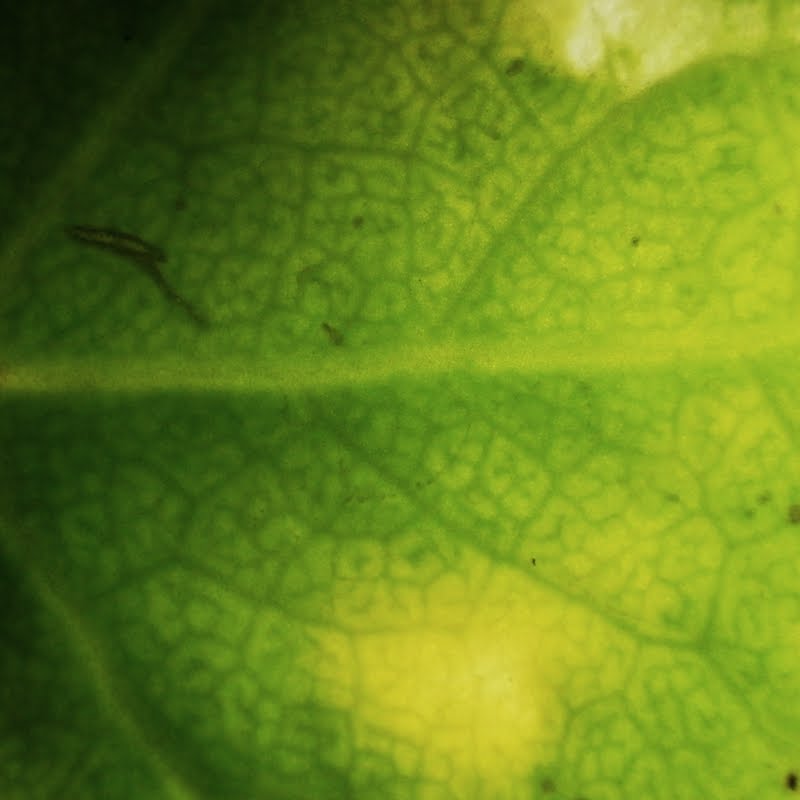 Senecio macroglossus.
 Chlorophytum x 'Fire Flash,' dead leaf.
 Malva neglecta.
 Saintpaulia ionantha NOID, petal.
 Hibiscus moscheutos 'Dave Fleming,' petal.
 Peperomia caperata.
 Ipomoea NOID, petals.
 Musa 'Zebrina Rojo.' (possibly Ensete 'Zebrina Rojo.')


 Posts




