Showing posts with label Syngonium. Show all posts

Monday, April 30, 2012

Selling and Trading

Okay. Well. The sell-trade post is completed at long last, and can be found via the link just underneath the header above ("Plants for Sale 2012") or you can just click here. The post should explain how the whole thing works, which plants are available, how they've behaved for me, which plants might be available later, and just about anything else you could possibly want to know; however, it is quite long, so before you start reading you should probably pack a light meal and some water, and wear something layered.

Syngonium wendlandii, 4" pot. $5.00 plus shipping.

If the last couple years are any indication, I am about to become very busy packing boxes and e-mailing people, so PATSP may not get back to full speed for a month or so, but I'll do my best.


Thursday, January 26, 2012

List: PATSP All-Stars

"All-Stars" are those plants for which:

1) I have had at least one specimen, continuously, for at least three years,

2) which is still living,

3) and looks as good as, or better than, it did when first acquired, plus:

4) no specimen has ever had spider mites, scale, mealybugs, thrips, aphids, whitefly, cyclamen mites, or fungus (Fungus gnats are excluded, because fungus gnats don't do enough damage to the plants to count as pests, and it's often difficult to tell what plant they're residing in anyway.),

5) no established specimen has ever gone into an abrupt and irreversible decline (new cuttings/divisions/offsets may still do so, 'cause that's part of the process of getting established), and

6) the plant has been successfully propagated,

7) more than once.

I have something in the neighborhood of 400-450 distinct kinds (species / subspecies / cultivars / hybrids) of plants in the house right now, and I don't have any idea how many other kinds of plants I've attempted to grow in the past, but I figure it has to be at least a couple hundred. Out of all those, a mere nineteen meet the above criteria at the moment.

(NOTE: The pictures which follow are not necessarily of the original plant nor particularly current; even those photos which are of the original plant and current may not impress, because looking better than when the plant originally came to live here is a lower bar to clear for some of the plants than it is for others. Also the Philodendron hederaceum 'Brasil' picture isn't even of my own plant.)

Aloe 'Walmsley's Blue.'

Anthurium 'Gemini.'

Anthurium 'Orange Hot.'

Begonia NOID, rhizomatous type.

Chlorophytum x 'Fire Flash.'

Dracaena fragrans 'Massangeana.'

Gasteraloe x beguinii. (Aloe aristata x Gasteria batesiana)

Nematanthus 'Tropicana.'

Peperomia obtusifolia, variegated.

Philodendron hederaceum, chartreuse version. (Possibly 'Aureum' or 'Lemon-Lime;' I've never had an official cultivar name.)

Philodendron hederaceum 'Brasil' or 'Brazil.'

Philodendron hederaceum micans.

Sedum morganianum.

Sedum rubrotinctum.

Synadenium grantii (green version).

Syngonium podophyllum NOID (possibly 'Neon').

Yucca guatemalensis, gray version.

Yucca guatemalensis, green version.

Yucca guatemalensis, yellow-margined version.


I don't know whether this would be useful information to anybody else, but there it is. Ordinarily with the List posts, I recommend three good ones and warn against one, but these are obviously all recommended, so we'll skip that part.

What are your All-Star plants, according to the above criteria?

-


Honorable mentions:

Honorable mentions are those which meet 6 of the 7 criteria. Depending on their reason for disqualification, some of these may move into the All-Star list eventually.
  • Aechmea fasciata (only one successful propagation)
  • Agave desmettiana (?), variegated (have only had ~1 1/2 years)
  • Agave victoriae-reginae (one's been here 4 1/2 years but never propagated; the other's been propagated more than once but has only been here for 2 years)
  • Aloe NOID, possibly 'Blue Elf' or A. x humilis (have only had 2 years)
  • Anthurium NOID w/ purple flowers (original is not as attractive as when first brought home)
  • Anthurium 'Pandola' (have only had ~2 1/2 years)
  • Begonia NOID cane-type (only one successful propagation)
  • Begonia x 'Erythrophylla' (have only had for 7 months)
  • Breynia disticha 'Roseo-Picta' (has had spider mites)
  • Codonanthe serrulata (have only had for 8 months)
  • Columnea microphylla (have only had for 8 months)
  • Echeveria coccinea (have only had 1 1/2 years)
  • Ficus elastica (has had spider mites)
  • Ficus microcarpa (has had spider mites)
  • Furcraea foetida 'Medio-Picta' (have only had for ~2 1/2 years)
  • Guzmania cv. (original is not attractive)
  • Hatiora salicornioides (has had spider mites)
  • Haworthia attenuata (specimens have abruptly declined)
  • Hoya carnosa 'Chelsea' (only one successful propagation)
  • Hoya carnosa 'Krimson Princess', solid-green revert (have not propagated >1 time)
  • Justicia scheidweileri (have only had 1 1/2 years)
  • Murraya paniculata (only one successful propagation)
  • Nematanthus NOID, orange-yellow flowers (specimens have abruptly declined)
  • Nematanthus NOID, orange flowers (have only had 2 1/2 years)
  • Pandanus veitchii, variegated (specimens have abruptly declined)
  • Peperomia pereskifolia (original plant got chopped back severely for propagation, so it doesn't look as good as it did initially)
  • Philodendron erubescens (?) 'Golden Emerald' (have only had 2 1/2 years)
  • Sansevieria trifasciata 'Hahnii' (have only had about 2 1/2 years)
  • Selenicereus chrysocardium (have had about 2 1/2 years)
  • Solenostemon scutellarioides 'Tilt-a-Whirl' (has only been an official plant for less than one month; have likely owned for less than a year but I'm not actually sure when I got it)
  • Synadenium grantii, red/purple version (have only had for 1 1/2 years)
  • Tradescantia pallida (original plant has been restarted repeatedly, and at the moment does not look better than it did when new)
  • Tradescantia zebrina (original plant is not attractive)
  • Zamioculcas zamiifolia (specimens have abruptly declined)


Saturday, September 24, 2011

Rumble Among the Jungle, Matches 1.13-1.16

Rules and Stuff
1) It's probably possible to vote more than once per poll, but please don't. If I believe that someone is voting repeatedly, I will throw out those results, repost the poll, and seriously question that person's priorities.
2) If you want to link to a poll on Twitter / Facebook / your blog / whatever and encourage your friends to come and pump up the support for your favorite plants, you are encouraged to do so.
3) You are also encouraged to leave comments on Rumble posts, if so moved.
4) All photos will enlarge if opened in a separate window/tab.
5) You can choose which plant is "best" according to whatever criteria you decide for yourself. My personal process is a bit convoluted.1
6) All polls will be open for three days.

Match 1.13
Ficus maclellandii (long leaf fig, alii fig) vs. Schefflera elegantissima (false aralia, Dizygotheca elegantissima)

(Ficus maclellandii.)


(Both Schefflera elegantissima.)


Match 1.14
Guzmania cvv. vs. Strelitzia nicolai/reginae (white/orange bird of paradise)

(Various unidentified Guzmania cvv.)


Clockwise from left: Strelitzia nicolai, S. reginae flower, S. reginae.


Match 1.15
Philodendron hederaceum cvv. (heart-leaf philodendron) vs. Syngonium podophyllum cvv. (arrowhead vine, nephthytis)

Clockwise from top left: Philodendron hederaceum 'Brasil,' P. hederaceum micans, NOID, P. hederaceum 'Aureum' or something similar, species, P. hederaceum 'Frilly Philly.'


Clockwise from top left: Syngonium podophyllum 'White Butterfly' (?), NOID (possibly 'Confetti'), 'Pink Margarita,' NOID.


Match 1.16
Dracaena fragrans cvv. (corn plant) vs. Saxifraga stolonifera (strawberry begonia)

Clockwise from top left: Dracaena fragrans 'Massangeana,' 'Sol,' 'Massangeana,' 'Sol,' 'Massangeana.'


(Both Saxifraga stolonifera.)


-

1 I'm deciding according to a hypothetical situation in which all of my houseplants are gone, as are all the other houseplants of the world, except for one producer/supplier/retailer. Said person is offering to restock me with one or the other of the plants in question but refuses to give me both. Which one would I choose?


Tuesday, January 18, 2011

[Exceptionally] Pretty pictures: transmitted light -- Part XXXVIII

There's probably a name for the condition of having writer's block, but having it with everything you try to do, not just writing. I don't know what the term would be, but I lived the experience all day yesterday (Monday). Couldn't bring myself to water, couldn't get anywhere writing the blog, mildly depressed (the AdSense decision factored into this, but I don't think it was the main cause), couldn't even manage to take a nap. In the end, I wound up on the couch, watching Beavis and Butthead Do America, which is my emergency self-treatment of choice for depression. It worked, in that it cheered me up (it always does; that's why it's the treatment of last resort. It'd be the treatment of first resort, but I'm afraid overuse would decrease the potency, so Beavis and Butthead only get brought out in extreme situations, maybe once or twice a year), but it didn't make me any more able to get anything done.

Which is why we have transmitted light photos again. Although I traditionally try to come up with a comment about each photo individually, I'm going to stop doing that unless I can think of something worthwhile to say: not only does this save me time writing, it also saves me the agony of trying to come up with something clever (or interesting (or even remotely connected)).

For this particular batch, with one pink exception, we have a green-or-orange thing going on. Hope you like.

(The previous transmitted light posts can be found here.)

Homalomena 'Perma Press.' It's turned out to be a less-terrible houseplant than I was expecting, from my experiences with H. 'Emerald Gem.' The main problem is that it wants to be really, really big, so all the petioles are bent and twisted because I don't have a spot where they can extend themselves the full two feet that they want.


Neoregelia NOID. It's really, you know. Pink.


Anthurium andraeanum cv. I don't know what happened to cause the water-soaked patches here: I didn't do anything to the leaf as far as I know, and although it's happened before, it's pretty rare. But it makes for a more interesting Anthurium photo than usual.


Ficus benjamina 'Midnight.'


Hemerocallis NOID, flower petal.


Syngonium wendlandii. Bad photo, but it's a good plant. I'm happier with my S. wendlandii than I have been with any of the S. podophyllums, amazingly enough.


Codiaeum variegatum NOID (most likely 'Petra.').


Zingiber malaysianum.


Solenostemon scutellarioides 'Splish Splash.' Tied for my favorite picture from this batch.


Canna 'Tropicanna.' The other picture that's tied for favorite. Less dramatic than the previous Canna photo, but arguably that works in its favor. The other one was pretty intense.


Thursday, January 13, 2011

List: Plants for Offices

I've been asked by a reader to suggest some plants that would work well in an office setting. Unfortunately, the list I came up with is kind of boring, because offices, taken as a group, present a very specific kind of unnatural environment. Generally, one is talking about low light, very low humidity, and occasional drought (if the office is closed on weekends and holidays, as is typical). Occasional cold may also be a problem in some places, because not all businesses bother to heat buildings which aren't in use, like on weekends, nights, and holidays. It's not a combination that's good, or even tolerable, for very many plants.

Obviously people whose workspace has a window, or who can add a small desk light, have more options to consider, but for purposes of this list, I'm assuming you can't add a light.

Chinese evergreen, Aglaonema cvv. (shown: 'Maria') Some varieties are better with cold than others, and there's no easy way to tell which are and which aren't, so this isn't a great choice for offices where the heat is turned off on the weekend, but they're good with drought, low humidity, and low light. They typically need to be cut back every couple years, and they're slow to resprout, so this may not be a good choice if you're looking for a plant to stay in the same spot for years and years.


Shoebutton tree, Ardisia elliptica. Very well adapted to office conditions in general, though drought may result in some leaf drop. The biggest drawback to Ardisia as an office plant is that they're very fast growers: they need frequent repotting, and the growth habit becomes less compact once they hit maturity, though they remain easy to care for.


Cast-iron plant, Aspidistra elatior. Sort of the opposite problem from Ardisia: Aspidistras are very slow-growing plants, and take a long time to get around to doing anything. On the other hand, low light, low humidity, occasional cold, and occasional drought are all taken in stride. Hot, dry offices may encourage spider mites, but that's about it for cultural problems. Aspidistras tend to be hard to find, and are more expensive than most other plants of the same size when you can find them, though.


Clivia miniata. Wasn't sure whether to include Clivia on this list or not: though dry air is well-tolerated, and they actually require cooler temperatures and drought for part of the year in order to bloom, light is potentially a problem. Ideally, these need bright indirect light, though plants can survive in less. In an office setting, you should probably not expect flowers, though they could make perfectly fine foliage plants.


Pothos, Epipremnum aureum. (shown: 'Marble Queen') Dry air and occasional missed waterings aren't problems. Low light is fine, though variegated varieties like 'Marble Queen' may revert to all-green if the plant is in too dark of a spot. Cold below 50-60F (10-16C) will slow or stop growth, and prolonged cold can damage or kill plants, depending on how cold and for how long, but most people, in most offices, should be able to grow pothos. May need to be cut back every few years for best appearance.


Heart-leaf philodendron, Philodendron hederaceum. Fine with low light, low humidity, occasional drought. Somewhat more cold-tolerant than pothos, but otherwise very similar in form and care.


Snake plant or mother-in-law's tongue, Sansevieria trifasciata. (shown: NOID birdsnest-type) Very tolerant of drought, though if you have helpful co-workers who water it for you, it may not last long, especially in combination with cold. Low light and low humidity are fine. In darker locations, leaves tend to become weak and floppy. The shorter birdsnest types seem to be touchier than the versions with longer leaves, particularly when it comes to overwatering.


Strawberry begonia, Saxifraga stolonifera. Extended drought is a problem, but dry air and low light are tolerated well, and cooler temperatures don't appear to be a problem at all, at least not the degree of cold one would expect in a reasonably large, insulated building.


Peace lily, Spathiphyllum cvv. Boring, boring, boring, but cold-tolerant into the 40s (F; 4-9C), low-light-tolerant to make you weep, and unbothered by dry air, whatever people will tell you. The only thing is: they don't allow a lot of margin for error when it comes to watering, and either you know how to water one or you don't. (The answer, for the record, is to wait until the day the leaves first start to droop, then water thoroughly, drain off the excess, and then do not water it again until you see the leaves begin to droop again. Letting the plant get too dry between waterings will cause some older leaves to drop, and not letting it get dry enough will lead to dead leaf tips and margins.) Flowers are most likely following a dose of fertilizer, but can happen at any time.


Arrowhead vine, Syngonium podophyllum. I'm not a huge fan of Syngoniums, because it's been my experience that unless one goes to a lot of effort, the best they're ever going to look is the moment when you buy them. Once they start to vine, which is usually within a few months, the new leaves get smaller, the plant's form gets stranger, and then you either learn to live with it or you cut back the vining bits to the base and hope they resprout in a timely manner. However, Syngoniums are still technically suitable for office settings, being fairly tolerant of missed waterings (or excessive waterings, for that matter, unlike a lot of the plants on this list), dry air, and low light. Cold may slow Syngonium down, but is unlikely to kill them.

For the recommends, well, these are all pretty sturdy plants, so doing recommends is kind of unnecessary. I've personally had the most positive experiences with Aglaonema, Ardisia, and Philodendron, and the most trouble with Sansevieria. Your results may vary.

Not pictured:
  • Ardisia crenata (coral berry) As for A. elliptica.
  • Chlorophytum comosum (spider plant) Best in offices that never get cold and have pretty good light. Minerals, especially fluoride, can cause leaves to get dead tips. Keep away from heat / air conditioning vents.
  • Chlorophytum x 'Fire Flash' (Fire Flash, Green Orange, Mandarin plant) As for C. comosum; keep out of direct sun.
  • Dieffenbachia cvv. (dumb cane) Warm, bright offices only. (Doesn't need sun, just bright indirect light.) Grows fast and needs to be cut back regularly; the larger varieties seem to be easier on all counts.
  • Dracaena deremensis cvv., including 'Janet Craig,' 'Warneckei,' 'Lemon-Lime'/'Goldstar,' 'Art,' 'Janet Craig Compacta,' 'Malaika,' etc. Not good for offices with helpful watering buddies. Mineral buildup or overwatering can lead to dead leaf tips and margins. Also not good for offices which may go below 60F/16C.
  • Dracaena fragrans (corn plant) As for D. deremensis cvv.
  • Dracaena marginata (Madagascar dragon tree) As for D. deremensis cvv., plus overhead light is much preferred to light from the side -- side-lit plants tend to look droopy, as the leaves adjust their position to take advantage of as much light as possible.
  • Dracaena sanderiana ("lucky bamboo," ribbon plant) Ugh. If you really have to. It's probably best to grow this in soil, rather than water, and if you do grow it in water, you'll need to do regular complete changes of the water, and add a little fertilizer from time to time. I don't think they're particularly good about cold, but they'll survive dry air, drought, and low light just fine.
  • Radermachera sinica (China doll) Generally tolerant of dry air, temperature extremes, and low light, but an aggressively fast grower, likely to look gangly once the dwarfing hormones wear off, and somewhat fussy about water, so definitely not ideal.
  • Rhapis excelsa (lady palm) Mineral buildup and dry air can cause burnt leaf tips, so these are also not ideal office plants, but they're flexible on temperature, drought, and light. They do need to be repotted every couple years, at least, to avoid root rot.
  • Sansevieria cylindrica ("wisdom horns") Tolerant of office conditions generally (though don't push it on cold unless you can also keep it pretty dry), though it would be happier in direct sun. Almost certain to be slow-growing in an office setting.
  • Zamioculcas zamiifolia (ZZ plant, eternity plant) Another one to avoid if you have helpful co-workers or if the office is ever unheated during cold spells. Otherwise very adaptable but slow-growing. Plants grown in very low light will produce weak, pale, stretched leaves.


Tuesday, December 7, 2010

The Quad City Botanical Center, Part 2 of However Many

This is the second post about our visit to the Quad City Botanical Center (henceforth QCBC) a few weeks ago. (Part 1)

The QCBC building. Photo by Ctjf83 at Wikipedia.

The tropical plants area of the QCBC is divided up in a way that makes it feel relatively small, but the pamphlet the husband picked up says it's 6444 square feet (599 square meters), and 70 feet (21.3 m) tall at its tallest point. So there's room, and somehow they've managed to get some very big plants in there, even though their website says they've only been around since 1998. (Presumably some of the plants were of pretty good size before they were planted.)

My favorite, naturally, was the Pandanus utilis.

Pandanus utilis.

I tried to take a picture that would show the spiral arrangement of leaves, to explain the common name "screw pine," but the sun was behind the plant, and there was only so much I could do. This was the best one I got:


Seeing this one at the QCBC made me even more determined to get a Pandanus utilis of my own someday, though. Not that I needed the push.

Odds are that more visitors are impressed by the coconut palm, Cocos nucifera, than the Pandanus. It was certainly much taller, if nothing else:

Cocos nucifera.

And it did, I admit, educate me a little as to how the coconuts are attached to the plant: I always thought they were held closer to the foliage than that. (You may have to open the picture in a separate window to see the coconuts.)

Not all the big, impressive plants were unfamiliar: the QCBC also has the largest Murraya paniculata I've ever seen. I can't imagine how overpowering the smell, when it's in full bloom. The people who clean the room must hate this plant. (My own makes a mess of the husband's office on a regular basis, and it's a tiny fraction of the size of this one.)

Murraya paniculata.

They also had a big, healthy Philodendron erubescens that was trying very hard to pull down the building:

Philodendron erubescens (?).

I suspect there is a law that all botanical-garden-type places have to have at least one gigantic Alocasia or Colocasia somewhere.

Alocasia sp.? Colocasia sp.? I'm not really getting any better at telling the two apart. . . .

I was surprised to find a Duranta at all (it's not a plant I think about a lot, or expect to see anywhere), but finding a really big, chartreuse one was a pleasant surprise:

Duranta erecta 'Golden Edge.'

No flowers on the Duranta, which is too bad. I want to smell one again sometime and see whether I still think it smells like cookies.

There were pothos plants climbing, literally, the walls (you can see some of them in the background of the pictures from Part 1), but this particular one got to the ceiling by climbing a support column.

Epipremnum aureum.

I also saw a Syngonium podophyllum with mature leaves at the QCBC. I'd seen this before, but it'd been a long time:

Syngonium podophyllum.


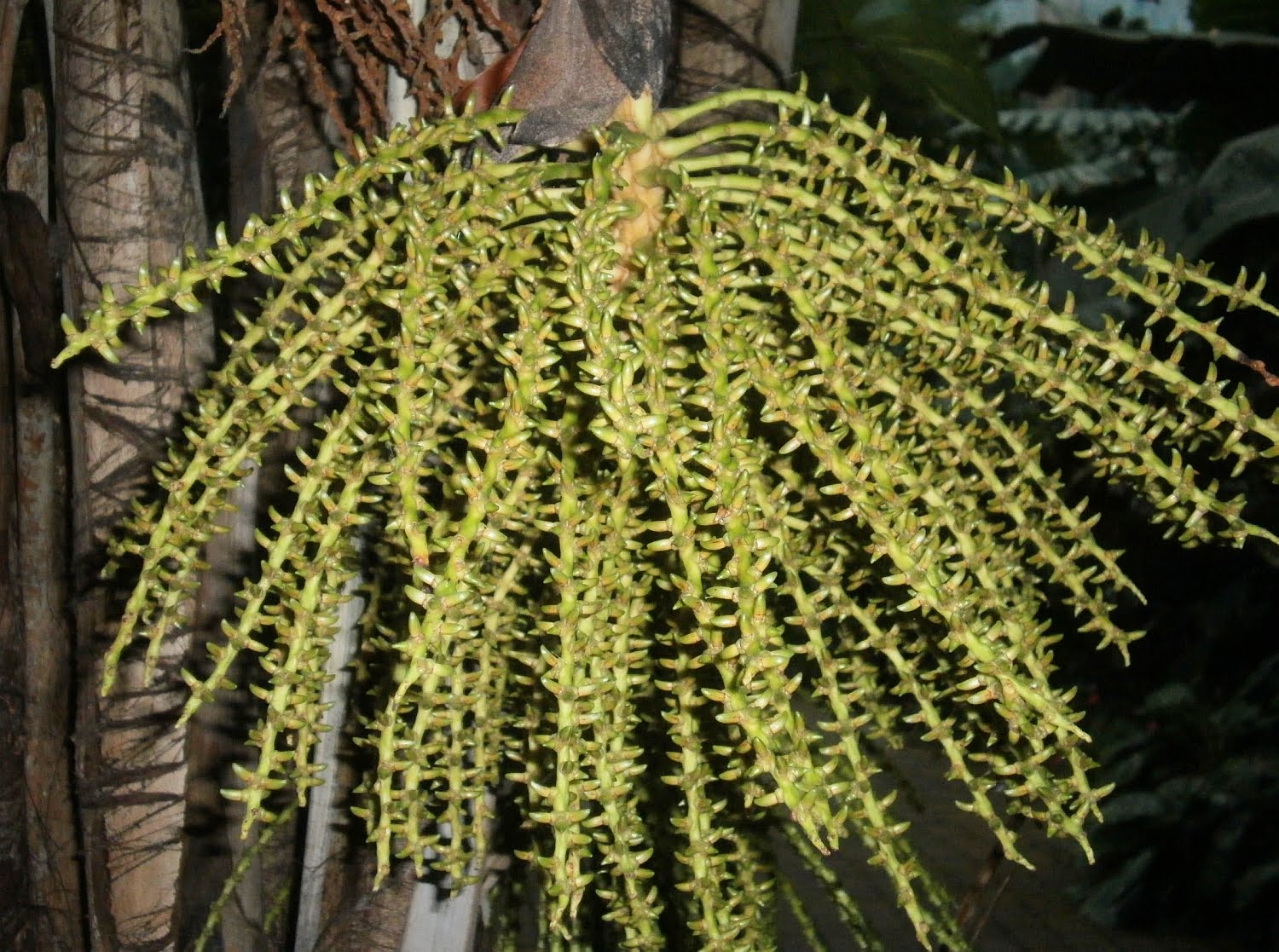
The plant that most impressed me, though, of all the plants there, was their Caryota mitis (fishtail palm), which was not only enormous --

Caryota mitis.

-- it was also flowering. Rather a lot.


The flowers aren't pretty, but apparently they don't have to be in order to work.


And this very new flower below looked like an octopus to me, which makes me like the species way, way more. I've never had good luck with C. mitis indoors (in my experience, it's hard to find one that's not buggy), but if they can grow octopi/-puses/-pods, then I think I need to rethink my position.


They also had a few other very large plants that I'm leaving out of the post because they didn't photograph well, including a Chorisa speciosa (silk floss tree) that nearly touched the ceiling and was dropping pink flowers on everything underneath it. I'd heard the name before, but it wasn't a plant I was familiar with at all. In person, it was maybe a little too huge and a little too far away for me to relate to, but still. Always nice to meet new folks.

There were also quite a few gigantic banana plants (Musa sp.), and a very large but badly lit Breynia disticha (snowbush, also sometimes Breynia nivosa). Maybe I'll get pictures of those the next time we go.