Showing posts with label Ipomoea. Show all posts

Tuesday, May 6, 2014

[Exceptionally] Pretty pictures: transmitted light -- Part LIII

Having one of those spells where I'm not having any trouble coming up with things to write about, but I'm never happy with the results. Also, as previously mentioned, the Anthuriums are the only plants here that are doing much of anything at the moment. Consequently, we're digging into the transmitted light photos, because that's what the transmitted light photos are for.

By way of observing how old these pictures are: of the six plants photographed for this set that I owned at one time or another (Dracaena, Iresine, Senecio, Chlorophytum, Saintpaulia, Peperomia), only two remain (Dracaena, Chlorophytum).

(The previous transmitted light posts can be found here.)


Dracaena deremensis 'Janet Craig Compacta.'

Never my favorite plant, and this photo is boring besides, but I'm appreciating it a lot more these days than I used to. No rot, no scale (knock wood), no defoliation. It just sits there, quietly, and photosynthesizes, like plants are supposed to do.


Iresine herbstii 'Blazin' Rose.'

One of the plants I used to own but no longer do. The main reason for this is that it just grew too fast and needed too much light. The coup de grĂ¢ce happened when spider mites started bothering it, and I decided it was just too much work to keep around any longer. Not necessarily a terrible plant, and it does photograph well occasionally, but I couldn't say I miss having it around. (Indeed, this is the first time I've even thought about I. herbstii in at least a couple years.)
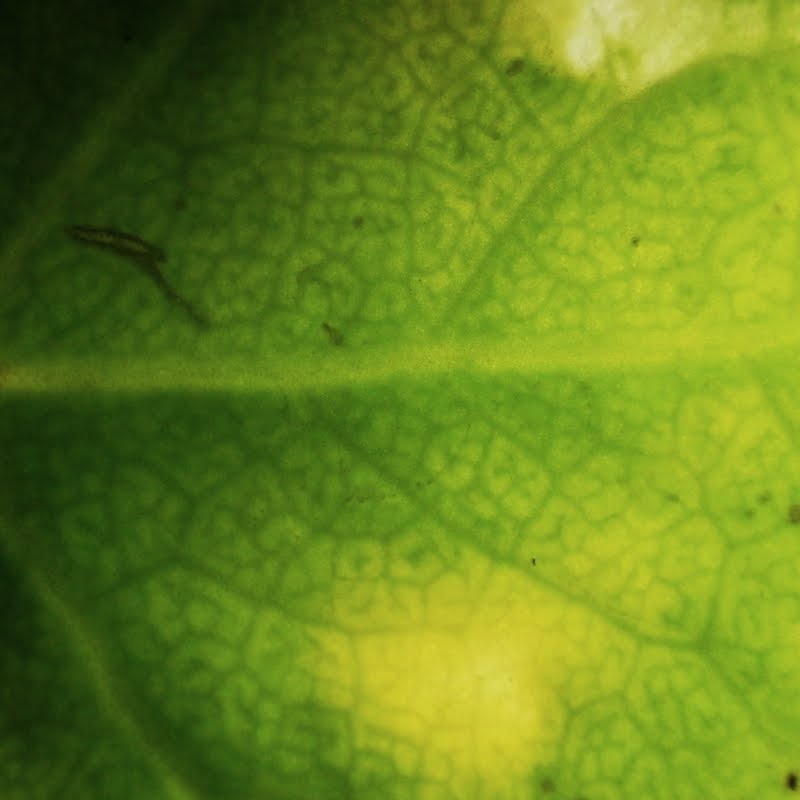

Senecio macroglossus.

Another one that's no longer around. I miss it . . . slightly. It had some nice qualities. It wasn't a good plant for me to be trying to grow, though, for three main reasons. One, it needed more light than I could give it. Two, it was forever tangling itself in the wire shelving I use, which did the plant no serious harm but was frustrating when watering time came around. Three, it needed a lot of grooming -- leaves were always dying but remaining attached to the stem, which made it difficult to groom. And it always needed to be groomed.

It'd be interesting to look at sometime with the microscope, though. You can see some weird stuff happening in there with the veins just from this picture.


Chlorophytum x 'Fire Flash,' dead leaf.

This picture is dramatic, but I think not good. Not the plant's fault, though. The plant is great.


Malva neglecta.

One of Iowa's less objectionable invasive weeds.


Saintpaulia ionantha NOID, petal.

The third plant I no longer own. I like African violets well enough to want to grow them, but not well enough to change the way I care for my plants to make growing them possible. By the time the last of the Saintpaulias went in the garbage, I was pretty exasperated with the genus, and I think I could live the rest of my life quite happily without ever trying to grow another.


Hibiscus moscheutos 'Dave Fleming,' petal.

I'm not particularly into the H. moscheutos varieties I've seen so far, and I don't know why. I mean, they seem like the sort of thing I would like. I like H. rosa-sinensis fine (I don't grow it, because overwintering always seems to be a problem, but I like them to look at.), and it's not that I have a problem with winter-hardy Hibiscus, because I think H. syriacus 'Blue Satin' is great. H. moscheutos is just too extreme for me, in some way I can't articulate. I don't see them very often around here, either. I mean, I see them for sale, just not usually planted. Though I suppose some of that is because I only recognize them when they're blooming, and for a lot of the year, they're not blooming.


Peperomia caperata.

The last of the plants I no longer grow, and the one I would be most likely to try again if I thought there was a chance of success. The problem with P. caperata was always watering. The 14-day cycle most of the plant collection is on is a bit too long for P. caperata, and if I tried to keep them wet longer by moving them to a larger pot, they'd rot. Irreconcilable differences. If I ever do find a way to deal with the watering differently, I will probably try this one again.


Ipomoea NOID, petals.

Say what you will about Ipomoeas (I. nil, I. purpurea, I. tricolor, and so on), but the flowers really are quite lovely even if the plants are weedy.


Musa 'Zebrina Rojo.' (possibly Ensete 'Zebrina Rojo.')

I probably took more photos of 'Zebrina Rojo' than necessary. (Previously: XLVIII, XLIV. And I think there's another photo in the transmitted light reserves.)


Sunday, November 4, 2012

[Exceptionally] Pretty pictures: transmitted light -- Part XLVIII

Hey, you know what we haven't done in a really long time? Transmitted-light pictures! (There are reasons for this, but they're really boring and not worth explaining, so let's get directly to the pictures.)

(The previous transmitted light posts can be found here.)


Ipomoea purpurea? I really like the way this one turned out. Plain though it is, it might be my favorite from this set.

Fragaria x 'Fort Laramie,' autumn. Will next year be the year we get to eat some of the strawberries our plants produce? 2009 didn't work because we'd just moved and everything was crazy-crazy. In 2010 and 2011, there were a few strawberries, but various animals got to them before we did, and there weren't that many in the first place. In 2012, they didn't produce any, because we moved them to a new spot and they needed time to recover. So 2013 might be the year that buying the plant finally pays off. Or, you know. Not.

Verbascum thapsus, with mildew. Unsurprisingly, the mildew does not improve the photo.

Philodendron 'Imperial Red.' I no longer have this plant; it never did very well for me, even though 'Imperial Green' did. I suppose they're not necessarily related, despite the names. This parallels my experiences with Philodendron 'Moonlight' and 'Autumn:' the red one limped along, the green one thrived. Coincidence?

Pilea pumila. Not sure why I thought this would be interesting. Possibly just the novelty of seeing a Pilea that lives in Iowa.

Episcia NOID. A nice range of colors, at least. Gesneriads rarely make for good transmitted light subjects.

Solenostemon scutellarioides NOID. Not sure what happened to this picture. It definitely doesn't look right.

Musa 'Zebrina Rojo.' (possibly Ensete 'Zebrina Rojo;' I don't know what specific botanical characteristics distinguish Musa from Ensete) Banana leaves are always nice.

Synadenium grantii var. rubrum. Probably the best houseplant on the list, though it's not like there's a lot of competition. And the picture doesn't do justice to the plant.

Alocasia amazonica 'Polly.' The venation here is a little ridiculous, and whoever thought chocolate brown and fluorescent lime green go together should be pointedly questioned, if not actually punished. But it's okay.


Monday, September 19, 2011

Pretty picture: Ipomoea sp.


I'd guess I. violacea, but I'm not sure. Wikiposedly there are some 500 Ipomoeas, and I don't have any idea how many of those are common enough that they might have wound up in the cornfield behind the house. I. violacea seems like a reasonable guess, from what I see while googling.

The cornfield is also home to a couple Helianthus sp. (possibly H. tuberosus?), though those are a lot harder to photograph, being tall, and so far I've been unsuccessful. Though it's possible that I've only tried once.


Sunday, June 26, 2011

[Exceptionally] Pretty pictures: transmitted light -- Part XLII

I'm going to be working on Berry Go Round #41 this week (hoping to have it up on Wednesday, but no promises), so it's transmitted-light time again.

(The previous transmitted light posts can be found here.)

Hosta NOID.

Tradescantia pallida.

Cissus rhombifolia. Something about the slight variations in color here makes me really happy. The plant itself mostly makes me angry, unfortunately -- I had one a few years ago that did reasonably well for a year or two, but then it slowly dwindled to nothing for no discernable reason. I've bought replacements for it, but they tend to begin dwindling immediately. Sometimes I also had mildew problems. Yes, I have fairly good humidity here in the house, but it's not so good that I should be seeing mildew. So Cissus rhombifolia is on the Never Again list.

Episcia NOID. Episcias don't tend to give particularly good transmitted light photos, despite the often-colorful leaves. Gesneriads in general tend not to turn out well, actually. I think the leaves are too thick for it to work properly.

Acer sp., autumn.

Aglaonema 'Jubilee.' Especially perceptive readers might notice that this is the same image as the one I'm using for the header for the next several weeks; that was accidental, and if I'd noticed it was part of the next set of transmitted light pictures, I would have picked something else. Oh well.

Prunus sp., autumn.

Asplundia 'Jungle Drum.'

Euonymous alatus, autumn. This is probably my favorite from this set, though I'm a little hazy as to why. Makes me think of lightning, a little.

Ipomoea NOID, petals. It's hard to find opportunities for blue transmitted light pictures. I think this one turned out nicely.


Tuesday, September 7, 2010

Pretty pictures: Pink

Today we have various thoughts from the plant kingdom about the idea of "pink." In a couple cases, it's maybe more my questionable judgment, and the plant was actually thinking of "purple," but whatever. I had a whole bunch of pictures that I needed to do something with, having just sifted through almost the whole photo backlog, and this sort of post is a really efficient way of getting through a lot of photos in a hurry, even if they're not seasonally-appropriate, as some of these aren't.

Asclepias syriaca flowers in extreme close-up. Some insect life visible if you look closely and/or open the photo full-size in a new window.


Polygonum persicaria. I don't think anybody actually likes this plant, but it's awfully familiar, at least. And technically pink, so it counts.


Lamium NOID. Shortly after taking this picture, I was looked at suspiciously by two women talking to one another over their backyards' fence. I expect that the suspicious looks happen all the time, but I'm not normally in a position to see them, so it was noteworthy.


Cyclamen persicum NOID. I don't see the frilly-edged Cyclamens for sale very often. Not that I necessarily want one. I just think it's interesting what is and isn't popular.


Torenia 'Catalina Pink.' This is arguably more purple than pink, but the tag said it was pink.


Ipomoea NOID. If loving morning glories is wrong, I don't want to be right.


Zinnia 'Profusion Cherry.' I had sort of intended to get some Zinnias this year, or at least some Zinnia seeds. As with all my other outdoor-related plans, that didn't work out.


Cyclamen NOID. This is probably my favorite photo from the batch.


Portulaca grandiflora, second-generation flower. These have not yet taken off like I'd hoped, but considering how late I started them, I suppose I can't be too disappointed. I should still be able to collect enough seeds to try again next year.


Weigela NOID. Came with the house. The husband and I are both kinda meh about it, but it'd be a lot of work to take it out, and neither of us have any ideas for something we'd rather see in that spot, so it stays.


Hibiscus moscheutos 'Dave Fleming,' at the ex-job. I've seen hardy Hibiscus varieties I covet, but this isn't one of them. It's big and bright enough that I find it sort of alarming. Not the sort of Hibiscus you want to run into, walking around the back yard at night.


Wednesday, August 4, 2010

Pretty picture: Ipomoea sp.

Very excited tonight (Tuesday), because I got an e-mail today telling me that my Pandanus amaryllifolius has been shipped from Florida. What's that, you say? You didn't know I was getting a Pandanus amaryllifolius shipped from Florida?

That's because I didn't tell you. I didn't want you to buy them all before I could get one, as I've been wanting one ever since I started working on the Pandanus profile, eight or nine months ago.

I don't necessarily vouch for the company yet, as I haven't received my plant, but here are the details: $18 for the plant, $13.35 shipping, total of $31.35 (*wince*). Supposed to be in a 5-inch (12.7 cm) pot. I bought it from Gardino Nursery, on I think Friday. I'll let you know what it's like, once it gets here. They had others as of Friday, but were limiting it to one per customer, so there may not be very many.


Anyway. Today's post is just the simple picture of a morning glory flower I saw a few months ago. I know morning glories have been done, and a lot of people don't even like them because they're weedy, but I still think they're pretty. And even if I didn't, it's very late and I have to post something and this was the first thing I saw that I thought would work.

Still working on the Schlumbergera profile. I'm thinking it might be ready Sunday. We'll see. Progress is being made, at least. (UPDATE: It was indeed posted on Sunday.)


Monday, August 24, 2009

[Exceptionally] Pretty pictures: transmitted light -- Part XVIII

I will admit that this particular batch is not my best. I've pretty well run out of new plants to get pictures of. The next batch, 19, is better than this, and there's always at least one pretty spectacular picture in each set, but there's sort of an overall let's call it a lull, from 18 to 23 or so.

What happened around Part 23 was, I realized that none of you guys are going back and looking at all the previous pictures anyway, so I can go back to plants I've gotten pictures of already and nobody will know, so Parts 24 and 25 ought to knock your socks off. Seriously. You will no longer be able to wear socks. But right now, we're at 18 and I know we've all seen better and I'm deeply sorry or something.

So let's hurry up and get this over with.

(The previous transmitted light posts, many of which are considerably better than this, can be found here.)

Hoya carnosa 'Chelsea.' The venation for thick leaves like this often wind up reminding me of clouds.


Syngonium podophyllum 'Neon.' There's an odd asymmetry to the symmetry here. I like it. It's different.


Homalomena cv. 'Perma Press.' Not terribly impressed with Homalomena cvv. as houseplants, but I will say for them that they have very graceful veins.


Fragaria cv. 'Fort Laramie.' I remember this as being a much better picture when I first took it. Either my memory is wrong, or something went badly awry during the cropping and editing process.


Streptocarpus 'Purple Martin.' I really am going to write that Streptocarpus profile someday, I promise. I've had some difficulty with it, in that I find it difficult to be interested.


Phlebodium aureum 'Blue Hare.' Maybe I should get one of these sometime. No idea how they'd do inside, and the growth habit is sort of wild and random, but the venation is so cool.


Ipomoea batatas 'Blackie.' Either this one or the Polypodium is my favorite from this group, I think: there's a lot of interesting detail in the full-size view, and it's a new color for these transmitted light pictures, kinda.


Anthurium andraeanum 'Pacora,' spathe. This didn't work out at all like I wanted. It might look a little better in full size.


Alternanthera cv. 'Partytime.' Interesting colors, though no individual leaf is all that impressive on its own: you sort of have to see the whole plant at once.


Solenostemon scutellarioides 'Splish Splash.' I've become somewhat disillusioned with coleus lately: I kept one indoors for over a year, and it didn't seem so terrible, though it was kind of leggy. Then I went kind of nuts buying them, discovered I didn't have anywhere to plant them, and they've had to suffer outdoors in tiny pots or inside without enough light. I'm not sure whether I'm going to try to keep them going through the winter or not: I know it's possible, but it's questionable whether this would be worth the trouble, when coleus is so easy to get in the spring. If I do keep some, 'Splish Splash' is likely to be one of the ones I keep.