Friday, April 11, 2014
Wednesday, April 9, 2014
New plants
I have about six long, talky blog posts in progress at the moment, but I'm also going through one of those spells when I'm unhappy with everything I write, so it's maybe going to be a while before any of them get published. In the meantime, I've bought two more plants, that aren't even Anthuriums, so let's look at those.
First up is a Huernia.
Two reasons for this purchase: 1) stapeliads are the best,1 and 2) it was $5.2
They had several specimens of this particular plant, one of which was flowering already. I didn't buy that one because there were aphids all over the flower. (Fortunately, there were several other specimens available.) I tried to get a flower photo anyway, but it didn't turn out well.
I'm a little hesitant about the ID; it was tagged as H. oculata, which has the most amazing flowers, but the flower doesn't match very well. In particular, that part at the center should be a lot lighter and more uniform in color. A little mottling is one thing, but that picture above is a lot more heavily patterned than I feel H. oculata ought to be.
I couldn't find any flower photos that matched any better, so it's possible that the one I took a picture of was immature, distorted by the aphids, or otherwise atypical, but in any case I'm not ready to say for certain that I have H. oculata. My plant has a few tiny flower buds on it, so we'll see what those look like.
I'll also keep an eye out for aphids. I had aphids on the Huernia zebrina last summer. They appear to be a common stapeliad problem.
The other plant I got at Reha's was Mangave 'Bloodspot.' This may or may not turn out to be a good idea; one of my two Mangave 'Macho Mocha' specimens lost a lot of leaves during the winter and is presently on the verge of death,3 and 'Macho Mocha' is, I think, the only Manfreda, Agave, or Mangave I have that hasn't had scale problems yet. So this is possibly a group of plants I should be more wary about. But you know how it is.
It was only $8, so if the purchase turns out to have been a bad idea, it was at least not a very bad idea. And I assume I'll get to enjoy it outside for a summer first.
-
I say they're "the best" because a few of them do extremely well for me. Huernia schneideriana (which I got from Liza) and Stapelia gigantea are a couple of my favorite plants. H. schneideriana bloomed all winter long even though it wasn't receiving that much light; S. gigantea has all kinds of fun textures and smells and is one of the easiest plants I grow.
2 Let's hear it for Reha's Greenhouses. They're also about $6 cheaper per bag than the ex-job on the brand of potting soil I like, which I wish I'd known before buying a bag at the ex-job.
3 The one that's doing poorly was about 8 inches from an obstructed west-facing window, and also probably stayed wetter longer because it was in a larger pot. The other one was on a south-facing windowsill, so it got a lot colder, but it also probably dried out faster and saw more sun.
Sunday, April 6, 2014
Pretty picture: Rhyncattleanthe Lily Marie Almas 'MGR'
And the photos from the 2014 orchid show begin. I said previously that I always say that I think the photos are better than the previous year's, but this year I think it might actually be true. Mostly because last year's batch was so crappy: so many blurry photos because I couldn't get close enough to the flowers and didn't want to step over the rope to get closer. This year I did step over the ropes to take pictures, once, but for the most part I didn't need to: the set-up this year was a lot more sensible.
Even when I did step over the ropes, nobody yelled at me, so it's probably not that big of a deal, but the important part is that I felt like a bad boy.
For the record, I didn't intend to follow one Rhyncattleanthe with another Rhyncattleanthe. It was accidental.
Rhyncattleanthe Lily Marie Almas 'MGR' = Rhyncattleanthe Orange Nuggett [sic] x Cattleya Jalapa (ref.)
Friday, April 4, 2014
Random plant event: Breynia disticha
I now have three Breynias in the house: the original, and two (barely) smaller plants from cuttings of the original. If they were easier to propagate from cuttings, I would have even more than that, because I like them,1 but a lot of cuttings fail. (Cutting failure is a good thing in this particular case, though, because they get big quickly, and if all the cuttings had been successful, we would probably have had to give them all their own room.)
I happened to notice a couple months ago that the original Breynia had decided to bloom. The flowers are small and inconspicuous, to the point where although I know I've seen them once before,2 I could easily believe that my plants have flowered several other times without me noticing.
This has no real practical application to anything -- I doubt I could pollinate them successfully. Nor is it particularly decorative, appealingly fragrant, or otherwise desirable. But it is news, technically, in that it is something that has happened. So make of that what you will.
-
Otherwise, Breynia is a good plant for me: not overly demanding of light, not prone to bugs (so far, though there have been brief minor spider mite infestations), copes well with indoor humidity and temperature. It's not my favorite plant or anything, but I like it well enough to have three of them.
If you live in a more tropical climate, be advised that Breynia disticha will propagate itself throughout your yard/garden, as well as those of your neighbors. If you live in Florida or Hawaii, in particular, you should not be growing Breynias outdoors. Not that it's going to bring back the native ecosystems, but you can at least try not to make things worse.
As houseplants, obviously, the damage to the ecosystem was done when the house was built, so grow whatever you want, just keep it inside.
2 Those photos are better than these photos, if you care.
Wednesday, April 2, 2014
Early April Anthurium (and Schlumbergera) Seedling Update
I think I finally have the color-fidelity problem licked. If not, all the photos in this post were taken on the same day, in as close to the same conditions as I could manage, so if the colors are biased, they should at least all be biased in the same direction.
Everything with buds on it as of March 24:
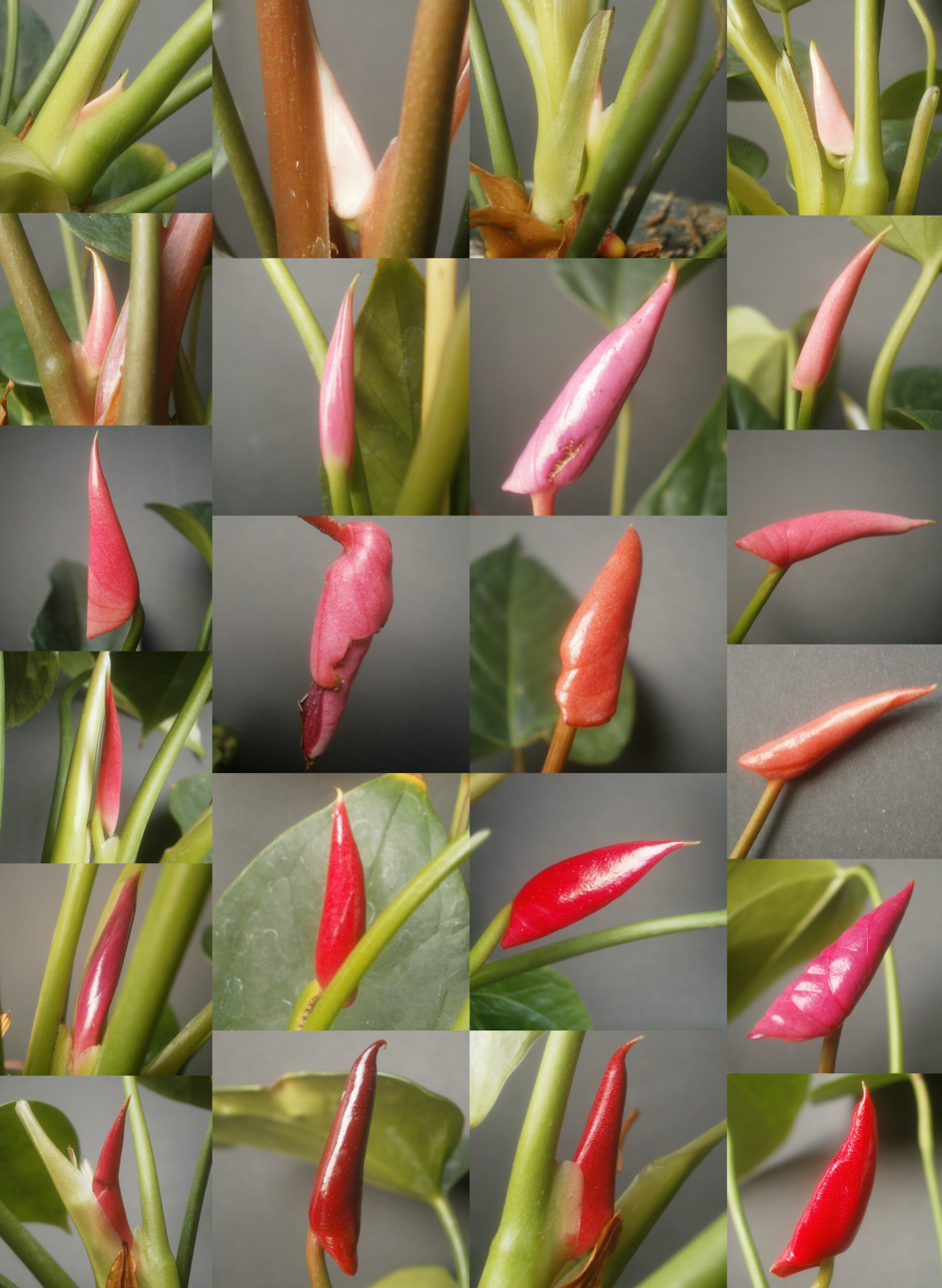
Second column: 066("Barbara Seville"), 085("Carson Trucks"), 046("Aurora Boreanaz"), 108("Deena Sequins"), 005("Chad Michaels").
Third column: 040("Ivy Winters"), 200("Mario Speedwagon"), 031("Sylvester"), 243("Sal Monella"), 058("Betty Larsony").
Fourth column: 202("Mason Pepperspray"), 280("Jujubee"), 283("Anne Pursand"), 118("Elijah Sturdabowtit"), 231("Rhea Listick"), 063("Audrey Quest").
Aurora Boreanaz appears to have a thrips problem. I was really excited about Aurora at first, because there was a little bit of purple in its spathe, but the bud in the picture has opened since that photo was taken, and it's a dead ringer for Deena Sequins: red with a dark purple spadix. So not only does it not have a new color, but by the time the spathes open they're pretty thrips-ravaged. It's not seeming like a promising candidate for future breeding. I may have to discard the plant and recycle the name.
Mario Speedwagon has gotten darker in the last week, which is a good sign, and a new, light pink, bud has appeared. This suggests that it's going to keep getting darker until it opens, which would make for a very pretty inflorescence. Lots of potential so far. Rhea Listick is looking pretty good, in similar ways: more on her in a bit.
Chad Michaels and Alexis Mateo (#002) both produced buds at basically the same time, and they were both very, very dark red, verging on black. Alexis's bud caught on part of the plant as it developed, and wound up snapping itself off (!), so I don't know what it would have done; Chad's is staying very dark. Very dark red Anthuriums already exist, but I don't have one, so I'm kind of excited about this.
Sylvester has started to open since this photo was taken, and it has remained orange. (The previous orangish bud, Elijah Sturdabowtit / #118, took a sharp left turn to pink as the spathe opened, which was disappointing. Worse, it wasn't even a pretty pink, and was so short-lived that I didn't even manage to get a picture. I'd been hoping it would be my first orange -- the seed parent was 'Orange Hot' -- but Elijah fizzled out in every way possible.)
Pretty much every time I water the seedlings, I spot a new bud or two; so far (as of 31 March 2014), 40 of the Anthurium seedlings have at least attempted to bloom. The only bud not in the above collage is 097 ("Colin Ambulance").
I've also seen new inflorescences on the Spathiphyllum seedlings (#3, #9, #11), and a few more Schlumbergeras (#007, #022, #024, and #057).
The Spathiphyllums look like Spathiphyllums. At least one of them (#3) has scented inflorescences, which is kinda special.1
The Schlumbergeras are, unexpectedly, all pretty similar to #25 ("Clownfish"). #24 is basically exactly the same as #25. #22 hasn't fully opened yet, but looks the same as #25 so far. #57 is slightly more pink/coral; I'm pretty sure there's a difference, but you probably wouldn't notice it in a photo. #7 has a lot more white in the petals, which should be exciting but in reality just makes it look kind of washed-out and sad. I suppose it's nice to know that if something happens to #25, I have replacements ready, but I had been hoping for more variety than this.
There are 19 Anthuriums with fully-opened spathes at the moment, 7 of which are interesting enough to show you.
Eileen is pretty similar to 'Red Hot.' So nothing new, but I suppose she's still nice. Eileen spent several weeks pretending she was going to be orange or coral, so the sudden swerve toward red at the very end was a surprise. I don't know why all the 'Orange Hot' children lie so much. Not raised right, clearly.
You can't tell in the photo because of how I cropped it, but the most surprising thing about Heather is how tiny the flower is. The biggest of the seedlings' spathes run about 2.5 inches (6 cm) long and wide; the average is probably about 2 inches / 5 cm; Heather's one spathe to date was just over 1 inch (2.5 cm). Not a very commercially-viable trait, but I've noticed that several of the seedlings produce larger inflorescences now than they did when they first started blooming, so maybe Heather will bulk up with time.
Zach's spathe looks pretty trashed these days, but the berries seem to be developing normally. It's still the only one of the seedlings I'm sure has been cross-pollinated, but 271 ("Wanda Reulthemal") seems to be getting a little bumpy, so Zach may not be alone for long.
Barbara's here because she happened to photograph well and it's her first bloom.
Also the first one for Yvette, though she didn't photograph so well.
I am increasingly infatuated with Ross. The only thing keeping him from being basically perfect is spathe size. On everything else -- spathe color, foliage, lack of blemishes, number of blooms -- he's up toward the top of my list. One of the reasons I'm looking forward to seeing what Rhea Listick does is because there's a good chance she's from the same parents, the bud is similarly purplish, and it's already looking larger and broader than Ross's. But Ross is a good plant regardless of what Rhea does.
Sawyer is another potential full sibling of Ross's,2 and also a good candidate for my favorite seedling. The color, obviously, is not that special, but the flowers are good about not cracking, large, pleasantly-shaped, and longer-lasting than most. As a bonus, the spadices are a bright, saturated yellow. I wasn't initially that impressed, but Sawyer's growing on me.
The next seedling update will probably happen once I can show you what happened with Rhea, Chad, and Mario's buds, plus a week or two to take and crop pictures. So maybe late April or early May. I will try really, really hard to write some general houseplant stuff before then.
-
The plant I think must be the pollen parent has a sort of soft, powdery, lilac / baby powder fragrance. It's nice, but it's not particularly strong, and often doesn't seem to be coming from the plant: any number of times I've gone hunting around the basement, trying to figure out where the smell was coming from.
The seedling's scent is similar: not very strong, lilac / baby powder, but when I first notice it, I often pick up a flicker of cinnamon before I notice the rest of the odor. I can't tell if that's actually part of the fragrance, or if "cinnamon" is just my brain flailing around for something to call the smell: it happens that fast.
2 The reason why I don't know is because I don't record attempted crosses, because I don't have much of a way to know if they worked or not. So far, I've just been randomly crossing things any time there are multiple flowers in bloom. The reason why I think they might be related anyway is because my notes say that they came from the same seed parent ('White Gemini') and were sown on the same day (5 May 2012). Since it's possible that not all the berries on a given spadix have the same pollen parent, and it's also possible that I took berries from more than one flower when starting the seeds, the relationship isn't really provable. But Ross may be siblings with:
Rhea Listick (#231)
Rowan DeBoate (#235)
Rudy Day (#238)
Russ Teanale (#239)
Sal Monella (#243)
Sawyer Ad (#245)
Selma Carr (#247)
and 32 other seedlings which have yet to produce flower buds. So far, Rhea is the only one to resemble it in inflorescence color, but one of the nonbloomers (#244, "Sara Problem") has similarly-shaped foliage.
Monday, March 31, 2014
Pretty pictures: Rhyncattleanthe Mary Weiss (?)
And here's the last orchid from last year's show; it's a contender for my favorite out of that batch just because the color is so weird. (The other contenders: Phalaenopsis Mistral's Sunrise Flame 'Mendenhall', Dendrobium pierardii, Caulaelia Snowflake 'Northland' (which you'll be seeing again in 2014), Rhyncholaeliocattleya Dick Smith 'Aloha Spirit,' Vanda Fuchs Cherry Chips, Cattleya amethystoglossa. It'd be a difficult decision, if someone forced me to pick a favorite.
2.jpg)
.jpg)
Rhyncattleanthe Mary Weiss = Rhyncattleanthe Memoria Christine Sineni x Rhyncholaeliocattleya George King
As for the blog, well, the husband has returned, so we're good there, but then I did something terrible to my back while trying to pick up the big Murraya paniculata on Saturday, which is complicating my life in a number of ways. So I feel pretty confident in saying that regular blogging (whatever that even means anymore) will resume at some point, but I have no idea when or what that will be.
I'm considering some kind of public service announcement post about what a bad idea it is to put large plants into clay pots. I just need a rhyming slogan of some kind.
Saturday, March 22, 2014
Pretty pictures: Paphiopedilum Bit-O'-Sunshine x Paph. William Sanders x Paph. malipoense
Since my last post, there's been a family event (death in the family on the husband's side). It would be complicated to explain, but the upshot is that although it's not a big emotional crisis for anybody involved, for the first time since 2006, I'm sleeping by myself, and all alone in the house,1,2 and everything is now all upside down and backwards.
So either I'm going to wind up writing lots of blog posts out of boredom, or I'm going to be writing no blog posts at all because I'm trying to clean the house top to bottom. Physical stuff seems more distracting than verbal stuff right now, so the smart money is on cleaning / no blog.
In the meantime, here is a new orchid for you to look at, and I will be back when I can.
.jpg)
2.jpg)
All I have on this one from the tag is "Paphiopedilum Bit-O'-Sunshine x Paphiopedilum William Sanders x Paphiopedilum malipoense". That could be
(Paph. Bit-O'-Sunshine x Paph. William Sanders) x Paph. malipoense,
or it could be
Paph. Bit-O'-Sunshine x (Paph. William Sanders x Paph. malipoense).
It looks like the tag is trying to suggest the first option, so that would be my guess, but parentheses would have helped clarify.
-
2 I would have gone with the husband, but you would be surprised how difficult it is to find someone to plant-sit 1000+ plants for a week on short notice, and many of the Anthurium seedlings in the basement wouldn't be able to survive a week without watering. To say nothing of trying to find someone to take care of Sheba. Maybe if we'd had more time to figure something out, I could have gone, but it was all pretty abrupt.
Tuesday, March 18, 2014
Pretty picture: Tolumnia Tequila Sunrise; also, New Plant
This particular orchid is unknown to the orchid registry where I usually confirm names, or at least it was as of a year ago, when I was looking for IDs on the 2013 batch. I found plenty of orchids named "Tequila Sunrise" (Cymbidium, Miltoniopsis, Phalaenopsis, Dendrobium, Rhyncholaeliocattleya), but Tolumnia wasn't among them. So I can't tell you what the parents are for this one.
.jpg)
And that is all I can say about Tolumnia Tequila Sunrise.
I came very, very close to not going to the orchid show this year,1 but I went. And it was . . . okay? Every year, it feels like the show is smaller than the year before, though I don't think it's actually changing in size; I think there's just something weird about the way I store orchid show information in my brain. (I also always think that I got better pictures than in previous years, which never turns out to be true either.)
Compared to previous years, the 2014 pictures seem unusually heavy on pink, purple, and shades in between, and unusually light on yellows and oranges. I tried to get fewer Paphiopedilum and Phragmipedium photos,2 though I wasn't entirely successful. I tried to get more Masdevallia pictures, but I don't think I succeeded at that either: there just weren't that many there, and the ones that were there weren't actually that interesting. Certainly nothing anywhere near Masdevallia Sunset Jaguar 'Night Breed,' which I would have loved to have seen again.
Regular posting will remain slow for the next week or two, while I sift through and upload this year's batch of photos. I'm hoping I'll be done with that by the time I run out of 2013 photos (at the end of March).
While in the Quad Cities, we also went to Home Depot, because I wanted to get a bunch of Glidden paint color cards. The reason is weird,3 and I felt really conspicuous and self-conscious about doing it, with the result that I was too distracted to pick up any yellows.4 Then I felt bad about coming to the store just to load up on paint cards,5 so I wound up buying an Anthurium, just like last year. $10 for a 4-inch pot (which seems to have become standard around here), but the color6 is unusual,7 and if it's interfertile with the plants I already have, it'll be good for breeding purposes.
The tag didn't include a variety name, and a trip to the Westland Greenhouses website didn't turn up any possible cultivars, but I e-mailed the company yesterday and they said it was Anthurium 'Joli.' I also learned from their website that, however unlikely it sounds, my 'Joli' was grown in Grand Bend, Ontario. Which I am still trying to get my head around. (How is heating a greenhouse in Ontario not prohibitively expensive? How can Ontario compete with Florida?)
Not only are they Canadian and prompt to reply to e-mails, but the instructions on the Westland Greenhouses tag are much, much better than the instructions from the Just Add Ice tag, and includes "don't place in direct sunlight during the summer months" and "add fertilizer once after every six waterings." Neither of those are exactly what I'd recommend, and of course "better than the Just Add Ice care instructions" is a very low bar to clear, but I am nevertheless pleased, and give you permission to purchase Westland-grown Anthuriums.
Also making me happy is the tag's shape. Perhaps I have a smutty mind, but, well -- you can see it, right?
-
2 They were there, of course. I just tried not to take many pictures of them, because I really want to be able to grow them and can't. Seeing photos of them just reminds me of this, and then I get depressed.
It's not like I'm great at growing any orchids, but I only get upset about not being able to do Paphs and Phrags.
3 It's been bothering me, when I write stuff down about the Anthurium seedlings, that I don't have better ways of describing spathe colors than just "red," "dark red," "pink-red," etc. I mean, that's fine as far as it goes, but it'd be nice to make finer distinctions, in cases where, for example, flower A is red, and so is flower B, but Flower A and flower B aren't the same color. Now that I have a set of cards to compare to, though, I can say that flower A is "Cherries Jubilee" red, and flower B is "Red Rose Bouquet" red, and feel more or less confident that I have made an important distinction. (note: All the Glidden color names in this post are ™ Glidden. In using their names, I do not mean to imply in any way that Glidden approves of me, my blog, Anthuriums, or plants in general; I'm just using them as a convenient means of identifying specific colors. Conversely, I don't want to imply that I approve of Glidden, their marketing department's color-namers, Glidden products, or paint in general, either.)
It may or may not actually be an important distinction, of course. But I've noticed in the plant patents I've looked at that they frequently make references to standardized colors (one set of which is apparently the Exotica Horticultural Color Guide, mentioned in the Dracaena deremensis 'Warneckei' profile), so it seems like this is something I'll eventually have to think about. May as well start now, I figure.
I tested this out yesterday. Compared cards to a couple spathes before dinner, and then checked all the plants that are currently blooming after dinner. My pre- and post-dinner assessments didn't agree, so there are clearly some problems with the whole concept. But it may be better than nothing.
4 The logic at the time was that I was so vanishingly unlikely to ever have a yellow Anthurium spathe to describe that I had no need to pick up any yellow cards. Then I got home and remembered: spadices. Almost all my spadices are yellow. D'oh!
5 The husband assured me that Glidden and Home Depot would manage to scrape by financially, even if I took their paint cards, and I believed him, but 1) he told me this after I'd already bought the plant, and 2) there's a good chance that I was rationalizing buying the plant with the paint chips thing. It's not like I need more plants, after all. And it's really not like I need more Anthuriums. But I wanted it. So there you go.
6 (somewhere between Blooming Fuchsia and Sexy Pink for new spathes, aging to Watermelon Smoothie)
7 Though Mario Speedwagon (#200) is similar, and is looking extremely interesting. The spathe is closest to Blooming Fuchsia (a darkish pink-purple) so far. The problem being that they often change as they develop, so Mario will get more interesting or less interesting with time, and I don't know which it's going to be yet.
2.jpg)
.jpg)
.png)
.png)
.png)
.png)
.png)
.png)
.jpg)
2.png)
.png)
.png)
.png)
.png)
.png)
.png)
.png)
.png)
.png)
2.png)
.jpg)
2.jpg)
.jpg)