Friday, May 20, 2016

Anthurium no. 0263 "Leo Long"

Leo's from an older batch of seeds, seedling group AS (seed parent 'White Gemini;' sown 5 May 2012). AS has given us both some of the best seedlings to date (0231 Rhea Listick, 0234 Ross Koz, 0239 Russ Teanale) and some mediocre to bad ones (0218 Noah Fence, 0232 Rhoda Badcek, 0244 Sara Problem), so I wasn't sure how hopeful to be. From the single bloom to date, it looks like he's closer to the good seedlings than the bad:


Good enough to promote to a 6-inch pot, anyway. The leaves are interesting,

(This is also a particularly good example of one of the five types of venation the seedlings produce: "fishbone."1

The plant as a whole is okay; there's plenty of suckering,


though I'd be happier with more consistent petiole length, and you can see a little bit of thrips damage here and there.

No real question about whether to keep Leo: I've already told you I moved him to a 6-inch pot. The single bloom to date has been cross-pollinated. We'll see what comes of it.2

-

1 They're my own categories, and I'm still working out how to think about foliage: it's perfectly clear to me that the leaves vary from seedling to seedling, and that the veining is part of the reason they look different, but actually assigning the individual seedlings to distinct categories is tougher than you would think.
Anthurium seedlings produce different leaves as they reach maturity, and it's not always obvious when a seedling has switched from juvenile to mature leaves; also plenty of seedlings have characteristics of more than one category. Leaves look different in different photos, too, and thrips damage can twist leaves so badly that it becomes basically impossible to determine what kind of leaves a plant is trying to make. So nothing about this is exact or particularly scientific. With all those caveats in place, here are some of the more extreme examples of the five types I've identified:

In "flat" venation, the only very prominent vein is the midvein (sometimes also there's a vein running on either side of the midvein that's about the same thickness), and even the midvein is narrow compared to the midveins on other seedlings' leaves. It's also usually the same color as the rest of the leaf, though occasionally they're slightly red. "Flat" leaves are rarely literally flat; they often fold along the midvein, or cup around where the petiole attaches to the leaf. And the flatness is not really the point: the point is that the midvein is relatively narrow, and doesn't stand out.
Juvenile leaves are almost always flat.
Flat seems to be most common with descendants of the NOID red, though the NOID red-violet, 'Red Hot,' and the NOID purple all have leaves closer to flat than to any of the other categories, and a number of other parents lean toward flatness. (The parents are harder to fit into specific foliage categories than the seedlings, so a lot of them have aspects of more than one category.)

("Flat" leaves, clockwise from top left: 0346 Lois Carmen DiNominatre, 0365 Murray Hill, 0597 Raven, 0380 Ewan Watarmi)

"Star" venation has a thicker midvein, as well as one or two pairs of thick, large veins which radiate out from a single point. Usually the veins are also lighter than the rest of the leaf, and the areas between the large veins are fairly smooth, without much visible veining.
This is the most common type among the parents: 'Gemini,' 'White Gemini,' 'Peppermint Gemini,' 'Pandola,' 'Joli,' and 'Krypton' are all stars; consequently, star veining is useless for trying to guess at pollen parentage. I mean, none of the types of veining are ever conclusive, but star is even less helpful than usual.

("Star" leaves, clockwise from top left: 0095 Clarice Fullhartz, 0206 Marcia Dimes, 0467 Regina Fong, 0245 Sawyer Ad)

"Lizard," on the other hand, is uncommon: it's more or less like flat except that all the secondary veins are wider and slightly sunken, giving the leaf a pebbled texture that I think resembles lizard skin or alligator skin. The leaves are usually thicker and heavier with lizards, too.
No parent variety is solidly a lizard. The NOID red, 'Gemini,' and 'White Gemini' all have lizardy tendencies, though. The most common spathe color is red, though there's one pink lizard, 0275 Yvette Horizon. Lizard is my favorite kind of venation, though I think that's more because I like the heavier weight of the leaves than because I care about the pattern itself.

("Lizard" leaves, clockwise from top left: 0072 Beth Rowe, 0076 Bob Humbug, 0203 Anna Mae Hemensouz, 0275 Yvette Horizon)

"Quilted" is like "star:" the midvein and one or two pairs of other large veins all radiate from a single point. The difference is that with "quilted," there are visible veins dividing up the different sections created by the main veins, and within those different sections, the veins are slightly sunken relative to the rest of the leaf, giving a quilted appearance. Hence the name.
The NOID pink, 'Florida,' 'Orange Hot,' and NOID green-pink all have some degree of quilting going on; it seems to be particularly common with orangish seedlings. (Oh yeah -- I'm now wondering whether 'Florida' might not have pollinated some of the seedlings after all. I'll have to explain some other time.)

("Quilted" leaves, clockwise from top left: 0171 Genevieve La Difference, 0317 Dred, 0328 Polly Esther Blend, 0408 Tex Messich)

Last, "fishbone" venation resembles "flat" in that the only prominent vein is the midrib, but there are also small but easily visible secondary veins running parallel to one another to each side of the midrib.
This isn't the main texture for any of the parent plants, but the NOID pink, NOID green-pink, NOID purple, and 'White Gemini' all have some inclination toward fishbone veining. No particular color preferences for fishbone seedlings that I'm aware of.

("Fishbone" leaves, clockwise from top left: 0005 Chad Michaels, 0228 Hoku Mama Swamp, 0263 Leo Long, 0276 Zach Religious)

I think the same basic pattern of veins (a midvein, three pairs of primary veins coming from the petiole, etc.) is present regardless of the seedling, and the differences are mainly a matter of which are most visible (because they're a different color, thickened, or slightly raised or lowered): they're not so drastically different from one another that I'd expect everybody (or anybody, really) to notice, but it's relevant to me, because it still makes a difference in how the plant as a whole looks.
As spathes are modified leaves, it's also possible that the leaf venation has subtle effects on how the spathes look. I haven't checked that out yet.
2 Though we're getting enough plants in bloom at once that targeted, specific crosses are, or soon will be, a possibility.
I've held off targeted crosses partly because I like the randomizing that comes from trying to pollinate with pollen from multiple plants at once, but it sure looks like there have been a few cases where the pollen parent was the same for a whole seedling group anyway, e.g. the AZ and BA seedling groups all came out dark red / yellow, and BF and BH have produced a lot of small and shitty pink or red blooms. If I'm going to get the same bloom over and over again anyway, I suppose I may as well know what cross produced it.


Wednesday, May 18, 2016

Anthurium no. 1038 "Adlai Lowe"

I swear that was the name 1038 got assigned forever ago; I didn't change it to fit this bloom. I just got really lucky, because the bloom is literally very close to the soil line, and also it's about as tiny and inconspicuous as an Anthurium bloom can possibly be.


Adlai is also noteworthy for blooming while in a 3-inch pot; it's not the first seedling to try (that'd be 0835 Brenda Dharling), but it's the first one to succeed (Brenda's first bud aborted).1 If you call this "succeeding." It still hasn't unfurled its spathe all the way yet (because it physically can't), so it's maybe cheating a little bit to count this as a completed bloom.

In any case. I appreciated the enthusiasm, if not the results, so I moved Adlai up to a 4-inch pot in early April, and we'll see what he does with that. I don't expect the bloom to be especially exciting -- I mean, we can see that the spathe is red, so unless the spadix is bioluminescent or metallic or something it's not going to be anything we haven't seen before -- but it's earned the chance to try again, I feel.

The foliage is pretty typical, if on the small side:


The plant as a whole is unremarkable as well, though some of that's because there's so little plant there to remark on.2 I mostly wanted to include this photo so you'd have more context for the size of the spathe:

(The sides of the pot are 2 in. / 5 cm long.)

Oh, and I suppose I should mention that if you count this as a bloom, Adlai is, technically, the first second-generation seedling to bloom. If you're holding out for a more traditional F2 inflorescence (visible to the naked eye, possessing a peduncle and a visible spadix, etc.), you'll have to wait until mid-June. Though that one's disappointing as well, in a different way.3 So far, the full list of attempted blooms from the F2s is:

The ones that are now dead because of scale
0687 Pauline Pantsdown: pink?, daughter of 0273 Wes Coast (pink / pink)
0654 Rosie Cheeks: no color recorded,4 daughter of 0276 Zach Religious (pink / orange)

The ones that aborted buds and haven't tried again yet
0721 Chandelier Divine Brown: red or pink-red, daughter of 0005 Chad Michaels (dark red / green)
0799 Hope Sandreams: pink-red, daughter of 0108 Deena Sequins (red / purple)

The ones that are still in progress
0805 Triana Hill: light pink or maybe peach?, daughter of 0234 Ross Koz (purple-pink / yellow)5
0694 Brad Romance: light pink?, son of 0005 Chad Michaels (dark red / green)6
0698 Landon Cider: red, son of 0005 Chad Michaels (dark red / green)
0855 The Very Miss Dusty O: light pink or pink, daughter of 0234 Ross Koz (purple-pink / yellow)
0811 Alma Children: red, daughter of 0234 Ross Koz (purple-pink / yellow)

Completed (more or less)
0716 Herbie Hind: pink / orange, son of 0239 Russ Teanale (pink / yellow)
1038 Adlai Lowe: red / ?, son of 0234 Ross Koz (purple-pink / yellow)

If I were heavily invested in the idea of getting pretty blooms from the seedlings, I suppose Adlai would be yet another disappointment to add to the list, but I'm less interested in seeing pretty blooms and more interested in seeing something new. And this is certainly new. Plus the bloom is surprisingly long-lived, considering its odd circumstances: at least two and a half months now, and it looks the same as ever. So Adlai gets to hang around for a while. Obviously he's no good for breeding if all the blooms turn out like this, but I'm betting that they won't.

-

1 A couple others have also tried, to varying degrees of success:
1232 Fiona St. James was felled by scale (what else) a month after I saw her bud, and didn't get a chance to complete it. It's not like me to throw out a plant that had a bud on it, especially one that had never bloomed before, so I assume what happened is that she dropped the bud and then got scale, but I don't actually have that information written down so it's just a guess.
0855 The Very Miss Dusty O [sic; the temptation to correct it to "The Very Dusty Miss O" every time I type it is nearly overwhelming] has a bud in progress now, though she may not get the chance to finish either; I saw scale on her the last time I watered. Tried to wipe it off, remove leaves that had visible insects on them, etc., but I don't know that that's actually ever worked so there's really no reason to think it will this time.
2 It's gotten bigger since the move to a 4-inch pot, but not in any sort of meaningful way. More leaves, larger leaves, but they look the same and it's not that big of a difference.
3 (Look at 0716 Herbie Hind on the Anthurium seedling gallery, if you don't mind Anthurium seedling spoilers.)
4 (I'm guessing that the bud dried up and died before I could take its picture.)
5 Considering how things have been going lately, I'm trying not to get my hopes up, but Triana looks like our best bet for a nice F2 seedling at the moment: the bud is decent-sized, there are a reasonable number of suckers, and she's relatively low on thrips damage.
6 Brad might also have potential. Though his bud is significantly smaller, it's a similar color to Triana's, and his foliage is large and less scarred. We'll see.


Tuesday, May 17, 2016

Pretty picture: Miltoniopsis Evergreen Premier

It's possible that there were other Miltoniopsis present at the show, but this is the only one I remember seeing, and the only one I got photos of. Evergreen Premier is as disgustingly cheerful as all the other Miltoniopsis; the most unusual thing about it is probably the yellow in the center, which we've only seen a couple times before.


I can't confirm that the plant was identified correctly. The only on-line source I could find with any picture of an "Evergreen Premier" was seattleorchid.com, but neither the genus nor the photos match in that case. The genus name may or may not be relevant -- the International Orchid Registry lists Miltonia as a synonym for this plant -- but the photo still seems relevant. Feels to me like either that one, or this one, has to be misidentified, though I suppose it's also possible that we're looking at different clones from the same grex.


Miltoniopsis Evergreen Premier = Miltoniopsis Limelight x Miltoniopsis Lilac Time (Ref.)

In unrelated news, a couple of comments about the previous post:

I did start, or try to start, cuttings from the 'Caribbean Dancer' that imploded. (Nine pots' worth, at nine or ten cuttings per pot, because I expect a lot of them to fail.) The one branch that survived the implosion remains intact, which I wasn't expecting, but I'm not sure it matters long-term: it seems too heavy to be able to hold itself up even if it's fine, and there are some indications that its lower segments are rotting, just like on the other branches, and the rot is just slower in this particular case.

There are indications that the Aloe variegata with root rot might have at least a small root system in place now. It doesn't come out of the soil if I pull on it gently, at least. Since I've had pretty crappy luck with Aloes w/r/t scale,1 I may decide to throw it out anyway -- and I probably ought to2 -- but the decision is still up in the air for the moment.

It's certainly possible that the potting soil for the Beaucarnea recurvata held water too well; I think I probably mixed in some "aquatic soil" / bits of fired clay when I up-potted it, but I don't remember for sure, and obviously the plant isn't around to ask anymore. I also have a hazy memory of it being in a spot where water was draining directly into the pot from overhead when I first put it outside, but I moved it out of the way once I noticed, and it grew fine for two or three months afterward. Doesn't mean that wasn't still the problem, but cause and effect are difficult to disentangle in cases like this.

-

1 And although I had forgotten about it, my records tell me that I threw out an A. variegata in October 2013 because of scale, so I know the species isn't immune.
2 I've toyed with the idea of throwing out all the plants, infested or not, that come from genera that the scale seem to like: Agave, Aloe, Haworthia, Gasterworthia, whatever Yuccas I can bear to part with. Haven't done it yet. Maybe won't. I mean, the most obvious solution here is to throw a bunch of plants out, and if I'm doing that, then the plants I should throw out should be the ones I expect to make me unhappy later. But it's hard to punish plants for crimes they haven't committed yet.
An alternate plan is/was to throw out every plant that is not currently delightful: all the plants I've been hanging onto in the hopes that they'd turn themselves around and look nice again, all the plants that I know will eventually look shitty in the future because that's just how that plant's habit is or whatever, all the plants where I've ever thought to myself, oh, I should probably just throw that one out. Same problem with that plan, though.


Saturday, May 14, 2016

Schlumbergera seedling no. 005

The plants will just not give me a break. The latest "fuck you" from the plants came from my Schlumbergera 'Caribbean Dancer,' seed parent to all of the Schlumbergera seedlings that have bloomed so far. I've had the plant since December 2008, and the photos I have of it vary wildly in quality, but I'm sure you'll get the idea anyway.

Top to bottom: November 2009, May 2010, November 2013, November 2015.

and now May 2016:


And I don't expect that the existing branch is going to remain for very long.

The decline was quick: it takes eight and a half years to grow a plant out that big, but they only need a week to disintegrate. I don't know what I did. It's been in the same location, receiving the same light, in the same pot, getting watered in exactly the same way and at the same times, for at least the last four or five years.

People occasionally say to me things like, oh, it must be wonderful to have so many plants, to be surrounded by all that LIFE and GROWTH and BEAUTY all the time. It's never actually felt that way to me, but people say it. Lately, though, it actually has been feeling like I'm surrounded by death, disease, and ugliness all the time, and it's right there in my house so I can't even get away from it. Just in the last three months:


I had a gigantic and lovely variegated Beaucarnea recurvata, which spent last summer outside and grew rampantly. It was amazing. Then I brought it in for the winter and it spent several months continuously defoliating, because (I eventually learned) its roots had all rotted out, probably because I'd up-potted it before moving it outside, and so it got thrown out in mid-January.

Before the 'Caribbean Dancer,' the salmon-peach NOID (likely pollen parent for all/most of the seedlings) suddenly shriveled and turned red. Nothing dropped off: it just kept getting more and more slumped and shriveled, and then the fruits started drying up and falling off. Threw it out at the end of April, when it finally became clear to me that the reason I hadn't seen any new growth was because the plant was in fact genuinely dead.


My surviving Eriobotrya japonica has always had a problem with spider mites to some degree or another, but they'd stayed more or less manageable, enough that I figured it was worth holding on to and just spraying with soapy water from time to time or whatever. And then at about the same time it had finally gotten large enough to start branching, the mite population exploded and I was like, do I really want to be fighting spider mites for the rest of my life? So it was gone in late January.

The Yucca guatemalensis in the plant room, multiple pots of a yellow-margined version I've had since 2001, had gotten scale in 2013 or 2014, I can't even remember which, and after trying to get rid of the scale with rubbing alcohol and various other things, I finally just cut the heads clear off and made them start over. Which worked! Kind of! As of last fall, they'd resprouted and grown enough new leaves to reach the point of kind of looking like plants again, and, well, you know how this story has to end so I'm not even going to bother finishing the sentence. (February or March, I can't remember)

An Aloe variegata from May 2008, and a Sansevieria hargesiana from May 2010, both given to me by friends from my days back at Garden Web, had both quietly been letting their roots rot away below the soil without saying anything. I'm trying to reroot both of them, on the grounds that even though I don't feel like it now, I may someday be happy that I did it anyway, but it feels pointless and I'm not necessarily going to stick with it long enough to recover the plants. (late March / early April)

Both specimens of my Columnea orientandina are falling apart all of a sudden; one is probably too dry, but the other one I have no idea what its problem is.

Every remaining division I had from an Agave victoriae-reginae I bought in April 2010 turned out to have scale and had to be thrown away. (mid- to late March)

The Murraya paniculata seedling (previously) has thrips, which makes a 1) new species with a problem, 2) new genus with a problem, and 3) new area of the house confirmed to have thrips. (late April?)

And those are just the high points. (Low points? Main points.)

I've talked before about the Texas Effect and how it's not necessarily a huge deal for things to be going badly with the plant collection, since any plant collection this size is going to have good things and bad things happening at the same time and mostly they cancel out. Well, they're not cancelling out anymore. The 'Caribbean Dancer' collapse is the last straw. I haven't figured out what "last straw" means, precisely, but . . . something. There will be changes.

Anyway. So there's also a Schlumbergera seedling to name today.


Obviously I don't feel like putting a ton of effort into the naming process at the moment. My first thought was Last Straw, but I had left a note for myself earlier that the previously-considered Circus Peanut would work well for this one, it being a lighter orange than most. So I'll say Circus Peanut. But my heart isn't in it.


Thursday, May 12, 2016

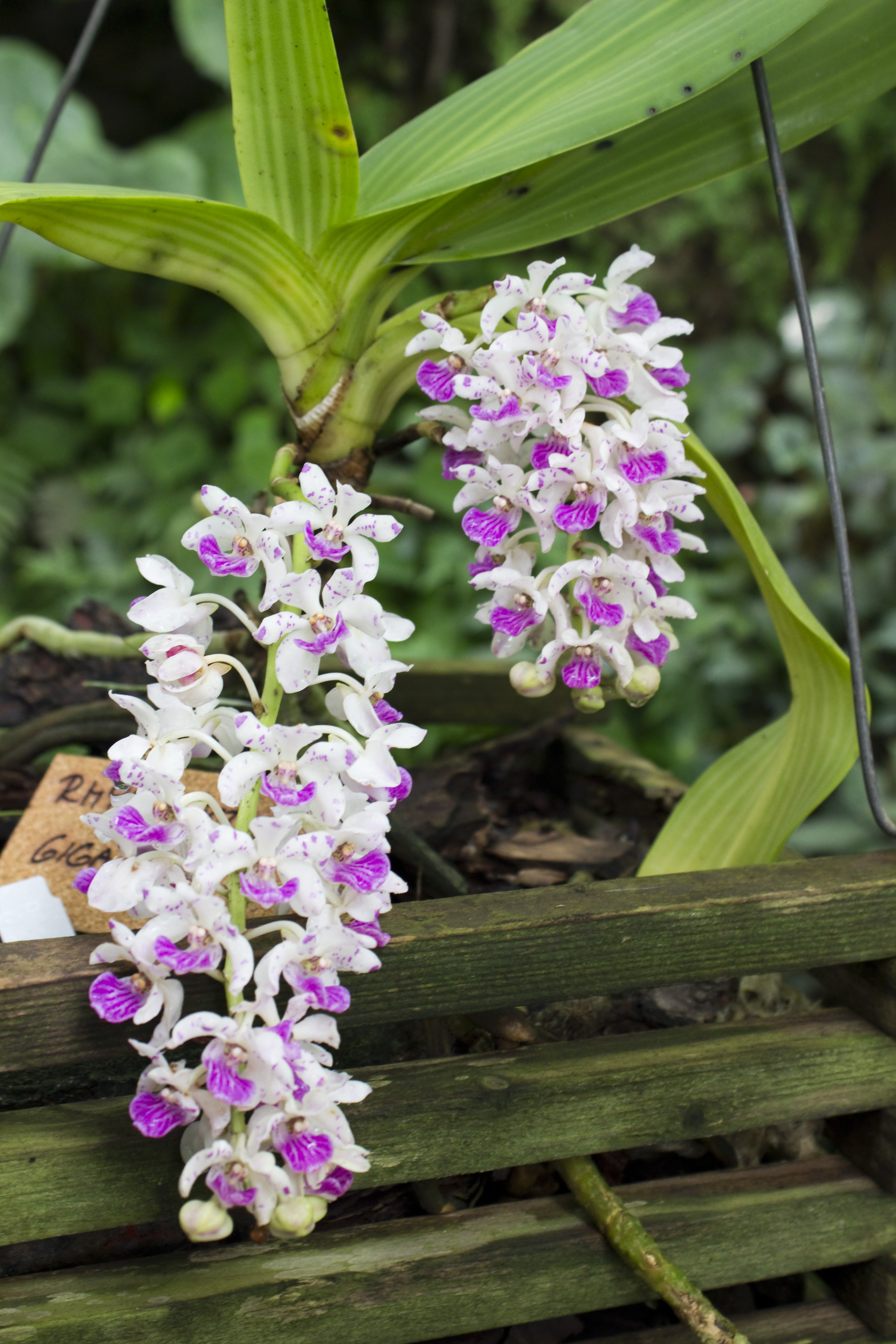
Pretty picture: Rhynchostylis gigantea 'Orange Star'

So, most pictures I found on-line of Rhynchostylis gigantea show white flowers with varying amounts of magenta or purple, in the form of dots, blotches, and labella. Except when they're solid purple, magenta, or white. And there is also a variety, R. gigantea var. vivaphandhul, which is apparently orange and pink. And, well, 'Orange Star' is apparently also pink sometimes, despite the name,1 and now I'm adding my photos of this pale pink/coral bloom.


Which all sort of raises the question: can you call any old orchid a Rhynchostylis gigantea and get away with it? As far as that goes, I'm not confident that I could prove, in like a court of law or something, that I myself am not merely an uncommon clone of Rhynchostylis gigantea. Maybe the entire world is just one Rhynchostylis gigantea after another, all the way down.

(Or not.)

As strange as it is to have a species that can bloom in so many different patterns and so many different colors, the ID is apparently legit: it's just a species with a very large natural range2 and lots of different clones available. They're also, as the name would suggest, and the linked photos earlier will attest, capable of becoming very large, though this particular specimen was small, maybe a foot / 0.3 meters in diameter at most. Bloom spikes can have hundreds of individual flowers on them, and of course there can be several bloom spikes to a plant.


They're also supposed to be strongly, sweetly fragrant; it's apparently incredible. I don't remember noticing any smell from this plant at the show, though. So I've seen a specimen of an enormous plant that grows huge, many-flowered, highly fragrant spikes of white/magenta/pink/purple/orange flowers, without getting any of the actual experience of seeing an enormous plant with huge, many-flowered, highly-fragrant spikes of white/magenta/pink/purple/orange flowers.

-

1 In fact, I wasn't able to find a photo of 'Orange Star' that I would call orange; the orangest photos I saw were of var. vivaphandhul. Why did someone name this pink-flowering plant "Orange Star" when it is not orange?
Ah. There I go again, expecting orchid names to make sense. I should know this by now.
2 Wikipedia: "Myanmar, Thailand, Malaysia, Laos, Cambodia, Vietnam, Hainan China, Borneo, Bangladesh and the Philippines"


Tuesday, May 10, 2016

Schlumbergera seedling no. 090

Wait. Didn't I just name this one? I guess I didn't. *sigh*

The good news, if you want to think of it as good news, is that after this one, there are only three Schlumbergera seedling posts left, and then we can once again get our boredom from pink Anthuriums, as nature intended, instead of orange Schlumbergeras.


Anyway. This one looks an awful lot like 028A Phil Collen, 092A Sparky, and 102A Michonne. Perhaps we could save some time by just looking at the previously considered names for those three and picking one?


Well. 028A Phil Collen was always Phil Collen; no other names were even considered. So he's no help. And I didn't like the original set of choices for 102A Michonne,1 so I free-associated my way into picking a different one and then edited the post after the fact to make it look like it had been under consideration all along. But there is still Lola, which I really wanted to use for 092A Sparky because of the color. Sparky's color is essentially identical to this seedling's color, so: is there any compelling reason not to go ahead and just name this one Lola?


Can't think of one. Ergo: Lola!

-

1 (Judith, Gamma Ray, Shipbuilding, Tokyo, Glass Heart, Easter Island, Rapa Nui, Hegahega, and Casino)


Monday, May 9, 2016

Unfinished business: Gasteria bicolor (?)

So. I got some seeds from one or more Gasteria bicolor plants in I think November 2012. I sowed them, several germinated and grew, and then they kept growing. Not all that unexpected so far, but in the first post, I noted that it was possible that the seeds were hybrids -- the original plants were identified as Gasteria bicolor, and sure looked like Gasteria bicolor to me, but I didn't know who the pollen parent was (the seed parents didn't belong to me, and the person they did belong to didn't know).

I also said that there was a good chance I'd never find out whether they were hybrids or not, because my track record with Gasterias was that I usually overwatered them.

And now, roughly four years after acquiring the seeds, I can say that it sure looks to me like they're hybrids. I didn't overwater them (yet), is one indication they're not G. bicolor. Another is that they're all at least a little different from one another. Sometimes a lot different.

Some of them look more or less like the species, or barely lighter than the species:


I'm pretty sure the top seedling is in a 4" / 10 cm pot, and the bottom one is in a 3" / 7.5 cm pot.

But a third plant is very short, small, and dark, and offsets heavily:

(3" / 7.5 cm pot)

And another is a lighter green, with thinner leaves.

(4" / 10 cm pot)

So I guess at least some of the blooms had been pollinated by something that wasn't Gasteria bicolor. So far, I kind of like the last one best, at least as far as color, but it's not an offsetter so it may not be propagatable.

Also so far: no scale detected on any of them. Doesn't mean scale aren't there,1, but I haven't seen them. Considering that my Gasterworthias and Gasteraloes have had an easier time in general with the scale than the Haworthias and Aloes, I'm sort of inclined to think/hope that maybe Gasteria genes make plants less palatable to the scale. In any case, I'm hoping to be able to keep a seedling or two as long-term residents, which will be easier to do if the scale leaves them alone.

I've gotten a similar result from a different set of seeds (which I will leave unidentified in the interest of building mystery) recently, but in that case there's much more variation among the offspring, which makes much less sense: it was a self-pollination from a plant which, up until pretty recently, I had been confident was a species. The seedlings are cool, and one of very few things the plant collection has done lately to make me happy.2 I'll show you toward the end of May.

-

1 (It could just be that by their bumpy and spotty nature, Gasterias provide better camouflage for scale than related plants in othere genera.)
2 (
Veeeerrrry few. Like, possibly the only.)


Sunday, May 8, 2016

Schlumbergera seedling no. 098

Schlumbergera seedlings don't usually need "practice blooms" like Anthurium seedlings do; for the most part, the first flower is like the later flowers will be, and I don't need to do a lot of guessing about what they might wind up doing later on. So although 098A only made the one flower this year, odds are pretty good that the slightly stretched-out shape, with the petals divided into a front half and a back half, will be seen in future blooms.


The problem, of course, is that there's always the possibility that this one will be an exception, and will do something substantially different next year. So I need a name that gestures non-comittally in the direction of the slightly odd shape, without actually promising a slightly odd shape. To that end, I'm going to dispense with the categories and try to come up with a name the old-fashioned way: by looking at a thing, then choosing words to describe the thing.

So when I look at this flower, what is it that comes to mind exactly? Well, the back half of the petals sort of brings to mind a ballerina's tutu. They're not ordinarily hunter orange, granted. But maybe that's useful. Hunting Tutu, or something along those lines?

The extended, tightly-packed anthers and stigma sort of evoke a chameleon, or frog -- one of those animals that shoots out a long, sticky-tipped tongue to catch and eat insects. Chameleons are rarely orange, though, and searches for orange frogs mostly turned up depressing Wikipedia entries about extinct or nearly extinct amphibians, which were actually mostly yellow anyway. There are some orange or red-orange poison dart frogs, though, and they do shoot their tongues out to catch insects --


-- so . . . maybe a name that has something to do with poison dart frogs? But what? (Also, a warning: searching for anything having to do with poison dart frogs will reveal a surprisingly large and robust poison-dart-frog hobbyist community. Very easy to get sucked in and lose an hour.) For all the information about the frogs, it was difficult to find a straightforward list of species with photos.1

The best option I could come up with, frogwise, was a relatively common (?) species, Phyllobates terribilis, the orange form of which is called "Orange Terribilis" in the frog trade. Though I expect to find out eventually that Latin is forbidden by whatever authority recognizes and approves cultivar names, it's possible that English/Latin is acceptable. And in any case I cannot afford to get sucked into any more poison dart frog sites, lest I start wanting some.2

So that's two possibilities. What would be a third? Well, it's kind of cheating, because most Schlumbergera flowers have it to some degree or another, but 098A has that windswept, petals-thrown-back thing going on, at least in these pictures. So what's orange and white and blows in the wind? Well, amazingly, Wikipedia has a list of flags organized by color, and it contains exactly one orange-and-white flag: that of Fukushima Prefecture, Japan.

Yeah. That Fukushima.

So that's kind of emotionally fraught. The people of Fukushima are, of course, not responsible for the earthquake and tsunami, but the fact remains that people get irrational about radiation,3 and "Fukushima" basically means "radiation" now to a lot of people, so it would probably not work out well commercially, however it was intended.

Further pursuit of orange flags found a site that claimed that Salt Lake City, Utah, was providing blaze orange flags for pedestrians at crosswalks, to wave around while they cross and give them greater visibility to drivers. Which seemed like it would eventually wind up being counterproductive.4 Other cities have tried the idea, with mixed results -- Seattle didn't notice it made a difference, and couldn't evaluate certain locations because people kept stealing the flags; almost nobody used them in Berkeley, California (only 2%), and many of the people who did use them stole them (Ref.) -- and I can't tell whether SLC is still using them or not. In any case, I'm thinking that instead of Fukushima, I'll go with Pedestrian as the flag-related name option, even though most cities seem to be going with yellow flags instead of orange.


So that's three. This post is feeling kind of long already, so maybe it's time to stop and pick one.

Pedestrian kind of works -- it's also maybe a subtle dig at 098A being just another orange bloom, by way of the "undistinguished; ordinary" meaning of "pedestrian." And it's also a common, familiar word. That all also makes it a less exciting choice, though.

Hunting Tutu is . . . well, I wish I had a way to just show you the mental image I have of this, because it is delightful. (This is the closest I could find via search, though I was picturing a different material: something heavier and more opaque, that would hold up longer in a game-hunting situation.) But it's also maybe a little too pointedly weird.5

Orange Terribilis has the Latin problem, and I've been trying not to use the bloom color in the names.6 It's also longer than the others.

I suppose I could roll the last two together into Terribilis Tutu. But that's awful.

Or is it?

Yeah. It's awful. Pretty sure. But so what then?

I don't know. I'd planned for this post to go up on 8 May, and it's already 6 PM on 7 May, and I still have a lot of watering to do, so I should just pick something. So . . . I guess if I'm being honest with myself, of the three and a half options here, I'm feeling the most drawn to Hunting Tutu, as in, "Larry gathered his knife, rifle, and hunting tutu."7 Not really altogether happy with it, but I have to choose something, and I'm too wiped out right now (long day, long story; everything's fine, though) to try to generate additional options. So there it is.

-

1 Some of the problem may be that many of the species have multiple color forms. As with plants, people tend to be more interested in the pretty colors than in getting the names right, and the world of poison dart frog hobbyists isn't immune to taxonomic upheaval either. So one can kind of understand why species names wouldn't be foremost on everybody's minds. Still doesn't excuse the lack of reference galleries.
2 Though I do wonder how good they'd be at handling thrips. The "poison" part wouldn't even necessarily be a problem, since they're not necessarily poisonous -- it looks from a quick skim like wild-collected frogs are knock-you-dead poisonous if eaten or handled, but they lose their toxicity one to three years after collection, and captive-bred frogs aren't toxic at all. I mean, Sheba would still be a concern, and I really doubt the conditions in the house are suitable for their long-term survival anyway. One only has just so much money for buying frog corpses. But the thrips situation has me thinking further and further outside the box, especially now that it's spread to the Schlumbergeras. And it's not like I haven't considered frog-administered services before. (This is my million-dollar idea, I can feel it. I just have to get the details right. . . .)
3 By which I mean that there's very little understanding of how widespread radiation actually is, and how much radiation it takes for something to be dangerous. This xkcd image illustrates both pretty well.
4 If you get drivers expecting to see pedestrians carrying flags, then don't you make the pedestrians who aren't carrying flags harder to see, and more likely to be hit?
5 Oh! Speaking of pointedly weird / tutus! I ran across this video from the Cincinnati Ballet a few days ago and thought of you. There's a quick moment at 0:46 that makes me laugh every time, and the stretch from 1:04 to 1:50 is pretty good too:


6 Perhaps it would be more accurate to say I've been trying not to use common color words in the names: "red," "orange," "pink," that sort of thing. 064A Rose Hoses, 022A Sad Tomato, 055A Pumpkin Festival, 082A Strawberry Madeleine, 208A Raspberry Possum, 058B Buff Orpington, and 103A Ginger Beer could all count as me directly naming a color in the seedling name.
7 And emphatically not in the sense of "Larry looked around. The Archbishop was nearby; he could feel it. But which direction? And why was he hunting Tutu in the first place?"