WCW told me once that if you want to, you can overwinter Hibiscus by letting them go dormant: you stick them somewhere cool, let all the leaves drop, and then only give them just enough water to get by until the spring. And then in the spring you put them outside and they leaf out quickly and then you go on.
It seemed like a sound enough idea, and WCW said she'd done it herself, but I wasn't quite ready to commit to it. I figured if I could keep them growing and flowering happily through the winter, then there was no reason not to, so I'd only let them defoliate if it turned out that I couldn't keep them growing happily.
So I stuck them in front of a small window in the basement, and waited to see what would happen.
For the most part, nothing happened. Some sporadic blooms at first, then they settled down and just sat there. I gave them full, thorough waterings when the soil got dry, but they didn't seem to be doing anything with it.
Then, beginning in maybe mid-December, specific branches would defoliate rapidly from time to time. Like, everything would be fine, and then suddenly all the leaves on one branch would go yellow and drop overnight, and the house would rattle as all the leaves hit the floor at once.
There didn't seem to be anything wrong with the plant otherwise: I saw a little webbing, but it looked like fairly coarse webbing, the kind that spiders make cobwebs from, and they were in the basement, where there are often spiders, so I didn't suspect spider mites at first. Plus I didn't actually see any mites, ever. But it kept happening, and I got kind of worried. Plus it sucks to get woke up in the middle of the night by the house rattling because your Hibiscus just had a massive defoliation.
Maybe I didn't want to let them go dormant after all. Maybe they were defoliating from lack of light, and if I just put them somewhere brighter, this would all stop.
So. They came out of the basement to the living room, and I gave them a spot on the floor near the big window. Plenty of light there. (Also a heat vent, but -- not a very big one! And it wasn't blowing directly at the plants!) Looked the plants over, didn't see any webs or any mites.
Imagine my surprise when a whole branch defoliated again, and, upon examination, turned out to be completely swarming with spider mites.
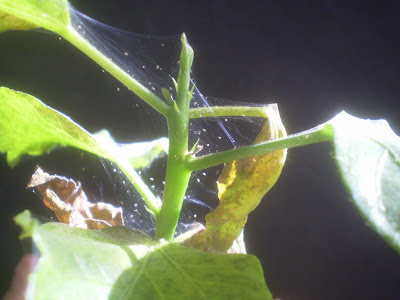
This is much more terrifying full-size. You can actually make out individual little legs on one of them. [shudder]Then imagine my depression, frustration and rage. Next, imagine my inebriation, as I drank to try to forget about the mites.
(You're really very good at imagining my mental states! Good job!)
So. Both
Hibiscus got a prolonged bath: dish soap, shower, more soap, more shower, and now they're back in the basement again. Where, to their credit, no branches have gone suddenly nude again. But still. Spider mites are despicable. In that I am completely able to despic them. I despic them
so hard, y'all.
So that was a bummer. Then, a few days after the
Hibiscus returned to the basement, I was watering the big purple
Neoregelia when I noticed some spots on the leaves that rubbed off, when I tried to rub them off. Which is a bad sign.
 Roundish green dots: part of the natural variegation. Roundish tan dots: scale. White crusty stuff toward the right side of the picture: mostly hard-water spots, I think. Though there could be some immature scale running around in there, I'd never know.
Further inspection revealed that I had scale. And they were everywhere. Leaf surfaces, leaf undersides, the inaccessible spaces at the base of leaves -- everything. It didn't appear to be too far gone, but it was still a surprisingly advanced infestation to be catching for the first time.
The long-term solution was to add imidacloprid granules to the soil. I don't know if this will necessarily help, but I had them already, and in theory they
should work. Eventually. (I have yet to be particularly impressed with systemic pesticides, actually. This is maybe something we could discuss in the comments.)
The short-term solution was to get a wet paper towel or two, or ten, or fifty, and try to wipe off as many of the bastards as I could. The only problem with that is -- well, look up at the first
Neoregelia picture again. See the spines all along the leaf margins? Yeah. They're actually kind of sharp. And pieces break off in your skin sometimes. So it's not that easy to get a hand down in there, never mind trying to do any serious leaf scrubbing once it's in.
So that was also a bad day. I haven't had any issues with
scale in something like ten years. (I bought a
Caryota mitis, fishtail palm, without noticing that it had a serious scale problem. I kept waking up to find the floor beneath it sticky, but somehow didn't put it together that there might be a bug problem for a really long time. When I
did figure it out, the plant was thrown away.) I have little itchy cuts all over both hands, and down the back of my right arm, and this is something I'm going to have to do repeatedly for a while.
 The slightly-raised tan circles are, again, scale. The small, white, elongated things scattered around them are probably baby scale. The babies are actually so small that I can't see them with my naked eye; I can only see them after taking a picture, uploading it to the computer, and looking closely at it.
For some plants, I'd just throw the thing out, rather than try to undertake an extermination program. I'm willing to try extermination in this case because the plant would be expensive to replace, I've already had it a long time, and the scale doesn't appear to have done much permanent damage to the plant yet. It
has spread to one other plant, also a
Neoregelia, but as far as I can find (and I looked pretty hard at everything in the vicinity) it's only the one, and the infestation on the second plant was very, very light. So I'm sort of optimistic that this can be dealt with in a way that permits me to keep the plant.
And it could always be worse. It's not mealybugs.
Still, though. Depressing.


2.png)
3.png)
.png)


.png)
.png)


.png)


.png)
.png)
2.png)
.png)
.jpg)


 Posts
Posts