The half-off rack at Lowe's. Boy did I feel self-conscious getting this photo.
I enjoy, as I've mentioned, occasionally picking up an ailing plant (big-box distressed racks, consignment stores, yard sales, abandoned plants hanging out near dumpsters for long periods) and trying to bring it back to some semblance of respectability. At best, it's a good way to get a good future plant for free or cheap, and at worst, it's a chance to learn which gambles aren't worth the risk.
This is on my mind more than usual lately because right now at work we're sort of beginning to switch over to thinking about the tropicals again, after the long neglectful nightmare that was the spring. Specifically, we've been going through the old stuff, disposing of the lost causes and cleaning up those few that might still make it, in anticipation of a new order of stuff which just arrived yesterday right before close.
 Tillandsia cyanea I got cheap from a grocery store over a year ago: it had bloomed out and was no longer especially desirable.
So I've been doing a lot of thinking about some trashy-looking plants lately, whether they'll come back, whether to give up, and in so doing, I've come up with some very general guidelines for how to make that decision. A lot of people, I think, are not as willing to take on fixer-upper plants as I am, and if you're one of those people, although there's no shame in that, a lot of this isn't going to be all that applicable to you. But if you
are one of those people, here's how I do it:
-
1. Mealybugs, Scale, Whitefly
Even if it's on a 6-foot tall plant with gorgeous, huge, fragrant flowers and leaves like rainbows, that spontaneously generates hummingbirds and chamber music all day long, if I see a
mealybug, it's out of the running, full stop. Ditto for scale or
whiteflies. Enough of those sneak past me as is; I don't need to deliberately bring in more.
 Mealybug on Cereus peruvianus.
2. Spider Mites
Spider mites may or may not count against a plant. If there aren't a lot of them, if it's a small plant with broad leaves that looks like it would be easy to wash off in a sink, if it's not a species normally prone to mites, then I might consider it. Spider mites
always disqualify the following species:
Hedera helix,
Dizygotheca elegantissima,
Araucaria heterophylla,
Codiaeum variegatum,
Hedera canariensis,
Schefflera actinophylla,
Schefflera arboricola,
Ficus elastica,
Ficus benjamina,
Polyscias spp.,
Maranta spp.,
Calathea spp.,
Fatsia japonica and
Fatshedera lizei.
 Spider mites on a Ficus elastica.
I may be willing to gamble on
Cordyline fruticosa or
Dieffenbachia spp. with spider mites, depending on the extent of the damage, the size (washability) of the plant, and the density of the infestation, though this is less because it's practical than because I like them more than most species.
3. Aphids
Aphids, on the other hand, never disqualify anything automatically unless they've clearly been there for so long that the plant has distorted growth. Or if they're big enough or dark enough that I can see them moving around, which sometimes squicks me out. Aphids are too easy to get rid of to be worth worrying about. (Indoors. Outdoors is a different story.)
 Aphids on a Salvia 'Black and Blue.' The plants are vigorous and look just fine, but they are bug magnets, and it's looking like a lot of the money we put into them is unrecoverable.
4. Fungus Gnats
Fungus gnats don't disqualify anything at all, ever. I don't mind fungus gnats. They're adorable. Like puppies. They're like puppies that try to crawl up your nose and drown themselves in your coffee.
5. Difficulty Level
I don't try to rescue plants that I have a hard time growing when they're in good condition, or that I haven't attempted in good condition. So no
Gardenia, no
Coffea, no
Alocasia or
Musa or
Calathea. Basically, if it's above 7.0 on my difficulty scale, I don't even think about it. I have, however, scored some perfectly respectable
Cordyline fruticosa (6.8),
Saintpaulia ionantha cvv. (6.1), and
Dieffenbachia spp. (4.5) before.
 This looks similar to the Saintpaulia variety that had me so impressed in December, though it is in fact a different one. I found it at Lowe's in late March for like $1.50 or something crazy. It had been overwatered, but has come back very quickly and beautifully. I like when they're grateful.
6. Sunburn
Sunburn is not usually a problem. Yes, it looks crappy, but most plants will pull out of it, given enough time to do so. Sunburned
Dracaenas are a particular enthusiasm of mine, but I've also seen
Chlorophytum 'Fire Flash' on the racks at Lowe's, and they'll bounce back from just about anything. Sunburnt
Spathiphyllum will also come back fine, so long as they're not having some other problem simultaneously (like being too wet, e.g.).
 Formerly sunburnt Dracaena fragrans 'Massangeana.'
7. Too Wet
Rot and overwatering usually
are problems, especially if the plant is coming from a big box store: if the soil is soaking wet, or the plant is in a drainageless pot, it still might work, but I'm a lot more cautious about it. I passed up a
Asplundia 'Jungle Drum' I wanted once, because of this. Sometimes I buy anyway, and I've had mixed results: roughly every other waterlogged
Dieffenbachia from Lowe's I buy makes it.
Always pass up overwatered plants from species that are especially sensitive to overwatering, like
Dracaena deremensis 'Janet Craig,' cacti,
Haworthia spp.,
Zamioculcas zamiifolia, and
Sansevieria trifasciata: the odds are very much against you. (Though see #11.)
 Half-drowned Aglaonema 'Jubilee', saved from an abusive customer and partially-rehabilitated. It's going to take forever to get anything particularly good out of the plant, but it's eventually going to happen.
One also needs to be on the lookout for signs of rot with too-wet plants: mushy stems, bad smells, etc. Sometimes it's possible to salvage a bit of healthy cane from a plant that's partially rotted away (
Aglaonema and I get along well for that reason); with other plants, by the time the rot is obvious, there's usually not anything left to save (
Dracaena marginata, for example).
8. No Good Reason to Discount
Some places will discount plants just to make space for new stuff: they may have a torn leaf or two, but essentially they're fine. Those can be rescued with no shame whatsoever. I've gotten a nice
Strelitzia nicolai that way, and I've seen slightly irregular
Monstera deliciosa that would have been of interest to me except that I have too many of them already.
 I think I paid Lowe's like $10 for this. It might have been less. I don't remember anymore.
9. Too Dry
Underwatering depends on severity: if there's no green left and the whole thing is crispy, it's a lost cause. If there's still some green, surrounded by brown, it could go either way. If it's all green but very limp, you've got a good chance. Again, some plants bounce back better than others. I'd skip over dry
Homalomena,
Coffea, ferns,
Radermachera sinica,
Hedera helix, and
Codiaeum.
 Asparagus plumosus, rescued from a customer who was I guess just not that into watering. The comeback is excruciatingly slow, and I may decide that I don't have the patience, but it's not taking up that much room so wev.
Other plants will spring back to life after a long dry spell, even if they've been dry for a long time.
Aspidistra elatior is one of those, as are
Yucca guatemalensis and
Sansevieria trifasciata.
10. Too Cold
Plants with cold damage have a good chance of coming back if they like cold anyway (
Hedera helix,
Rhapis excelsa,
Cissus rhombifolia), if there's not much visible damage, if they're known to be tough plants (
Crassula ovata,
Yucca guatemalensis), or if they're very large plants with large rootballs. Plants like
Dieffenbachia,
Aglaonema,
Dracaena, and
Musa, with tropical origins and big broad leaves, tend to be more tender and are probably not worth your time. Also bear in mind that although a lot of plants will survive some degree of cold damage, just because it doesn't kill them doesn't mean they're ever going to be pretty again.
Also the odds of survival are, as you'd expect, related to how cold the plant got, and for how long. Almost all houseplants can survive a brief dip into the 50s (F; roughly 10-16C): they may drop some leaves, but it usually won't kill them. On the other hand, most of them will die from sustained temperatures in the 30s (4C to -2C), and only a rugged few will come back from 20s.
11. Propagatability
Sometimes plants aren't ever going to look any better than they do already, but they may be a decent source of raw material for propagation. A thoroughly trashed
Syngonium,
Epipremnum, vining
Philodendron,
Aglaonema,
Cissus,
Hoya,
Begonia,
Ficus,
Peperomia,
Cordyline,
Tradescantia,
Sansevieria,
Echeveria,
Zamioculcas,
Sedum, etc., may still be perfectly good for starting a new plant: the question is just, how long do you want to wait for it, and how much room are you willing to devote to it? A plant that's too far gone may, of course, still not make it, but I've managed to propagate a lot of plants from bits and pieces.
Peperomia caperata is particularly valuable in this respect: as we have
seen a couple times, all you need is a single moderately healthy leaf and some time.
Zamioculcas is likewise, except for needing considerably more time.
 Discounted Syngonium podophyllum from Lowes.
 Also a discounted Syngonium podophyllum from Lowe's, except this one's been turned into cuttings.
Bromeliads also tend to fall especially into this category.
Guzmania,
Aechmea, and
Vriesea, specifically, are all usually discounted after the blooming period is over, so if you're willing to invest the time, you can get five or six plants for the price of half of one. This can be a pretty good deal, but you do have to make a bit of a commitment. I think
Vriesea splendens is plenty attractive even when not in bloom, so it's consequently an especially good prospect, though it also tends to be more expensive than most, even when discounted, and because it's still attractive when not in bloom, I think it's often held at full price longer. It's good to check bromeliads for root rot before getting excited, but if the roots are still working to anchor the plant, there shouldn't be a problem.
 Baby Zamioculcas zamiifolia from a leaflet I grabbed from the floor of a competitor, well over a year ago. (They would have just thrown it away, and it was already broken off. Also this was before I had my present job, so they weren't a competitor at the time, exactly.)
12. Wouldn't Know a Good Thing if it Bit Them on the Ass
My
Hylocereus was discounted when I bought it, because it had been the base for a graft, and the graft fell off. I didn't care about the lurid red
Gymnocalycium anyway, so I wound up getting the plant that I wanted, for half the original price, and with some of the work of de-grafting done for me already.
 Hylocereus undatus.
13. Repetitions
Plants that you have had before, and cared for successfully, are more likely to work out as rescues, for the obvious reason that you already have some idea what these plants want and how they communicate.
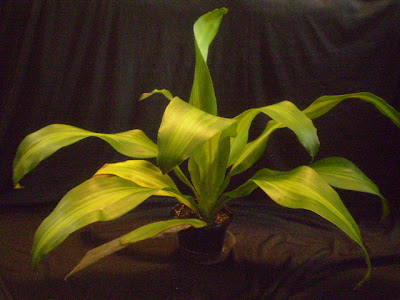 My third Dracaena fragrans 'Massangeana' rescue. This is a piece that got broken off of a plant we got in the last tropicals shipment, in March. I rooted it in water, planted it, and I think I'm going to wind up keeping this one.
-
So those are the basic ideas. Most of it's pretty common sense, really.
My employer, incidentally, doesn't put tropical plants on clearance ever: it's something I've talked to her about before, and the gist of the logic is, if the plant could be brought back to respectability, then we should just do that and sell it at full price, and if it can't be brought back to respectability, then we shouldn't be selling it to the customers under any circumstances, discounted or not. This, I think, is a little oversimplified (yes, we could put $25 worth of man-hours into bringing back a
Peperomia with one good leaf, but if we're then going to turn around and sell it for $3.50, we'd be money ahead to just put it on clearance, no?), but she worries about us getting a reputation for having trashy plants.
I agree that this should be a concern. We aren't going to have the cheapest plants in the area, ever -- it's just not possible, given our size and suppliers and stuff -- so the least we could do is try to have nice plants, and unusual plants. People will still buy from us if ours look the best and if we have stuff nobody else has. (
Although, it's difficult to have the best-looking plants when everybody
else gets them straight from the supplier looking perfect, has them a week or two, and then puts them on clearance, without ever having to put any time into caring for them. Plus the competition can buy them cheaper to begin with. I think this may be a losing fight. Hence the pushing to get different stuff, weird stuff, etc., so that at least we can have stuff that nobody else does.) So I try to maintain everything as best as I can, but I don't think there's anything
necessarily trashy about repricing things that aren't selling.
WCW agrees. If we can't get permission for discounts, we have to look for other options, and what we've come up with instead is, anything that looks unhappy gets brought into a back room, or is shoved under a table, and has to fend for itself. If it comes back, then awesome, we'll put it back out and sell it; if it won't, then it gets thrown away, chopped to pieces and propagated, or it follows one of us home. Benign neglect in a new location does sometimes work, though it's not an especially efficient way to go about fixing things up, and sometimes, depending on what kind of space is available, we may end up displaying crappy-looking merchandise anyway.
Don't look at me like that. Like
your job doesn't involve catch-22s too.


 Posts