Saturday, June 4, 2016

Anthurium no. 0367 "Petey Gibson"

I get Petey mixed up in my head with 0366 Maureen Biologist a lot. Similar bloom color (though Petey's darker red than Maureen), adjacent ID numbers, potentially nice foliage with "lizard" venation.


Petey distinguishes himself from the other red and dark red blooms in the mid to high 300s by having unusually long, narrow foliage, which has become more extreme as he's aged. The early leaves were only a little narrower than average,

I know. It's the best picture I've got, gimme a break.

but the trait has been getting more dramatic as the seedling ages. They're also folding themselves along the midrib more and more with each new leaf, which makes them look even narrower in photos:


A few other plants have done something along the same lines, which surprised me, since none of the parent varieties are so extreme. Presumably a few recessive genes are showing themselves. It appears to be most likely when genes from 'Gemini' meet up with the ones from the NOID red, though that's tough to prove, since I'm not 100% certain about any of the pollen parents, for any of the seedlings.

Other seedlings with long, narrow leaves. Clockwise from top left: 0040 Ivy Winters, 0464 DQ, 0779 Hollee Luja, 0768 Glenda Bender.

Petey has some ongoing scale problems. I'm not sure how much of a problem this is; at least some of the trouble appears to be the result of having scale-prone neighbors.


Verdict: keeper, at least until the scale situation becomes clearer.

Random site that might be of interest: THE POISON GARDEN website (all-caps in the original, don't blame me), which contains a lot of interesting stuff about various poisonous plants. I found it via MetaFilter, in a post about Balkan endemic nephropathy, a disease found in isolated villages near the Danube River which defied explanation for many years but now appears to be the result of ingestion of a "medicinal" plant, Aristolochia clematitis.

The Aristolochia post is interesting by itself, but there are plenty more like that at the site, so if you like reading about people suffering and dying because of plants, you'll love THE POISON GARDEN. If not, wait, and I'll try to find something else.


Thursday, June 2, 2016

Pretty picture: Lysudamuloa Red Jewel

There were two different specimens of Red Jewel in the show, one with a clone name attached ("Sweet Baby") and one without. I didn't notice this until after I got home. I can't tell any difference between the photos, and wouldn't be surprised if both plants were the same clone of Red Jewel, but I'm putting them in separate posts anyway. (This is the no-name one; "Sweet Baby" will show up in November.)


I like Lycaste-type orchids as much for their foliage as for their blooms: the leaves remind me a bit of Asplundia 'Jungle Drum.' Though I see I have failed to get any particularly good pictures of the foliage for this post.

Supposedly, Lysudamuloa Red Jewel is fragrant, but for all the usual reasons (too many fragrant plants and people around to tell which is which, some orchids are only fragrant at certain times of day, or during a certain part of the bloom cycle, wind currents, nasal congestion, etc.), I cannot verify that this is the case.


Lysudamuloa is a new nothogenus, but we've seen the occasional Lycaste here in the past.

Lysudamuloa is an unusually messy and awkward name. (At least it tripped me up for a while; maybe it sings like a bird for you.) But, thinking about it, I was suddenly hit with the realization that all the nothogenus names I've run into lately have been clunky in the same way. I mean, it wasn't that long ago that I was regularly running into nothogenera that were obviously [person's name + -ara], like Aliceara, Beallara, Collierara, Goodaleara, Jackfowleara, and so on, but it feels like it's been quite a while since that happened. Now the names are all constructed in pieces from the names of the parent genera, like Prosrhyncholeya, Rhynchomyremeleya, Laeliocatanthe, Guaricattonia, and Brassocatanthe.

I suppose this has the advantage of making the ancestry clearer: a Guaricattonia is probably a hybrid of Guarianthe, Cattleya, and something else to provide the -onia (My guess was Bratonia but it turns out to be Broughtonia.1), whereas a Jackfowleara could be anything: you'd only know that it's Cattleya x Caulaelia x Laelia x Guarianthe if you happened to have already memorized the formula [Jkf. = C x Cau x L x Gur]. So maybe this is an improvement on the old system? Certainly it seems like it would be a lot easier than suddenly scrambling to find a new set of people to name nothogenera for every time there's a taxonomic earthquake in the Orchidaceae. And it would also have the advantage that if it turns out that Collier was a real asshole or something,2 you're not stuck honoring him every time you refer to a particular group of plants.

The down side being, of course, that the new nothogenera are all like six syllables long and frequently unpronounceable. (And if you think orchid vendors and exhibitors get the names wrong now, what happens when they have to start contending with stuff like Rhyncatclia, with that sneaky "L" hiding toward the end, just itching to be dropped?) And it doesn't fit the name-based older names, because some (most? all?) of them are still in use, e.g. Jackfowleara.

I don't know that there's any sensible way to fix all this, but I'm tempted to think we'd all be better off if the taxonomists had just burned the whole system to the ground and started fresh, with all-new genus, species, and nothogenus names, with an eye toward giving them names that would make for pronounceable, spellable, and logical nothogenera. Like the way the pharmaceutical companies have settled on a system for constructing generic drug names based on what they do. (If generic drug names often sound like they come from some extraterrestrial language -- e.g. vernakalant, eltrombopag, pralnacasan, etc. -- it's because they kinda are.)

-

References: Respect to the St. Augustine Orchid Society, and specifically member Sue Bottom, for this .pdf, which I have been referring to an awful lot lately. It only covers the name changes within the Cattleya Alliance, but those turn out to be complicated enough to require six pages of explanation.

1 I assume that when orchid taxonomists get into fights (which I'm sure they must, all the time) and Taxonomist 1 says "bring it on," Taxonomist 2 is obliged to respond, "oh, it's already been Broughtonia." [How many other blogs are going to give you an orchid-taxonomy/Bring-It-On joke, hmm?]
2 I have no idea. Maybe Collier was, like, the best guy, universally beloved by all who met him. But odds are he was a jerk at least some of the time, and to certain people more than other people.


Wednesday, June 1, 2016

Anthurium no. 0515 "Diane Torr"

Diane has good points and bad points, definitely an improvement on 0417 Burt Fieder; however, I go back and forth about whether she has enough good points to keep her out of the trash. Her main advantage on Burt is that the bloom color is subtly unusual:


There have been pink-purple blooms before -- 0534 Celia Putty is particularly similar -- but Diane's is a bit lighter and purpler, and her spadix is a little more orange. It's not an amazing color combination, but it's pleasant, and different enough that I consider it unique. So I figure she's earned the right to stick around, at least for a while.

Like Celia (and so, so very many other seedlings), Diane's biggest problem is thrips. The leaves initially improved after I started blasting the leaves with water at every watering, progressing from this


to this,


but then they regressed a bit -- the latest leaf hasn't fully unfurled yet, but it's clearly going to be closer to the first leaf photo than to the second.

The blooms aren't improving either. Diane's second bloom looked like this:


So, interesting color or not, I'm trying to lower my expectations for Diane.

The plant as a whole isn't suckering, but is fairly compact. So that's also sort of mixed.


So in the end, I'm not sure about Diane's ultimate fate. I'm definitely keeping her until the berries on the first bloom either ripen or abort. After that? I like the color well enough that I'll probably keep her if I can come up with a way to justify doing so, but I may not be able to if the thrips problem continues to worsen. We'll have to see.


Monday, May 30, 2016

Anthurium seedling no. 0517 "Burt Fieder"

Burt has all the problems common to the BF seedling group, and his only redeeming features are a willingness to bloom and a fairly compact habit. First bloom was small, the same coloration as the seed parent ('Gemini'), and mildly distorted by thrips.


Second seedling was the same but with a straighter spadix. They both had a dead-looking patch at the tip of the spadix, which I suppose could be due to coincidental damage at the same point in development or something but could also just be what he thinks spadices are supposed to look like. Either way, it doesn't make much of a case for his commercial viability.


The leaves are badly distorted and scarred,


and the plant as a whole is nothing to get excited about either.


So Burt's gone in the next purge, unless something miraculous happens. It hasn't felt like it, but we've had a pretty good run lately with the Anthuriums; the last seedling with no redeeming qualities was maybe 0470 Heather Haldane, and that was almost two months ago. So I suppose we were due for something like this.


Saturday, May 28, 2016

Pretty picture: Phragmipedium Rouge Bouillon

First phrag from the 2016 show. They weren't well-represented in my photos this year, though there were plenty around: they're tougher to photograph than Paphiopedilums (which are easier for my autofocus to deal with, because of their flatter "faces").


Don't have a lot to say about it; the color's pretty nice, I guess. Tag was misspelled, again. *sigh*


Phragmipedium Rouge Bouillon = Phragmipedium dalessandroi x Phragmipedium Memoria Dick Clements (Ref.)

Haven't seen this particular grex before, but 2012's Phragmipedium Peruflora's Cirila Alca is related on the Phrag. dalessandroi side, and 2013's Phragmipedium Noirmont is related through Phrag. Memoria Dick Clements.

Should also mention, for the orchid fans in the audience, that Kev's Orchids has a lot of orchid photos too, and unlike me, he's blogging about his own plants (with the occasional non-orchid) and knows something about how to grow them. I'm partial to Phalaenopsis Corning's Violet (can that really be the bloom color?), Prosthechea Green Hornet x Epicattleya Miva Etoile 'Noire,' and Coelogyne usitana, but there are plenty of others to look at, so go check it out.


Friday, May 27, 2016

Unfinished business: Polyscias fruticosa

So I told you a while back that the plant collection had done one thing that made me happy during the previous three months or so. This is that thing.1

A quick recap of the Polyscias saga so far:

At the end of last May, both my original Polyscias fruticosa and the plant I started from a cutting of it bloomed. I tried to pollinate the flowers, not knowing if it was self-fertile, and got berries. Started the seeds from those berries on vermiculite in late September. To my surprise, the seeds began to germinate in mid-October, and the first seed leaves were visible in early November.

And then I stopped blogging about them, but they continued to do things. Eventually it started to become a problem to keep the vermiculite moistened, so I potted up the sturdiest-looking eleven seedlings on 12 January.

I hadn't been very optimistic about the seedlings. I've never actually done this before with Polyscias, and it's not like I really need more of them. I thought the best case scenario was that I'd get five or six that I could sell at the consignment store or on Craigslist or something, ideally before they got huge.

Instead, all eleven survived. Here they are on 3 February, looking a little yellow:


In March, with all eleven still intact, it started to become apparent that something unexpected was happening. They were starting to diverge in appearance a little. Young leaves aren't necessarily representative of mature foliage, but it got my attention. 11 March:


By April, it was clear that something was up. As each new leaf appeared, the seedlings weren't all converging on a standard "Polyscias fruticosa" form like I'd expected: instead they were getting more and more distinct from one another in leaf shape, size, amount of branching, etc. And I started to get a little excited. 4 April:


By late April, it was official. Not only were they consistently different in appearance from one another, but they were distinct enough that some of the plants were individually recognizable.

Here are shots of individual leaves2 from the eleven seedlings, arranged in order of decreasing fluffiness.3

Seedling 01

Seedling 04

Seedling 05

Seedling 03

Seedling 08

Seedling 06

Seedling 11

Seedling 07

Seedling 02

Seedling 09

Seedling 10

The appearance of the individual seedlings sort of logically follows from the appearance of the leaves, so I'm not sure I actually need to show you the entire plants, but I guess in the interest of completeness, and because I have comments about a few of them, I may as well. Same order:

Seedling 01

Seedling 01 is a monster. The leaves keep getting bigger and more complicated. It's also one of the taller seedlings, though I realize you can't tell that from the photo very well, because of the angle. The veining is also a lot more prominent than on most of the other seedlings, which doesn't mean a lot, but gives the leaves a sort of striped appearance close-up. Which is sort of attractive.


Seedling 04

Seedling 04 is also producing really substantial, three-dimensional leaves, and since this photo was taken, it's also started to branch. (I think technically you can see the beginnings of the branches in this photo, down low on the stem, but they're more obvious now.)


Seedling 05


Seedling 03


Seedling 08

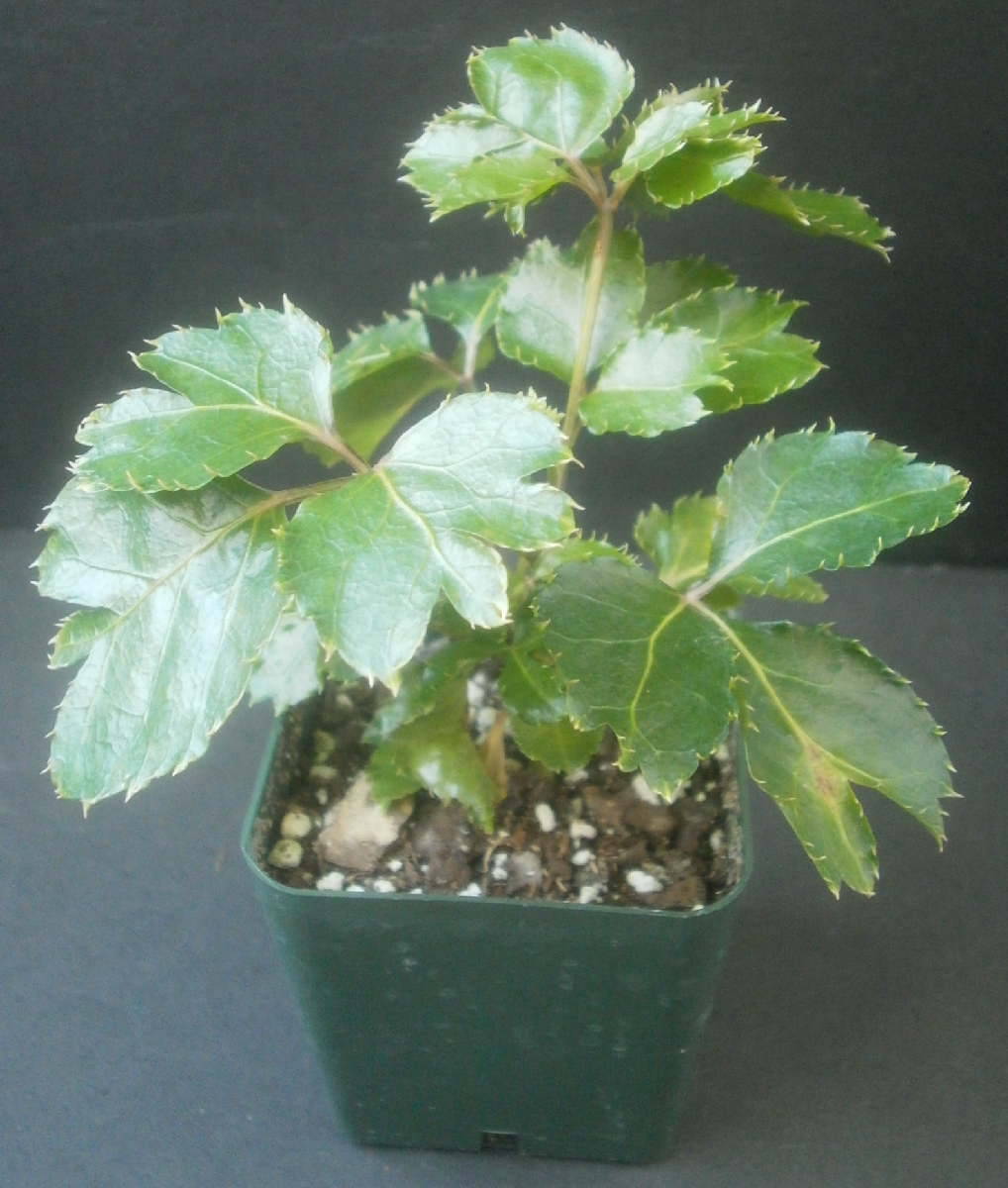
Seedling 08 is also very distinctive because of how narrow all the leaflets are. I don't find it especially appealing, but I can pick it out of the crowd: 08's the one that looks like a tangled mess. It's possible that it will have some redeeming feature, like being unusually durable or whatever.


Seedling 06


Seedling 11


Seedling 07


Seedling 02

Seedling 02 is either my favorite or second-favorite, along with seedling 01. Doesn't actually look that much like holly, but it nevertheless makes me think of holly.


Seedling 09

It's pulling out of it now, it looks like, but seedling 09 is the only one that's ever seemed to struggle at all; I'm not sure exactly what's wrong with it, but all the leaves suddenly developed yellow-brown spots, more or less evenly-spaced, and the leaf in front, the really yellow one, dropped off. I'm assuming that I overwatered; the spots are plausibly edema.4


Seedling 10

Seedling 10 is very short but also very thick: one of the first seedlings to start branching. The two things appear to be related. It's like there's only so much vertical growth possible, so the ones that branch tend to be short, and the ones that don't branch wind up tall. Which makes sense, though seedling 04 is both tall and branching, so it's maybe not a firm rule.

So . . . how to explain this, then. I'd never had any reason to suspect that my plant was anything other than a regular old Polyscias fruticosa, and yet a wild-type species plant, crossed with itself, shouldn't give offspring this varied, should it?

It's possible that my parent plant is a hybrid -- I don't know for sure that Polyscias species can hybridize with one another, but I don't know that they can't, and there are other species in cultivation,5 so surely someone has tried before. Searching for "polyscias hybrid" turns up pages where both words appear, but the sites all appear to be using "hybrid" interchangeably with "cultivar" or "variety;" there's no "_______ is a hybrid between P. _____ and P. ______" anywhere.

It's also possible that maybe P. fruticosa produces a lot of sports and/or is naturally variable, like Rhynchostylis gigantea, and all of them have the potential to produce variable offspring. In any case, I'm surprised, don't know how this happened, and am finding it kind of a fun puzzle.

As to whether any of them might be special enough to try to propagate on a larger scale, or patent, or whatever, well, it's still really early. They're only eight months old, and haven't even broken my heart yet,6 so let's don't go counting chickens. But I'm really interested in seedlings 01 and 02, especially 02, and I think I can safely assume that they'd propagate true from cuttings, so . . . maybe someday.

-

1 I'm also pleased to be able to report that there have been a couple other things: first, the previously-mentioned Anthurium seedling 0805 Triana Hill has opened a first bloom, and it actually is pleasant, as I had hoped. (Not wildly different from anything we've ever seen before, granted -- very similar to 0097 Colin Ambulance -- but still pretty and unusual.)
Second, the Neofinetia has bloomed again, which is less earthshaking this year than last, but I appreciate it anyway.
2 Whichever leaf was largest and newest, for each seedling.
3 A technical term. I don't have a fluffimeter (fluh-FIM-i-ter; prounouncing it "FLUF-ee-ME-ter" alerts people that you're not a real scientist) here, so I'm estimating from appearance.
(I should probably say approximate decreasing fluffiness.)
4 The spots don't show well in the photo because of the angle I had to shoot from, but I feel confident in ruling out scale or thrips, and the only thing I've seen anywhere that looked at all like this is edema. And the soil was very wet.
It took me a while to trust that the seedlings didn't have to be kept wet all the time; since they were coming from a very damp germination container, I figured they wouldn't be able to dry out at all, so I was watering a lot. Even so, seedling 09 is the only one that ever complained about it, and I've been watering more cautiously and normally since. It's replaced the dropped leaf already, and then some.
5 (The other two used as houseplants are P. guilfoylei, formerly balfouriana, and P. scutellaria; another three or so are commonly cultivated outdoors, according to Wikipedia.)
6 They will. Let's not kid ourselves. The Anthuriums have, the Schlumbergeras have. I suppose the Coffea and Spathiphyllum seedlings haven't done it yet, but only because they can't: I'm not especially emotionally invested in either group.


Thursday, May 26, 2016

Anthurium no. 0228 "Hoku Mama Swamp"

So the actual plant here isn't that unusual, but the more I see the name "Hoku Mama Swamp," the more I love it. She's a faux queen (a female performance artist who uses the style conventions associated with drag queens, i.e. a female female impersonator; other faux queens whose names you've seen before are Holy McGrail and Ms. Lucia Love.).

I initially had some trouble accepting the idea of faux queens (where's the challenge in a woman looking like a woman?), but am totally on board now, because I'm seeing the whole thing as a set of conventions, the way someone is recognizable as a clown if they do enough things that signify "clown:" white makeup with an exaggerated red grin, red nose, baggy and colorful clothing, floppy shoes, etc. Queens do queeny things instead of clowny things, but it's the same kind of deal: if the wig, clothing, makeup, and so forth all add up to "queen," the actual original gender of the performer isn't really relevant. (If it looks like a duck, and quacks like a duck, etc.) It's not any more remarkable that someone can do drag-queen things and wind up looking like a drag queen any more than it's remarkable that someone can wear a black-and-white striped shirt, white gloves, black pants, paint their face white, and look like a mime. So I welcome the faux queens, personally.

That having been said, I think Hoku's name is more interesting than she is, at least of the things I found of hers on YouTube. Liked some of them, didn't like others. (Here is one of the videos that worked for me, despite the low quality recording. It starts slow, too, so if you're bored, try skipping ahead a couple minutes and see if you like that any better.)

Similarly, I generally approve of Hoku the seedling, though there are definitely some things she could be doing better. The bloom color is red / white, which is boring but well-executed.


Her most notable feature is her size: both the individual leaves and the plant as a whole are gigantic. No offsetting, which is sort of a problem. Not crazy about the internodal distance either, though considering how old she is (sow date: 5 May 2012), she's not sprawling.


The foliage isn't perfect, but it's one of the better seedlings for resisting scale and thrips damage. Top 10% or so, anyway.


The biggest challenge the leaves face, I think, is mechanical damage -- plants with large leaves on long petioles easily get caught on things and tangled in other plants, sometimes resulting in injuries. And injuries accumulate over time, so.


I want to keep Hoku, but I'm not sure about her long-term prospects. She's badly underpotted already, as you can see from the whole-plant photo, and as she becomes more and more rootbound, the soil's going to dry out faster and faster. I don't have room to move any more plants up to 6-inch (15 cm) pots, though, and even if I did, she'd take up a disproportionate amount of room. It's hard to justify using that much space for a seedling that's just another red / white.

On the other hand, she's at least a nice red / white. And I wouldn't mind keeping some big-leaf, thrips-/scale-resistance genes handy. So I imagine her fate depends on how much space I can find in the basement in the next few months.


Tuesday, May 24, 2016

Schlumbergera seedling no. 075

Just one more Schlumbergera after this one, and then we're free of them for a few months.1 So let's hurry up and get this sucker named.


I don't know how typical it's going to be, since this is another late-blooming seedling that only made one bloom before retiring for the season, but the shape is the only unusual characteristic of this seedling's flower. Front petals strongly reflexed; back petals partly reflexed and partly not: either this photo was early, and the bloom just hadn't opened all the way yet, or this is the Schlumbergera equivalent of a mullet ("business in the front, party in the back"). And I would consider Mullet as a name, because it would be easy and I could quickly move on to some other post, but ew. No.2 So I will dig deeper.

There's a sort of overall triangular shape to the bloom, at least in the below photo, so maybe we could do something with orange triangles? Slow-Moving Vehicle, perhaps? It's a little long, I guess.3 And maybe implies not very many flowers?4

Image searches for "orange pointy" were dominated by high heels and manicures; "orange spiky" was dominated by other plants, in particular kiwanos, which wasn't especially useful. Though one always enjoys the opportunity to think about kiwanos.

So I guess it's time to look at the lists of emergency and previously-considered names.

Ever since I considered Francis S for 114A Gallant Fox, I've toyed with the idea of naming the seedlings after specific people from my life, in a way that preserves anonymity for them and plausible deniability for me.5 I'd even kind of done it already, without intending it at the time. (Stoked, as a word, is very strongly associated with a particular person I knew about 25 years ago. Blood Frenzy and Strawberry Madeleine also refer to specific people on some level or another, the former more overtly than the latter.) So I've been thinking about that, and I made a list of people, and I've been adding name ideas to go with the people as I thought of them. Of the few name options that fit the person perfectly and will definitely get used at some point or another,6 the one that I think matches this particular seedling best is Pushover. With enough imagination, one could even imagine the petals as a row of dominoes in the process of falling from right to left:


So I'm thinking this one will be Pushover.

-

1 Oh, and, for anyone left in suspense, the last major branch on 'Caribbean Dancer' fell off too, on the 19th or 20th of May. When they decide they're done, they're done.


2 As a midwesterner of a certain age, I have to say that I don't feel like mullets are always unattractive. At the same time, for any specific individual, a mullet is unlikely to be the best hairstyle option available.
3 The seedling names range in length from 20 characters (082A Strawberry Madeleine) to 4 characters (027A Kiln, 090A Lola); Slow-Moving Vehicle comes in at 19.
4 Which might be accurate, of course. Can't know until next year.
5 If done properly, this would also mean that the people so honored wouldn't actually recognize that they were being honored, or they might suspect if they happened to find out, but couldn't be sure. Which, frankly, appeals to me as well. I suppose this implies that it's not so much about recognizing them, the individual people, and more about celebrating the particular historical me that was connected to them, and if true then that's kinda egotistical, but I'm going ahead with the plan anyway.
6 Assertive, Pushover, I'm Really Sorry (I suppose in one way or another I'm Really Sorry works for all the honorees, but it's especially appropriate for one person, and I didn't say it when I should have.) Good Daddy, Perturbed, and Francis S.