I seem to be kind of on a roll this week as far as posting every day -- which hasn't happened since December -- so let's see if I can't make it seven for seven just to prove that it's still possible.
All of these pictures are from the ex-job, over the last three or four months. Anybody who can identify one of the three plants here with any degree of confidence should let me know in the comments.
Friday, May 10, 2013
Three Unidentified Cactus Blooms
Thursday, March 15, 2012
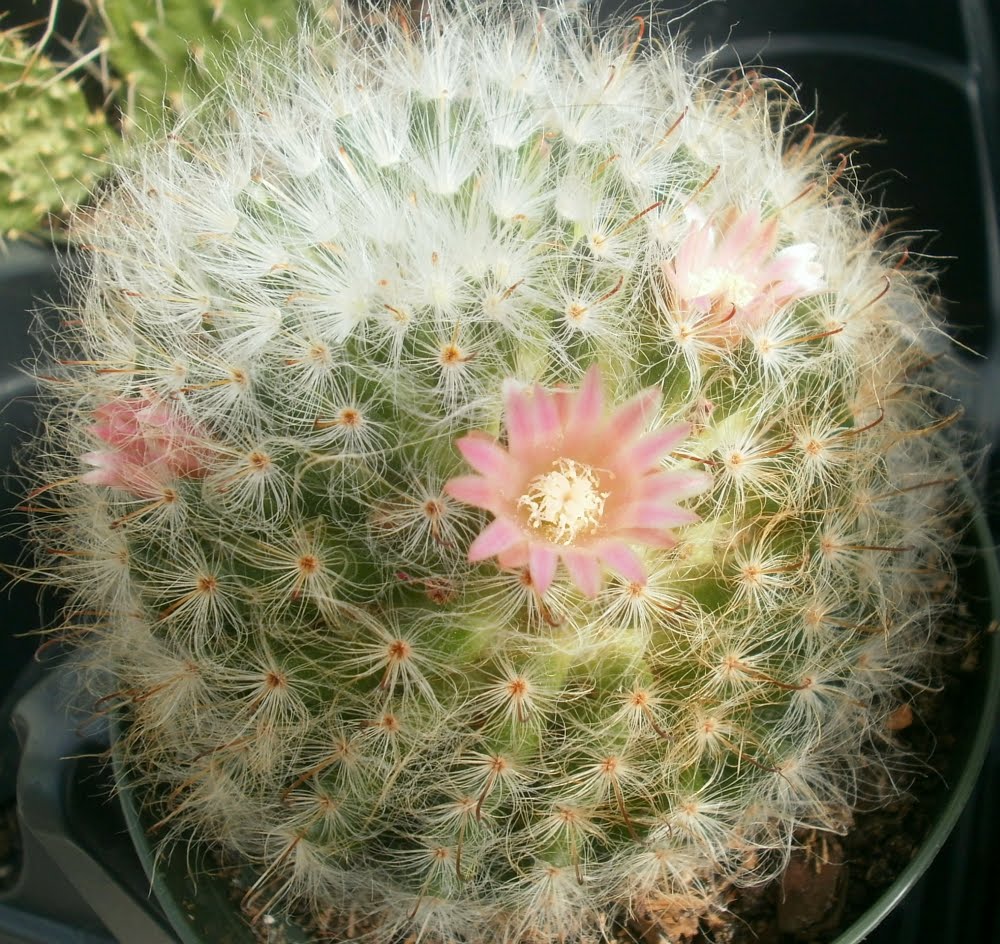
Pretty picture: Mammillaria (?) NOID
Okay. I feel a little better. The orchid show pictures were a little easier to sort through than last year's, because 1) the lighting worked out better or something -- more of them were decent to begin with -- and 2) I didn't take as many shots of each flower, so I didn't have to do as much agonizing over which shot to use. Some of them still didn't turn out that great, but what they may lack in quality, they make up for in quantity: I now have 91 orchid posts scheduled through March 2013, with the pictures already in place (if not any text yet). So I'm pretty sure you'll never have to wait more than 5 days between posts, even if I don't write another post for a year. (We still have 2 pictures from last year to burn off first, but after that, look out.)
Meanwhile, some cactus flowers, from the ex-job. These pictures were taken at the end of January.
I suspect Mammillaria, but I'm not positive, so if anybody has any guesses, feel free to share. Perhaps the stripes are a clue?
Sunday, September 25, 2011
Rumble Among the Jungle, Matches 1.17-1.20
Rules and Stuff
1) It's probably possible to vote more than once per poll, but please don't. If I believe that someone is voting repeatedly, I will throw out those results, repost the poll, and seriously question that person's priorities.
2) If you want to link to a poll on Twitter / Facebook / your blog / whatever and encourage your friends to come and pump up the support for your favorite plants, you are encouraged to do so.
3) You are also encouraged to leave comments on Rumble posts, if so moved.
4) All photos will enlarge if opened in a separate window/tab.
5) You can choose which plant is "best" according to whatever criteria you decide for yourself. My personal process is a bit convoluted.1
6) All polls will be open for three days.
Match results, 1.1-1.4
Today we have the first set of official results to report, from matches 1.1-1.4. Winners advance to the second round; losers . . . slink quietly away in shame or something.
In match 1.1, Clivia miniata decisively defeated Kalanchoe tomentosa, 74-53.
Match 1.2 was remarkably close for the entire three days of voting; small Vriesea hybrids barely slipped past Peperomia obtusifolia cvv. with a score of 65 to 58.
Clivia miniata and small Vriesea hybrids will face one another in a couple weeks, in Match 2.1.
Ficus elastica narrowly lost match 1.3 to Cryptanthus cvv., 56-68, which surprised the hell out of me.
Finally, Tradescantia pallida made Yucca guatemalensis wish it had never been germinated in match 1.4, by a very decisive 81 to 39, which leaves me extremely disappointed with you people.
Cryptanthus cvv. will go up against Tradescantia pallida in match 2.2.
Now for today's matches:
Match 1.17
Phalaenopsis and Doritaenopsis cvv. (moth orchid) vs. Senecio rowleyanus and S. radicans (string of pearls / string of bananas)


Match 1.18
Monstera deliciosa (swiss cheese philodendron) vs. Musa / Ensete cvv. (ornamental banana)


Match 1.19
Mammillaria cvv./spp. vs. Sansevieria cylindrica (wisdom horns)


Match 1.20
Chamaedorea elegans (parlor palm) vs. Araucaria heterophylla (norfolk island pine)


-
1 I'm deciding according to a hypothetical situation in which all of my houseplants are gone, as are all the other houseplants of the world, except for one producer/supplier/retailer. Said person is offering to restock me with one or the other of the plants in question but refuses to give me both. Which one would I choose?
Sunday, February 6, 2011
Walkaways Part 12
Well okay. Back in the saddle again, or something like that. Went to Cedar Rapids on Friday, saw some plants, bought some, didn't buy others. And some of this was somewhat interesting. I guess. If you're me. I'll leave the plants I actually bought for another post. (There were three: all three were gesneriads; two were unusual; one of the unusual ones was very cool.)
The theme for the walkaways on this trip: slightly-unusual varieties of perfectly ordinary plants. First up is a variegated Euphorbia milii, from Peck's Garden Center. I'd heard of these, but hadn't seen one myself until Friday. As with most of the walkaways on this trip, I didn't buy it because I had slightly less money than it cost. (In this case, I was also trying to conserve money for later purchases -- Peck's was the first garden center we hit.)

Peck's also had a NOID Dieffenbachia I've seen before in Cedar Rapids. One day, I'm going to own this, but I had way less money than needed for this plant.

I liked this NOID cactus, too. The photograph makes it look less impressive than I found it at the time. I assume it's probably a Mammillaria. I could have afforded this, but was saving my money for the super-cool stuff I was sure I'd find elsewhere.

Finally, I passed up what I think must be a cultivar of a bird's-nest fern (maybe Asplenium nidus or A. antiquum), because anything that might be an Asplenium is automatically removed from consideration. They hate me, I hate them, we have an agreement and we stick to it. Still, though, I don't think I've ever seen one quite like this before. (I have a nagging suspicion that I may have seen one semi-recently on someone else's blog, though -- has anybody posted about this plant lately?)

We stopped at Lowe's, but they didn't have anything I was interested in (I came close to picking up a partly-dead hanging basket of Hoya lacunosa, because it's one of my favorite plants, it only cost $2.50, and it was only partly dead.), so then we went on to Frontier.
Frontier looked like they were getting ready to receive a new shipment of stuff, because a lot of the tables were cleared off, so they had fewer options than usual. I lingered over a Polyscias I've never seen before --

-- which I thought at the time was a new variety of P. fruticosa, but having gotten home and looked at my fruticosa and balfouriana, I think it's actually a mutant balfouriana. Balfouriana leaves are often divided into three leaflets like the above plant and the leaflets are usually rounded. Fruticosa leaves are much more subdivided, and there's nothing rounded about them: they're all angles and points. This makes me feel better about not buying it: balfouriana and I are still not entirely sure we like one another.
Frontier also had a monstrose Cereus peruvianus (or maybe C. hildmannius) that was interesting. I've seen a lot of small monstrose cacti (mostly C. validus or C. repandus?) for sale, and we had them at the ex-job quite a bit, but the bigger ones are rarely available. So I was tempted, but yet again, it was slightly out of budget.

The main one I went back and forth on (to the point of considering asking the husband if he could buy it for me) was a Zamioculcas zamiifolia. Now, I already have a Zamioculcas. In fact, officially, I have seven. But this is a slightly different variety. I've written about it before (reader consensus was: "yuck."), but had never seen it in person until Friday.

The variety names I've heard for it are 'Mini' or 'Zamicro.' I'm kind of puzzled about why: it's not noticeably smaller than the species, as far as I've seen. Mostly the difference is in the plant shape, but it's a really subtle difference -- the leaflets are a little pointier than the species, and are held more horizontally. You can sort of see the leaflet shape better in the photo from the top of the plant:

Otherwise, they appear to be the same thing, which was why I kept going back and forth on it. I already had it, but I didn't, but I kind of did, and yet I sort of didn't. In the end, I decided that the species and I don't get along well enough to justify collecting every variety I ever see. (We're doing better lately, but it's been difficult for me to figure out how to water mine: contrary to what you'd expect, I think I was under-watering for a long time before I figured it out.)
So that's what I didn't get in Cedar Rapids. Which non-purchase was the biggest mistake?
The pictures of plants I did buy will be posted relatively soon.
Monday, January 24, 2011
Question for the Hive Mind: Cactus IDs
I'm either sick or underslept to the point of feeling sick on Sunday evening as I write this, so I don't have it in me to write very much. I've had these photos for a long time, and have been meaning to go to CactiGuide.com or somewhere and try to come up with IDs so I could use them for List posts, but I never did. If you have a guess on any of them, leave it in the comments. Or keep it to yourself. Whatever.
I, meanwhile, am going to go to bed early and hope that I'm just tired. It doesn't feel like tired -- every joint and muscle is achy, I have a headache, my face feels hot, my eyes and mouth are dry -- but this has happened before, once or twice a year for several years, and if I'm sick, it's the kind of sick that twelve straight hours of sleep usually cures.
There will be a mashup this afternoon; I wrote that post already.
Cactus NOID no. 5.
Cactus NOID no. 6.
Cactus NOID no. 7; Ferocactus sp.
Cactus NOID no. 8.
Cactus NOID no. 9.
Cactus NOID no. 10.
Cactus NOID no. 11.
Cactus NOID no. 12 (tagged Ferocactus sp.).
Cactus NOID no. 13. (Melocactus sp.?)
Cactus NOID no. 14; Mammillaria sp.
Cactus NOID no. 15, with fruit; Mammillaria sp.
Cactus NOID no. 16; Mammillaria sp.Saturday, May 8, 2010
Saturday morning Sheba and/or Nina picture, except without any pictures of Sheba or Nina
Well, Sheba's run of twenty vomit-free days came to an end this week, on Tuesday night or Wednesday morning. On the one hand, this is a new record, but on the other, we were really kind of hoping for longer. Maybe the baby mice she found and ate on Tuesday morning's walk didn't agree with her, or maybe it was the sponge she tore apart on Monday (she didn't get all of it, or even very much of it, but I doubt the pieces we recovered afterward would have been enough to reconstruct the entire original sponge), or maybe we just went a little overboard with the treats Tuesday night. The treats thing seems most likely, but I have to explain that one by way of a story.
The husband and I were going to go to Cedar Rapids on Tuesday, because I hadn't been to Frontier in a while, and I needed clay pots. Once we got to Iowa City, though, the "CHECK ENGINE" light came on, and it suddenly seemed like a bad idea to go all the way to Cedar Rapids, so we decided not to. I bought pots at Lowe's and my ex-work, as well as *coughcoughcough* some plants (Agave, Mammillaria, Parodia; photos throughout the post). Then we stopped at the grocery store so I could buy some cactus-repotting tongs -- 'cause you gotta have cactus-repotting tongs -- and when I got back in the car, I suggested that we stop by the animal shelter.
It wasn't that I wanted to get another dog; the shelter is on the way home, and I wanted to check up on Fervor. I can't exactly explain why. I just did. So we went.

He was still there. Got very excited when we paid attention to him, talking to him through the cage and stuff. I stuck my hand through and rubbed his stomach (neither I nor the husband could remember him rolling over for stomach rubs when he was living with us), and he jumped around and wanted to play and all that. I'd been fairly certain, the last time I'd seen him, that he remembered us, but I was less sure about that this time -- I mean, maybe he did, but it's also possible that after five months in the shelter, he'd have been just as thrilled with attention from a total stranger. I don't know.
I hadn't really planned on staying a long time, and I didn't want to have them go to the trouble of getting him out, especially since I knew there was no chance we could adopt him, but the temptation was there. (The husband and I found out after we left that we'd both been thinking well maybe we could take him and he could just live outside some of the time, or maybe the allergy thing wouldn't be such a big deal now that he's not shedding anymore, or endless variations on surely there's some way we could make it work. . . .)
Anyway. So I went in and asked the shelter people whether anybody had even applied to adopt him since we'd brought him back, whether there had been any interest.

And no. It turns out that there has not. In six weeks. So then I felt kind of awful again.
The point of relating this story -- or at least the first reason, because I think there are two -- is that then when we got home, finally, we may have over-doted on Sheba a little, which makes very little rational sense but seemed like the thing to do, emotionally. The emotional logic, I think, was that if we couldn't take care of Fervor, then we'd take extra-super-good care of Sheba. You know, like, love-her-'til-she-pukes kind of good care.
Which in this case turned out to be literal.
Plus I'd given her a couple treats when we left, as an apology for leaving, so it seems likely that the treats are, and maybe always have been, a lot of the problem.
And the second point is, if you're in or near Johnson County, Iowa, and you're looking for a really big but basically well-behaved and sweet dog, I can recommend one. And if you're not looking for a dog, perhaps you ought to be? Maybe? Think about it? I'm really not going to rest easy until someone adopts him.

Wednesday, March 10, 2010
Link of interest
A reader e-mailed me an interesting link this morning, to a site with a lot of interesting macro photos of cacti, as well as even some photos taken with the aid of a microscope, which makes me sad all over again that my plans to get a microscope last spring didn't work out. The cacti in question appear to be mainly Mammillarias.
A Close-up View of Several Members of the Cactus Family
Friday, December 11, 2009
Cactus Blindness: Its Causes and Treatment
It's time to admit my shameful secret: I have cactus blindness.
Cactus blindness is one of a number of widespread horticultural learning deficiencies (HLD), resembling (and often overlapping with) other HLDs like fern blindness, shrub blindness (I am also considerably shrub-blind, by the way), and palm blindness. Afflicted individuals are easily able to learn and recall names of different cactus species, but are unable to visually distinguish cacti well enough to apply the names accurately to plant specimens.
Many causes have been proposed for HLDs, ranging from the socioeconomic (lack of exposure to, or accurate identification of, enough plant species in childhood) to the organic (HLDs sometimes occur following stroke or brain injury in previously unaffected individuals). Though below-average intelligence and sensory impairment may also lead to the inability to distinguish cactus species from one another, persons with these conditions are specifically excluded from the DSM-IV definition of cactus blindness, as they lead to much broader difficulties.
Cactus blindness is also distinct from the condition called cactus alexia: in the latter, species are easily distinguished, but the patient experiences great difficulty in learning the names that go with the plants.

I bring this up first of all because of Karen715's brave admission a couple weeks ago that she, too, suffers from cactus blindness. Her courage has given me the strength to admit that I, too, find it extremely difficult to identify many of the specimens I encounter. (It is my hope that we can start a support group or something.)

Secondly, I recently went back to my former workplace and photographed a few cacti there (bought a couple, too, alas), thinking I could identify them easily and then use the photos for yearbook pictures, and I think I even actually did, with great difficulty and the assistance of the photos at cactiguide.com, identify a couple of them. However, some of them continued to stump me, either because none of the 1257 species represented at cactiguide.com looked like the plant in question, or because far too many of them did for me to be able to pick one. (Some of the more questionable photos I took are decorating this post; I welcome any ID verifications or suggestions anybody wants to throw at me.)

Treatment of cactus blindness typically falls into one of three types. In conventional cactus blindness therapy (CCBT), CB sufferers are encouraged, with the aid of worksheets, photographs, and (when possible) actual cactus specimens, to describe plants in minute detail, with the aim of training the individual to notice the small distinctions between species. This is essentially the training of afflicted individuals to become cactus taxonomists, and while it has a high success rate (about 80% of subjects will become able to identify at least 100 cactus species with at least 70% accuracy), it also takes a considerable amount of time, and requires the assistance of a qualified trainer at all times. Consequently, it is very expensive, and CCBT-certified trainers may not be found in all areas, though cases are known of people who have taught themselves to overcome cactus blindness through informal CCBT-like methods.

The other treatment approach is known as wholistic cactus blindness therapy, or WCBT. WCBT de-emphasizes verbalization of the distinctions between species and instead focuses its efforts on the subconscious: subjects are presented, repeatedly, with randomized pairs of photos or specimens of cacti, and asked to identify whether they are the same species or different species. This, it is said, trains the mind to identify the relevant details which distinguish one species from another, without the tedious completion of worksheets as in CCBT. WCBT is also easily adapted to computer software, making it considerably more affordable and accessible than other therapies. Critics of WCBT point out that it does little to link the image of a particular cactus species to a species name, and is therefore not particularly useful in fostering cactus-related communication. Many WCBT trainers have responded to this charge by adding an additional four-week program to the end of a course of WCBT specifically for the purpose of linking names to the now-mentally-distinct species in the subject's mind.

Incremental cactus blindness therapy (ICBT), the newest of the CB therapies to gain acceptance, focuses on learning the distinguishing characteristics of only the most commonly-sold or -observed cacti, and those with the most distinctive appearances (e.g. Astrophytum myriostigma, which is fairly hard to confuse with anything else), slowly expanding the pool of one's knowledge only once the initial easy group have been mastered. Its largest advantage over the other methods is that it is more immediately useful than either CCBT or WCBT, enabling the subject to identify several commonly-encountered cactus species after the very first therapeutic session. ICBT is also somewhat adaptable to computer software and requires considerably less of a therapist than CCBT, making it less expensive and easily available. The main disadvantage of ICBT is that accidental exposure to unknown cactus species can result in the mental assignment of mistaken identities, which are frequently difficult to unlearn later on. ICBT also has a rather steep learning curve, which subjects often find discouraging, leading to a dropout rate more than double that of CCBT or WCBT.
To the best of my knowledge, the above therapies have not been attempted with other varieties of HLDs.

Personally, I'm working a combination of CCBT and ICBT, on my own, with only the internet to guide me, and if I manage to learn anything I'll let you know. Meanwhile, perhaps we should be looking for some available church basements, or setting up a dedicated CB blog, or something. Who's in?

UPDATE: Enormous thanks to Daiv Freeman, Peter Breslin, erin, and CelticRose, for their help and suggestions on the NOIDs in this post, and confirmations on the ones I thought I had right.
-
Totally skippable political correctness disclaimer and commentary:
I'm not trying to imply that actual learning disabilities aren't real or shouldn't be taken seriously. They of course are, and should. The targets of ridicule here are more the non-disabled people who patronizingly claim every little obstacle's defeat as being inspiring and courageous than for the people who actually have the disabilities, people who try to make unchosen conditions into something shameful, and my own very real difficulty in distinguishing cacti from one another.
Sometimes overcoming disability / adversity / tragedy actually is courageous, of course, but sometimes one never really gets a choice about whether or not to overcome, and in any case it's kind of a weird thing to take someone who has an unusual life situation and single them out as being even more unusual by waxing poetic about their courage and whatever.
As far as it goes, I also don't mean to suggest that the blind are more disabled than others, by using the word "blindness" as part of the term for my made-up condition. It seemed like a better metaphor than, say, deafness, because people generally look at cacti a lot more than they listen to them.
As I have alluded to before, I don't want PATSP to be accidentally offensive to anybody, of whatever age, gender identity, sexual orientation, degree of disability, country of origin or residence, race, mental illness, etc. I want as much of the offensiveness as possible to be on purpose. At the same time, pretty much any reference to certain of these topics is going to be offensive to somebody, however it's phrased, because minority communities don't ever necessarily agree unanimously on PC language, reclaiming slurs, etc. (There's not even total agreement on whether "the disabled" exist as a group, or, if they do, exactly who belongs in it.) So I figure my choices are to never mention these people at all, effectively "disappearing" minority groups into nonexistence, or mention and try to make clear that I'm doing the best I can not to piss people off through my own privilege as a white, able-bodied, cisgendered, American male. (I've been noticing lately that I tend to assume my readers are U.S. or Canadian residents, in a way which probably marginalizes readers from other countries, and have been trying to think of ways to make that happen less often.) I do actually try to think about these things. Sometimes I don't think hard enough.
If I have expressed myself in a particularly inelegant or ignorant way on the matter, please let me know.
Monday, November 23, 2009
Pretty pictures: Mammillaria decipiens (?) flowers
I think all four of these are Mammillaria spp., but only the first three are M. decipiens. I don't know what the last one is. The file names say differently because I was in a hurry while sorting through the pictures and didn't notice that the last one was different until I'd uploaded them to Blogger.1.jpg)
I'm having a tough time keeping up with the blog lately. For one thing, none of the plants here at home are doing anything very interesting, so I don't have much material for new posts. (These Mammillaria pictures are from May 2008.) I tried going to the ex-job to stock up on pretty pictures, but although they got a new order in around the beginning of November, I'm told that most of what was on it was orchids and Norfolk Island pines (Araucaria heterophylla). 2.jpg)
The orchids sound promising until you consider that 1) they were about 80% Phalaenopsis, 2) of varieties I've photographed before, plus 3) it was a dark, rainy day (so the light was for crap) and 4) I didn't get there until about 4 PM anyway, so the sun actually set while I was there, making a crappy lighting situation considerably crappier. A couple of the poinsettia pictures turned out okay, but a lot of us would rather not be looking at poinsettia pictures this time of year -- or any other time of year, for that matter -- so I'm reluctant to use them. 3.jpg)
And I have ideas for posts, and am in fact working on two longish posts right now, but neither of those are going well, and both have already taken weeks to write. I intend to get them finished one way or the other by Saturday, but they still need a lot of work, leaving me even less time to come up with the other three daily posts this week. And and and, when I do manage to find something to post, a lot of you aren't going to see it anyway, because U.S. Thanksgiving messes up everybody's schedules. So instead of reading PATSP, people will be traveling, waiting to travel, enjoying time with family, or trying not to kill family. Which says something about your priorities, but I'll try not to judge.4.jpg)
So. If it seems like I'm phoning it in with some of the posts this week, it's not because I don't love you, Canadian and other non-U.S. readers. If not for y'all, I wouldn't bother to post anything. I just don't have much to post about, and I'm fairly preoccupied and frustrated by these two large posts, which may or may not be good enough to make up for the in-phoning. Forgive me. It'll get better.
.jpg)
.jpg)
.jpg)
.jpg)
.jpg)