Saturday, November 7, 2015

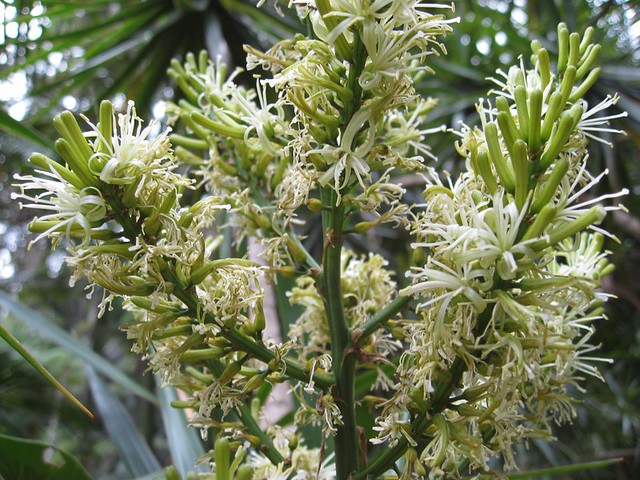
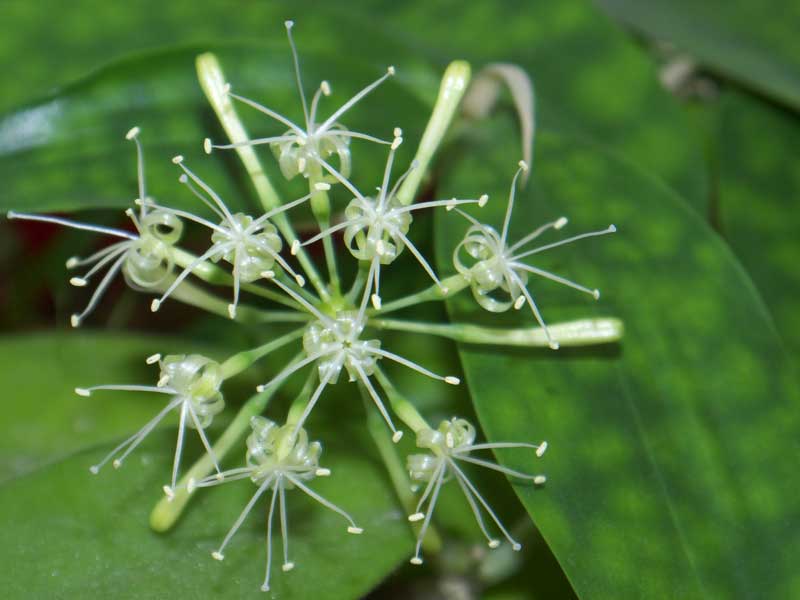
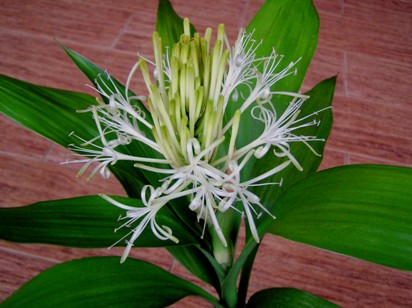
Random plant event: Dracaena 'Indonesian Tracker'

The husband's office was a magical place this summer and fall, apparently: the Polyscias fruticosa bloomed for the first time in June; the Anthurium schlechtendalii bloomed in October, and now the Dracaena 'Indonesian Tracker' in November.1 I had no reason to think that any of them would ever bloom, so it's neat that they all have, and downright peculiar that they did so within a few months of one another.


There is, of course, a smell. It's definitely an improvement on the vinegar / garbage can smell of the Anthurium,2 which is lucky for us, since it's also really strong. It's a bit like I remember the Dracaena surculosa flowers smelling, though some of that might be because the flowers look a lot the same and my brain is lazy.3 I described D. surculosa as smelling like an intense generic floral smell, with maybe a note of a chemical/solvent-type thing in there.

I would describe the smell of 'Indonesian Tracker' similarly, up to a point: the solvent/chemical note is still there. In fact, in the early afternoon, it's all that's there, and it's not pleasant. But a heavy floral scent takes over pretty shortly thereafter. I couldn't figure out specifically what it smells like. It's sort of especially hard to figure out in this case, because I only get about ten seconds to try to name it before my nose adapts and I can't smell it anymore, plus I can only identify a few flowers by scent in the first place so my vocabulary's pretty limited,4 and worst of all, it changes during the course of the night, but it reminds me a little of the Murraya paniculata in the early evening, and of carnations in the late evening.


There's also a sweet note to the fragrance -- on Halloween night when the flowers first began to open, I was working in my office and kept getting distracted by a new smell that was definitely not the Hoya lacunosa,5 something that brought to mind white birthday cake. This is hard to detect when closer to the flowers, because the floral smell overwhelms it, but it seems to be the component that travels the best. The only thing I can think of that smells at all similar to this part is Duranta.

I don't know much about 'Indonesian Tracker.' Asiatica Nursery (where I bought my plant, in 2008) presented it as a Dracaena hybrid, but they've since gone out of business, so I can't ask them about it. Logee's sells 'Indonesian Tracker,' and their information page for 'Indonesian Tracker' also identifies it as a hybrid but doesn't go any further than that. I'd really like to know what it's a hybrid of, but nobody seems to know or care, and searching the internet mostly brings up people selling it or my own posts mentioning it. No patent, even. So I'll guess D. fragrans (for the long leaves, upright habit, and sweet-smelling blooms) x D. surculosa (for the spots and whorls of leaves): if you stretched a D. surculosa leaf out to D. fragrans length, and the spots stretched along with it, you'd get something that resembled 'Indonesian Tracker.' I doubt that's correct, but it's my guess.


As a houseplant, it's a little underwhelming, in the usual Dracaena ways: it gets leggy over time, it gets taller but not wider. That sort of thing. I wouldn't say it's bad, though. I mean, if nothing else, it's very easy, and it grows so slowly that you'll have it for a few years before the legginess becomes a problem.

With some Dracaenas, the appearance of flowers would mean that the stem is about to branch; I suppose we'll find out if 'Indonesian Tracker' is one of those.

-

1 Technically October: the first blooms opened on Halloween night.
2 I don't remember there being a smell with the Polyscias.
3 Dracaena flowers all look like this to some degree or another. The color varies slightly, but the basic construction is similar: long, narrow white petals, with equally long white stamens and one (?) pistil in the center. (Examples:
Dracaena marginata, Dracaena fragrans, Dracaena surculosa var. punctata, Dracaena sanderiana, Dracaena thalioides.)
Also very similar: Sansevieria flowers. (e.g.) Sansevieria and Dracaena are pretty closely related -- part of the subfamily Nolinoideae, along with Aspidistras (whose flowers look nothing like this) and Beaucarnea (ditto except for being approximately the same color) -- so this shouldn't surprise me as much as it does.
4 I can sort of imagine the smells of Gardenia, marigolds, roses, lilacs, lily-of-the-valley, geraniums, petunias, peonies, Sansevieria, chrysanthemums, Eucharis, carnations, and Murraya paniculata, at least well enough to decide whether something smells like them. I can't really conjure up jasmine, hyacinths, tuberose, lilies, iris, heliotropes, lavender, alyssum, freesias, orange blossoms, or sweet peas, though I'm certain I've smelled all of them at one time or another.
5 (which is what's usually responsible for pleasant smells that suddenly appear after dark)


Friday, November 6, 2015

Anthurium no. 0532 "Amber Alert"

Perhaps I should stop naming Anthurium seedlings "Amber."


I mean, okay, "Amber Alert" is better than 0558 "Amber Waves," to be sure. If nothing else, she appears to have a functional spadix, and the color is smoother and prettier. But the peduncle is unusually short, like that of 0335 "Donna Fanuday",1


the leaves have lots of small blemishes,


and the plant overall has very few leaves and looks sort of unfinished.


I suppose that last point could be a good sign -- Amber wants to bloom so badly she'll start doing it before she's grown many leaves! -- but whether she's going to be a heavy bloomer or not, I'm not impressed with this Amber either. She has a bud at the moment, so I'll let her finish doing whatever she's going to do before making a final decision, but it'll have to be one hell of a second bloom if she wants to stay.

Speaking of second blooms:

I said I would give 0416 "Holy McGrail" a chance to make a second bloom, the theory being that maybe it would be better than the first. And this is what she came up with:


It's a larger bloom than the first one, I think, and it's not torn like the first one, but it actually has more thrips damage, and the color is both boring and poorly executed, so as soon as I have time to deal with the paperwork, Holy's out of here.

EDIT: I've added two new pages to the blog, Anthurium seedling gallery and Schlumbergera seedling gallery. They're mostly there for my own convenience, to save me time when I need to talk about multiple seedlings at once by collecting basic information about the seedlings and the posts about them into a single location, but I didn't see any reason not to make them public, so there you go. Just in case you have a crisis that can only be solved by looking at a ton of Anthurium and Schlumbergera photos or something.

-

1 I was undecided about Donna in her introduction post, but I have decided since that she's worth keeping. The second peduncle was taller, the thrips mostly seem to leave her alone, and the foliage is nice. Granted, I can still change my mind. But I think Donna's okay.


Wednesday, November 4, 2015

Anthurium no. 0333 "Isaiah Littleprayer"

A bit of an emotional roller coaster with this one. The bud was a bit purple, which excited me so much that I moved Isaiah up to a 6-inch pot before seeing the finished bloom. And then the bloom eventually did open, and it was underwhelmingly red.


I'd been expecting a color closer to that of 0386 "Violet Chachki," given the color of the bud. It was also a pretty small bloom. So then I was upset with myself for having wasted a 6-inch spot on such an ordinary seedling.

But. A couple days later, it actually had gotten a little more purple.1


And I noticed that the spadix had gotten a little more purple as well. Purple enough to look sort of familiar. Where had I seen that combination of pale yellow and pale purple before? Eventually it hit me: 'Krypton!'

('Krypton')

For some reason, 'Krypton' has been a difficult seed parent. It blooms sporadically. When it does bloom, it's difficult to pollinate. When pollinated, it doesn't produce many seeds. When it does produce seeds, they tend not to germinate, and the seeds that do germinate tend to either die or remain small. I don't have numbers for the number of blooms, seed production, and germination; I just know that I've been frustrated by this for a long time.2

But Isaiah changes things a little. I'd suspected for a while that even if 'Krypton' was difficult to pollinate, it was still at least producing pollen. This is the first indication I've gotten that that could be correct.3

Not that 'Krypton' is so special that its genes need to be preserved at all cost -- it's fine, but it doesn't bloom a lot, and the blooms are small -- I'm just more likely to see unusual things if I have a larger genetic pool to play around with. So this is encouraging.4

As far as Isaiah goes, his leaves and overall shape are decent: a little leaf damage from thrips or whatever here and there, but it's fine. The spathe itself is surprisingly blemish-free.


So. Given the opportunity to do it all over again, I'd probably still move Isaiah up to a 6-inch pot. He's a keeper. And as I get used to him, I'm finding him easier to appreciate. Everything's worked out fine. But I really should stop moving plants up before they've even bloomed.

-

1 Some of the difference between the photos is due to my not getting exactly the same color balance, which is pretty obvious when you compare the backgrounds. The color change really did happen, though.
2 I can tell you that I've only ever managed to pot up seven seedlings from 'Krypton,' only three of which survive, and only one survivor (0599 "Butta") has been robust enough to move to a 4-inch pot. And "Butta" is actually the smallest 4-inch plant in its flat.
3 (Isaiah's seed parent, incidentally, is the NOID red. He's a sibling of 0334 "Jean Poole," who is so much larger and oranger that I'm guessing they're only half-siblings. Though Jean's spadix is also a little on the purple side, so you never know.)
4 It's still probably the case that 'Gemini,' 'White Gemini,' and the NOID red make up the bulk of the seedlings' genes: they're all extraordinarily good at catching pollen, and the NOID red is also good at shedding pollen. I don't have hard data on it, because I don't know who the pollen parents are for my seedlings, but I would estimate that 'Gemini,' 'White Gemini,' and the NOID red combined have probably contributed 75% of the seedlings' genes, with the remaining 25% from 'Orange Hot,' the NOID purple, 'Pandola,' 'Krypton,' 'Peppermint Gemini,' 'Joli,' the NOID green/pink, 'Midori,' NOID pink, NOID red-violet, and 'Red Hot' combined.


Monday, November 2, 2015

Pretty picture: Paphiopedilum Keyeshill

This one's a nice, dignified, respectable-type Paphiopedilum. Nothing too out of the ordinary, though the petals (or are these sepals? I can never remember. . . .) are maybe a little narrower than usual for a paph.


Also noteworthy: Winston Churchill sure gets around, doesn't he?

Paphiopedilum Keyeshill = Paphiopedilum Carl Keyes x Paphiopedilum Winston Churchill (Ref.)

Winston Churchill and his offspring previously: 2012, 2013, 2015


Saturday, October 31, 2015

Anthurium no. 0331 "Elvis Herselvis"

Elvis is the fourth seedling from the AX seedling group (seed parent: NOID red; sow date: 9 November 2012) to bloom, and as predicted, she doesn't resemble the other three any more than they resemble one another. In fact, if anything, she looks like the odd one out: they're at least all sort of orange, with spadices that are sort of beige, and none of them flip their spathes backward.

0331 "Elvis Herselvis." And keep in mind that this was the best picture I managed to get.

The other AX seedlings to have bloomed so far. Top to bottom: 0328 "Polly Esther Blend," 0329 "Gladys Panzarov," 0330 "Faye Quinette."

Elvis's foliage is pretty nice, strongly resembling her mother's. Which is sort of too bad: it would maybe be worth keeping the plant around for the leaves, if the blooms were at all attractive.


Elvis also doesn't offset much, and doesn't have an especially large number of leaves.


So she's probably destined for the landfill, the only question remaining being how soon.

The reader will maybe have noticed by now that there's a sort of pattern to these Anthurium seedling posts, that about one out of every four or five seedlings will be laughably terrible, an equivalent number will be novel or impressive enough for me to want to keep it, and the remainder will be in between: not especially pleasant, but also not obviously headed for the discard pile. That's how things have gone for most of the time I've been doing this,1 so it's not new, but I mention it because I'm sort of surprised at how consistent it's been. Ordinarily, with something like this, I'd try to schedule the posts so that you didn't wind up having to wait too long between decent blooms, but I haven't needed to do that: the Anthuriums have been doing their own scheduling for a while now (i.e., I schedule the posts in the order that new blooms appear), and the result has been pretty much the same.

That said, I'm getting really excited about the upcoming switchover to Schlumbergera seedling posts.2 Schlumbergera season officially began here on 25 October, when the NOID yellow produced the first bloom of the year,


and as I write on 28 October, 'Caribbean Dancer' and the NOID white have joined the party as well.

My seedlings haven't bloomed yet; it looks like it's neck and neck between 082A "Strawberry Madeleine" and 018A (unnamed) to be the first bud to open. There are now 21 previously-unbloomed Schlumbergeras with buds on them: every plant I moved to a 4-inch pot last year is budding this year save four: 062, 072, 104, and 111A "Morning Sun." None of the 3-inch plants I mentioned on 23 October have tried to bud yet either, as far as I've seen. Plenty of time for that to change, though. And even if some of the seedlings never do bloom, enough of them are budding that the plant room is going to look totally amazeballs when they're at their peak.

-

1 Though the obviously-crappy seedlings are becoming slightly more common, and the impressive seedlings are becoming slightly less common. Part of this is that seedlings have to do more in order to stand out as superior, since so many plants have bloomed already; there's also some reason to think that the group that's matured most recently may be genetically subpar. So it's a little bit subjective, and it's a little objective.
2 The Anthuriums will keep appearing as long as they keep blooming; I just figure they'll be so outnumbered by Schlumbergeras that the latter will basically take over for a few weeks.


Thursday, October 29, 2015

Anthurium no. 0589 "Hetty King"

Just in case you were under the impression that drag kings were a new thing, Hetty King (born Winifred Emms) was performing as a male impersonator before World War I. She even got decently famous at it, along with several other male impersonators from around that time (two of the bigger names being Vesta Tilley and Ella Shields). I mean, male impersonation then didn't mean quite the same thing that drag kings do now, obviously, but it's clearly in the same neighborhood, and I don't get the impression that it was considered particularly shocking and immoral. At least no more shocking and immoral than the music halls they would have been performing in, anyway.

Shamefully, I didn't do as much research into King as I probably should have if I'm going to talk about her.1 But there's a nice long article/interview with King here, and YouTube has some relevant videos as well.

Hetty King's seedling namesake is, alas, much less interesting. She's yet another in a long line of LPAs,2


and although the foliage is pretty nice,


the only notable thing about her, really, is that she produced a second bud really quickly. Lots of pent-up blooming energy, perhaps: she was 39 months old before making a first bloom.3 The overall plant is fine,


but the spathe flipped backward after opening, and I have plenty of pink/pink Anthuriums already. Hetty's not so terrible that I need to go out of my way to discard her, but she's not so good that I'm going to feel bad when I eventually do.

-

1 What with watering, trying to blog every day, Anthurium-taping, e-mail, trying to sell plants on Craigslist, trying to make sure Sheba takes her Benadryl every morning, getting pictures of the plants and sorting through them, and physical therapy exercises, I've been perpetually exhausted.
Notes and explanations:
• trying to sell plants on Craigslist hasn't actually resulted in any sales yet. It almost never does. Craigslist is the worst. Sadly, it's also the only. So I keep trying.
• Sheba's been chewing holes in her fur, especially the fur on her feet. We think this is probably an allergy (it's happened in other years; also my allergies have been acting up intermittently during the same period), and giving her Benadryl twice a day, and spraying her feet with a lidocaine-based spray, seem to keep it under control better than anything else we've tried, but she doesn't actually like the Benadryl or the spray, so it's a little bit of a hassle to administer them, and they aren't able to stop her from doing it altogether, just enough to keep her from chewing actual wounds into her skin.
• I have been having trouble with my right shoulder, off and on, since the spring, which got bad enough that I saw a doctor about it a month ago. Got a referral to a physical therapist, who I like and who I believe knows what she's talking about, but she gave me exercises and stretches to do twice a day, which was tough to fit into my schedule but I (mostly) kept up with.
Then at the follow-up appointment, it turned out that I had been doing the exercises mostly wrong, partly because I was finding it so difficult to fit them into my day that I was trying to rush through them, taking shortcuts, etc. My shoulder got somewhat better anyway, but an elbow started hurting instead, so the only thing I accomplished was moving the pain from one joint to another.
And then the physical therapist, at the follow-up, assigned me a set of new exercises that take just as long to do as the old exercises did, plus I'm supposed to continue the old exercises. The one time I attempted to do all six things, I was trying to work out before watering plants, so I was in a hurry, and even though the correct way to do the exercises had been clarified for me at the follow-up, I was doing doing them all wrong anyway, and could tell I was doing them all wrong, but got frustrated with myself for not being able to do them right, and the whole situation was miserable. So, as I write this (26 October), I've more or less decided that I prefer the shoulder pain to the exercises, and I've stopped doing them entirely, which is obviously not a mature or productive reaction to the situation and will certainly not make anything better. But so my point is that time I might have spent researching early-20th-century male impersonators has been going toward hurting myself with poorly-performed exercises instead. For which I am doubly sorry.
2 (= Little Pink Anthuriums)
3 The average length of time from sow date to first bud continues to increase, as some of the earliest seedlings get around to making buds, but it's still around the two-year mark. The mean is 28.5 months, and the median is 27.2 months. 39 months is really late, though the record at the moment for the latest bud belongs to 0045 "Lineysha Sparx," who finally produced a bud, after 47 months, and then dropped it.


Tuesday, October 27, 2015

Pretty picture: Zelenkoridium Kukoo

Seems like there were a lot of new nothogenus names this year at the orchid show (so far: Brassostele, Papilionanda, Neostylis, and Sarcochilus), and now we have a new one. In most (all?) of those cases, the plant wasn't that different from what we've seen before, just a familiar genus with a new, less-recognizable name, and that's also what's going on here: Oncidium onustum got changed to Zelenkoa onusta, so Oncidium Kukoo becomes Zelenkoridium Kukoo.


I found it interesting that O. onustum was the only Oncidium species to be moved to Zelenkoa, and Z. onusta is the only species in Zelenkoa; it didn't look that different from the Oncidiums. So I went looking for an explanation.

And it turns out to be more different than it looks. And also less different than it looks. I will explain.

According to Wikipedia and this video, Zelenkoa onusta grows:

• epiphytically, which is a perfectly orchidy thing to do,
• at high altitude, which doesn't seem weird either,
• in direct sun, which is a little unusual for the kinds of orchids that get widely cultivated, but sure, why not,
• on top of desert cacti (tilted head, puzzled look),
• and during the dry season it pushes its roots into the cacti it's growing on and sucks moisture out of them, so it's parasitic, which is so out of character for orchids that when I searched for "parasitic orchids," I got lots of results along the lines of, "Are orchids parasites? Absolutely not!"1

Except that when I looked for more specific information about Zelenkoa's parasitism, I found a lot of botanically-oriented, big-word-type sites that didn't mention it at all. For example. Which you would think that parasitizing other plants would be unusual enough that it'd be the main piece of information people would bring up, whenever talking about the orchid.

Also Z. onusta certainly doesn't have to be parasitic, because it can grow and live out a full life cycle on all sorts of surfaces, including rocks. Which makes me wonder where the parasitic claim is coming from, originally.

And it turns out that the parasitism wasn't even the reason it was separated from Oncidium in the first place; it lacks a particular minor-sounding structure in the flowers that the other Oncidiums all have, or something boring like that.2


The hybrid, Zelenkoridium Kukoo, has a similar appearance,3 but is apparently much easier to grow. Though the US Botanic Garden in Washington DC helpfully informs us that Z. onustum [sic] is "one of the easiest orchids to grow once you understand its native habitat,"4 it sounds pretty challenging from everything I've read about it. So my advice is, stick with Kukoo, if you want to grow something that looks like this.

Zelenkoridium Kukoo = Zelenkoa onusta x Oncidium cheirophorum (Ref.)

-

1 It turns out to be sort of a complicated question, with at least three different layers of answers.
There are apparently a lot of people whose high school biology teachers never told them about epiphytes. So these people see orchids growing on the trunk of a tree, or on the branches of a tree, and assume that it must be a parasite, because why else would a plant grow on another plant? The "absolutely not!" answers are directed at these people, and is essentially correct for most practical purposes.
Except that then there are also some orchids that have turned symbiotic relationships with fungi into parasitic relationships, where the orchid only takes from the fungus. (But don't feel too bad for the fungus, since it's parasitizing a different plant: the fungus is apparently also living in the orchid's roots, like a symbiotic fungus would, so I don't follow how it's managing to take nutrients from a different plant, but I am assured that this is what's happening.) Corallorhiza maculata and Danhatchia australis are a couple orchid species that make their living this way. When people think of parasitic plants, they usually mean plants that steal from other plants, not fungi, but it's still parasitism if the orchid's not giving anything back to the fungus. So the answer at this level to "are orchids parasites?" is, a few of them, yes. Technically.
And then there's Z. onusta, which if we believe the video -- and we possibly shouldn't -- actually is a parasite of other plants in the straightforward way that a layperson would imagine, in which case the answer is, yes, at least one of them, but not the one you're asking the question about.
2 I mean, it's not boring if you're a taxonomist or an orchid specialist, I suppose. But that's why we restrict plant taxonomists to renaming things endlessly, and don't let them run TV networks: because they have weird ideas about what's interesting. ("Next on Lifetime: Mother, May I Cross-Pollinate Without a Tabula Infrastigmatica?")
3 Z. onusta has broader, more square-shaped blooms, but that's the only obvious difference I can see.
4 This resembles "easy to grow provided that you can supply the exact conditions it wants to be grown in," which is tautological, except that the USBG version isn't even true: understanding its native habitat does sweet fuck-all for you if you can't reproduce it. (What happened to you, US Botanic Garden? You used to be cool.)


Sunday, October 25, 2015

Anthurium no. 0380 "Ewan Watarmi"

Ewan is sort of familiar-looking: a very dark red, along the lines of 0002 "Alexis Mateo" or 0005 "Chad Michaels." I've had mixed luck with both of them. Chad produced a bunch of seeds in August 2014 and then appears to have suffered some kind of root rot, from which he hasn't yet come back. I'm starting to think he never will.

Alexis is doing better; she bloomed once semi-recently, though the bloom was small, and she made a new leaf that was amazing and gorgeous (Alexis has always had the prettiest leaves), but that's not a huge list of accomplishments, really. As old as Alexis is (sow date 18 July 2011, so more than four years old now), she should be a lot larger and better developed than this.

The point being that I'm still looking for a halfway decent dark red. And Ewan might be the one.

Photo: 27 September 2015.

As with the other dark reds, the camera seems to assume that it's a regular red, and adjusts the color balance accordingly. But you can still see that it's got some nice blistering,1 and although I've seen thrips on this bloom, they don't seem to be scarring the spathe significantly. Or if they are, it's hard to see. There's maybe a minor problem with the spathe tearing -- you can see some rips on the far left and far right of the above picture -- but it's only the first bloom, too. Could be a fluke.

Ewan's part of the "social science clique,"2 and has large, nice leaves, like most of them:3


And the plant as a whole is pretty nice.


The blooms have gotten darker with age, which the camera refuses to acknowledge but I swear it's happening.

Photo: 22 October 2015.

My guess is that the red pigment is not getting more intense, it's that the small amount of green pigment is increasing. I'm mainly basing that on the observations that it's normal for red pigment to stay at about the same concentration, and it's at least not unusual for green pigment to intensify. (Some of the pink-blooming plants wind up more green than pink by the time the berries are ready to pull off. 0220 "Nora Morse" in particular winds up kind of a muddy pink-green-brown mess, but in a way I find unexpectedly pleasant.)

Anyway. I'll move Ewan to a 6-inch pot as soon as I can: even with the torn spathes, he's better than the last several blooms, and I think there's a good chance that the torn spathes will stop.

-

1 I haven't mentioned blistering in more than a year, apparently, but the term refers to spathes with a sort of lumpy, quilted texture to them, where the larger veins in the spathe are raised relative to the rest of the spathe. It's considered a desirable trait for cut flowers, though I suspect that's because blistering only shows up well on large blooms, and large is a desirable trait for cut flowers. The best blistering I've gotten from any of the seedlings so far is probably with 0231 "Rhea Listick:"


2 The seedlings with numbers between 357 and 371, and 375 to 385, so named from the Dewey Decimal System. This turns out to be the same thing as saying, plants from seedling groups AZ and BA (Seed parent 'Gemini,' and sow dates from March 7 to 18, 2013). I'm all but certain that the pollen parent was the NOID red for both groups.
The other clique members to bloom so far are: 0357 "Rhea Litré," 0360 "Heidi Gosique," 0361 "Willam Belli," 0362 "Dennis Office,", 0365 "Murray Hill,", and 0371 "Deb Autry." The sibling resemblance is a lot stronger with AZ/BA than with many of the other sibling groups, which I'm taking as further evidence that they probably all have the same pollen parent.
3 I wouldn't say 0362 "Dennis Office" has especially nice leaves, but the others in the group are all at least above average. 0357 "Rhea Litré" and 0360 "Heidi Gosique" both have incredible leaves.