This photo is very old (actually all of these photos are very old; I'm still working on a backlog of transmitted light photos from like 2009), but seems particularly appropriate right now. I had two Ficus elasticas. I just threw the small one out because it had scale, and I was like, whatever, I don't like trying to get rid of scale and it's a duplicate anyway, so I'll pitch it and grow the other one. But then the other one came in from outside, and it's been growing mostly horizontally the whole time it was outside because it's apparently one of those trailing rubber trees,1 so I don't have any spot large enough to put it. And it's not like I'm hugely fond of F. elastica even when they're grown well. So I'm seriously considering throwing it out, or restarting from cuttings, or trying to sell it on Craigslist, or something like that. It's actually looking like a lot of the plants are going to have to be thrown out, sold, or restarted, in order to make space for the ones I actually want to keep. October's gonna be rough.
Pilea peperomioides, newish leaf.
Pilea peperomioides is probably not the most difficult "easy" plant I've ever tried to grow, but it's definitely on the list somewhere. And I have no idea what I was doing wrong.
This is perhaps not as flashy as some of the photos that follow it, but I think it's my favorite picture from this set. It's possible that I'm just a sucker for parallel venation.
Caladium 'Cardinal.'
Look out green! The red is right behind you! Run! Run! Aiiiieee!
Canna 'Tropicanna.'
As much as I love the red-blooming, green-leaved Cannas (and I do, very much), it seems weird that I haven't yet made it a priority to get one of the other varieties. Not necessarily 'Tropicanna,' (does it even come true from seed? Probably not, right?) but something. It's not as if there aren't a lot of options to choose from. Maybe 2014 will be the year.
I've seen Graptophyllum for sale exactly one time since I've been blogging, and I didn't buy it, because it was kind of underwhelming in person. (The books make it look a lot cooler.) Also you have to figure that if it were a satisfying houseplant, people would already be growing it everywhere. So I'm thinking I didn't miss much, but the picture still wound up pretty cool.
-
1 A joke: there is no such thing as a trailing rubber tree. Though there is a rubber vine (Cryptostegia grandiflora), which is neither related to Ficus nor to Hevea brasiliensis, the "real" rubber tree. Common names are dangerously misleading! Shun them!
Yes, Nina is still around. I don't post about her a lot, both due to embarrassment over how water-spotted and overgrown her terrarium has gotten and because she just doesn't really do that much that needs documenting -- I mean, if you've seen one Nina photo then you've pretty much seen all of them. But yes, she's still here. I also still need to replant the terrarium (possibly without the Pellionia pulchra -- I'm happy that it's done so well in there, but it might be nice to have more than one species represented, too1). Replanting is one of those things I think about every few months but never actually attempt, partly because I dread trying to catch Nina, partly because I can't decide what I want to plant in there instead.2
But in any event, Nina herself is doing fine. I think so, anyway. Not really sure what a lizard "acting out" would look like.
-
1 There was a Fittonia in there at one time as well, but no longer: between being eaten by crickets, rebounding poorly from the inevitable droughts, and being outcompeted by the Pellionia, it faded away to nothing some time ago. 2 I've spent a lot of time thinking about this, but never manage to come up with a plan. Most of the options are also problematic because they have the same advantages and drawbacks as Pellionia -- I have lots of material from which to start new plants, and I'm confident that they'd root, but they'd also quickly take over the terrarium, and then I'd be back in this position again.
Rules and Stuff 1) It's probably possible to vote more than once per poll, but please don't. If I believe that someone is voting repeatedly, I will throw out those results, repost the poll, and seriously question that person's priorities. 2) If you want to link to a poll on Twitter / Facebook / your blog / whatever and encourage your friends to come and pump up the support for your favorite plants, you are encouraged to do so. 3) You are also encouraged to leave comments on Rumble posts, if so moved. 4) All photos will enlarge if opened in a separate window/tab. 5) You can choose which plant is "best" according to whatever criteria you decide for yourself. My personal process is a bit convoluted.1 6) All polls will be open for three days.
I'm finding it interesting that so far, the winner of the first twenty or so votes has always accurately predicted the final result. Maybe this is a sign that I don't understand statistics. Even in the closest match so far (1.2: Peperomia obtusifolia vs. small Vriesea hybrids), every time I checked, the same plant was always ahead, and it was the one that eventually won the match. Considering that Vriesea was sometimes only down by 2 votes, I would have expected the leader to change back and forth at least once.
The ongoing match between Mammillaria spp. and Sansevieria cylindrica (match 1.19) may be the first one to break this rule -- initially Sansevieria cylindrica was leading, then Mammillaria. They were exactly tied as of 3 PM CDT today.
Anyway.
Match 1.5 was very nearly a blowout, as Saintpaulia cvv. pounded Hemigraphis exotica into a sticky green-purple paste, 82 to 27. Sure, that's more or less what I was expecting to happen, but still. Pretty brutal.
In what I consider a stunning upset, Echinopsis spp. stomped Cyclamen persicum in match 1.6, 72 to 45. I would have bet money that Cyclamen would win that one: apparently I had underestimated the amount of Cyclamen hatred (or Echinopsis love?) out there.
Saintpaulia cvv. will face off against Echinopsis spp. in match 2.3, in a couple weeks. I'm pretty sure I know how that one's going to end up, but we'll see.
Match 1.7 saw Pachypodium spp. making a good effort against Epipremnum aureum, but not quite good enough. Pachypodium loses, 47 to 68.
Finally, Match 1.8 was very nearly the same story, as a perfectly nice, somewhat unusual plant (Scindapsus pictus) was defeated by a popular and well-known one (Crassula ovata et al.). The only difference was the more one-sided margin of victory: the final score was 31 to 85.
Epipremnum aureum will face off against Crassula ovata in match 2.4. That one's going to be really interesting to watch.
And now, today's matches:
Match 1.21 Dracaena marginata cvv. (madagascar dragon tree) vs. Ficus lyrata cvv. (fiddle-leaf fig)
(L-R:) Dracaena marginata, D. marginata 'Colorama,' D. marginata 'Bicolor.'
L-R: Ficus lyrata, F. lyrata, F. lyrata 'Little Fiddle.'
Top: Maranta leuconeura 'Marisela.' Bottom: M. leuconeura var. kerchoveana.
Clockwise from top left: A. 'Pandola,' NOID, A. 'Florida,' NOID.
-
1 I'm deciding according to a hypothetical situation in which all of my houseplants are gone, as are all the other houseplants of the world, except for one producer/supplier/retailer. Said person is offering to restock me with one or the other of the plants in question but refuses to give me both. Which one would I choose?
I don't post pictures of her that often, mostly out of embarrassment at how water-spotted her walls have gotten, but Nina is still here, and is doing as well as she ever was, as far as I can tell. The Pellionia has more or less taken over the tank, being more drought-tolerant than the Fittonia (though the Fittonia is still in there, which is good, because the cuttings I tried to take have failed, after malingering for months in the basement). I intend to replant the tank at some point, but you know how it is. It's never an emergency, and it's never my most entertaining option when I'm looking for something to do, so on the rare occasions when I think about it, I still don't wind up doing it.
Not that she seems to mind. I suspect she might actually prefer it this way, actually: the crickets are harder to find, but it's much easier for her to hide, when she wants to hide.
Sheba gets a bordetella shot on Monday, which is about all the news there is for her.
Sadly, I've discovered that the anti-vaccine people are opposing vaccines for dogs, too, though in this case it appears not to be about fears of autism (can dogs even be autistic?) as it is about selling people a specific brand of (I assume) high-priced dog food. No doubt this will do the same thing for pet dogs that it's done for children, i.e., result in more cases of completely preventable illness and death, while enriching the anti-vaxers.
*sigh*
As cynical and misanthropic as I try to be, I somehow never quite manage to be cynical and misanthropic enough.
The term "Manic Pixie Dream Girl" was coined by Onion reviewer Nathan Rabin, who defines her thusly in his review of the 2005 movie Elizabethtown:
. . . that bubbly, shallow cinematic creature that exists solely in the fevered imaginations of sensitive writer-directors to teach broodingly soulful young men to embrace life and its infinite mysteries and adventures.
A much longer and mildly unsafe for work explanation is here (just keep the closed-captioning on and you'll be fine):
I kind of understood the character type already, but I figured I should dig deeper if I were going to write about it, so I watched three of the movies listed in the YouTube video above, to get a better handle on the trope: Joe Vs. the Volcano,1Elizabethtown, and Garden State. (I have thoughts about these movies, which I want to write about, but the thoughts aren't especially relevant to Fittonias, so I'm going to stick them in a footnote. That way you can read them or not, according to your level of interest.2) One thing that is relevant to the plant is that MPDGs have a tendency to die or disappear when the protagonist's need for them ends (though that doesn't happen in the three movies I watched). Bear this in mind as you read on.
Fittonias (common names: mosaic plant, nerve plant) resemble Manic Pixie Dream Girls in the following ways:
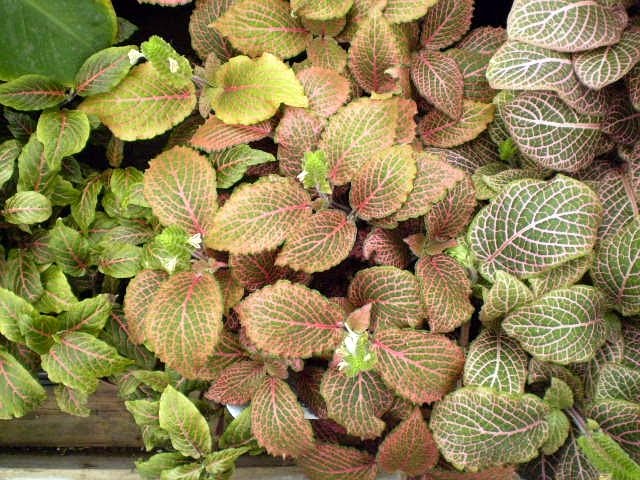
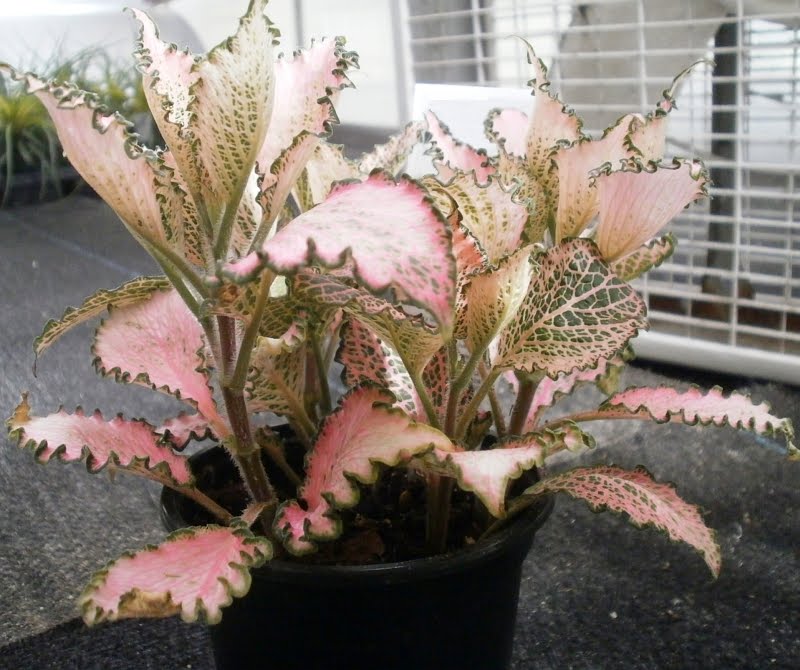
They're small, cute (one might say pixieish) plants, usually no taller than six inches (15 cm). They're also kind of manic-colored (if "manic" can be a color): the leaves are green or dark green, with a netting of veins in white, pink or red. Fittonias also tend to be fast-growing, which is obviously a bit manic as well. Depending on the variety, the leaves may be either oval or diamond-shaped, and will have smooth or scalloped (crenate) margins. They also tend to die by the end of the movie, so to speak: they're not the easiest houseplants.
Fittonia albivenis 'White Anne.'
MPDGs also often have an unsettling, mildly criminal side which occasionally verges on actual mental illness. I was surprised to find out that this also applies to Fittonia: among the claims I found while researching is that Fittonia was used by the Machiguenga people of southeastern Peru as a hallucinogen, for some unknown period until they happened upon a plant that was a better one. (The only specific description of the hallucinations is that Fittonia produces "visions of eyeballs." Not much of a description, but I suppose one detail is better than none.)3 And it's not just another pretty, hallucinogenic face: it can also be brewed into a tea for headache, muscle pains, or cases of difficult or painful urination. (Does it work? The Kofan and Siona-Secoya tribes in Ecuador think it does. I wouldn't personally be willing to take their word for it, but that's the claim.)
Will buying a Fittonia teach you to embrace life again, living it to the fullest? Are despondent men who have lost their joie de vivre more inclined to buy Fittonias than other plants? I suspect not, on both counts,4 but it certainly has that cheerful, perky, impulse-buy look to it.
So how do you keep your Fittonia alive, then?
Fittonia albivenis cvv.
LIGHT: In its natural habitat, Fittonia grows in the understory of tropical forests, so it doesn't expect to receive a lot of light. Some people strongly warn against having a Fittonia sitting in direct sun; I'm not sure it's all that bad (the ones at work were in full sun, after all, and they always did fine as long as we remembered to water them). My Fittonias have been happy with artificial light, so I haven't seen a need to move them around a lot.
In any case, Fittonias are comfortable with a fairly wide range of light levels. Too much allegedly leads to smaller new growth; too little light and the new growth is weak, pale, and stretched. The sweet spot is -- as for most indoor plants -- bright indirect light, filtered sun, or bright artificial light. A little direct sun in winter is probably okay also.
Fittonia albivenis cv., possibly 'Pink Vein.'
WATER: You probably already know that tropical forests tend to be wet, so you won't be surprised to find out that Fittonias need to be kept moist. They're much less flexible about this than they are about light. Plants that are too dry droop, then collapse, much like peace lilies. Also like peace lilies, a wilted plant that's watered promptly will pop back up again and look no worse for the experience, though prolonged drought is another story.
Too much water can also be a problem, alas. Don't let your Fittonia stand in its drainage water, and don't keep the plant constantly sopping wet. If you do, you risk rotting the roots.
Soil is not usually much of a concern; any potting mix for container plants should work fine, though the composition of your potting soil will determine how often you need to water. Even the peaty mixes used by the growers are acceptable: peat holds water, which is usually bad for potted plants indoors, but my larger plant has been in a very peaty mix since I bought it, and is fine. Peatier mixes may be more dangerous if you're inclined to overwater, but I'm (usually) not.
Fittonia albivenis cv.
HUMIDITY: This is the other big problem people run into. So long as you provide high humidity, warmth, and don't let the plant dry out to the point of wilting too often, it'll forgive anything else you do to it,5 but if you have dry air, a drafty home, or a tendency to space off when it comes to watering, the gods themselves will not be able to save your plant. You've been warned.
Contrary to the prevailing advice about humidity, I don't think misting or pebble trays are very useful. I mean, try 'em if you want, but if you urgently need to grow a Fittonia in a dry home, my first, second, and third recommendations would be to plant it in a terrarium. If that's not an option, I'd say place it among your other houseplants6 -- the transpiration from the other plants will keep the humidity higher for the whole group, at least in the immediate vicinity. Some rooms (kitchen, bathroom) tend to be more humid than others, too, though that is somewhat a function of lifestyle; not everybody's bathroom is going to be humid enough for a Fittonia even if some people's might be.
In really desperate circumstances, you could cover the plant with a clear glass vase or bell jar or whatever, though that's so close to being a terrarium that really you should just go ahead and plant it in a terrarium.
See? Terrariums are nice: hardly scary at all! (Photo from Plantgasm. Used by permission.)
TEMPERATURE: There is widespread agreement that Fittonias shouldn't be exposed to temperatures below 60F/16C. (Too much heat isn't good for them, either: don't go above about 85F/29C if you can help it.)
PESTS: Few common plant pests seem to like Fittonias. My theory is that this is because hallucinating eyeballs is a much scarier thing when you have compound eyes. I don't think nerve plants are immune to pests (because nothing is -- even artificial plants can get fungus), but I can't say I've ever seen one with a serious infestation of anything.
Fittonia albivenis 'Frankie.'
What Fittonias do get are bacterial and viral diseases. The main bacterial problem is Xanthomonas campestris, which causes black or brown spots on leaves (or sometimes along margins or along veins). X. campestris can infect a lot of different plants, but Fittonias seem to be special favorites. There's not really a cure; if you have a plant you think is infected, you should probably get a second opinion (from me -- not that I'm an expert on bacterial infections or anything -- the brilliant and stunningly attractive PATSP commentariat, Garden Web, davesgarden.com, local university extension office, a garden center near you that you trust, etc.), and if they confirm it, then you should destroy the plant. Be aware, though, that black or brown leaf margins can also be a sign of low humidity or too-frequent drought: if keeping the plant in wetter air and soil makes the problem worse, then it's probably X. campestris, and if keeping the plant wetter makes the problem go away, then it was probably the care you were giving it.
Other bacteria cause root rot in plants that are too wet. Not really a cure for that either, though with root rot, you can at least start over from cuttings. (See PROPAGATION)
There is also at least one virus (Bidens Mottle Virus), which causes distorted, stunted, yellowing leaves. (Black and white image of affected Fittonia leaves here.) No cure here but the fire. Or the garbage can, as it were. (Don't throw BDV-afflicted plants into compost heaps: BDV can infect a lot of other plants as well, including Zinnias, lettuce, Ageratum, fava beans, and bishop's weed. You don't want to spread it.)
Fittonia albivenis cv.
Also, considering the care requirements and the peaty potting mix growers typically use, fungus gnats are common Fittonia hitchhikers. They don't really hurt the plants, but a lot of people find fungus gnats annoying,7 so you've been warned. See the above link for recommendations on how to get rid of fungus gnats.
PROPAGATION: Propagation is said to be easy, though I've had trouble with it personally. I've tried starting cuttings directly in damp soil, with 0% success in one variety and about 30% in the other. (My error may have been failing to cover the cuttings with plastic to keep the humidity high while rooting was taking place.) Cuttings are also supposed to root in water, though I've heard otherwise from Derek of Plantgasm, and haven't tried it personally. Older plants will root along the stem ("self-layering") if they grow over moist soil, forming clumps which can be divided, though I suspect that's not that common in indoor, non-terrarium plants.
Some of the 0%-success cuttings. They started looking like this more or less immediately, and then got progressively wiltier until I threw them out. A sterile medium like vermiculite or perlite might have worked better, or I could have covered them with some clear plastic. I'll have to try again and get back to you.
FEEDING: I have basically no information to go on here; nobody really talks about it. I assume regular feeding, year-round, with a houseplant fertilizer mixed according to package directions (or at reduced strength with every watering, which is what I personally do) will work.
GROOMING: Fittonias will flower, and the flower spikes have an interesting shape --
-- but are less ornamental than the leaves, so people usually remove them when the spikes start to form. The actual flowers are pale yellow to off-white, and appear one or two at a time. I have no clue what the seeds look like.
Repotting is different from most indoor plants, too: nerve plants have a relatively shallow root system, so too large of a container will lead to rot. One might cut off an inch or two (2-5 cm) from the bottom of the root ball, and a half-inch to an inch (1-2 cm) from the sides, and then replace the plant in the same pot with a layer of new soil surrounding the old root ball is probably the way to go, if you think repotting is necessary; I'd say you're probably better off restarting an older Fittonia from cuttings than trying to keep it going in a new pot.
Fittonia albivenis cv., possibly 'Pink Vein.'
I have long been confused about the proper species name for cultivated Fittonias; I learned it first as F. verschaffeltii, then saw the same plant called F. argyroneura, and now I'm seeing the name F. albivenis.8 As best as I can tell, F. albivenis is in fact the correct name at the moment. It's the only species name GRIN acknowledges; Plant List includes albivenis and another species, F. gigantea.9
The many, many cultivars are apparently the result of sports and natural variation, not hybridization, which I kind of expected: there are more characteristics than species. All the Exotic Angel hybrids' patents say they were mutations of older, non-patented varieties, which I assume is also the case for the other cultivars out there. Why would Fittonia albivenis bother throwing out that many sports? My guess: it was feeling insufficiently unique, and trying to do something nobody'd ever done before.
Selected References:
Though I didn't find it until I was almost finished writing, and it has nothing to do with plants whatsoever, I really must recommend this post (Death of a Manic Pixie) by Phoebe North. It addresses why the MPDG is a problematic trope for real girls to have to contend with, and is an interesting read besides.
Botany.com (general care) Gardenstew.com (responses to a question about general care, some of which are a little questionable. Also the page contains multiple animated .gifs and ads, which are annoying) GRIN (alternate common names, natural range) Davesgarden.com (list of all cvv. known to davesgarden.com) Fittonia production guide -- University of Florida (wholesale production, emphasis on common problems like bacterial and fungal infections and their treatment) Jaycjayc.com (thorough indoor and outdoor care advice) Manu.montana.com (about headache treatments used by indigenous peoples worldwide; Fittonia gets a couple paragraphs) Nparks.gov.sg (mostly worthwhile for the photos of different varieties; also some minimal care info that may or may not apply to indoor growers) HEAR.org (brief note indicating that Fittonia has been introduced to the Galapagos Islands; it's apparently not behaving invasively so far, though) TV Tropes (elaboration on the definition for, and many, many examples of, Manic Pixie Dream Girls in various media)
-
Photo credits: all mine except the one from Plantgasm.
1 Which I already owned. (On VHS, even!) 2 A) I kinda disagree with the inclusion of Joe Vs. the Volcano (1990). In JVTV, Meg Ryan plays three characters. The first embraces life and its mysteries, etc., way less than the depressed Tom Hanks character does, and isn't especially manic, either. The second is quirky and manic, but barely on-screen, and has very little influence on Joe (Hanks), plus she gets at least one monologue that's very specifically about her personal life, art, relation to family, etc., which is all the more significant because she's in such a tiny part of the movie. The third is not especially quirky or manic, spends a significant chunk of the movie unconscious, talks a fair amount about her interior life and relationships when not unconscious, and just doesn't seem to fit the MPDG trope at all. (Joe's part of the plot, where he goes from being a depressed hypochondriac to a fun-loving, life-embracing guy, in fact does match the MPDG trope, but I'd posit that JVTV is an MPDG movie without any MPDGs.) B) Garden State (2004) and Elizabethtown (2005), on the other hand, are not only good examples of the trope, they're almost exactly the same movie. In both cases, there's a dude (Zach Braff; Orlando Bloom) who's in bad shape (overmedicated; suicidal). One of his parents (mother; father) dies, he has to go to (New Jersey; Elizabethtown, KY) to make arrangements related to the death, and in the process he meets (Natalie Portman; Kirsten Dunst), who is extremely outgoing and quirky, so he eventually falls in love, whereupon he learns to enjoy life and stop being so overmedicated/suicidal. C) The husband and I disagreed about which was the better movie: I preferred Garden State, despite not liking Zach Braff at all; the husband favored Elizabethtown, possibly because he hates Zach Braff more than I do and couldn't get past that. Elizabethtown looked promising at first, but the jokes and plotting were, I thought, really lazy. I mean, I saw most of the plot developments coming, and anything that was a surprise wasn't particularly funny or interesting. (Though Paula Deen had a cameo that I thought was mildly clever, which says nice things about whoever was in charge of casting Elizabethtown, I guess.) and by the end of the movie I was so excited about the fact that the movie was finally ending that I cannot tell you whether Orlando Bloom and Kirsten Dunst end the movie as a couple or not. D) One thing I found disturbing and/or irresponsible about Garden State is that it is implied that if you're on psychiatric medications of some kind and are not entirely happy with your life, the way to fix your life is to stop taking the meds. Which is all the weirder because Zach Braff, who wrote and directed the movie, has publicly admitted to having obsessive-compulsive disorder, and his mother is a clinical psychologist, so you'd think he'd be more sensitive to the implications. The movie does sort of tell you that there was never anything wrong with Braff's character in the first place, but it'd be easy to miss, because of course he's clearly acting like there is something wrong with him for a lot of the movie. 3 The original source of this claim appears to be this page, which looks like the work of a sober and scientifically-minded person, so it could be true. Certainly the leaves look like they ought to be hallucinogenic.
Whoa, dude. Trippy.
At the same time, though, I have no idea whether anything ever happens, if anything does ever happen how much you have to use, whether it's only hallucinogenic in combination with other substances (as one of the answers on this page suggests) or whether there are side effects (the Machiguenga stopped using it for a reason, after all). And anyway, if you want to look at eyeballs, there are more convenient and less risky ways of doing that. (Mirrors and Google image searches being the two I can come up with off the top of my head.) And odds are, even if you do manage to get something to happen, it's going to be anticlimactic. I mean, if tripping on Fittonia tea was really as awesome as all that, you would probably have heard about it before now, no? So there's really not much to recommend Fittonia experimentation. More importantly, any recently-purchased plant could contain systemic pesticides, or pesticide residues on the leaf surfaces, and you don't want to be ingesting those on purpose. A one-time pesticide-and-hallucinogen tea isn't likely to kill you, but why tempt fate? So if you must try it out -- and I know there has to be at least one person out there saying oh, yes, I must, I must -- at least wait two or three months after your purchase, to give any pesticides time to break down and wash away. I'd argue more strenuously against Fittonia experimentation, but they aren't considered toxic, so I doubt you can do any serious damage to yourself by eating them unless you're eating entire plants several times a month. 4 (If you're despondent enough, of course, you're probably not buying any plants.) 5 Within reason. Like, they're probably not going to bounce back from being frozen in a block of ice or watered with gasoline. They're more resilient than their reputation would suggest, though, is my point. Herselfshouseplants.com agrees with me on this. 6 And if you don't have other houseplants, obviously you should go buy several. I have some ideas about which ones. I also have ideas about which ones you should avoid. 7 (I'm not one of them.) 8 Not only me -- at least one other person is frustrated with it too. 9F. gigantea sounds interesting: it allegedly grows to two feet (0.6 m) tall and has muddy green/purple/red leaves; there's a picture here, though it's from the top down, so you can't tell how tall the plants are. (Here's another picture, of a younger plant.) It's unclear to me whether F. gigantea is in the horticultural trade at all, either as itself or as hybrids with F. albivenis.
I almost came up with a caption for this, but everything was coming out subtly wrong. Feel free to suggest something.
Nothing exciting with either pet this week, though it appears that Nina's Fittonia, the new one with the pink veins, is not going to root. The cuttings I'd tried to start in the basement didn't work either. Perhaps this is not the way to go about propagating Fittonias.
This is an odd category to build a list around, because "terrariums," actually, is sort of hard to define. I usually assume, when I hear "terrarium," that we're talking about an enclosed glass container, no bigger than a couple feet in any direction, that's being used to grow moisture-loving plants, but of course there are also extremely large terrariums, terrariums that fit inside an incandescent light bulb, open-topped terrariums, desert terrariums, unplanted terrariums which house animals, etc.
So if you want to get technical about it, there's no plant that couldn't be grown in some kind of terrarium if one is sufficiently flexible about the definition, so the list of "plants for terrariums" equals every plant that exists. Which is an easy answer, but not particularly satisfying.
So what I'm assuming with this list is that we're talking about: an enclosed glass container, no bigger than a couple feet in any direction, that's being used to grow moisture-loving plants. Which means that we're looking for plants that like humidity and moist soil, which grow slowly, and don't need full sun. (Full sun is fine, except that it also comes with quite a bit of heat, and since there's nowhere for heat to escape in an enclosed terrarium, sooner or later an enclosed terrarium in full sun will cook itself to death.)
Which is still a pretty long list, it turns out.
Calathea makoyana. Some Calatheas can get to be large (to at least two feet / 61 cm in diameter) quickly, especially in a terrarium, and large Calathea leaves can block most of the light from reaching plants underneath them, but it's a lot easier to grow a Calathea under glass than it is to grow one on a windowsill.
Cryptanthus NOID. Some varieties can get to be pretty large, but most of the ones I've seen top out at about six inches across (15 cm), and they don't spread like some of the choices on this list will.
Episcia 'Coco.' Happy Episcias will produce plantlets on runners, which should root when they contact the soil (you may need to pin them down gently first, so they're firmly in contact), so they do spread a little, but they stay short.
Fittonia albibenis cvv. are fast-growing, spreading plants. The small-leaved varieties stay very short, while the varieties with larger leaves reach about six inches (15 cm) tall and then bend over under their own weight. The stems root when they touch soil, so over time they'll expand.
Hemigraphis exotica. Can get to be twelve inches (30 cm) tall in good conditions, though usually they're shorter than that.
Hemionitis arifolia. Also to about 12 in / 30 cm tall and about as wide. Mature plants will produce plantlets where the petiole joins the leaf; I'm not sure if they'll bend over and root on their own, or if they have to be helped, but either way, allow a lot of space.
Pellionia pulchra. Fast-growing, aggressive trailing plant in a terrarium. Stays short, but the stems need to be cut back periodically.
Peperomia argyreia. Another somewhat mounding plant that needs about 12 in / 30 cm in height and diameter.
Saintpaulia 'Harmony's Red Star.' I don't know about this variety specifically, but there are many, many Saintpaulia varieties, including miniatures (under 6 in / 15 cm in diameter). (Most get to be larger.) All grow well in terrarium culture, and stay relatively short. Spent flowers do need to be removed regularly, so this may not be the plant for you if you want to plant your terrarium in a narrow-necked bottle.
Soleirolia soleirolii, chartreuse cv. This is another low, mat-forming ground cover. Plants stay short but will spread fairly quickly if not cut back.
Recommends and anti-recommends are more or less pointless here, because what's going to work for you depends on the size of terrarium in question and what you want it to do. If you're interested in planting a terrarium, find out how big the plants you're thinking about including will get before you plant them. You should also try to find out how fast they'll grow: some people like having to get in and prune back the plants every so often, and some people don't.
A few of these plants will also need a more specialized growing medium than ordinary bagged potting mix. Most orchids would like the conditions in a terrarium just fine, but need to be planted in bark instead of potting mix, so I left them off the list.
Dionaea muscipula (venus flytrap), though they have fairly specific temperature and water-quality needs which won't necessarily mesh with other plant species
It's Nina's turn this week, and I was going to get a brand-new picture of her, just . . . I don't know, just because I was -- but when I first put the camera in the terrarium, she hid. And she was really, really good at hiding, too, because the Pellionia has done such a thorough job of climbing over everything that the actual soil in there is pretty much hidden from view. Plus her coloration is sort of camouflage all by itself. So this is the best I could do for a current Nina picture:
She's under there somewhere.
Since Nina is unable to fulfill her duties this week, Sheba will be filling in.
When Sheba first got here, almost a year ago, right away she wanted to jump up on the couch. And right away we told her no. And that was pretty much that, for a while. She wasn't supposed to be on the couch, and she understood that. (She did forget herself occasionally. I'd be in the office and hear her jump up on the couch and then back down again immediately. I don't recall ever having to tell her to get down, it was that fast.)
But I decided that I kind of wanted her on the couch, when we watched TV, because . . . I don't know. We'd be up there, and she'd be on the floor, and -- the floor seemed so very far away. So we had to re-explain the couch policy, which she likewise understood almost immediately. It's turned out well: I like having the three of us together, the husband doesn't have a problem with it, everybody's happy. Sheba seems to have concluded that we've given the couch to her, though, so that's where she sits, most of the day. She'll still allow us to use it at night, though.
Here are the most recent additions. I was originally not going to do the first three, which I got about a month ago, because while they're nice enough and I'm happy to have them, they didn't seem particularly interesting to me and I wasn't sure you'd care. But, I mentioned this concern to someone I was e-mailing back and forth with at the time, and s/he said I should post about them anyway, because even if they were boring to me, they wouldn't necessarily be boring to someone else who had less-jaded tastes. Which seemed sensible. So if this bores you, blame that person. And even if the first five plants bore you, there's a pretty good chance that the sixth one will not.
I am still somewhat intimidated by Fittonia, having had a couple bad experiences with them in the past, but it's a pretty decent-sized pot, they're easy enough to propagate (I hear: haven't actually tried it personally yet) if the plant starts to decline, and there's always the possibility that Nina might need one at some point. Looking at it now, that's pretty dumb logic, but the whole trip was triggered by me feeling like I'd go nuts if we didn't go to Lowe's immediately, so I could buy something, so the logic was probably never the point anyway.
It could have been worse than a Fittonia. And so far (this was a few weeks ago) the plant has been fine in the basement. I regret nothing.
Chlorophytum laxum. Lowe's, $2.50.
I think this was also half-price, and it's also something I wouldn't ordinarily have been interested in, but I have seen these and wondered what they were like. I haven't been doing so great with spider plants (Chlorophytum comosum) lately, for unknown reasons, and as far as I can tell, this is just a spider plant with petioles (the "stems" that attach a leaf to the main stem of a plant), so this may have been a bad idea. So far, so good, though.
I don't know. This was the same trip as the Lowe's plants.
I've had a variegated P. clusiifolia for a very long time now (four years). We've had bad times and good times, but it's still alive, at least, and things have been going pretty well lately. I may like the plain-green version better (it's less ubiquitous), and it was very cheap, and I felt kind of sorry for it, sitting there all dusty, on the bottom shelf of a crappy plastic display stand. Not bad for the money.
This one, and the next two plants, were from last week's trip to Cedar Rapids.
I have been trying to get a Saintpaulia with flowers that weren't blue or purple for some time, but it's been unexpectedly difficult to do so. This one, though, not only solves that problem once and (hopefully) for all, it's also a much darker black-red color in person. Very, you know, goth. Which is cool. If one must have little-old-lady plants, one can at least try for the butchest possible little-old-lady plants.
I'm not sure quite what I have in this plant; a Google search turned up no pictures of it, as in not even one, and there were only four hits for the name. It looks like it's going to be a doubled ruffly chartreuse/white flower with pink-red "thumbprints" on the petals, but so far there's only the one flower, which won't fully open, so I'll have to wait for the next round of flowers before I'll really know what I have.
Close-up of the one flower.
The logic with this one was not that it was pretty -- because it really isn't, at least not yet -- as that it would be fun to try to cross it with the other ones I have and see what happens. It has enough odd characteristics that I figure something interesting would have to happen, eventually.
Though now I'm picturing a future in which I have 900 or so houseplants, and then another 900 or so Saintpaulia and Schlumbergera seedlings besides. African violets can produce a lot of seeds, after all. The idea does give one pause.
Finally, the plant you've all been waiting for:
Aeschynanthus NOID. Peck's, $6.
I don't exactly know what I have here. It looks like a lipstick plant, but it doesn't really have noticeable calyces ("calyx" = the cup-like thing that surrounds the base of the flower) like Aeschynanthus lobbianus does, and light pink is a very unusual color for Aeschynanthus, and the leaves are shorter and rounder than what I think of when I think of lipstick plants too. But I asked them about it, and they said that's what it was, and then later I found a very similar-looking plant on-line at the Violet Barn, which they're calling Aeschynanthus 'Thai Pink.'
UPDATE: I have received an e-mail telling me that the pink things in these photos are actually not the flowers, but are the calyces, and there will be proper flowers at some point later. I'd looked inside the calyces before and saw little white things, which I assumed to be pistils because what else would they be, but I just went back and looked again and they're actually small balloon-shaped things that look for all the world like flower buds. So this is apparently not even the interesting part of the show yet.
Close-up of the flowers calyces. So far, the flowers have still not opened up fully. The color really is this faint.
There are other people selling it on-line under that name too, so for the moment I'm going with the name Aeschynanthus 'Thai Pink.' The Violet Barn also says that it's a shy bloomer, so this may be the last flowers I see on this plant for a while, but hell, it was worth six bucks just to see it once. A pink lipstick plant. Of all the crazy ideas.
Have questions about PATSP? See the Infrequently Asked Questions post, or ask directly by e-mail. To e-mail, remove the two "d"s from the below address:
mrsubdjunctive@doutlook.com
Please note: I am a person, not a houseplant-care-advice vending machine. If you've asked a plant-care question and I responded, that took time and effort that I could have spent on something else, and it's nice if you acknowledge that with a "thank you."
Also: no, I will not help you draw attention to your Kickstarter. No, I do not need the services of a blog-ads optimizer. No, I'm not interested in promoting/reviewing/giving away your products. Fuck, no, I will not write for free for your blog. I know these things are important to you, and you feel that your case is so special that I would obviously make an exception to the rule if you asked me because of how special your thing is, but I assure you: it is not special, and I will not make an exception. (This means you, Mother Earth Living.)
As of 20 June 2021, comments may not be approved for several days, because Google / Blogger has made it less convenient for me to check them.
Lynn P. Griffith, Jr. Tropical Foliage Plants: a Grower's Guide (Amazon • B&N) Lynn P. Griffith, Jr. Tropical Foliage Plants: a Grower's Guide, 2nd Ed. (Amazon • B&N • Powell's)
Mr_Subjunctive used to work at a family-owned greenhouse / garden center in Iowa City, IA. As of 16 December 2021, he has 1234 houseplants, which is too damn many. Most are Schlumbergeras.
Photos on this blog attributed to mr_subjunctive are licensed under a Creative Commons Attribution-Noncommercial 3.0 Unported License. All other photos retain the licensing preferences of their owners and require permission for reuse. Contact mr_subjunctive for help in locating the sources for other photos.
Text on this blog: all rights reserved. Text may not be duplicated by any means without permission of its author, who is actually pretty easygoing under most circumstances and will probably say okey-dokey if you ask to reproduce something (but you still have to ask, and credit mr_subjunctive as the author of the excerpted part).


.jpg)






 Posts
Posts