Monday, October 29, 2018

Schlumbergera seedlings 196 and 125

No promises, but I might be back again for a bit. We'll see how it goes.

Seedling 196A isn't that exciting to look at. Orange / light pink, a bit less orange than usual but otherwise pretty typical. It mostly distinguishes itself in the number and timing of the blooms: like 025A Clownfish, it appears to be unusually insensitive to day length and temperature, and is willing to set buds much more freely than the average Schlumbergera. Which is a desirable trait, so I was hoping to find a really good name for it.


But I don't think I did. The name finalists: Can't Slow Down, Fred Rogers, Lady Boyle's Last Party, and No You Hang Up First.

Can't Slow Down is just a reference to the unusual amount of blooming. Fred Rogers is the television personality, previously considered for 062A Open World but rejected on the grounds that I couldn't be certain that there wasn't already a Schlumbergera named for him somewhere out there. (Which I suppose is still a concern, but I'm less worried about it this year.)


Lady Boyle's Last Party will need some unpacking. It's the name of one of the chapters in the video game Dishonored. The actual story is pretty ugly (if you're interested, you can read a summary at the Dishonored wiki), but the way the space is designed, and the artwork that goes along with it, are so amazing that I think it may be my favorite chapter of any video game I've ever played.1 (Some non-violent, non-gross art examples can be seen here and here.) I've used game-related names before,2 and Dishonored is great (my only complaint is that it's too short), so eventually there will be a Dishonored-related name, even if it's not this one.

No You Hang Up First is a roundabout reference to how hard it was to settle on four name finalists. Sometimes you just have to let the thing be done, even if you sort of want to keep going.


So. No You Hang Up First was sort of always intended to be a throwaway option; the rules say that there have to be four names to choose from, so I needed a fourth name.3 And Lady Boyle's Last Party is problematic in a number of ways, the main three being that it's awfully long, the storyline that goes with it is kinda icky, and the dominant colors in the level are browns and golds (which is striking partly because the game is otherwise primarily blue and gray), not vivid orange.

Which leaves us with Can't Slow Down or Fred Rogers, and Can't Slow Down is a bit abstract. Plus we don't actually know that 196A can't slow down. It hasn't so far, but the name shouldn't be making promises like that. So this one will be 196A Fred Rogers.


Seedling 125A is yet another white child of the NOID white; it doesn't do anything particularly interesting, and it's likely that I'm going to wind up selling or discarding it. What I decide to call it until then doesn't matter very much.


The name finalists are: Effet De Neige, Glass Slipper, Mae West, and Weighted Companion Cube.

Weighted Companion Cube is yet another video game reference (again to Portal). It has in its favor that the coloration of the flower (white / pink) is similar to the coloration of the video game object (light gray / pink), and that's about it.

Mae West was previously considered for 290A Our Lady Of Assumption, 067A Cyndi Lauper, and 133A Fading Commotion.


Effet De Neige means "effect of snow" in French, and is an art reference. I'm not really qualified to talk about art history and consequently won't try, but my understanding is that the French Impressionists got really into snow for a few decades in the late 1800s, leading to works like Vue de toits (Effet de neige) (Gustave Caillebotte, 1878):


Effet de neige (Gustave Courbet, 1860s):


La Pie (Claude Monet, 1868-69):


Effet de neige à Petit-Montrouge (Édouard Manet, 1870):


Paysage d'hiver (Le chemin, neige) (Robert Antoine Pinchon, 1905)


and so on. I mean, we could look at French Impressionist snow all day,4 but we've got seedlings to name.


There's also Glass Slipper, which was considered and rejected for 193A Arcade Gannon and 135A Chiune Sugihara,5 and sort of considered for 290A Our Lady Of Assumption.

So I'll drop Weighted Companion Cube on the grounds that it's long, and there's already a Portal-related seedling. Very tempted by Effet De Neige, but having looked at all the paintings now, I'm sort of inclined toward holding that name in reserve for a prettier white seedling. Which leaves us with Mae West or Glass Slipper, and of the two, I think Glass Slipper is the more disposable name. So we'll go with 125A Glass Slipper.

-

1 Though most of the competition is probably also from Dishonored, and what isn't is probably from Half-Life 2, which had the same art director, Viktor Antonov. Apparently I'm just really on his wavelength.
2 Games in general: 062A Open World; 424A Speedrun.
Fallout: New Vegas: 193A Arcade Gannon
Half-Life 2: 107A Nova Prospekt; 379A Can't Find The World
Pac-Man: 067B Clyde
Portal series: 072A Chell
3 Yes, they're my rules, and I could change them if I wanted, but . . . I preferred to add a fourth option that I knew I wasn't going to pick, instead of proceeding with only three options. *shrug*
4 (All of the paintings were public domain images from Wikipedia, by the way.)
5 Which has unexpectedly died as of a couple weeks ago; I don't know what the problem was. It's really unusual for the Schlumbergeras to die on me if they've lived long enough to bloom, though it also happened with 042A Mary Tyler Moore, last year. 042A was always a little weak-seeming, so I wasn't shocked, but 135A had seemed perfectly normal. So I'm puzzled.


Saturday, October 20, 2018

Random plant events: Leuchtenbergia principis, Zamia furfuracea

Everything was going fine, and then it was time to dig up the Cannas and bring them in for the winter. And you've seen the Cannas.1

As of 18 October, direct-weighing on a bathroom scale has given us the approximate figure of 787 lb. (357 kg) of Canna rhizomes brought inside for the winter, and we haven't even dug them all up yet.2 My best guess is that another 200-300 lb. (91-136 kg) remain to be dug up.

Meanwhile, one of the Leuchtenbergia seedlings has decided to bloom, in the basement, under artificial lights. I'm surprised that this is even possible.


The seedling in question was sown on 8 May 2013, so it's about five and a half years old. In some ways that feels like a really long time to wait for a bloom, and in other ways it feels incredibly fast. (It's not as if Leuchtenbergia is known for its speed.)


Also, I purchased four kinds of seeds from seedman.com at the beginning of September. Three of them are sort of disappointing. There's nothing at all going on with Chamaedorea cataractum, and one of the six seeds in that package was rotten when it arrived, so I kind of suspect that was wasted money. A few seeds of Ficus religiosa and Ficus benghalensis have germinated, but they're developing slowly and I'm not optimistic about getting actual plants of either one.3

But the fourth one, Zamia furfuracea, is doing more or less what it's supposed to.


I have germination on eight of the ten seeds so far, and it's only been four or five weeks (the first seed to germinate, photographed below, took 26 days; the package instructions said to allow "several weeks to a few months"), so I'm hopeful about the other two.


Not that the Zamias are much to look at so far. But still. It's something.

I have no idea when I might get back to regular posting again.

-

1 (Well, some of the Cannas. There were a lot of Cannas.)
2 Also, this omits a box with about 35-40 lb. of Cannas that we just gave to a total stranger because he stopped at the house and asked. (He knew we had them because we piled all the cut stalks on the curb, in hopes that the city will eventually take them away for us, and the pile was kind of . . . unmissable, I guess is the word.)
3 Though you never know. I tried F. religiosa once many years ago, and got at least one plant that survived long enough to develop some leaves. It didn't transition to a pot well, probably because I was asking it to go too long between waterings. There's probably a reason people don't normally grow these species indoors anyway; I just thought it might be fun to try. (It hasn't been.)


Sunday, September 30, 2018

Schlumbergera seedlings 130, 160, 187, and 402

Okay, well. There was never any danger of getting through all of the 2017-18 Schlumbergeras before the 2018-19 ones started to bloom, but as of a few days ago I'm officially a season behind: the first blooms from 423A and 437A have happened, with substantial buds on two more seedlings (469A and 472A). I can't catch up, but I can at least try not to fall further behind, so we have four seedlings to name today.

Seedling 130A, from the NOID white:


Name finalists: Barn Owl, I've Said Too Much, Myrtha,1 Serenity Prayer.2


I'm fond of barn owls, and this does have nice clean curves that makes Barn Owl seem somehow appropriate, but it turns out that they're not always the snowy white I was imagining: sometimes they're brown. So maybe not. And I've forgotten how I've Said Too Much got on the list in the first place.


I'm going with 130A Myrtha, mostly based on it being shorter to type than Serenity Prayer. Though I bet Serenity Prayer is going to keep coming back until it gets used.


Seedling 160A, from the NOID peach somehow:


It's not amazing or anything, but it's a different coloration than usual, so I'm fond of it despite all the thrips damage.


Name finalists: Bite Tongue Deep Breath,3 Composition In Red & Pink, Just Lucky I Guess, Roseate Spoonbill.


I should perhaps explain a couple of those. I had the idea several months back that I should look at paintings for name ideas, since artists have to come up with names for things all the time and maybe some of those would be worth stealing. Unfortunately, the book we had available to consult was a book about modern art, primarily, and an awful lot of modern art has stupid titles. Lots of "Untitled" and "Composition" and "Self-Portrait." So it didn't really work out for me, but Composition In Red & Pink is just short enough to be workable if I allow the ampersand, so what the hell, let's try it. It's not going to be usable for any other blooms, because "red" and "pink" are as short as Schlumbergera-relevant color names get. And of course the Roseate Spoonbill is the bird, which is more or less these colors, though in different proportions, so it kind of works.


I think I want to save Roseate Spoonbill for a better color match -- surely a red/pink/white will come along eventually -- and Just Lucky I Guess is kinda meh. In the end, I think I like the pretentiousness of 160A Composition In Red & Pink.


Seedling 187A, from the NOID magenta:


Name finalists: Funny Farm, Mister Orange, Perp Walk, Replacement Goldfish.


Funny Farm is a bit insensitive, now (it's a slang term for a psychiatric hospital), though it's meant as a reference to someone from my life, in which context it's less so. (Explaining would make the reference more explicit than I'm comfortable with.) Mister Orange is more or less a reference to Tim Roth's character in Reservoir Dogs, a movie I used to really love but haven't seen in a long time for fear that it wouldn't hold up well. Perp Walk is sort of a reference to orange prison jumpsuits, though now that I've included it on the list, I'm realizing that a) it's also sort of insensitive, and b) it doesn't really even work as a reference, since normally the perp walk happens well before the jumpsuit. And then Replacement Goldfish is the trope, which hopefully is familiar enough that you don't need me to explain it.


So. Replacement Goldfish is a bit darker, as a trope, than I was thinking when it went on the list, and Perp Walk doesn't work, so it's a choice between media nostalgia and personal nostalgia for me, and I guess personal nostalgia should win, even though it looks insensitive. So 187A Funny Farm. I can always change it if it bothers me later.


Finally, seedling 402A, also a nice-looking white seedling from the NOID white:


Name finalists: Booster Separation,4 Cirrus, Magician's Dove,5 Sinclair Lewis.

Cirrus is the meteorological designation for high, thin, wispy clouds, which I imagine this seedling resembles. Sinclair Lewis is the first author from the U.S. to receive the Nobel Prize for Literature (in 1930); I read a few of his novels back in high school (Main Street, Babbitt, Arrowsmith, Elmer Gantry), and the only one that really stuck with me at all was Arrowsmith, which I really enjoyed. I don't know how Lewis is thought of currently; people seemed to like him at the time he was writing, but he's a lot less famous now than his contemporaries Ernest Hemingway, William Faulkner, and F. Scott Fitzgerald. Wikipedia suggests that Arrowsmith, at least, is still read occasionally, and I've seen plenty of references to It Can't Happen Here recently though I'm not sure how many people have actually read it. (I haven't.)


I don't think I knew before reading the Wikipedia entry for Sinclair Lewis that he was a redhead (or if I knew, I had forgotten), so I'll save the name for a red-orange seedling. The other three all reference the shape and color of the bloom to some degree or another, and I think Cirrus works best, or is at least easiest to type, so we'll go with 402A Cirrus.

-

1 (previously considered for 122A Tickly-Benders)
2 (previously considered for 136A Khutulun)
3 (previously considered for 281A No Bad Vibez)
4 (previously considered for 062A Open World)
5 (previously considered for 119A There Would Be Peace and 136A Khutulun)


Friday, September 14, 2018

Anthurium no. 1352 "Queen Bee Luscious"

Queen Bee Luscious is unusually difficult to photograph, because her spathes have a very pronounced saddle shape to them.


Or at least usually they do: the first bloom looked more or less normal. Except for the missing spadix.


As mentioned in the post for 1323 Kayla Stratus, QBL also has a lot of thrips damage, which is really disappointing.


On the positive side, she's produced a lot of blooms under nonideal conditions, and I feel like if the thrips weren't involved and she could consistently remember to make a spadix, I'd think of the inflorescences as "pretty." (As it is, the thought is more potentially pretty.)


The foliage is surprisingly unblemished:


And there's a decent amount of it (at least, there was last November when the photo was taken):


Though the internodal distance is a bit of a problem, as it was with 'Joli,' the seed parent. So I'll keep her, but she could also be doing better.


QBL is one of the seedlings in line to be promoted to a 6-inch pot the next time I have room to do that: maybe she'll handle herself a bit better once that's happened.

Side note about the blog: I'm probably going to have to slow down or stop for a little while after this post, as life has become a bit unmanageable again. Everything is fine; I just can't keep up.


Wednesday, September 12, 2018

Schlumbergera seedling no. 377

337A is the other exciting new thing from the 2017-18 seedlings, along with 392A Subjunctive. It's similar to Subjunctive but not quite the same:


Basically the same coloration, but where Subjunctive is magenta, 377A is light pink. I personally like this one slightly better, on the grounds that I think the yellow and pink harmonize a little better with one another than the yellow and magenta, but obviously they're both nice. I shouldn't be trying to pick favorites.

Anyway. The name candidates this time are so weird that only one of them makes any kind of sense on the surface, and one of them doesn't even make sense after you find out where it came from. We have: 52-Hertz Whale, Butterchange My Stranger, Neatrup, and Nesh.


Two of those are from the dialect dictionary.

Neatrup is the spelling I like best out of the four given. The definition given by the book, with some formatting changes:
netop, neatrup, eat-up, meet-up, n. A friend. Cf. "Folk Ety."1

1829-30 Mass. netop = friend, crony. Indian wd. Dunglison Glossary.
1850 e.Mass meet-ups, pl.
1932 & before s.w.Conn. Danbury 'They are great eat-ups (or neatrups).' Said of 2 persons having a sudden violent affection for each other. Used in one family, esp. by a 93-year-old woman.
1934 netop. Algonquian wd. Used in salutation to an Indian by Amer. colonists. Web.

I mean, I don't know how strongly the seedling feels about me, but "violent affection" isn't far from how I feel about it. So it kind of works.

For what it's worth, I did poke around a little bit on-line to see if I could find out what the original Algonquian word was, but failed.


Nesh is a bit simpler:
nesh, adj. Dainty, fragile.
1826-1900 N.Y.C. Educated. A. P. Terhune in N. Am. Rev. May, 1931.
1934 Obs. exc. dial.
The flower itself is no more dainty or fragile than any of the others, but I'd argue that the coloration is a little more delicate than the loud, blaring oranges we usually get. So it kind of works.

Butterchange My Stranger is the one that's not going to make sense even after I explain it: it's a Markov chain result2 that I find appealing for reasons I don't entirely understand: I put the list of potential names I'd already come up with into this site, and Butterchange My Stranger was one of the options that got spit back out at me. I think the origin is from BUTTERCream Frosting + CHANGE MY STRide + the unintentional inclusion of Bible verses in the input data that included the word "stranger," presumably either Leviticus 19:333 or Zechariah 7:10.4, 5


I tried pretty hard to invent a way to make Butterchange My Stranger mean something, anything, but the best I could come up with was a very specific and weird situation in which two people, let's call them Alice and Bob, are in a diner, and two people neither of them know come in and order their food, which comes with pats of butter. Somehow in the course of talking, Alice and Bob wind up assigning each other strangers so they agree that one is Alice's stranger and one is Bob's stranger, and then Alice and Bob make a bet about who can replace their stranger's butter with margarine, or garlic butter, or some other butterlike substance which is not the original pat of butter. (I am coining the verb "to butterchange" here, meaning "to replace butter with some other butter.") So if you're Alice or Bob, you're thinking of your objective as being to now Butterchange My Stranger.

[beat]

Which is at minimum very, very weird. But, I don't know, something about the sound of it -- specifically, I think, the rhyme between "change" and "strange" -- appeals to me. And it doesn't hurt that we've got kind of a buttery light yellow in the flower. So . . . *shrug* . . . let's throw it into the list of options and see how it does. Why not. Worst that could happen is I wind up with a nonsensical name that requires explanation, and it's not as if that's never happened before.

Finally, the 52-Hertz Whale is a whale of unknown species that calls at the frequency of 52 hertz (52 cycles per second), a very low G-sharp or A-flat (Wikipedia says 52 Hz is just higher than the lowest note reachable by a tuba, if that gives you any idea of the note.). This is much higher in pitch than the calls of blue whales (10-39 Hz) or fin whales (20 Hz), and as far as anyone can tell, it is the only whale in the entire world which calls at this pitch. It was first recorded in 1989, in the Pacific, and its call has since deepened in pitch to 49 Hz, from G-sharp to G; researchers presume that this reflects the whale's growth.

The 52-Hertz whale moves at times, and for distances, suggesting that it may be a blue whale, though it doesn't seem to be moving as part of a group of blue whales; it might also be a blue/fin hybrid, a deaf blue whale, a group of whales, or the last survivor of some nearly-extinct whale species.

People have sort of latched on to the 52-Hertz whale's existence as a metaphor or whatever; there are a lot of articles out there referring to it as "the loneliest whale in the world,"6 and anthropomorphizing it, and . . . I mean, I get the appeal; surely most of us have felt at one time or another like we were not quite speaking the same language as everyone else. But we don't actually know that the 52-hertz whale is lonely: we're not even positive that it's singular. Maybe it's fine. One must imagine the 52-Hertz whale happy.

Anyway. 52-Hertz Whale could work as a name. It at least emphasizes the uniqueness of the color. There could be other seedlings that look like this down the road, but it's the only one we've seen in four years of doing this, so it's probably not a coloration we'll see a lot.


So. Where to even start. I guess I'll drop Nesh. It would work; I think the word and meaning even fit one another well.7 But whenever I imagine how I'd feel in the future, having chosen each of the four options, Nesh is somehow the most disappointing. And I like the meaning of Neatrup, but in that case I feel like the word and idea really don't match one another particularly well.

So we're left with Butterchange My Stranger or 52-Hertz Whale. 52-Hertz Whale has more of an explanation, is one syllable and ten characters shorter, is a bit more melancholy, and is probably less likely to age badly. (I worry that Butterchange My Stranger will appeal a lot less after the novelty has worn off.)


But I don't know. I'm feeling really drawn to Butterchange My Stranger. Maybe I will regret it later, maybe you'll all judge me, maybe six months from now competitive butterchanging of strangers will go viral and no one's butter will be safe anymore and it will be all my fault. Dumber things have happened, and I won't be able to say that I didn't see viral butterchanging coming. I suppose if I need to I can switch the name to 52-Hertz Whale. But at least for right now, this one's 377A Butterchange My Stranger; God have mercy on us all.

-

1 Meaning "folk etymology;" this is the process by which an unfamiliar or difficult word gets modified into something more familiar or easier to say, generally mangling the original word beyond recognition and sometimes resulting in a misunderstanding of what part of the original word is the base word and what part is a prefix or suffix. Sometimes it's a deliberate mispronunciation for humorous effect (in which case it's probably more proper to call it a pun), but the book gives the impression that it's normally the result of people hearing a new word, especially one from a foreign language, and then breaking it down into words they already know unintentionally, like when English borrowed cucaracha from Spanish and reformed it into two existing English words, cock (rooster) and roach (originally a kind of fish).
"Eggcorns" are not quite the same thing, though I admit to being a little fuzzy on the difference between eggcorns and folk etymologies.
A few examples given by the book: sankfield used in place of cinquefoil; summer-stop for thermostat; brown-kitties for bronchitis; sparrowgrass for asparagus.
My favorite historical example is probably centipede becoming sandy Pete.
2 Markov chaining is explained in the post for Anthurium seedling 0696 "Jessica Wild." Possibly not explained well, but I tried.
3 When a STRANGER sojourns with you in your land, you shall not do him wrong. (English Standard Version)
4 ' . . . and do not oppress the widow or the orphan, the STRANGER or the poor; and do not devise evil in your hearts against one another.' (New American Standard Bible)
5 (In some cases, I remind myself what the possible name refers to by putting something in parentheses with it; I neglected to strip out the parenthetical bits before plugging the name options into the Markov chaining program.)
6 Example 1, Example 2. Plus Wikipedia.
7 Not so much in "Don't touch that! It's nesh!" as in "Oh my god Becky you have to buy it, it's soooo nesh."


Monday, September 10, 2018

Schlumbergera seedlings 138 and 380

The Schlumbergeras in the house are already budding up in anticipation of the 2018-19 season; I still have way too many seedlings to show you before those posts can happen. Though the saving grace could be that most of the seedlings that can produce blooms already have: I haven't potted up any new seedlings or moved any seedlings from the basement to the plant room. So maybe I'll make up for the unusually large number of 2017-18 seedlings by having an unusually small number in 2018-19.

Anyway. Seedling 138A has a bit more pink in it than most of the white blooms do, but otherwise it's what you'd expect from the NOID white seed parent:


Name finalists: Blind Cave Fish, Foreshadowing, Jellybean Cake, Private Conversation.


I explained Jellybean Cake (sort of) the last time I considered using it for a seedling, for 044A Iktsuarpok.

Foreshadowing is a glancing reference to the fact that although I had three white/white or white/pink blooms early in the season (044A Iktsuarpok, 122A Tickly-Benders, 136A Khutulun), the 21 new seedlings after Khutulun were red, orange, yellow, and magenta. 138A is the point at which the white ones started to come back. And then I couldn't shut them off.1 It maybe doesn't make sense as a name now, since I'm blogging about the seedlings in non-chronological order. Also there's something sort of perverse about assigning "shadow" to a white seedling, but I suppose that could be overlooked.


Blind Cave Fish are exactly what they sound like: fish, which live in caves, and are blind. This has happened several times, to different species of fish (e.g. the Mexican tetra, Astyanax mexicanus; Wikipedia has a whole article about cavefish, if you're interested). Given enough time, the species finding themselves in caves tend to lose their pigmentation and eyes, for the straightforward evolutionary reason that if nobody can see your pigments, mutations that wreck your ability to make pigments aren't a liability, and if there's no light to be seen, mutations that prevent normal construction of eyes don't make it any harder for you to eat and reproduce. Though Wikipedia suggests that some species do build eyes anyway, and then cover them with skin.2

Granted, actual cave fish are often not blindingly pure white as the flower, and what color there is tends to be more yellowish or purplish, but one can find pinkish cave fish, so I figure the name is still justified.

I don't remember why Private Conversation seemed appropriate for this seedling when I put it on the list. There's a Lyle Lovett song by that name, which is probably what I was thinking of, but that doesn't actually make it any more understandable.


So. Happy to drop Foreshadowing since it no longer makes sense in this context, and although I don't hate Private Conversation, if I don't see how it fits the seedling then I may as well drop it. Which leaves the happy, if sort of extreme, Jellybean Cake on one hand, and the slightly sad and grotesque Blind Cave Fish on the other. And I think I'm going to go with 138A Jellybean Cake. Not because it's happy, but because the flowers sometimes photograph really well, and the color is fairly strong: I feel like a Blind Cave Fish should be a bit duller and uglier.


So now we move on to 380A, which is sort of the opposite of 138A Jellybean Cake: magenta where 138A is white, white where 138A is pink. It was pretty nice the one time it bloomed,


and I'd be pretty pleased with it if not for the fact that the seed parent was the NOID yellow. It could have been so much more interesting. The overwhelming majority of the Schlumbergeras from this year bloomed in a different color than their seed parents. Out of the NOID peach's eight seedlings to bloom for the first time this year, only one (https://plantsarethestrangestpeople.blogspot.com/2018/03/schlumbergera-seedling-no-047.html047A Pluto) was remotely peach/white. The NOID magenta's seedlings produced fifteen new first blooms this year, none of which were magenta/white.

I mean, I understand that pollen makes a contribution. But you'd think the seed parents weren't even involved in the process, except for the NOID white and 025A Clownfish, whose seedlings usually look more or less like their seed parents.

So, our name candidates: It's A Funny Story, Jellybread, Lesley Gore, Magic Words.

It's A Funny Story is a reference to getting magenta from the NOID yellow; the NOID yellow's offspring have inspired a lot of comedy-related names this year.3

Jellybread was considered for 382A Permanganate and is explained there.


Lesley Gore sang the most famous version of "It's My Party" in 1963, which went to #1 on the pop charts; she also had a #2 hit with "You Don't Own Me," also in 1963. Gore was sixteen and seventeen, respectively, when the two songs were released. Wikipedia says that "It's My Party" even had a sequel ("Judy's Turn to Cry"); I include this because it strikes me as remarkable for songs to have sequels.4 This article at Curve includes some interesting details about Gore's personal life, focusing on her 32-year relationship with jewelry designer Lois Sasson.

Magic Words is one of the names intended to honor someone from my life.


So, first, I guess we can lose It's A Funny Story: it's longer than the other options, and maybe not that clever either. And although I like Jellybread, it's not grabbing me as much as the other two options.

I could probably be happy with either Lesley Gore or Magic Words, but I find myself leaning toward Magic Words for whatever reason. So Leslie Gore will have to come back for another seedling, and this one will be 380A Magic Words.

I didn't expect to wind up with two personal honorific names, but there you go. Another really good Schlumbergera coming up on the 12th.

-

1 White seedlings to follow: 125A [name TBD], 118A Milky Quartz, 142A Gimme A Second, 155A [name TBD], 137A [name TBD], 406A Flock Of Wolves, 130A [name TBD], 144A [name TBD], 402A [name TBD], 147A [name TBD].
2 Which is also allowed by evolution, of course; it's just a little wasteful. It would be better for the fish not to squander the time and resources making eyes if they're just going to cover them up with skin, but natural selection only requires a species to be good enough to survive and reproduce, not to be perfect. Apparently covering eyes up with skin is good enough, however ridiculous it seems.
3 e.g. 369A Punch Line, It Is To Laugh (considered and rejected for 382A Permanganate, presently under consideration now for 375A), Hi Hungry I'm Dad (coming up in 374A's future post), and Who's On First (being considered for 375A). There will probably be more by the time all the NOID yellow's seedlings are named.
4 Though maybe it shouldn't. I feel like if I tried, I could think of examples of songs that continue the story from an earlier song: maybe it's just that the idea of calling a song a "sequel" is strange to me.


Saturday, September 8, 2018

Anthurium no. 1720 "Mado Lamotte"

I've been teasing a green flower for a few posts now, and it's finally here. This is Mado:

26 November 2017.

Personally I think this is very pretty, though I suppose your feelings about green flowers may vary. Less attractively, the color changes over time, with the spathe getting lighter and lighter and the spadix getting darker and then abruptly changing to white.

29 November 2017.

This isn't the worst thing in the world, I suppose, and I actually like the spadix changing from light green to dark green to white, but I would have been happier if the spathe had held its color better, or gotten darker with age.

8 December 2017.

Also, as you can see, the thrips got to it a bit.

12 December 2017.

But whatever Mado's deficiencies, it's still a green/green. And it's a bit more solid than the previous greenest seedling, 1419 Maya Douglas, from a year ago. Mostly the problem with Maya is that she's only produced one inflorescence, so I don't know what a "normal" Maya Douglas bloom looks like yet.1

Mado hasn't bloomed again either, but it seems like it ought to be only a matter of time: the plant is large and vigorous, and only about two and a half years old, so I'm not worried yet.


And the leaves, individually, are nice. Not any thrips damage that I can see in the photo.


So Mado is a good candidate to get promoted to a 6-inch pot, if and when I can find space for a new group of 6-inch plants. Which may never happen. I don't know. I might wind up discarding some of the existing 6-inch plants, instead of creating new space: a few of them have been annoying me a bit.2

Mado's seed parent was 0234 Ross Koz. Just to refresh your memory, Ross looks like this:


I have no idea what pollen parent could produce green/green offspring from a purple-red / light yellow seed parent. Possibly 0330 Faye Quinette? Faye does make pollen, and there's some green pigment in her spathes. I'm pretty sure I never got pollen from 'Midori,' and in any case I think 'Midori' was already dead by the time Ross would have been pollinated for this seedling. But who knows.

Anyway. Obviously a keeper. Many of the species of Anthurium used for modern hybrids produce green spathes,3 so there's a sense in which it feels like moving backwards to make green blooms on purpose. But I don't care: this one's mine, and I think it's pretty.

The performer Mado Lamotte is from Montreal; I don't know anything about her besides what the Wikipedia article says.

-

1 I think Maya did produce a second bud several months back. It didn't get very far before being aborted, though.
2 (Looking at you, 0083 Carmen Adairya.)
3
• A. formosum is pale greenish white to pale lavender, with a light yellow spadix that turns white at maturity.
• A. hoffmannii is yellow-green / light yellow.
• A. nymphaeifolium is (green or white) / (yellow or pale purple).
• A. ravenii is light green / white.

The Anthurium-breeding book also includes photos of some hybrids involving other species, specifically A. cerrocampanense, A. garagaranum, A. lentii, and A. caperatum, without ever describing or photographing the species themselves, though the internet came through with some descriptions:
• A. caperatum is pale green / pale green according to this site, though I couldn't find photos.
• The same source says A. cerrocampanense is light green to yellowish green with streaks of dark green or purple, with a green spadix.
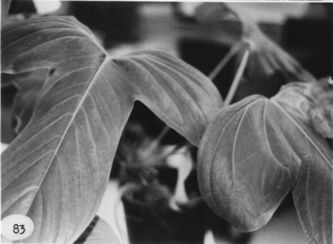
• A. garagaranum is an obsolete name for A. trilobum, and has pale green / yellow inflorescences. (A. trilobum also seems like it would be a really good species to use if you were trying to introduce some variation in leaf shape: as the name suggests, the leaves are divided into three lobes. (NOTE: aroid.org still considers A. garagaranum the correct name, so it's possible that it's been changed back, or was never officially changed in the first place. Trilobum does a better job of describing the plant, but garagaranum is much more fun to say and type, so I can't decide which name I want to win.)
• A. lentii's spathe is green tinged with purple (ref.), and the spadix is purple.