Monday, November 25, 2013

Unfinished business: Billbergia, Haemanthus, Leuchtenbergia, Strelitzia

Some odds and ends today.

Billbergia nutans

This is probably more of a random plant event than unfinished business, but: the Billbergia nutans1 is blooming again. Much smaller show than last year: then, I had seven flower spikes happen more or less at once, and so far this year it's only two. (This could be because I didn't repot this year, though it didn't actually need repotting, so if it's withholding flowers just because I didn't repot then it's being awfully petty.) That doesn't make as much difference as you'd think, photographically, because the flowers aren't terribly interesting unless you're close.


It would also probably help if I had better light for photo-taking, but you know how it is: every spot in the house that gets decent natural light also has plants piled in front of it, and consequently, it's an afternoon of work to set up a spot and take enough pictures to justify all the effort. By which point the sun has often changed positions anyway. This picture didn't turn out so bad, but you should see some of the pictures I tried to get on Saturday.


Haemanthus albiflos


I got my Haemanthus almost exactly one year ago, and in that year, the only thing it has ever done is drop leaves. I think this was mostly due to unusually long and cold shipping, and not because they're naturally big leaf-droppers, but even so, it was sort of disappointing. That only lasted for a couple months after it arrived, though; then it stabilized at three leaves. I then spent nine or ten months looking down into the center of the plant every so often to see if there was any new growth, and being disappointed. Then, a couple days ago, I looked in and there was something new. So I realize this is not the most amazing plant photo you've ever seen, but it's easily the most exciting plant photo in this post as far as I'm concerned.


Leuchtenbergia principis

For the time being, I'm still watering the Leuchtenbergias even though the information I found when writing the Leuchtenbergia profile clearly indicates that I shouldn't. I like to live on the edge like that. Both of the adult plants still have fruits on them, though the fruits don't appear to be doing much of anything. The interesting part, to me, is that they're distinctly different colors. The big plant's fruit is very slightly red-purple:


and the small plant's fruit is very slightly yellow-green:


Does this mean anything? Probably not. But it's new. Kinda.

The Leuchtenbergia seedlings I started are sort of doing okay. Probably they would be doing better if I were keeping up better with the watering. Of the 15 seedlings I potted up in individual tiny clay pots, 12 are fine, and 3 have had to be replaced. The usual cause of death, as far as I can determine, is either that I didn't water them when they needed water (small roots means a limited ability to take up water, and seedlings don't have much in the way of water reserves, so when they're out of water, they're out of water), or that I dislodged them from the soil when watering and then they got completely buried under the soil. In some cases, I suspect both things happened. I still had some seedlings that hadn't been potted up, though, so I just replaced those three seedlings and went on. There hasn't been a lot of change in the other 12 seedlings; they might be a tad bigger than they were when I potted them up, but the change is awfully subtle.

Seedling number 13 (with 10 and 7 in the background) as of 24 November 2013. The pots are 2.5 inches (6.4 cm) in diameter.


Strelitzia juncea

Speaking of seedlings.2 A second Strelitzia juncea seed has germinated, and unlike the Leuchtenbergias, Strelitzias don't waste any time getting going:
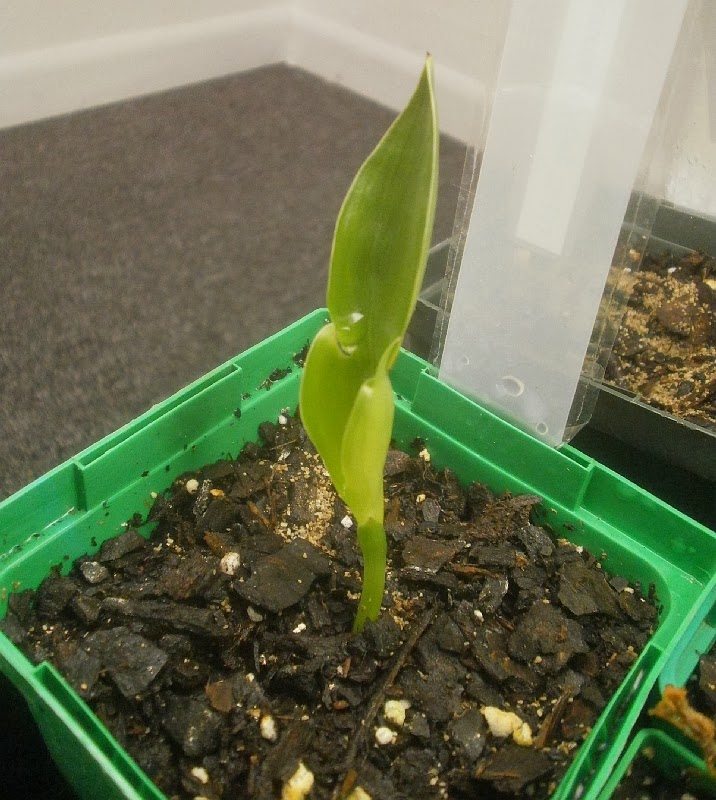
Seedling no. 2.

Seedling no. 3.

Strelitzia juncea is primarily of interest because it doesn't have the big, broad leaves of the more common species like S. nicolai and S. reginae,3 so you may be wondering what's going on here. It's pretty simple: S. juncea is one of those plants with different kinds of foliage at different ages. Young plants grow leaves and resemble S. reginae, but as they get older the leaves shrink down to the point where they're basically just petioles and midribs and nothing else. Which is why I was interested. But I'm going to be seeing regular-looking leaves for quite a while first, I expect.

-

1 (Or Bizzlebergia nutans, to some.)
2 (All due respect, Mr. S., but when are you ever not speaking of seedlings?)
3 Full-grown plants look like this:
Photo credit: BotBln, at Wikimedia Commons.


Saturday, November 23, 2013

Saturday morning Sheba picture


Sheba's itching problem has gotten bad enough that in spots, she's bitten off all her fur and then kept going, leaving sores. You can't see them in the picture because I've deliberately chosen an angle that hides them (you might still be able to see a little bit on her back right leg), but they're there. We've tried everything we can think of here (anesthetic sprays, baths, oatmeal baths, benadryl, changing her bedding, changing her food), and none of it seems to make any difference (the benadryl might help slightly, but it's such a small amount that any perceived improvement might be wishful thinking). And still no obvious indications about what's causing it in the first place. I feel like a bad dog dad. So she's got a vet appointment on Tuesday, which is too damn far away but also the best we can do.

My primary worry is that this is going to turn out to be a mold allergy, because if we have mold, I suspect that the plants will be indirectly responsible. Not that I'm so thrilled with the plants lately anyway. It might be nice to have a reason to get rid of some of them, but I wouldn't be okay with getting rid of all of them.

Not sure what the best-case scenario would be. Maybe a laundry detergent sensitivity? I guess the best explanation would be that she was biting holes in herself because she's just that hungry. I'd feel way worse, but it'd be even easier to fix than the laundry detergent thing. I doubt that's our problem, though.


Friday, November 22, 2013

Pretty picture: Phragmipedium Haley Decker

Hey, finally another decent orchid photo. Seems like it's been forever. I think the last one I was happy with was also a Phragmipedium, so the clear lesson here is that I should take more photos of phrags. (I was kidding when I wrote that, but when I go back and look at the Phragmipedium tag, they actually do seem to wind up being one of my better orchid-photo subjects.)


Phragmipedium Haley Decker = Phragmipedium kovachii x Phragmipedium Saint Ouen


Thursday, November 21, 2013

Yet another Anthurium-seedling update

So the first Anthurium seedling flower (on #59, "Bijoux Tuit"1) has developed, opened, and died. Since I first reported the bud in September, that's only about ten weeks from start to finish, which is a lot faster than I expected. But Bijoux has a second flower already beginning to unfurl.2

Bob Humbug's (#76) second flower has now aborted like the first, which is starting to concern me. How am I supposed to breed him for his nice foliage if he never produces any flowers? Also, I'd reported a bud on Elijah Sturdabowtit (#118), but that one also aborted.

That still leaves us with ten plants with blooms in varying stages of development, though, and a few more have opened since the last Anthurium seedling update. Hence this post.


Deena Sequins (#108)


Deena did eventually get around to opening. The color is less interesting than I had hoped for from her, considering that I'd really like to have a nice solid purple purple, like her mother, but on the other hand, it's a little different, she's the first one to have a spadix that matches the spathe, and the foliage seems solid. Better than most. Definitely better than her mother (whose foliage has always been crappy for me).


Deena is also the first Anthurium I've seen thrips on, unfortunately, and the spathe has some irregular brown edges on the base and one side that are likely from drought stress. So she's not perfect, but she's at least different. At this point in the process, I'm willing to accept different. And she has a second flower in progress, so maybe this was just a practice bloom. We'll see how it goes.


Depending on the light, the flowers are red to red-violet; definitely not the same as Bijoux, but it's hard to name exactly how they're different. A little darker, a little more purple.


Dave Trading (#282)


I'm a little disappointed with Dave's color, which didn't photograph well here (bad lighting) but is basically the same as Bijoux and 'Gemini' -- pinkish-red with a yellow spadix. On the positive side, Dave's got a larger, flatter spathe, with no brittle edges from drought stress, so he may nevertheless be good breeding stock.3


Rudy Day (#238)


Sort of a mix of nice traits, with Rudy: he's got a color similar to Sal, flat spathes like Dave, nice foliage like Bob. Not really the best at anything, but decent at lots of stuff. And he photographs well.


Rowan DeBoate (#235)

In late October, I said that Zach Religious (#276) and Rowan were ones to watch, because they both had unusually light-colored buds so far. Zach has since darkened to a medium pink, definitely lighter than Bijoux / Dave / 'Gemini,' but not as much lighter as I'd hoped, so I'm less excited about him. Rowan has also darkened, from ivory to a pale pink.


That might continue as the inflorescence develops, but it seems like the spathe is pretty close to opening already, and I could be perfectly happy with a color slightly darker than this.

So that's the report. There are still four seedlings not mentioned elsewhere in this post that have buds forming:
  • Peaches Christ (#26) and Sawyer Ad (#245) both look like they're going to be similar to Bijoux / Dave / 'Gemini.'
  • Aurora Boreanaz (#46) looks like it's going to abort, but it'll be medium pink or pinkish-purple if it develops.
  • Erin Dirtylondry (#126) is the same ivory color that Rowan was a few weeks ago, so I'm expecting a light pink.

And that's that. I appreciate y'all bearing with the Anthurium posts; I know some of y'all probably don't even like Anthuriums that much, and even those of you who do may not need this much detail.4

-

1 Surely I don't need to keep explaining about the drag queen thing, do I?
2 Unfortunately, the new flower is also weirdly misshapen, and looks like it's probably going to tear and crack, like the first one did. This might be because of the care she's gotten -- maybe it's too hot, maybe too bright -- or it could be that she's growing too fast, and her spathes are always going to do this. Time will tell. It also occurred to me for the first time, while writing this post, how appropriate "Bijoux Tuit" is for the very first plant to bloom: it wasn't planned that way. All the more appropriate if it's in such a hurry to bloom that it's tearing its flowers apart in the process.
One hopes that "Sal Monella" and "Rudy Day" are never as appropriate.
3 So far, really, all the plants that have produced fully-developed flowers have something going for them, in terms of being useful for breeding: Bijoux and Sal Monella bloom when still very young. Dave's got large, nicely-formed flowers. Sal has a nice solid red color and a decent shape. Deena has the whole spathe-spadix matching thing (which is not necessarily desirable, but it's not necessarily not desirable, either). Bijoux, Sal, and Deena have been quick to produce second blooms. Etc.
No doubt I'll eventually get to a point where I'm like, ho hum, another pinkish-red like all the other pinkish-reds, but we're not there yet.
4 This was a minor motivation for the drag-queen names, actually: the logic being that if you're not interested in the process, you might be momentarily amused by the names.
The main motivation was to make it easier for me to keep straight which seedling is which. I have no hope of remembering which numbers are which, but I can remember stories about Deena, Dave and Rudy just fine. This will get more problematic once I run out of unique first names, but I have 445 available and only 219 currently assigned, and if need be I can get creative with spelling, so that's a problem I shouldn't run into for quite a while, if ever.


Wednesday, November 20, 2013

Stupid plant tricks: NOID trees

Yarn-bombing trees isn't a new thing, but this is the first time I've seen it in person, and I wish I'd gotten more pictures. (I had somewhere to be; couldn't be helped.)


The whole downtown area appears to have been done; there are many much better photos here.

There's also an intermittently awkward and under-edited interview with one of the organizers, if you're really interested:


Tuesday, November 19, 2013

Random plant events: Hatiora and Schlumbergera

Oh hi. Apologies for the three-day gap in posting.

Imidacloprid II: The Imidaclopridatening1 has finally ended, so all that's left to do is sit around with my fingers crossed until I find out whether or not it's worked. I'm finding scale less often now, which might be a good sign. It also might just be a sign that all the really badly-infested plants were thrown away, and the ones left are only slightly infested. Time will tell.

In other news, Sheba and I are both extremely itchy lately. Losing-sleep kind of itchy. Biting-bald-spots-into-the-whole-inside-of-your-leg itchy.2 I have no idea why: there are no bumps or rashes or anything, we haven't changed laundry detergents, etc. The main environmental change is probably the addition of all the imidacloprid, but that really should be staying confined to the pots, and in any case I'm not pouring it down my legs, which is where I'm having the worst problems.

Besides imidacloprid, the other theories include: mold, weather, the house heating system, karma and/or divine retribution, allergies, excessive washing, inadequate washing, witches, and bunnies.3 This has always been going on to some degree or another -- I first blogged about Sheba getting hot spots a year and a half ago, and I first noticed that I was feeling itchy frequently last July. But it's so much worse right now, for both of us, that I'm thinking surely this can't be a coincidence.

Of course, thinking about it also sometimes sets it off, so I should move on to another topic quickly. Maybe plants?

The plants are still doing things, and I'm still taking pictures, though it's been hard to get very good pictures lately -- too cold and/or rainy to go outside for good light, too dark to get good pictures inside. So I apologize for the quality, but:


My NOID orange (but sometimes not-orange) "Easter cactus" has bloomed again. This isn't supposed to happen when it's not Easter, as far as I know, but perhaps it's been confused by the temperature in the plant room -- we were late setting up the heater, so it's been cold in there. Some plants like this more than others. Historically speaking, the flowers are red when they first open, then gradually turn more orange. Not sure what happened this year that we're starting out with orange at the beginning. Maybe that's temperature-related?


In any case, the buds were initially kind of a light pink, then magenta --


-- and opened up orange, with no red stage this year at all. I guess Hatiora likes to keep a person guessing. Or at least this Hatiora likes to keep this person guessing. Perhaps the appropriate "person" for Hatiora's eventual plant profile should be M. Night Shyamalan.4


The plant is approximately the same size now as it was in February. Maybe a little bigger. It's not that it hasn't grown quite a bit in that stretch of time; it just drops pieces whenever I'm not watering perfectly, and sometimes when I am watering perfectly, so the net growth is basically zero. There remains a strong argument for Patsy Cline as the profile "person."


Meanwhile, and more predictably, the Schlumbergeras are in full swing at the moment as well. 'Caribbean Dancer' (above) is the main bloomer, but that's to be expected, since it's the largest and oldest of my plants. I also have a salmon/peach variety, which is just barely visible in this photo (slightly to the right of center, under a couple layers of 'Caribbean Dancer' blooms), which is having its biggest year to date, a magenta one (not pictured) that's got some buds but no actual flowers yet, and a white one (also not pictured) with plenty of buds that are only just now beginning to open. The previously-reported bud on seedling number 25 aborted shortly after I took that picture, I guess because I wasn't feeling bad enough about the plant collection. If I can figure out a way to move the seedlings into the plant room by February or so, I might start seeing buds on the seedlings that actually open. And boy will that be a crazy day.

Just to end on a bit of a tease, other random plant events coming up this week:5 Phragmipedium, Anthurium, Leuchtenbergia, Billbergia, Strelitzia, and some unidentified trees in downtown Iowa City.

-

1 (1. dumping imidacloprid into the pot of every plant in the house. 2. Well it's a word now. Deal with it.)
2 (more Sheba than me on the bald spots. Though if I could reach . . . . In any case, I'm pretty sure we're both having trouble getting to sleep, and then waking up early, because of itching.)
3 Some of those are jokes. Which ones are jokes is left as an exercise for the reader.
4 Pro tip: you do not want to get me started about M. Night Shyamalan.
5 (where "this week" = a vaguely-defined period of time which includes not only this week but also the following week, a solid chunk of December, and never, and where "random plant events" means random plant events, stupid plant tricks, and possibly graffiti)


Friday, November 15, 2013

Pretty picture: Zygopetalum (Kiwi Klassic x Mishima Goddess)

Do all Zygopetalums look like this? It seems like they all look like this. Though usually they're less blurry.


Tuesday, November 12, 2013

Grab bag

Not much to report lately; I'm heavily preoccupied with trying to dump imidacloprid into all the plants. It isn't particularly difficult to do: it just makes watering take longer, so there's less time for anything else. And of course I'm still finding scale as I go, though less of it than I expected.

Here are five things I've found interesting enough to stop and photograph, but not interesting enough to write a whole blog post about, in the last couple weeks:


1. Coffea arabica


Of the eight pots of Coffea seedlings I started back in February, I still have six. (The other two got sold at a consignment store in Iowa City.) I up-potted them to 6-inch/15 cm pots a couple weeks ago, because they were drying out before their turn in the watering cycle came around. I've been surprised at how quickly they've grown: I once believed that the plants we got in at the ex-job, about this tall, in 4-inch pots, were probably about a year old, but it seems more likely now that they were only six months. If even that.


2. Corn


The cornfield behind the house got harvested yesterday.1 Sheba sometimes worries when the machinery shows up to do things to the field (understandable: it's a large, blurry object making growling noises in the back of the house where she plays: I'd be alarmed too), but she either didn't notice it this time or she's getting used to it.

This is slightly sad for me; I like when the field is planted in corn better than I like when it's planted in soybeans. Since we've lived here, they've alternated plantings, so next year will probably be a soy year.


3. Neoregelia 'Gazpacho'


As expected, the Neoregelia 'Gazpacho' has continued to bloom. Less expected is the fuzzy white fungus that appears to be growing on the spent flowers. I can't recall seeing this before, and my ongoing battle with fungus on the Euphorbias has me worrying more about this than I otherwise would, even though I doubt it's the same fungus.

Aside from that, though, the Neoregelia is behaving normally. It already has two good-sized offsets on it.


4. Ananas 'Mongo'


Speaking of offsets.

This is a lot faster than I was expecting. The fruit is still on the plant and everything, though the reduced light indoors has made it lose a lot of its color. Pretty sure all the true flowers have opened and closed already.


5. Spathiphyllum NOID


Finally, one of my older Spathiphyllums (I got it in January 2007) has self-pollinated a number of times, and has produced a couple hundred seeds, but the seeds have so far mostly fallen to fungus, instead of germinating. I had been hopeful that this spadix, which appeared to have been pollinated successfully, and which seemed to be developing normally, might provide another chance, but instead it started to get these white cauliflower-like bumps, and then I accidentally broke it off its stem while I was trying to get it ready for photos, so I never got to see the cauliflowers develop into whatever they were going to develop into. This may be a good thing, depending on why the atypical growth was happening, but I was a little bummed all the same.


There is one exciting thing to report on the whole Spathiphyllum-breeding project, though: my biggest peace lily (likely 'Mauna Loa' or 'Sensation'2), which I've had since January 2003, is blooming right now, after a long bloomless period. The spathe hasn't opened yet, and I don't know for sure if it will be interfertile with my other plants when it does, but I've wanted to propagate it for years now. In almost 11 years, it has never offset, so the only way I'm going to propagate it appears to be by seed. I'm keeping my fingers crossed.

-

1 (Also our first snow, though I didn't get a picture of that.)
2 I'm guessing those cultivar names on the grounds that they're the main varieties of Spathiphyllum that I'm aware of which get really big. 'Mauna Loa' is one of the oldest and most popular of the big varieties, and 'Sensation' is the largest variety the growers' guide could come up with that's at all common -- supposedly 'Sensation' can reach 5 feet (1.5 m). Mine's not anywhere near 5 feet tall, but it's been indoors for 11 years, so some stunting would be understandable. Even under my non-ideal conditions, the leaves are all a solid 13-19 inches (33-48 cm) long, and it's vastly bigger than my other spaths.
Allegedly there are even peace lilies out there somewhere that can reach 9 feet (2.7 m) tall, though the largest I've personally seen was this guy:


Who was maybe 5 or 6 feet (1.5-1.8 m), and sold to us as 'Sensation.' Even if not the world's largest Spathiphyllum, I wouldn't want to run into it in a darkened alley or anything. Not considering some of the things I've said about spaths in the past.