The actual petals and other important parts of Masdevallias are stuck way down in the center of the plant, and are tiny. The sepals, which have become fused together, are the brightly-colored bits with the long "tails."
I think most of the Masdevallias I've seen are less pretty than just odd. I like odd, usually, so that's not really a problem. And the first one I posted about, Masdevallia Prince Charming, I actually think is kind of pretty, too. Everything breaks down with M. ignea x constricta, though, as my brain insists that it's creepy and off-putting. The odd shape, combined with the large numbers of flowers in these pictures, somehow add up to "alien invasion" in my head.
Also the color, let's face it, is not the most appealing.
Maybe if they were edible, and tasted like cheese, it would work for me.
Though I'm not a big fan of cheese either, actually, so maybe not. I don't know.
Masdevallia is another genus I will probably never grow, though I have more hope for Masdevallia than for Miltoniopsis; Masdevallia might be okay in our basement. It's humid and cool, and there are fluorescent lights all over the place, so if I managed to water often enough, I might be able to keep a Masdevallia happy. Not, like, an alien cheese invader Masdevallia, but with some other, more pleasingly-colored hybrid.
Monday, August 23, 2010
Pretty picture: Masdevallia ignea x constricta

Sunday, August 22, 2010
List: Houseplants Native to Southern Africa
Houseplants tend to be from the same few places over and over again: Southeast Asia is popular, as are Central America and Brazil. But one of the richest sources of houseplants, particularly succulent houseplants, is the southernmost segment of Africa. South Africa lucks out because it has the Karoo, a very dry inland section of the southern end of the continent. The westernmost section of the Karoo (which is actually called the Succulent Karoo) is very dry, hot, and windy, and the plants living there have gone to fairly extreme lengths to survive, dispensing with stems entirely (Lithops spp.), or living buried in the soil with only the translucent leaf "windows" exposed to the sun (Lithops again, but also some Haworthias, Senecios, and Peperomias).
Most of us don't actually keep the inside of our homes broiling hot and windy, but the low humidity and sometimes-neglectful watering of some homes are compatible with these plants' needs as long as enough light is provided. Other South African houseplant species come from the moister areas to the south and east of the Succulent Karoo, but these also tend to be more tolerant of dry soil and air than your average tropical rainforest plant. (There are less drought-tolerant exceptions, like Saintpaulia and Streptocarpus.)

It's difficult to come up with a comprehensive list of houseplants from this region, because it's impossible to be precise about "houseplant" and "this region." Some of the plants on the list are only found in a single fairly tiny location, say around a specific town. Others have ranges stretching up through East and Central Africa, or even east to Madagascar and around the Indian Ocean. But these, at least, can naturally be found at some spot or another within the southernish part of Africa, wherever else they might or might not exist.


For the recommends, I'll go with Aloe harlana, Strelitzia nicolai, and Euphorbia pseudocactus. All three are pretty easy-going most of the time -- I've literally never had a problem with my Aloe harlana, and only the most minor problems with Euphorbia pseudocactus, which were entirely my fault anyway. Strelitzia nicolai and I have had our ups and downs, but I'm still fond of it, so much so that I'm apparently willing to delude myself into thinking it's an entirely different plant so I can justify purchasing it over and over.
For the anti-recommend, I don't know. I've had minor problems with all seven of the remaining plants from the list, ranging from generalized failure to thrive (Chlorophytum, Senecio) to various speeds and flavors of decline and rot (Gasteria, Sansevieria, Saintpaulia), to extreme demands for light and the heartbreak of etiolation that causes (Euphorbia), to underwatering followed by hardcore needle drop (Asparagus).
I think Sansevieria is the one I'm least likely to buy in the future, as the Sansevieria problems have been a lot more permanent, and seem to happen to every specimen I buy sooner or later. Most people will think this is ridiculous, because everybody but me finds Sansevierias easy to grow. But that's the one I want for the anti-recommend anyway.
-
Not pictured:
Adromischus cristatus
Albuca bracteata
Aloe aristata
Aloe brevifolia
Aloe ciliaris
Aloe ferox
Aloe greatheadii
Aloe maculata
Aloe polyphylla
Aloe striata
Aloe variegata
Anacampseros rufescens
Argyroderma delaetii
Asparagus densiflorus
Bowiea volubilis
Ceropegia woodii
Cissus quadrangularis
Clivia miniata
Conophytum spp.
Cotyledon orbiculata
Crassula arborescens
Crassula coccinea
Crassula muscosa
Crassula ovata
Crassula rupestris
Crassula tetragona
Didymochlaena truncatula
Ensete ventricosum
Euphorbia anoplia
Euphorbia caput-medusae
Euphorbia cooperi
Euphorbia enopla
Euphorbia grandicornis
Euphorbia horrida
Euphorbia ingens
Euphorbia obesa
Euphorbia susannae
Euphorbia tirucalli
Faucaria tigrina
Fenestraria rhopalophylla
Gerbera jamesonii
Gloriosa superba
Haworthia spp.
Hoodia gordonii
Kalanchoe beharensis
Kalanchoe gastonis-bonnieri
Kalanchoe luciae
Kalanchoe thyrsiflora
Kalanchoe tomentosa
Ledebouria socialis
Lithops spp.
Ornithogalum spp. (aka Albuca)
Pachypodium geayi, lamerei, other Pachypodium spp.
Pelargonium spp. (some)
Plectranthus amboinicus
Plectranthus ciliatus
Plectranthus oertendahlii
Pteris cretica
Rhipsalis baccifera
Sansevieria cylindrica
Selaginella kraussiana
Senecio macroglossus
Senecio radicans
Stapelia flavopurpurea
Stapelia gigantea
Streptocarpus spp. (most spp.)
Strelitzia reginae
Tylecodon spp.
Zamioculcas zamiifolia
Zantedeschia spp.
Saturday, August 21, 2010
Saturday morning Sheba and/or Nina picture

There's a bed-of-roses / bed-of-Fittonias joke in here somewhere, but my brain keeps going to "I beg your pardon / I never promised you a rose garden" instead, which is especially weird because that's an old country-and-western song and those are the only two lines I know and I'm not even sure how I know those. So I can't find the joke, is the point. But I know there's one in there somewhere.
[shaking fist toward sky] Okay, brain, you win this time. But I'll be back!
Friday, August 20, 2010
Random plant event LOLPlant: Sansevieria trifasciata
Sometimes you can wait a while to repot a plant, and sometimes it's sort of an emergency. And then every once in a while, it's kind of both at once.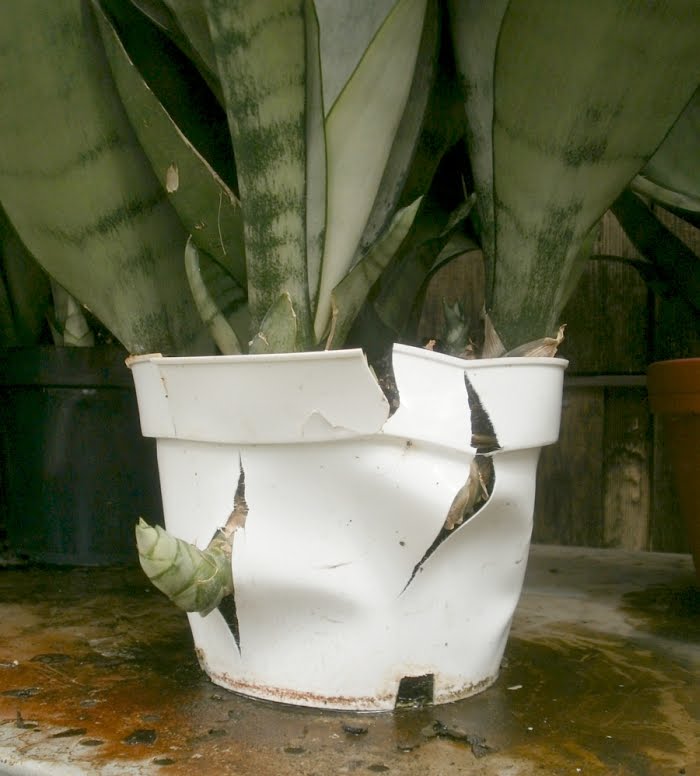
UPDATE: Andrew's much-improved LOLplant version:
(Link to Sansevieria trifasciata profile)
Thursday, August 19, 2010
Unfinished business: Pandanus amaryllifolius
In case anybody'd been losing sleep over it: I have received a replacement Pandanus amaryllifolius from Gardino Nursery. It looks quite a bit like the last one:
And no mealybugs either, as far as I could find. So I'm happy. Now to wait for the pesticide to wear off, so I can heat up a leaf and smell this "pandan smell" I've heard so much about. I really hope it's worth the nine- or ten-month wait.
Pretty picture: bumblebee on Gaillardia
We went to Iowa City yesterday. I'd hoped to find exciting new stuff to show y'all, but instead it was just the same old stuff, and so now here I am again, trying to write a blog post at the very last possible minute. (Seriously, folks: this never happens. Two trips outside the house in one week? Craziness. Total granny-slapping insanity.)
So that's why I didn't reply to anybody yesterday. On the plus side, I saw the above little vignette of bumblebee and Gaillardia 'Oranges and Lemons.' I'd heard of 'Oranges and Lemons' somewhere (someone else's blog, probably, or else Twitter) but hadn't seen it personally before yesterday. The ex-job didn't carry it when I worked there. It seems nice. And obviously the bumblebees approve.
I also reached the end of a watering cycle yesterday, so I now have maybe two days in which to really buckle down on the writing. Wish me inspiration, 'cause things will get crazy again around Sunday and Monday.
Wednesday, August 18, 2010
New Plants (and one Walkaway)
Here are the plants of interest from the trip to Cedar Rapids on Sunday, including the supercool one I was so excited about on Monday.
I bought this first one at Lowe's, because I thought it was an orange bird of paradise, Strelitzia reginae. I've been looking for a decent S. reginae for quite a while, so this was exciting. What got me thinking that it was a reginae (even though it was tagged S. nicolai, the white bird of paradise), was that a couple of the leaves have sort of orangish midribs, which I knew happened with reginae but I didn't think happened with S. nicolai, plus the leaf texture was a bit heavier and stiffer than on my nicolais at home. True, the tag said otherwise, but since when do we believe the IDs on the tags at Lowe's, right?
So I was pretty certain I had a reginae when I bought it, but the more I thought about it after getting it home, the more I was like, don't the orange BOPs have grayer leaves than this? And narrower? And it was tagged as a white. Maybe the leaf texture is just because they're grown in better conditions. This could be a white BOP after all.
But! I had noticed that the UPC sticker said that the plant was produced by Costa Farms, a company in Florida who I sort of knew, by virtue of following their account on Twitter. So I thought, okay, I'll just harness the power of social networking and tweet them the question and we'll see if it's plausible that I could have a 6" orange BOP, easy-peasy.
So I tweeted, and their first response was to tell me that they thought I had a Heliconia. So then I had to send another message explaining that no, it didn't actually have orange flowers on it, I know it's a Strelitzia, I'm just trying to figure out which species of Strelitzia. And then while I was waiting on the response, I realized that they surely had a website, and I could just look at the website and see whether they grew orange BOPs and find out that way. So I went to the website, where I found . . . "Strelitzia reginae [White Bird of Paradise]." Which is to say, they had mismatched the names, so I still didn't know.
And then they tweeted an answer to the effect of, "Yes, we sell white bird of paradise" and asked me to refer future questions to an e-mail account, which made me think I was probably pissing them off, so I let it drop there even though that didn't answer my question either.
So but I still don't know. Do Strelitzia nicolai plants grown in high light get orange midribs? Are Strelitzia reginae leaves always grayish, or can they be as green as nicolai? And does Costa Farms produce both species in 6" pots? Just the white? Just the orange? These really shouldn't be difficult questions to get answers to, but my whole day was like that on Monday.
Even if the new plant is just another white (I already have three of them, so a fourth is really not necessary), it was crazy cheap ($8-something), and there are four plants in the pot, so it was a good deal. And it's a plant I like, see above re: already had three of them. So whatever. But I do kind of need to know whether I should continue questing for Strelitzia reginaes or not.
Anyway.
The one notable walkaway from the trip isn't pretty or interesting so much as bizarre and unpleasant: it's a cigar plant (Cuphea ignea) with white flowers. 
To me it looks ten kinds of wrong. I mean, Cuphea ignea is pretty worthless without the flowers (and even more worthless indoors, by the way: I'm having a really bad experience with it so far, and it's not thrilled with me either), and the flowers are so tiny that they have to be a bright, screaming color in order to be noticeable. This just wasn't a good idea at all.
But it's different. So now you've seen that.
TANGENT: Speaking of plants in wrong colors, has everybody seen the picture of the dark-purple Catharanthus roseus at Greensparrow Gardens? Equally wrong, but I really like those. They're very nearly cool enough to make me forget that I hate Catharanthus roseus intensely and for many reasons. (Bad work experiences.)
And then finally, we have the plant I was so excited about. I'm not thrilled with the way this picture turned out, but it's as good as they got:
It's a Dracaena deremensis 'Malaika.' I'd had it on the want list in the sidebar for a long time, because I'd seen pictures on-line and thought it was neat, but I'd never seen it for sale around here and didn't think I probably would anytime soon, and anyway I have a gazillion variations on D. deremensis already so what do I need with another.
But Frontier Garden Center had one. For way cheap, too (it was $9.73 after tax). It's sort of a backwards 'Lemon-Lime,' or a yellowish 'Warneckei:' the margins are very dark green, with a gray/chartreuse center. The picture doesn't really do it justice. This is maybe a little better:
The plant's tag had a link to a website in the Netherlands, which I think may be the least helpful plant-related website I've ever seen. More animated dragons per page than any plant-related website I've ever seen, and so few plant sites think to include a page for children to color anymore, so I appreciate that. But in terms of finding out anything about the plants, disappointing. Monday was just a bad internet day, apparently.
Tuesday, August 17, 2010
6 Things They Don't Want You to Know About the Plants

"What they don't want you to know about the plants" is a verbatim Google search that brought some anonymous (and, presumably, disappointed) person to PATSP many months ago. The idea tickled me, and I've wanted to write a post on the subject ever since, but it was obviously a problematic topic while I was working -- it's not a good idea to blog about what "they" don't want "you" to know about the plants when "you" are the "they."
Now, though, "they" are "they" and "you" is "me" and "scare quotes" are "scare quotes" and the post seems much more writable. It feels a little weird: though most of this is stuff I've talked about on PATSP at one time or another, this is the first time I've collected it all together. When I was actually in the business of selling plants, these weren't things I necessarily shielded all customers from knowing about -- if it was relevant to the situation, I'd generally let you know -- but I also didn't rush up and give everyone unsolicited lists of reasons to take their business elsewhere, either. And most of these things would apply anywhere a customer could go anyway, so telling people about it wouldn't have benefited anybody.
1. The soil is probably crap.
This was really not our fault at all, and it's not likely to be different anywhere else, but it's true: most of the time, the potting mix the plants were in was what they'd been shipped to us in, i.e., mostly peat moss, which is unsuitable for most indoor plants: peat holds water too long, and then becomes water-repellent when it dries, making it too wet when it's wet and too dry when it's dry. It also tends to lead to fungus gnats. I assume the growers use it mainly because it's cheap, but I'm not sure: in the warmer climates where tropical houseplants are produced, it may be that you actually need something that will hold a little water on the plant, lest you be forever watering.

Anyway. Bad soil is not a particularly good reason not to buy a plant. One, it's fixed easily enough by repotting, which you may need to do regardless. Two, everybody's plants come from the same places and are potted in the same mix.
2. We sprayed pesticides in here less than a week ago.
Where I worked, we sprayed pesticides every week, usually on Saturday night after the store closed.1 The specific pesticides in question changed from week to week, but the spraying itself was a constant.
We used what was basically a very large fogger, so nobody needed to be present when the actual spraying was happening, but I still had to measure and mix the pesticides du jour before leaving for the day, and although all the relevant safety precautions were taken, and I had the very best protective equipment that an extremely small amount of money could buy, I still figured this was probably not doing me any good, especially doing it weekly, and then being around the residue afterwards.2
This might be a legitimate reason not to buy a plant, if you know you're sensitive to certain kinds of chemicals, though most people don't handle, lick, or consume their plants enough to where I can see it making any kind of difference, and even if you do, plants can also absorb dangerous chemicals from indoor air. I'm on record as believing that the air-purifying qualities of houseplants have been criminally oversold and probably don't matter in most home situations,3 but a very tiny absorption of toxic chemicals from the air would more or less balance out any very tiny release of pesticides that happen to be on the plant when you buy it. Also, even the most chemically-fertilized, pesticide-drenched houseplant will become an organically-grown plant if you grow it organically, so in the long run, you're probably ahead, chemical-exposure-wise, to buy the plant anyway.
Big box stores like Lowe's and Home Depot do not, as far as I'm aware, spray their plants while they're in the store, though they'd generally have been sprayed before they were shipped, so you can't expect to avoid pesticide exposure by shopping in those sorts of places.
Organically-grown houseplants do exist, but I'm only aware of one location in Iowa that ever sold them. It's in Ames, I've only been there once, it was three years ago, I don't know the people who ran it, I don't know if it still exists,4 and I was a little uneasy about buying stuff when I was there because I saw bugs in the sales area. So the idea might still need some work. However, organic produce is mainstream(ish) now, and people have been generally anti-pesticide for a long time, so one might see organic houseplants in stores in the future. The first person who figures out how to grow houseplants organically, for prices comparable to conventionally-grown houseplants, and is able to advertise the fact effectively, stands to make a lot of money. I don't know whether anybody's trying yet.
3. It may be cheaper somewhere else.
There are many good reasons to buy your houseplants from a locally-owned garden center, as opposed to a large chain store like Wal-Mart or Lowe's, but price is not one of those reasons. From what I've seen, the prices on small, non-succulent plants (in 3- or 4-inch pots5) tend to be approximately the same anywhere you look, but cacti and succulents, or large tropicals, get considerably more expensive at independent garden centers. Seasonal blooming plants like Cyclamen or poinsettias also tend to be cheapest at box stores, and even grocery stores, though you take more of a gamble on the quality of the plant itself and the advice you receive about its care. Florists are potentially better on the advice, but also the most expensive places to buy plants, from everything I've seen.

I wish this weren't the case. I wish that local places could offer the sorts of prices that the big chains can. I also wish I had a magical, talking unicorn that granted wishes and pooped gold coins.6
I don't patronize local places exclusively, though when I checked it out with the spreadsheets, I was a lot closer to doing so than I would have guessed.7 It wasn't a deliberate, principled decision to keep my money local. That's just where the selection is broader and weirder, so that's where I've tended to look. Lowe's has better prices, but they also have the same twenty plants over and over and over again.
4. Some of the plants are not good long-term prospects.
I've covered this already in a separate post, pretty much, but it turns out to be true of outdoor plants as well: this post at Bloomingwriter talks about plants being sold in garden centers despite not being hardy for the zone, or despite being extremely invasive, or otherwise inappropriate for your situation. Doing a little research before you shop will help, but people who aren't into houseplants (or plants in general) don't necessarily know that they have different requirements and will buy whatever first gets their attention. And I think all beginners get cacti wrong the first few times.8
The industry could provide better information on this point than it actually does, but they don't have a lot of incentive. The most demanding plants are also often the prettiest, with a few exceptions, and people impulse-buy pretty things a lot more than they impulse-buy plain things. It doesn't pay to put obstacles in the way of these impulse purchases by, for example, telling customers something about the plants. So if there's anything at all, it's probably just a name and "easy-care." I've seen so many plants called "easy" and "low light" that were definitely not, that I consider claims like this to have no meaning whatsoever. Freedom's just another word for nothing left to lose; easy-care/low-light's just another word for for-sale.

It's unfortunate but true that retailers run the risk of making no sales at all, if they try to steer customers away from potentially bad experiences. Not every customer is willing to listen to the how-to-grow, once you've said a plant is difficult. I know I had more than one customer who put down bad choices readily enough, but then never picked up a better one: sometimes it might have been better for the business (if not the plant or the customer) if I'd just told people what they obviously wanted to hear.
Because of this, any plant seller immediately jumps up several notches in my estimation if they'll admit that a plant is difficult, and immediately becomes a favorite place to shop if they can tell me in what way it's difficult and how to grow them successfully. This is vanishingly rare anywhere, but it's more common at independent, local garden centers.
5. Some of the plants are barely rooted.
This took me a while to clue into, but one day a customer wanted to buy a Yucca guatemalensis, and have us repot it, and when I took it out of the grower pot to put it in the new pot, I discovered that it barely had any roots at all. This is mainly only a problem with plants grown by sticking a section of mature cane into a pot until it starts to sprout new foliage, something that gets done a lot with Yucca guatemalensis, Dracaena fragrans (there's a reason why they're so often damsels in distress), and Polyscias species. My recommendation would be, don't buy sprouted-cane sorts of plants unless you can see some roots coming out of the drainage holes, or sticking a finger down into the soil hits some roots. Tugging the plants to see if they shift or pull out is also a method, but obviously the retailer's not going to be happy with you if you pull all the Dracaenas out of their pots.

Where I used to work, we propagated some of our own plants, and it did occasionally happen that plants would take off growing new leaves before they'd really gotten a decent root system, and they got put out for sale and then people brought them back, angry, because they weren't particularly rooted yet. I mean, they would have gotten there eventually if the customer hadn't, you know, tried to fiddle with them. But that was my fault; I don't think it's a common occurrence. (It wasn't even a common occurrence with us. Maybe it happened twice.)
6. Some of the plants have bugs.
I am convinced that if you start out with one plant, and add one at a time to any given location, be it a personal collection or a sales floor or whatever, once you reach some critical number of plants, you are guaranteed to always have some kind of bug problem happening at any given moment. I'm not sure what the critical number is: personal experience tells me it's higher than 15 and lower than 850. I realize that doesn't really narrow anything down.
Now, you'd think that being sprayed with pesticides weekly would fix this problem, and make the bugs go away, this being what pesticides are supposed to do. They don't. Bugs come in from the suppliers, they wander in from outside, they find places to hide from the pesticide and then re-emerge when the spraying is over, they evolve resistance to the sprays. There will be bugs. Somewhere. Lurking. Knowing what they look like, and checking a plant carefully before you buy, is important.
This isn't really fair to beginners, who won't know what the common plant pests look like. In a perfect world, you could rely on the employees and the cashiers to tell you if you've chosen a plant that has bugs,9 but A) sadly, many of them don't know what bugs look like either, B) even if they did know, bugs are small, and they hide, and can be missed, and C) even if they did know, and did see them, they wouldn't necessarily tell you about it, unless it was to upsell you on a bug spray of some kind. (I honestly only recall one particular time when I saw a possible pest problem and didn't say something to the customer, and that was a very special case where the customer was being an extreme asshole and needed to be punished.)
Still. Forewarned is forearmed. At the very least you should learn what the more common insect pests look like, so you can reject plants for yourself instead of having to rely on strangers being such great people that they'll act counter to their self-interest. In brief:
Aphids: sometimes they'll be big enough to see actual bodies, but I've also seen them looking like a sprinkling of sand or dust on the surface of a leaf. They can be green, yellow, whitish, black, red, and probably other colors I've forgotten.

Mealybugs: resemble gray-white fungus or cotton on the plant, especially under leaves and where leaves join stems (the axils). They're tricky because some plants naturally have fluffy white cottony bits on them, so it can be difficult to tell if you've got a mealybug or if that's just how the plant is. When in doubt, don't buy. Watch for mealybugs everywhere, but especially on cacti and succulents.
Scale: scale are really hard to identify, especially when they're on woody stems, because they look like the natural bumps of the stem. If they're on the underside of a leaf, or on an otherwise-smooth surface like a Cereus peruvianus stem, they're easier to detect. Scale will come off if scratched with a fingernail; natural bumps and pits won't.
Spider mites: spider mites give leaves a dusty or slightly bronzed appearance that doesn't clean up when wiped with a finger. They also spin webs under leaves and around leaf axils, which are easily seen since the mites themselves often live and poop in the webs. They favor Hedera helix, Codiaeum variegatum, Musa spp. (banana), Calatheas, and Schefflera species, among others. (More comprehensive list here.)
Fungus gnats: tiny, blackish, slow-moving flies that fly around when you bump the plant. They're most common in peaty, overwatered soil, whatever the plant is. I don't personally consider fungus gnats a big enough problem to reject a plant, since they're not that harmful, really, but your tolerance may vary.
Whiteflies: also tiny, but in this case white. Sometimes when they fly around, they look a little bit like cigarette ash floating around in the air: they have that same erratic movement. You'll notice them if you bump a heavily-infested plant, but smaller infestations are easier to miss. Check the underside of leaves, especially on thin-leaved tropicals. They're especially fond of Hibiscus, Abutilon, poinsettias, and basil.

And remember: at least one of these bugs is somewhere in the store with you. You can just about count on it. So be vigilant.
I don't mean, with this post, to make it sound like buying a houseplant should be a particularly intense emotional experience for you. Most plant purchases work out just fine so long as you have #4 and #6 covered: know what you're buying, and check it for bugs. But the other things are still occasionally relevant, and in any case, this is the best answer I can give for "what they don't want you to know about the plants." So, my mysterious Googler, I hope you see this someday. Sorry it's so late.
-
1 Because we closed earliest on Saturday nights, and opened latest on Sunday mornings, so that was the longest period during which no one would be in the greenhouse.
2 Perhaps it's self-centered of me, but I think the pesticide residue was a bigger issue for me and the other employees than it would have been for customers. I mean, I wouldn't have eaten our herbs, most of the time, but we did only use stuff that was supposed to break down relatively quickly, that was safe to be around once the greenhouse was reopened, and very little residue would have been left on any specific plant. Plus some more would have washed off once we watered the plants on Sunday morning. So the exposure a person could get by walking through the house would have been minimal (one might take a bigger risk eating an apple), and it would have been just the one time, too. But for those of us being exposed day in and day out, the risk didn't seem as trivial. I worried about it; I did.
3 Though in cities and buildings with very poor indoor air quality, having plants is surely not going to make the situation any worse. I just don't like the tactic of manipulating people to buy plants based on air-quality issues that plants may not improve or that aren't even problems, like when people talk about plants oxygenating the air, like low air-oxygenation is a common problem in our modern world.
There is a word for not having enough oxygen in the air: it's called suffocation. If your bedroom gets life-threateningly low oxygen levels at night, one, you'd already be dead and therefore not in a position to be buying plants, and two, having a peace lily in the corner wouldn't save you anyway: houseplants don't grow fast enough to make a significant difference. The same thing goes for people who worry about their plants releasing carbon dioxide at night (which most of them do, though there are exceptions): there isn't enough of it to make a difference, and it's not worth factoring into your decision to buy or not buy a plant.
Possibly if you had seven or eight hundred of them in a small house, someone with an finely-calibrated oxygen meter might be able to tell the difference, but what kind of nutbar is going to fill their house with hundreds of houseplants? I mean, seriously, you'd never be finished watering. It'd be insane.
4 (Much of Ames being under water right now.)
5 Metric equivalents not provided because I'm not even sure if this is true throughout the U.S., much less being true around the world.
6 Actually, the talking bit would mostly depend on what it had to say. I mean, suppose I got a talking unicorn that was really into football or Twilight or something, and that's all it ever wanted to talk about. Also it wouldn't have to be a unicorn. A horse would probably be fine, if it granted wishes and talked: the horn's really more just decorative. But the gold coins thing sounds nice. Perhaps I should think about this a bit more.
7 The graph of how it breaks down:

"Big box" stores cover nationwide chains like Target, K-Mart, Wal-Mart, Lowe's, etc. "Chains" are stores which are also widespread networks of stores, but which don't have national coverage or gigantic stores: I think the only ones that apply are Earl May, a local garden-center chain, and Ace Hardware, which might be national but tend to be physically small stores. Part of the "Grocery" category is also chains (Hy-Vee, which is local to the Upper Midwest U.S.), and part isn't (the now-defunct grocery where I worked for a while a long time ago), which in retrospect I probably should have divided that up differently. "Free from businesses" is mostly stuff I salvaged from the ex-job; a solid chunk is also from Wallace's, the Begonia leaf they gave me (I had permission) a couple years ago and have since propagated the hell out of.
But the point stands: of the plants I have at the moment, only 11-18 percent of them are from any kind of chain, 48% are from small businesses (mail order counts) and 47% are from local, independent area businesses.
I honestly would have thought I'd bought more from Lowe's than that, but the spreadsheet says only 46 plants, out of 867, and the spreadsheet knows all.
I'm also shocked at how many of my plants are here via trades. Would not have guessed that, either.
8 (HINT: They do need to be watered sometimes, and more than just a teaspoon.)
9 Actually, in a perfect perfect world, there wouldn't be insect pests in the first place, I suppose.


 Posts