Showing posts with label Senecio. Show all posts

Tuesday, May 6, 2014

[Exceptionally] Pretty pictures: transmitted light -- Part LIII

Having one of those spells where I'm not having any trouble coming up with things to write about, but I'm never happy with the results. Also, as previously mentioned, the Anthuriums are the only plants here that are doing much of anything at the moment. Consequently, we're digging into the transmitted light photos, because that's what the transmitted light photos are for.

By way of observing how old these pictures are: of the six plants photographed for this set that I owned at one time or another (Dracaena, Iresine, Senecio, Chlorophytum, Saintpaulia, Peperomia), only two remain (Dracaena, Chlorophytum).

(The previous transmitted light posts can be found here.)


Dracaena deremensis 'Janet Craig Compacta.'

Never my favorite plant, and this photo is boring besides, but I'm appreciating it a lot more these days than I used to. No rot, no scale (knock wood), no defoliation. It just sits there, quietly, and photosynthesizes, like plants are supposed to do.


Iresine herbstii 'Blazin' Rose.'

One of the plants I used to own but no longer do. The main reason for this is that it just grew too fast and needed too much light. The coup de grĂ¢ce happened when spider mites started bothering it, and I decided it was just too much work to keep around any longer. Not necessarily a terrible plant, and it does photograph well occasionally, but I couldn't say I miss having it around. (Indeed, this is the first time I've even thought about I. herbstii in at least a couple years.)


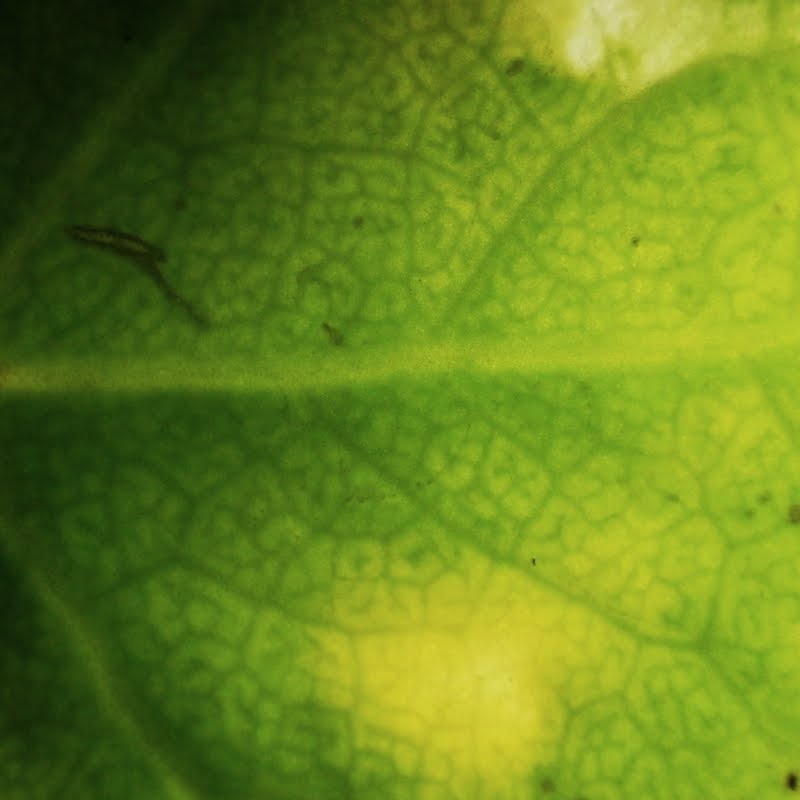
Senecio macroglossus.

Another one that's no longer around. I miss it . . . slightly. It had some nice qualities. It wasn't a good plant for me to be trying to grow, though, for three main reasons. One, it needed more light than I could give it. Two, it was forever tangling itself in the wire shelving I use, which did the plant no serious harm but was frustrating when watering time came around. Three, it needed a lot of grooming -- leaves were always dying but remaining attached to the stem, which made it difficult to groom. And it always needed to be groomed.

It'd be interesting to look at sometime with the microscope, though. You can see some weird stuff happening in there with the veins just from this picture.


Chlorophytum x 'Fire Flash,' dead leaf.

This picture is dramatic, but I think not good. Not the plant's fault, though. The plant is great.


Malva neglecta.

One of Iowa's less objectionable invasive weeds.


Saintpaulia ionantha NOID, petal.

The third plant I no longer own. I like African violets well enough to want to grow them, but not well enough to change the way I care for my plants to make growing them possible. By the time the last of the Saintpaulias went in the garbage, I was pretty exasperated with the genus, and I think I could live the rest of my life quite happily without ever trying to grow another.


Hibiscus moscheutos 'Dave Fleming,' petal.

I'm not particularly into the H. moscheutos varieties I've seen so far, and I don't know why. I mean, they seem like the sort of thing I would like. I like H. rosa-sinensis fine (I don't grow it, because overwintering always seems to be a problem, but I like them to look at.), and it's not that I have a problem with winter-hardy Hibiscus, because I think H. syriacus 'Blue Satin' is great. H. moscheutos is just too extreme for me, in some way I can't articulate. I don't see them very often around here, either. I mean, I see them for sale, just not usually planted. Though I suppose some of that is because I only recognize them when they're blooming, and for a lot of the year, they're not blooming.


Peperomia caperata.

The last of the plants I no longer grow, and the one I would be most likely to try again if I thought there was a chance of success. The problem with P. caperata was always watering. The 14-day cycle most of the plant collection is on is a bit too long for P. caperata, and if I tried to keep them wet longer by moving them to a larger pot, they'd rot. Irreconcilable differences. If I ever do find a way to deal with the watering differently, I will probably try this one again.


Ipomoea NOID, petals.

Say what you will about Ipomoeas (I. nil, I. purpurea, I. tricolor, and so on), but the flowers really are quite lovely even if the plants are weedy.


Musa 'Zebrina Rojo.' (possibly Ensete 'Zebrina Rojo.')

I probably took more photos of 'Zebrina Rojo' than necessary. (Previously: XLVIII, XLIV. And I think there's another photo in the transmitted light reserves.)


Thursday, December 20, 2012

List: Missing From Retail, Part 5 of 5

The explanation and background for this post can be found here, at part 1. (Part 2) (Part 3) (Part 4)

So here we are at the end. It's been fun, right?

Russelia equisetiformis Photo by Eurico Zimbres, via Wikimedia Commons.

I have seen Russelia equisetiformis (firecracker plant, coral plant) for sale in Iowa once, maybe twice. The ex-job has had them. I don't know if they sold, or if they died really fast, but either way, they weren't around for very long. I have no idea what they'd be like to grow indoors, but they do get a lot bigger than I expected from the (mostly close-up) pictures in the books. I'd think providing adequate light would be a problem.


Salpiglossis sinuata cv. Photo by Hephaestos, via Wikimedia Commons.

I've never seen Salpiglossis cvv. (painted tongue) plants for sale, nor can I recall seeing the seeds anywhere. The seeds part could just be me not paying attention, but I know I would remember seeing the flowers.

The commenters at davesgarden.com remark a couple times on the plants' tendency to wilt suddenly for no apparent reason, so it could be that it's difficult for growers to maintain a healthy-looking stock. Where they are sold, they are apparently typically marketed as annuals, though I believe they are actually perennials if protected from cold (USDA zone 8-11).

I encountered one reference to Salpiglossis that suggested its unavailability is mostly a matter of fashion, not a matter of difficulty. Fern also claims that Salpiglossis has come "roaring back" into fashion recently. I can't say I've seen any evidence of that here in Iowa.


Schizanthus wisetonensis 'Angel Wings.'

While researching this post, I've had a tough time keeping Schizanthus cvv. (butterfly flower, poor man's orchid) distinct in my mind from Salpiglossis; the two names both begin and end with "s," are nearly the same length, and are alphabetically close to one another, so I guess my brain would like them to be the same plant. Having now seen several photos of different varieties of each, though, I believe I can finally tell them apart. If nothing else, there's a clue in the name: schizo- means "split," so that'd be the one with the split petals.

I've never seen Schizanthus around here either, though there are a number of websites referring to growing them from seed, or growing them indoors, so apparently this really is something that people do. I couldn't swear I've never seen seeds for sale.

They're typically sold as annuals, but in mild climates may be short-lived perennials, so maybe it's the "short-lived" part that's the problem? They also need a lot of sun, are slow to start from seed, and at least one site said they prefer cool, humid conditions. Any of those could be a problem; all of them together seems like it would definitively rule them out as indoor plants. And yet, there they are in the books (Crockett and Kramer) anyway.


Senecio confusus 'Sao Paulo.' My photo.

I've only seen Senecio confusus once or twice; the first time (photographed above) was at the ex-job, and I can't recall for sure whether there was a second time or not. Its identity may be somewhat in flux: I found some sites claiming that it had been changed to Pseudogynoxys chenopodioides. Plant List says that both Pseudogynoxys chenopodioides and S. confusus are accepted names for (I assume) different species, so I don't actually even know what plant we're talking about.

It's another vining plant, that has the potential to get big (vines to 10-12 feet / 3.0-3.7 m long), which is possibly the only reason one needs not to grow it in one's house. That said, it's apparently also really easy to propagate, so it could probably be restarted regularly, whenever it gets too large. It also needs a lot of light.


Solanum pseudocapsicum? My photo.

Solanum pseudocapsicum (Jerusalem cherry; winter cherry; various botanical synonyms including S. capsicastrum) has never interested me that much, even when I saw it in books, but while I was reading through them in preparation for these posts, I noticed that it seemed to come up quite a bit (Kramer, Crockett, Powell). I've only ever seen it at the ex-job. If I remember correctly, that only happened a couple times, and they dropped a lot of leaves shortly after arrival on both occasions.

The consensus at davesgarden.com is that they need cool bright conditions in the winter. They're possibly also not helped by their fairly plain appearance when not bearing fruit (though that doesn't stop people from growing Citrus), their appeal to bugs (not personally experienced, but that's the claim here) or the poisonous foliage and fruit.


Sonerila pulchella. Photo credited to Alexey Yakovlev, kind of obviously. Found via (and owned by?) TopTropicals.com. Used in compliance with the non-commercial use guidelines on this page.

Only the Kramer book mentioned Sonerila cvv. (sonerila), and there's remarkably little about them on-line either, so it's entirely possible that they're not missing from retail so much as not yet arrived in retail. I had to go through four pages of Google results to find a single mention of them as a cultivated plant, and that (WARNING: autoplay video/audio) wasn't really what you'd call informative. (Houseplantsguru.com, on page 5 of the Google results, covers most of the same information in a much less chaotic context, and page 6 gives us the French version, which I can't read but possibly some of you can.)

There's near-universal consensus that they're attractive plants (many of the Google results are links to sonerila drawings, paintings, or photography), so I have to assume that there's a problem with them being too slow, or too touchy, for mass production. They do apparently demand a lot of warmth and high humidity, if nothing else.


Stanhopea radiosa. Photo: Orchi. Found via Wikimedia Commons.

(I'm fairly certain that I've seen Stanhopea spp./cvv. (no common name?) on the blog of at least one person I follow, but I can't remember who, or where. If I could remember that, I'd link to you, so if you think you might be the person I'm remembering, say something in the comments.)

I've never seen a Stanhopea for sale around here, even from specialty sellers or at the orchid show. Why not? No clue: they're apparently cultivated all the time. The short life of the flowers (~3 days, per Wikipedia), need for cooler temperatures (according to this care sheet, anyway) and odd growth habit (the flower spikes typically grow down instead of up, requiring plants to be hung for best display, and necessitating the use of special pots with holes in the sides) might all be factors.


Trachelospermum jasminoides. Photo by Wouter Hagens, via Wikimedia Commons.

Trachelospermum jasminoides (confederate jasmine, star jasmine) doesn't seem to be sold around here, though some of the true jasmines (Jasminum spp.) are. Not sure why this would be: a quick look around the internet didn't turn up anything especially damning. They can get to be big, heavy plants, but they restart easily from cuttings, so that shouldn't be a problem, and unlike a lot of the plants on these lists, Trachelospermum doesn't appear to require a cool winter (though cool winters are apparently not a problem, either). And I can't even remember the last time I heard so many people gush so hard about a single plant. (Not that the davesgarden.com people are reliable gushers: they think Aspidistra elatior is a nice plant too.) So there's no huge, obvious reason why Trachelospermum wouldn't sell in Iowa. I might even be interested in a little one, if only to see why it's such a big deal.


Tolmiea menziesii. My photo.

I really, really tried with Tolmiea menziesii (piggyback plant, youth on age), but . . . no. Just no. At least some of my problem is that it's too warm in here -- they do prefer cool, humid air -- but I was never able to get watering right either.

It's not like they're even pretty; I'd gotten one because I'd been under the impression that they were fairly easy plants. They grew well in the greenhouse at work, so I figured they'd grow well for me too.

I do still see Tolmiea occasionally -- the ex-job has had large hanging baskets once or twice, and I'm pretty sure I've seen 4" plants at one other place in Iowa City as well -- but it's pretty rare. Fine by me.


Veltheimia bracteata 'Lemon Flame.' Photo by BotBln, via Wikimedia Commons.

Veltheimia cvv. (forest lily, cape lily, bush lily) do still get sold, if you know the right places. Unfortunately, none of those places seem to be in Eastern Iowa. V. bracteata is apparently a very nice houseplant, for people who can provide enough light, and who don't panic at a short summer dormancy. (Which rules me out, twice.)

The Bulb Maven attributes their disappearance to the whims of fashion,1 rather than difficulty providing the right growing conditions. Could be, I suppose, though I have no memories of them ever being widely available.


As I noted, I'm mildly curious about Trachelospermum jasminoides, unless someone can provide a compelling reason for me not to be. Schizanthus or Stanhopea would be my wouldn't-it-be-cool-if plants, from this group, but I don't anticipate ever actually trying them.


Not pictured:
  • Rechsteineria cardinalis (cardinal flower): have never seen.
  • Reinwardtia indica (syn. R. trigyna, yellow flax): have never seen.
  • Rivinia humilis (pigeonberry, rouge plant): have never seen.
  • Ruellia makoyana (monkey plant, Mexican wild petunia, trailing velvet plant): have never seen in person, though I see photos all over the place.
  • Schizocentron elegans (creeping princess flower): have never seen.
  • species Schlumbergeras: have never seen in person, though I'm pretty sure I've run into Schlumbergera gaertneri (now possibly Hatiora gaertneri) for sale a few times on the internet.
  • Sprekelia formosissima (Aztec lily, Jacobean lily): have never seen, but I ran into a few sellers on-line while writing this.
  • Streptosolen jamesonii (marmalade bush, orange browallia): have never seen.
  • Tabernaemontana divaricata (crepe jasmine): have never seen for sale. No idea if I've ever seen them in person.
  • Tetranema roseum (Mexican violet, Mexican foxglove): have never seen.
  • Tetrapanax papyriferus (rice-paper plant): have never seen for sale, though I've seen it on blogs, Danger Garden in particular, so I know they're out there.
  • Tibouchina semidecandra (princess flower, glory bush): have never seen.
  • Tulbaghia fragrans (sweet garlic, pink agapanthus): have never seen.
  • Vallota (apparently Cyrtanthus now; no common name?): have never seen.
  • Zephyranthes candida (rain lily, zephyr lily, fairy lily): have never seen.
-

1 (Also known as "plant obsolescence.")


Tuesday, March 13, 2012

Random plant event: Senecio cephalophorus 'Blazin' Glory'

Between trying to keep up with watering the plants, propagating new plants, keeping up (poorly) with e-mail correspondence, sorting through all the orchid photos I got on Saturday,1 trying to make decisions regarding the book (which is looking increasingly like it will not be a book, but something shorter), writing the blog, and working on half a dozen small side projects of various kinds, I'm getting very close to the point of being so overwhelmed by my list of things to do that I'm unable to do any of them. Consequently, posting is going to be light for . . . a while. I don't know precisely what I mean by "light," or "a while:" time will have to tell, but I figured I should let you know this is coming, and apologize for it. In previous years, things had normalized again around mid-June, but this year may never actually settle down: if I find myself with time again, I may have to use it on writing the "book" (or whatever the hell it's going to be) instead of posting more to the blog.


Oh, and there's also a plant. I don't know much about Senecio cephalophorus 'Blazin' Glory,' except that it's a Proven Selections2 plant and the ex-job has some this year. (I think this is the first year they've had them.) The plant in the photo is just barely more than a plug;3 I'm not sure how big one can get in a single season, but I bet large quantities of 'Blazin' Glory' are impressive outdoors when they're all in bloom.

The Proven Winners website claims that 'Blazin' Glory' can be grown indoors as a houseplant. That's probably true, but I'm positive that I don't have a bright enough spot for one. (That's been a problem for other Senecios in the past, as well.)

Plant List says that the correct botanical name for this plant is Kleinia cephalophora. The Timber Press Guide to Succulent Plants of the World (Fred Dortort) says that not all botanists agree about splitting some Senecios off into the genus Kleinia, and that in any case Senecio is the name most accepted in the horticultural world.

-


1 You'll probably see a lot of orchid posts during the next year. I got pictures of somewhere in the neighborhood of 90 different plants, and unlike last year, most of those turned out well enough that I can probably use them without too much manipulation.
By comparison to the last year of orchid show photos, Paphiopedilum fans will be pleased; Cattleya fans will be disappointed.
2The difference between a Proven Winner and a Proven Selection, according to the Proven Winners website:
Proven Selections® are regionally accepted, but not great performers in all locations.

Sometimes plants that are known to be very good, but generally available become Proven Selections®. Most gardeners are not aware there is even a difference in these two types of plants. However, this is our way of trying to focus great plants into the parts of the country where they will do their best, rather than sending them willy-nilly everywhere, which will not help gardeners succeed.

3 Many annuals are started in trays containing hundreds of small cylindrical pockets of soil and then are shipped to the retailer once they've rooted in the tray. A solidly-rooted plant will pull out of the tray along with its cylinder of soil; these small plants are called plugs. As soon as plug trays arrive, we repotted the plugs into the pots we were going to sell them in (usually 4"): potting up plugs is one of the major February and March garden center tasks.


Thursday, March 1, 2012

Random plant event: Senecio mikanioides

I've never tried growing Senecio mikanioides, indoors or out, but I do occasionally see people talking about doing so (mostly in books). The flowers aren't anything special to look at --


-- but I was struck by the fragrance, which was fairly strong and pleasant. (If memory serves, it was in the jasmine / gardenia neighborhood, but this was a while ago, so I may be misremembering. Or mis-describing.) The fragrance is honored by the new name, Delairea odorata: as I have just gotten it into my head that it's spelled mikanioides instead of mikanoides, I'm not going to give the old name up yet. (C'mon, taxonomists -- meet me halfway at least, eh?)

It's also an invasive species in places where winters are mild. Apparently it's particularly bad in California and Australia. (One source says Montana as well, which confuses me a bit, since Montana is not known for balmy winters.) It doesn't appear to be a serious problem elsewhere so far, though the Mediterranean coast, the Atlantic coast of the U.S., southeast England, and similar climates ought to keep a look out. I don't see the appeal of the foliage anyway:


But I could understand being tempted by the flowers' fragrance, I suppose. Anybody out there ever grown it indoors? Is it easy to keep alive and/or bring into flower? Would I have to have direct sun? I can't buy the plant in the photo, for . . . reasons, but I see it for sale once in a while around here in the spring, so if I should get one, now's the time to tell me.

If it helps with the recommendation: I've had a Senecio macroglossus for quite a while and have decided that it's probably not worth my time, even if it doesn't actually die.


Friday, October 7, 2011

List: Succulents Which Don't Need Full, All-Day Sun (But Might Nevertheless Prefer It)

The initial inspiration for this list comes from a post at Garden Web by someone whose apartment only gets partial sun, who still wants to be able to grow some succulents inside. The post has received one response (as I write this), and I mostly agree with what that responder said, but that's no reason not to write a post about it.

This is also a question I've had to face fairly directly myself, since the main flaw of the house is its disappointing lack of south-facing windows. (The few it does have are partly obstructed by the neighbors' house and our garage, alas.)

Most of the stuff in this list that I've personally grown still gets at least a couple hours of afternoon sun or all-day bright artificial light, so don't take this as the final word on what you can grow in these conditions -- it'll depend on how big of a window you have, how obstructed it is, and so on. But if you have a spot with some sun, just not all-day sun, you should still be able to grow:

Agave victoriae-reginae. I wouldn't believe this if I hadn't done it myself, but my largest, oldest victoriae-reginae has been in a west window for the last two years and is apparently just fine with that. (The leaves are perhaps a little further apart than they would be in a brighter spot, and I'm not sure if they're maybe not also a bit longer. But still. Doable.) It's not even very close to the west window. I don't recommend any other Agave species for anything other than full sun or extremely bright fluorescent light, though.

Beaucarnea recurvata. My Beaucarnea and I have only recently started getting along, more or less since I switched fertilizers. I've never really had the option to give it full sun, but it hasn't seemed to mind that too much, so long as it got some direct sun. It's presently close to a west window.

Cereus peruvianus. I've tried a lot of cacti here -- at one point, cactus-collecting was verging on becoming a full-blown thing for me -- and most of them just don't seem to be able to cope without a lot more light than I can provide. Cereus peruvianus is one of the few that can handle a west window without getting all etiolated and weird. They don't bloom, they don't grow fast, but the base of the plant remains roughly the same size as the new growth.

Dischidia ruscifolia. Dischidia ruscifolia seems perfectly content to live in a semi-obstructed east window in the husband's office, and has been doing so for long enough that I think it's safe to say that it could keep doing so for years.

Euphorbia NOID. I've been calling this plant "Euphorbia kokopelli" in my brain, because the shape sort of resembles the deity as he is commonly portrayed --


-- but you may or may not see the resemblance. The plant's height has forced me to try to grow it in less than ideal locations, and it's performed admirably in them. Currently, it gets only artificial light, and not even very much of that, yet it still grows, and it looks the same as it ever did.

I got E. "kokopelli" from someone through Garden Web, and have never had an ID for it, or even much of a guess as to an ID, so if you thought to yourself when you saw the above picture, oh, that's obviously a Euphorbia ___________, you should leave me a comment telling me what you thought.

The above picture that's a plant, not the above picture that's a humpbacked flute-playing fertility god.

Haworthia limifolia var. limifolia. Haworthias are pretty reliable plants for reduced-sun spots; I had one in a north window, where it never got any direct sun, for a couple years, and it did fine.

Ledebouria socialis. My history with Ledebouria is complicated. My plants have done better in a south window than in the west window where they currently reside, but fertilizer is a large part of that, and to be honest, they're also not terribly close to the west window, so I still think an east or west window should provide sufficient light for a Ledebouria.

Selenicereus chrysocardium. Jungle cacti are pretty flexible about light, as a group. My observations are that Selenicereus chrysocardium will grow faster with more light, but otherwise it behaves the same -- the stems aren't smaller, the color's the same, etc. My best results to date have been with the plant in a hanging basket, suspended below a shop light, but they've grown fine in minimal fluorescent light as well, just a lot more slowly.

Senecio rowleyanus. Senecio rowleyanus initially grew in a good spot in a west window, but it was slow, and stems periodically would just up and die for no obvious reason. The reason I know this wasn't a light problem is because it's been in the same spot this spring and summer, growing like a monster, and the only thing that changed was the fertilizer. (Again, I know. But fertilizer is sometimes very important.)

Stapelia gigantea (and probably other Stapelia spp.?). My Stapelia actually burned when I first brought it home, which you can actually see a bit on the stems in the picture. I thought I was being nice, giving it a spot outside where it could get all the light it could possibly want, but instead it burned. Ungratefully. So it came inside, and has been growing nicely in a west window ever since.


Ordinarily I would pick out three of these to recommend especially at this point, but I'm fairly fond of all of the above plants, and I've already talked about them a little, so we'll skip that part this time.

Not shown:

Explicitly NOT recommended for windows without full sun (and in some cases, not recommended indoors for windows with full sun either):
  • Aeonium spp.
  • Agave spp. that aren't victoriae-reginae
  • Aloe congolensis
  • Aloe juvenna
  • Aloe 'Minibelle'
  • Aloe variegata
  • Anacampseros rufescens
  • Astrophytum myriostigma
  • Astrophytum ornatum
  • Bryophyllum daigremontianum
  • Bryophyllum tubiflorum
  • cacti generally (though there are a few exceptions)
  • Crassula falcata
  • Crassula muscosa
  • Crassula perforata
  • Crassula rupestris
  • Echeveria spp.
  • Euphorbia anoplia
  • Euphorbia drupifera
  • Euphorbia enopla
  • Euphorbia flanaganii
  • Euphorbia grandicornis
  • Euphorbia horrida
  • Euphorbia pseudocactus
  • Hylocereus spp.
  • any Kalanchoe sp.
  • Lampranthus blandus
  • Lithops spp.
  • Myrtillocactus geometrizans
  • Pachyphytum cvv.
  • Sedum burrito
  • Sedum rubrotinctum
  • Sempervivum cvv.

I lack sufficient experience with these to say one way or the other, or have had mixed results, or it grows fine but isn't as colorful, etc.:
  • Adenium obesum
  • Adromischus spp.
  • Alluaudia procera (gets a hesitant thumbs-up at the Garden Web thread, but I've never tried to grow it personally)
  • Aloe arenicola
  • Aloe brevifolia
  • Aloe dorotheae 'Sunset' (definitely won't turn red; still seems to grow okay, though)
  • Aloe ferox
  • Aloe 'Fire Ranch'
  • Aloe greatheadii var. davyana
  • Aloe maculata (A. saponaria)
  • Aloe striata
  • Aloinopsis rubrolineata
  • Argyroderma spp.
  • Browningia hertlingiana
  • Ceropegia woodii
  • Cissus rotundifolia
  • Crassula arborescens
  • Crassula ovata
  • Dischidia nummularia
  • Euphorbia ammak
  • Euphorbia bougheyi
  • Euphorbia lactea
  • Faucaria spp.
  • Furcraea foetida cvv.
  • Gasteria 'pseudonigricans'
  • Hoya obovata
  • Isolatocereus dumortieri
  • Leuchtenbergia principis
  • Pleiospilos spp.
  • Portulacaria afra
  • Senecio crassissimus
  • Senecio jacobsenii


Sunday, September 25, 2011

Rumble Among the Jungle, Matches 1.17-1.20

Rules and Stuff
1) It's probably possible to vote more than once per poll, but please don't. If I believe that someone is voting repeatedly, I will throw out those results, repost the poll, and seriously question that person's priorities.
2) If you want to link to a poll on Twitter / Facebook / your blog / whatever and encourage your friends to come and pump up the support for your favorite plants, you are encouraged to do so.
3) You are also encouraged to leave comments on Rumble posts, if so moved.
4) All photos will enlarge if opened in a separate window/tab.
5) You can choose which plant is "best" according to whatever criteria you decide for yourself. My personal process is a bit convoluted.1
6) All polls will be open for three days.


Match results, 1.1-1.4
Today we have the first set of official results to report, from matches 1.1-1.4. Winners advance to the second round; losers . . . slink quietly away in shame or something.

In match 1.1, Clivia miniata decisively defeated Kalanchoe tomentosa, 74-53.
Match 1.2 was remarkably close for the entire three days of voting; small Vriesea hybrids barely slipped past Peperomia obtusifolia cvv. with a score of 65 to 58.

Clivia miniata and small Vriesea hybrids will face one another in a couple weeks, in Match 2.1.

Ficus elastica narrowly lost match 1.3 to Cryptanthus cvv., 56-68, which surprised the hell out of me.
Finally, Tradescantia pallida made Yucca guatemalensis wish it had never been germinated in match 1.4, by a very decisive 81 to 39, which leaves me extremely disappointed with you people.

Cryptanthus cvv. will go up against Tradescantia pallida in match 2.2.

Now for today's matches:

Match 1.17
Phalaenopsis and Doritaenopsis cvv. (moth orchid) vs. Senecio rowleyanus and S. radicans (string of pearls / string of bananas)

(All unidentified Phalaenopsis cvv.)


Clockwise from top left: Senecio rowleyanus, poorly-photgraphed Senecio radicans, Senecio rowleyanus flower.


Match 1.18
Monstera deliciosa (swiss cheese philodendron) vs. Musa / Ensete cvv. (ornamental banana)

Clockwise from top left: close-up of Monstera deliciosa leaf, M. deliciosa 'Cheesecake,' mature plant at the Quad City Botanical Gardens, M. deliciosa 'Cheesecake.'


Lower left is Musa x 'Cheeka;' others are NOID Musa or Ensete cvv.


Match 1.19
Mammillaria cvv./spp. vs. Sansevieria cylindrica (wisdom horns)

Clockwise from top left: Mammillaria elongata 'Pink Nymph,' M. spinosissima, NOID, M. bombycina, NOID.


Clockwise from top: Sansevieria cylindrica, S. cylindrica flowers, cutesy braided S. cylindrica.


Match 1.20
Chamaedorea elegans (parlor palm) vs. Araucaria heterophylla (norfolk island pine)

(All Chamaedorea elegans.)


Top: young Araucaria heterophylla. Bottom: mature A. heterophylla.


-

1 I'm deciding according to a hypothetical situation in which all of my houseplants are gone, as are all the other houseplants of the world, except for one producer/supplier/retailer. Said person is offering to restock me with one or the other of the plants in question but refuses to give me both. Which one would I choose?


Thursday, February 17, 2011

[Exceptionally] Pretty pictures: transmitted light -- Part XXXIX

It's hard to follow the plant profiles. Even when it's not a great profile, I've put enough effort into it that I usually don't have time to come up with something else. So: transmitted light photos.

(The previous transmitted light posts can be found here.)

Peperomia orba. I don't know why this wound up being such a crappy picture; the leaves are thick, but I've gotten better pictures with thicker leaves before. Unlucky, perhaps.

Taraxacum officinale. This one, on the other hand, is unpleasant because it was taken at the end of fall and the leaf in question was old. There may have been mildew on it too.

Senecio macroglossus.

Fragaria x 'Fort Laramie,' autumn. I was reminded last fall how brilliant the colors can be on strawberry plants. One of those things I knew at one time but forgot about.

Callisia repens.

Colocasia esculenta. If you only concentrate on the darker areas around the main veins, this sort of looks like a few very carefully-arranged green feathers.

Caladium 'Cardinal.'

Weigela florida 'Alexandra.' If I'm reading correctly, the on-line consensus is that this is the same as 'Wine and Roses.' Looks pretty, whatever you call it. A little dark for the yard, maybe.

Stromanthe sanguinea 'Triostar.' These often turn out nicely, but I rarely think that the photo came out looking like the leaf actually looked in person. This one isn't quite right either (though it's still a nice picture).

Quercus sp., autumn. I have a lot of autumn Quercus photos stockpiled; this isn't the best one by a long shot, but it's still my favorite from this set.