Showing posts with label Iresine. Show all posts

Tuesday, May 6, 2014

[Exceptionally] Pretty pictures: transmitted light -- Part LIII

Having one of those spells where I'm not having any trouble coming up with things to write about, but I'm never happy with the results. Also, as previously mentioned, the Anthuriums are the only plants here that are doing much of anything at the moment. Consequently, we're digging into the transmitted light photos, because that's what the transmitted light photos are for.

By way of observing how old these pictures are: of the six plants photographed for this set that I owned at one time or another (Dracaena, Iresine, Senecio, Chlorophytum, Saintpaulia, Peperomia), only two remain (Dracaena, Chlorophytum).

(The previous transmitted light posts can be found here.)


Dracaena deremensis 'Janet Craig Compacta.'

Never my favorite plant, and this photo is boring besides, but I'm appreciating it a lot more these days than I used to. No rot, no scale (knock wood), no defoliation. It just sits there, quietly, and photosynthesizes, like plants are supposed to do.


Iresine herbstii 'Blazin' Rose.'

One of the plants I used to own but no longer do. The main reason for this is that it just grew too fast and needed too much light. The coup de grĂ¢ce happened when spider mites started bothering it, and I decided it was just too much work to keep around any longer. Not necessarily a terrible plant, and it does photograph well occasionally, but I couldn't say I miss having it around. (Indeed, this is the first time I've even thought about I. herbstii in at least a couple years.)
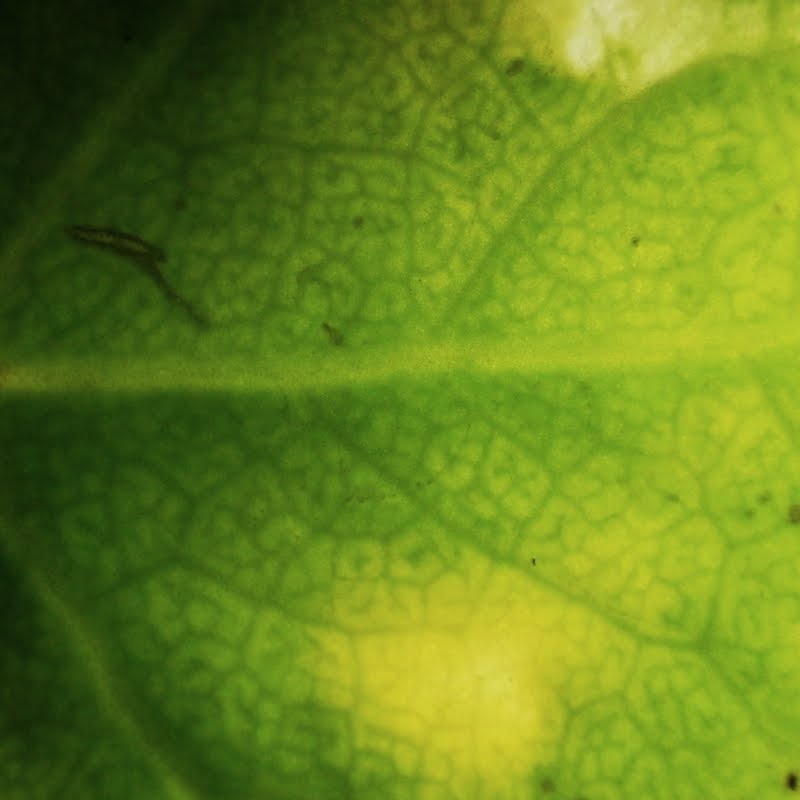

Senecio macroglossus.

Another one that's no longer around. I miss it . . . slightly. It had some nice qualities. It wasn't a good plant for me to be trying to grow, though, for three main reasons. One, it needed more light than I could give it. Two, it was forever tangling itself in the wire shelving I use, which did the plant no serious harm but was frustrating when watering time came around. Three, it needed a lot of grooming -- leaves were always dying but remaining attached to the stem, which made it difficult to groom. And it always needed to be groomed.

It'd be interesting to look at sometime with the microscope, though. You can see some weird stuff happening in there with the veins just from this picture.


Chlorophytum x 'Fire Flash,' dead leaf.

This picture is dramatic, but I think not good. Not the plant's fault, though. The plant is great.


Malva neglecta.

One of Iowa's less objectionable invasive weeds.


Saintpaulia ionantha NOID, petal.

The third plant I no longer own. I like African violets well enough to want to grow them, but not well enough to change the way I care for my plants to make growing them possible. By the time the last of the Saintpaulias went in the garbage, I was pretty exasperated with the genus, and I think I could live the rest of my life quite happily without ever trying to grow another.


Hibiscus moscheutos 'Dave Fleming,' petal.

I'm not particularly into the H. moscheutos varieties I've seen so far, and I don't know why. I mean, they seem like the sort of thing I would like. I like H. rosa-sinensis fine (I don't grow it, because overwintering always seems to be a problem, but I like them to look at.), and it's not that I have a problem with winter-hardy Hibiscus, because I think H. syriacus 'Blue Satin' is great. H. moscheutos is just too extreme for me, in some way I can't articulate. I don't see them very often around here, either. I mean, I see them for sale, just not usually planted. Though I suppose some of that is because I only recognize them when they're blooming, and for a lot of the year, they're not blooming.


Peperomia caperata.

The last of the plants I no longer grow, and the one I would be most likely to try again if I thought there was a chance of success. The problem with P. caperata was always watering. The 14-day cycle most of the plant collection is on is a bit too long for P. caperata, and if I tried to keep them wet longer by moving them to a larger pot, they'd rot. Irreconcilable differences. If I ever do find a way to deal with the watering differently, I will probably try this one again.


Ipomoea NOID, petals.

Say what you will about Ipomoeas (I. nil, I. purpurea, I. tricolor, and so on), but the flowers really are quite lovely even if the plants are weedy.


Musa 'Zebrina Rojo.' (possibly Ensete 'Zebrina Rojo.')

I probably took more photos of 'Zebrina Rojo' than necessary. (Previously: XLVIII, XLIV. And I think there's another photo in the transmitted light reserves.)


Friday, October 14, 2011

[Exceptionally] Pretty pictures: transmitted light -- Part XLIV

A lot of things aren't working properly for me at the moment (oddities with loading certain websites, a literal headache, a bureaucratic thing which prompted an unscheduled trip to Iowa City yesterday -- and no, Mercury is not in retrograde), so tasks like e-mail and plant-watering are piling up, necessitating a transmitted light post.

(The previous transmitted light posts can be found here.)

Pilea cadierei. Quite a bit duller than you'd expect from seeing the leaves by reflected light, but sort of quietly interesting. To me, anyway.

Curcurbita sp. (C. pepo?), petals. Many of these photos are very old: I've been taking pictures faster than I've been using them. I think this is from fall 2009.

Pandanus veitchii.

Polyscias balfouriana. This isn't the greatest picture, but P. balfouriana tends to have veins that are particularly good for photographing.

Quercus sp., autumn. I can't decide whether the tears and brown spots improve transmitted light photos of deciduous trees like Quercus (oak) and Acer (maple) or ruin them.

Iresine herbstii 'Blazin' Rose.'

Weigela sp. I really like this kind of leaf. Not particularly taken with the plant (one came with the house: it isn't causing any problems, and it's impressively large, but it doesn't do much for me either. Considering how difficult it is to get enough light in the house, I'd really sort of prefer that we not have anything tall in or near the house at all. But it's probably staying anyway.

Hypoestes phyllostachya, white cv.

Dieffenbachia NOID. I keep seeing this variety over and over, but I have no idea what it's called. My best guess is 'Golden Sunset,' but given how many varieties there are, and how variable the leaves may be, a lot of them sort of shade into one another, and it's hard to be very sure.

Musa 'Zebrina Rojo.' (possibly Ensete 'Zebrina Rojo.') Sort of the obvious favorite from the set.


Tuesday, November 2, 2010

[Exceptionally] Pretty pictures: transmitted light -- Part XXXIII

Transmitted Light Week continues!

I think I may be self-sabotaging: on yesterday's walk with Sheba, I wound up collecting several dead leaves. Brought them home, and then spent half an hour or so taping them to the kitchen window, getting pictures, and pulling them down. I think I probably got enough photos yesterday that I technically lost ground. (I may have gone a little nuts with the oaks.) But oh well. I'll still be ahead for the week.

(The previous transmitted light posts can be found here.)

Iris cv. There seems to be some kind of mathematical pattern to how lit up the different veins are, but I can't quite figure out what it is.


Rheum sp. Whatever. A lot of transmitted light photos wind up looking like this.


Acer platanoides key, red cv. This seemed like a good idea at the time, though now that I look at it again, six months later, I'm not sure I like it. In person, it was very pretty, though. I guess the camera didn't capture what I was hoping to capture.


Philodendron bipinnatifidum (?) 'Spicy Dog.' From the venation, I think it probably is either P. bipinnatifidum or a hybrid of something with P. bipinnatifidum: it looks very much the same, except that P. bipinnatifidum's leaves are more deeply split. The plant is growing fine for me inside, though it's getting to the point where I think I'm going to have to find it another spot already: it's gotten big fast.


Iresine herbstii 'Blazin' Rose.' I like this photo better than the Iresine picture from Sunday.


Unknown Spiraea cv. I wouldn't have had any idea on the ID for this plant had it not been flowering when I took the picture. Very pleased with how it turned out: this is probably my favorite from the batch.


Solenostemon scutellarioides 'Tilt a Whirl.' I'm surprised at how similar this is to the last 'Tilt a Whirl' picture I took, a long time ago.


Liriodendron tulipifera. The full-size photo is nice. I was really excited about tulip trees this spring, when they were blooming, and even though we don't actually want to plant a lot of trees in back ('cause I want whatever sunlight we can get for the plants inside; it's bad enough having the maple out there blocking a lot of the afternoon light), I thought about trying to get one of these. Then I found out they get to be 120 feet tall (eventually) and have a tendency to fall apart in high winds, and I gave up on that plan.


Heuchera 'Green Spice.' I feel like I ought to like this one better than I do. I mean, the texture is interesting, it's in focus, there are interesting shapes. I think I must be having trouble with the color combination. Not a big fan of mustard yellow and brown.


Schlumbergera 'Caribbean Dancer,' petal. Probably Schlumbergera petals are too small to do this effectively, but at last it's a nice, bright color.


Sunday, October 31, 2010

[Exceptionally] Pretty pictures: transmitted light -- Part XXXI

About a week ago, Errant asked whether there was a possibility of me doing transmitted light photos of autumn leaves anytime soon. My answer was that I post the transmitted light pictures in more or less the order I take them, and that there was enough of a backlog at the moment that I was only ready for photos I took toward the beginning of last spring. I'm not posting the photos as quickly as I take them, either, so I'm always drifting further and further behind real-time. Maybe, I said, I would have to do an all-transmitted-light week sometime, to use up some of the photos I've been diligently collecting.

(Also: by the time the leaves on an outdoor plant have made it to autumn, they're usually pretty beat-up, and lots of leaves curl as they dry, which makes them nearly impossible to photograph. Eliminate the curled, cracked, or spotted leaves, and there's not much to take pictures of this time of year. I have gotten some, but you probably won't be seeing those until next spring.)

I actually try pretty hard to avoid following posts with the same kind of post -- if I post pretty pictures one day, then I post a random plant event or question for the hive mind or list the next. I figure changing it up that way means that if you don't care about the Monday post, you'll still come back to see what Tuesday is. So I'm a little hesitant to do a whole week that's all the same thing (I think the last time I did this was during the plant toxicity series back in April 2009, and in that case, I knew there were people wanting to see it.) But I have something like 200-250 unposted transmitted light photos now, and I figure we may as well get through some of them sooner instead of later. So, this week, we're going to do Part 31 to Part 36.

I might have an explanation later this week for the "good stress" I was talking about, too. If that happens, it'll get a separate post.

(The previous transmitted light posts can be found here.)

Platycerium bifurcatum. A few diagonal scars in the upper-left corner also look a little like veins.


Aloe 'Doran Black.' Aloe transmitted light photos are possible, and I even kind of like the way this one turned out.


Acer platanoides. Turned out exceptionally well, if I do say so myself.


Gasteraloe x beguinii (Aloe aristata x Gasteria batesiana). For anyone who didn't believe me when I said transmitted-light photos were possible on Aloes. Believe me yet?


Solenostemon scutellarioides 'Alabama Sunset.' Not really at all what I was expecting from this variety. I'm noticing that coleus are often sort of disappointing that way. 'Glennis' never looked the way I'd hoped it would either.


Aglaonema 'Peacock.' Better by reflected light, alas, but it's a nice enough plant. Mine drops a couple leaves every time I water, lately; I haven't repotted it in quite a while, which could be the problem.


Caladium NOID. Caladiums make terrible inside plants; I've tried more than once, and they just need more heat and humidity than I'm willing to deal with in my home. I'm not sure I like them that well as outdoor plants either, actually. But there's no denying that the leaves are pretty.


Calathea zebrina. I like how this turned out, though there are flashier Calatheas out there.


Iresine herbstii 'Blazin' Rose.' I've been, ultimately, disappointed with this as an indoor plant. It does grow, despite less than ideal light (north window) and watering (it needs a faster watering schedule than I can give it), but the variegation that attracted me to it in the first place disappeared immediately, and hasn't come back despite me experimenting with the light level for a while at first. I can't really be mad -- it's not doing anything wrong -- but it's been inconvenient enough that I don't think I ever want to grow it again. I bet it overwinters better than a coleus, though, and it could maybe do the work of one outside if I planted it in the ground, so I'm not ready to get rid of it yet.


Maranta leuconeura 'Marisela.' My favorite picture from this set. It's hard to go too terribly wrong with a Maranta.


Sunday, April 11, 2010

Really, Really New Plants, plus bonus pretty picture

After a very long period (a couple weeks?) of neither gaining nor losing any plants, the count ratcheted up a couple times last Thursday and Friday. They're not all incredibly interesting, but a few of them are unusual enough to be noteworthy.

Also I should show you the new Iresine herbstii 'Blazin' Rose' that I got at Wallace's when I went there for the orchid show, just because I think it's cool. Are Iresines supposed to be huge like this, or is this something specific to this variety? 'Cause seriously, some of these leaves are like five inches long, and almost as wide. I don't think I've ever seen anything like that. It's practically a croton.

Iresine herbstii 'Blazin' Rose.' The pot is five inches (13 cm) in diameter.

But better, obviously, on account of not actually being a croton.

Then the batch from last Thursday came from Jake Henny, of the blog Plant Daddy (that's right: the Jake Henny! E-mailed me!), who offered to send an Aglaonema 'Golden Bay,' since I said a few posts back that I didn't have one yet, in passing, while complaining about the disappearance of Dieffenbachia 'Tropic Forest.' I expect to like 'Golden Bay;' other white-stemmed Aglaonemas ('Peacock,' 'Brilliant') have done really well for me, and 'Golden Bay' was well-behaved at work when we had them.

Aglaonema 'Golden Bay.'

That was nice enough on its own, but then as a bonus, he threw in a couple plants of a new variety of Philodendron hederaceum, 'Frilly Philly,' which I had seen on-line a few times but had not yet viewed in person. It didn't look quite like I expected: a lot of the on-line photos were unclear, or had the plant trained vertically, so I couldn't really tell what it was like.

So what's it like?

Philodendron hederaceum 'Frilly Philly.' (Henny uses P. scandens oxycardium as the species name. Tomato, tomahto.)

Well. You wouldn't think it was a P. hederaceum to look at it. The leaves are narrow, and fairly small, not even remotely heart-shaped. When I showed the husband, his comment was that it looked almost like a trailing bamboo or something. Everything about it on-line so far appears to be press releases, so it's very new, but 'Frilly Philly' was developed via irradiation (a mutation technique touched on in the profile for Begonia rex-cultorum, q.v.) of P. hederaceum (see .pdf file) and the mutation is apparently stable. It's also supposed to branch a lot more freely than other varieties of the same species. Do I like it? I'll let you know. For right now, I'm mostly just surprised at how different it is, both from the parent plant and from my expectations.

Then on Friday, I was going a little crazy from not getting out of the house since the trip to Wallace's, so we went to Iowa City and I stopped at my former workplace. I had every intention of not buying anything; I was just going to take pictures to use on the blog, talk to whomever was around, and then go, but you know how these things work.

So I got a replacement Crassula muscosa (I'd had one a while ago, but I pitched it when it got mealybugs) --

Crassula muscosa. Sometimes also Crassula lycopodioides. I'm not sure whether lycopodioides is an obsolete synonym or a different species entirely.

-- and an Agave victoriae-reginae. I had one of these already, but this one -- which has been at the store for years, by the way; I was the one who divided it off its parent and potted it up originally -- looks like it's offset seven or eight more rosettes, which in theory could be divided. Even if I lose half and only get four plants out of it in the end, that's still a pretty good deal, for a plant that's not found that often around here.

Agave victoriae-reginae. The pot is three inches wide diagonally. I haven't tried to count up how many offsets there are here, but it's a lot. Some are just very very tiny.

Also I bought a plant that was labeled only "Haworthia hybrid."

"Haworthia hybrid."

I suspect it is actually an intergeneric Aloe x Haworthia ("Alworthia") or Gasteria x Haworthia ("Gasterworthia") cross, rather than a hybrid of two Haworthia species, mostly based on the flowers.

The flowers on the "Haworthia hybrid." It was, obviously, already in bloom when I bought it.

All the Haworthia flowers I can recall seeing are small white five-petaled things with a greenish stripe down the center of each petal; all the Gasteria flowers I can think of are pinkish-orange tubular things with a slightly bigger base (the botanical name comes from the Greek gaster, meaning "stomach," and refers to the shape of the flowers). The flowers on this seem like a pretty straightforward compromise between the two things, being tubular five-petaled flowers with a pinkish-orange, slightly bigger base, shading to white with greenish stripes, so I suspect Gasterworthia more than Alworthia. But there are Aloes with tubular pinkish-orange flowers that end in green-striped white as well; witness Aloe 'Doran Black:'

Flowers from Aloe 'Doran Black,' or something I think might be Aloe 'Doran Black,' photographed in front of Plectranthus 'Mona Lavender' flowers. Secondary colors!

Which means that 'Doran Black' is a cross-generic hybrid too and I've just misidentified it, that Aloe is a really variable genus, that flowers are not sufficient to identify specific genera within the Asphodelaceae family, or some combination of these. So I don't think I'm ever really going to know what this is. But it was a largish Haworthia-oid thing, so I had to have it. Because that is just how I roll.

[UPDATE: There appears to be agreement that this is a Gasterworthia / Gasworthia / Gasterhaworthia, possibly 'Banded Pearls' or 'Royal Highness.' Neither appears to be especially common, so there aren't a lot of photos to investigate in either case, and the photos I did manage to find are fairly variable, suggesting that there's either a lot of misidentification going on out there or that they're highly variable plants. So for now we'll call it Gasterworthia cv.]

[ALSO: Gasworthia, Gasterworthia, and Gasterhaworthia all appear to be used to describe Gasteria-Haworthia crosses. Searching Google for each turns up 245 incidences of Gasworthia, 984 Gasterhaworthias, and 13200 Gasterworthias, so Gasterworthia is the one I'm going to use.]

And speaking of large, and really, really new: Philodendron 'Spicy Dog.'

Philodendron bipinnatifidum (?) 'Spicy Dog.'

This is so new that there's basically nothing about it on the internet (I found exactly two mentions on the whole internet, neither one of which contained any useful information beyond confirming that the plant exists), so I have no idea what kind of ride I'm in for, whether it's available under a different name, whether it's a hybrid or a variety of Philodendron bipinnatifidum, or basically anything else. All I know at this point is that the pot had a sticker on it identifying it as P. bipinnatifidum, it looks like the P. 'Xanadu' that ate Cleveland (the longest leaf is 14 inches / 36 cm), the petioles are spotted, and the name makes no sense whatsoever -- there's nothing spicy or canine about it as far as I can tell. (I checked with Sheba, in her capacity as resident canine expert, and she concurs.) It looks like injury to the leaves and the consequent leaking of sap leads to a mold problem sooner or later; the undersides of some of the leaves had the sooty black mold on them that I've seen on other plants. But it came off.

I don't, of course, have room for it, but it's getting warm enough to be thinking about keeping some of the plants outside, so maybe some of them will move out, leaving room for new indoor residents. We can hope.