Showing posts with label transmitted light. Show all posts

Tuesday, May 6, 2014

[Exceptionally] Pretty pictures: transmitted light -- Part LIII

Having one of those spells where I'm not having any trouble coming up with things to write about, but I'm never happy with the results. Also, as previously mentioned, the Anthuriums are the only plants here that are doing much of anything at the moment. Consequently, we're digging into the transmitted light photos, because that's what the transmitted light photos are for.

By way of observing how old these pictures are: of the six plants photographed for this set that I owned at one time or another (Dracaena, Iresine, Senecio, Chlorophytum, Saintpaulia, Peperomia), only two remain (Dracaena, Chlorophytum).

(The previous transmitted light posts can be found here.)


Dracaena deremensis 'Janet Craig Compacta.'

Never my favorite plant, and this photo is boring besides, but I'm appreciating it a lot more these days than I used to. No rot, no scale (knock wood), no defoliation. It just sits there, quietly, and photosynthesizes, like plants are supposed to do.


Iresine herbstii 'Blazin' Rose.'

One of the plants I used to own but no longer do. The main reason for this is that it just grew too fast and needed too much light. The coup de grĂ¢ce happened when spider mites started bothering it, and I decided it was just too much work to keep around any longer. Not necessarily a terrible plant, and it does photograph well occasionally, but I couldn't say I miss having it around. (Indeed, this is the first time I've even thought about I. herbstii in at least a couple years.)
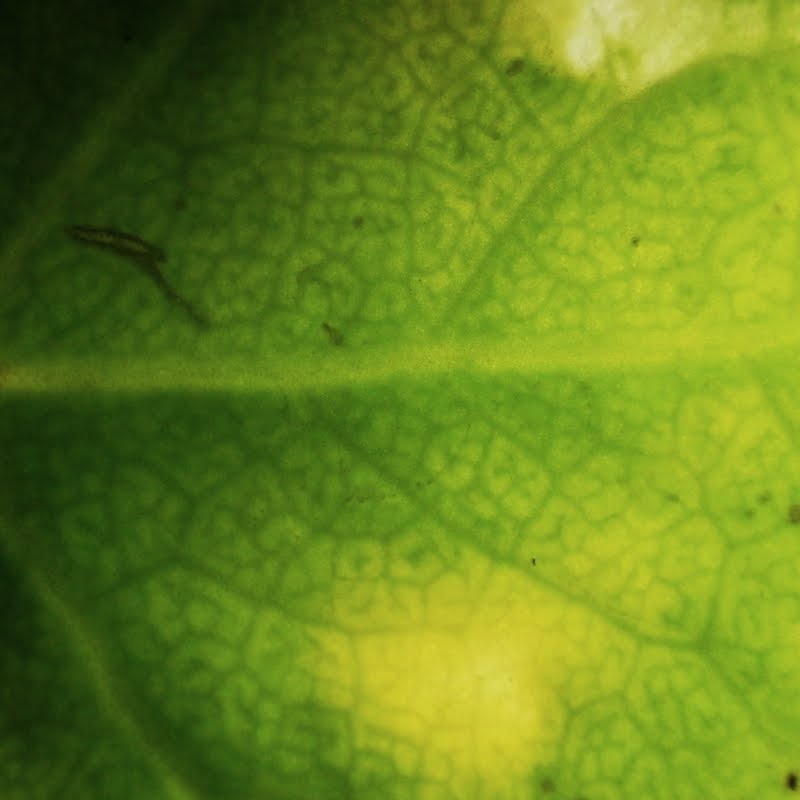

Senecio macroglossus.

Another one that's no longer around. I miss it . . . slightly. It had some nice qualities. It wasn't a good plant for me to be trying to grow, though, for three main reasons. One, it needed more light than I could give it. Two, it was forever tangling itself in the wire shelving I use, which did the plant no serious harm but was frustrating when watering time came around. Three, it needed a lot of grooming -- leaves were always dying but remaining attached to the stem, which made it difficult to groom. And it always needed to be groomed.

It'd be interesting to look at sometime with the microscope, though. You can see some weird stuff happening in there with the veins just from this picture.


Chlorophytum x 'Fire Flash,' dead leaf.

This picture is dramatic, but I think not good. Not the plant's fault, though. The plant is great.


Malva neglecta.

One of Iowa's less objectionable invasive weeds.


Saintpaulia ionantha NOID, petal.

The third plant I no longer own. I like African violets well enough to want to grow them, but not well enough to change the way I care for my plants to make growing them possible. By the time the last of the Saintpaulias went in the garbage, I was pretty exasperated with the genus, and I think I could live the rest of my life quite happily without ever trying to grow another.


Hibiscus moscheutos 'Dave Fleming,' petal.

I'm not particularly into the H. moscheutos varieties I've seen so far, and I don't know why. I mean, they seem like the sort of thing I would like. I like H. rosa-sinensis fine (I don't grow it, because overwintering always seems to be a problem, but I like them to look at.), and it's not that I have a problem with winter-hardy Hibiscus, because I think H. syriacus 'Blue Satin' is great. H. moscheutos is just too extreme for me, in some way I can't articulate. I don't see them very often around here, either. I mean, I see them for sale, just not usually planted. Though I suppose some of that is because I only recognize them when they're blooming, and for a lot of the year, they're not blooming.


Peperomia caperata.

The last of the plants I no longer grow, and the one I would be most likely to try again if I thought there was a chance of success. The problem with P. caperata was always watering. The 14-day cycle most of the plant collection is on is a bit too long for P. caperata, and if I tried to keep them wet longer by moving them to a larger pot, they'd rot. Irreconcilable differences. If I ever do find a way to deal with the watering differently, I will probably try this one again.


Ipomoea NOID, petals.

Say what you will about Ipomoeas (I. nil, I. purpurea, I. tricolor, and so on), but the flowers really are quite lovely even if the plants are weedy.


Musa 'Zebrina Rojo.' (possibly Ensete 'Zebrina Rojo.')

I probably took more photos of 'Zebrina Rojo' than necessary. (Previously: XLVIII, XLIV. And I think there's another photo in the transmitted light reserves.)


Sunday, December 1, 2013

[Exceptionally] Pretty pictures: transmitted light -- Part LII

My last surviving grandparent died last week. This both was and was not a big deal, and consumed enough of my week that I was unable to work much on the blog, so posting will probably be light for a while until I can catch up.

Funerals remain horrible things that are not remotely consoling. I really have no idea why anyone would ever want one.1 There was more family politics involved with this one than with the other three grandparent funerals, about which I have Feelings, but this is probably not the place to describe those. Let's just say that I like the deceased less now than I did three months ago.2

While we wait for me to get new posts together, here is another batch of transmitted light photos.

(The previous transmitted light posts can be found here.)

Cordyline fruticosa.

Pilea nummulariifolia.

Solanum lycopersicum NOID.

Dracaena reflexa 'Riki.'

Acalypha wilkesiana cv.

Polyscias scutellaria.

Ctenanthe lubbersiana. (This one is probably my favorite from the set.)

Stapelia gigantea, petal.

Begonia NOID.

Quercus sp., autumn.

-

1 I can appreciate the value of bringing the whole extended family together, because that part is actually kind of pleasant. (If you like your extended family, anyway.) I can appreciate doing something special to give everyone some kind of closure. But, well.
Let's say somebody steals your car, but leaves a note behind telling you that they stole your car for a really, really good reason, a reason they decline to provide any specifics about. And then let's say that everyone you talked to about how your car was stolen immediately reacts with oh, that's too bad, but I'm sure they had a good reason for taking it, and well, you'll probably see the car again sometime, like on the street or something, right?, and how about we drone some songs at 1/4 speed about how awesome your car thief was: whaddya say? And you're all like, but I don't really want to sing about how awesome the car thief is, 'cause the fucker, you know, stole my car, and they're like but you have to sing, everybody's going to be expecting you to sing, if you don't sing then people are going to be upset.
This is what religious funeral services feel like to me, except more so, because people are more valuable than cars.
2 So in a roundabout way, I suppose the funeral was successful in making me feel less bad about the loss. Though I don't think that's how funerals are supposed to achieve that feeling.


Monday, September 30, 2013

[Exceptionally] Pretty pictures: transmitted light -- Part LI

The plants are coming in for the winter, and I've got a gigantic backlog of photos to deal with, so it's time for transmitted light pictures again.

(The previous transmitted light posts can be found here.)

Cissus rhombifolia.

Rotate it 90 degrees clockwise and there's a (subtle) peace sign!


Euonymous alatus, autumn.

Well. It's certainly very red, isn't it?


Ficus elastica 'Burgundy,' dying leaf.

This photo is very old (actually all of these photos are very old; I'm still working on a backlog of transmitted light photos from like 2009), but seems particularly appropriate right now. I had two Ficus elasticas. I just threw the small one out because it had scale, and I was like, whatever, I don't like trying to get rid of scale and it's a duplicate anyway, so I'll pitch it and grow the other one. But then the other one came in from outside, and it's been growing mostly horizontally the whole time it was outside because it's apparently one of those trailing rubber trees,1 so I don't have any spot large enough to put it. And it's not like I'm hugely fond of F. elastica even when they're grown well. So I'm seriously considering throwing it out, or restarting from cuttings, or trying to sell it on Craigslist, or something like that. It's actually looking like a lot of the plants are going to have to be thrown out, sold, or restarted, in order to make space for the ones I actually want to keep. October's gonna be rough.


Pilea peperomioides, newish leaf.

Pilea peperomioides is probably not the most difficult "easy" plant I've ever tried to grow, but it's definitely on the list somewhere. And I have no idea what I was doing wrong.


Episcia NOID.


Ananas comosus 'Ivory Coast.'

This is perhaps not as flashy as some of the photos that follow it, but I think it's my favorite picture from this set. It's possible that I'm just a sucker for parallel venation.


Caladium 'Cardinal.'

Look out green! The red is right behind you! Run! Run! Aiiiieee!


Canna 'Tropicanna.'

As much as I love the red-blooming, green-leaved Cannas (and I do, very much), it seems weird that I haven't yet made it a priority to get one of the other varieties. Not necessarily 'Tropicanna,' (does it even come true from seed? Probably not, right?) but something. It's not as if there aren't a lot of options to choose from. Maybe 2014 will be the year.


Fittonia albivenis NOID.


Graptophyllum pictum.

I've seen Graptophyllum for sale exactly one time since I've been blogging, and I didn't buy it, because it was kind of underwhelming in person. (The books make it look a lot cooler.) Also you have to figure that if it were a satisfying houseplant, people would already be growing it everywhere. So I'm thinking I didn't miss much, but the picture still wound up pretty cool.

-

1 A joke: there is no such thing as a trailing rubber tree. Though there is a rubber vine (Cryptostegia grandiflora), which is neither related to Ficus nor to Hevea brasiliensis, the "real" rubber tree. Common names are dangerously misleading! Shun them!


Tuesday, May 21, 2013

[Exceptionally] Pretty pictures: transmitted light -- Part L

Still have a lot of these photos stockpiled from . . . I don't even know how many years ago. Long time. I should probably try harder to burn through those, 'cause I'm still taking new pictures, and at this rate I'll never actually end up posting them.

(The previous transmitted light posts can be found here.)

Tetrastigma voinieriana. Alas, my Tetrastigma was lost in the big scale purge in February. It didn't have scale: I just got tired of it. It was top-heavy, and I couldn't actually let it climb anything like it wanted to, because I wouldn't have been able to take it to the tub to water it, and it had never grown very well, so out it went. I can't say I miss it much, though it's not particularly a bad plant, just not well-suited to my growing situation here.

Platanus occidentalis, autumn. I think sycamores are my favorite outdoor trees. Though tulip tree (Liriodendron tulipifera) is competitive. This particular photo does a terrible job of showing why it's my favorite tree, but that's not really what I was trying to do in the first place so whatever.

Strelitzia nicolai.

Fothergilla x 'Mount Airy.' This was obviously taken at the ex-job; we don't have a Fothergilla here.

Ligularia stenocephala 'The Rocket.' Same here, though I have run into Ligularias occasionally in houseplant books, and have always wondered how well they'd really grow indoors.

The only time I've ever seen anyone come close to trying is when we kept one in the greenhouse at work for a while; it produced some flower buds, which was exciting, but then the actual flowers turned out to have thrips, so they were all twisted and stunted and gross. The whole affair was pretty disappointing.

Plectranthus amboinicus, variegated. I'd like P. amboinicus better as a houseplant if it didn't try to get so big so fast.

Dieffenbachia 'Starbright.' One of the four or five Dieffenbachias I still own. Most of them get thrown out once they get too tall and leggy for me to deal with: either I decide I don't like them and just throw them directly out, or I'm emotionally conflicted about throwing them out, so I try to cut them back and root the cutting, but they don't resprout and the cutting doesn't root and so then I throw them out.

I've always loved the way Dieffenbachias look, and obviously they make for great transmitted light pictures, and it doesn't hurt that they're kind of dangerous -- I like the dangerous plants -- but overall? I don't find them worth growing. The exceptions are the really huge cultivars like 'Tropic Snow' and 'Tropic Rain,' which do well enough for me, and resprout consistently when cut back, that I don't mind having them around.

Pilea 'Moon Valley.' I don't know how many times I had to attempt a photo of 'Moon Valley' before I got this one, but it was a lot. So this is probably my favorite from this batch, whether or not it deserves to be.

Aglaonema 'Sparkling Sarah.' My original plant, which had three individual plants in it and looked decently full, is not as attractive as it used to be, though that's my fault, not the plant's -- I accidentally broke one of the canes off. It's still one of the better red/pink Aglaonemas in my experience.

Caladium 'Fire Chief.' Not a houseplant (though don't think I haven't tried, more than once), but the photos are almost always great.


Tuesday, April 2, 2013

[Exceptionally] Pretty pictures: transmitted light -- Part XLIX

Goodness. It's been so long since I did a transmitted light post that I don't even remember how I'm supposed to do them.

Actually no, that's not true. It's only been like five months. But it'd been nine months before that. I'm definitely a little rusty.

(The previous transmitted light posts can be found here.)

Schlumbergera truncata NOID, phylloclade. Though Schlumbergeras are not quite as abundant in the house as the Anthuriums, they've getting there. The most recent stats for the collection: 959 plants total, 198 Anthurium seedlings (21% of total), 116 Schlumbergera seedlings (12%). None of this changes the fact that they make lousy transmitted light subjects.

Philodendron [erubescens?] 'Golden Emerald.' I don't know what the deal is with this one; it never seems to photograph as bright and saturated as it actually is. It's really much prettier than this in person.

Brassolaeliocattleya Helen Brown. Probably by now it's not Brassolaeliocattleya anymore, but who has time to keep track of these things.

Iris ensata variegata. I have no memory of seeing a variegated Iris of any kind, anywhere. I mean, I know they exist; it's just that this photo is the only evidence I have that I've ever seen one. I didn't even take a photo of the whole plant, so there's no context for this picture. It's a weird feeling.

Salvia elegans. On Sunday, I semi-accidentally wound up looking at some of the pictures of the Salvia elegans we planted in the yard a couple years ago, when it was huge and in full bloom, and: I'm afraid we're just going to have to do that again. Even though I no longer seem to be capable of overwintering them. (Probably the basement is too warm now, what with all the lights.)

Callisia repens.

Tradescantia zebrina. I didn't actually intend for this to wind up next to the Callisia, but it's an interesting comparison, since they have a nearly identical growth habit.

Caladium NOID. Not one of my best Caladium pictures, but with Caladiums, even a bad picture is still okay.

Quercus sp., autumn.

Stromanthe sanguinea 'Triostar.'