Showing posts with label Acalypha. Show all posts

Sunday, December 1, 2013

[Exceptionally] Pretty pictures: transmitted light -- Part LII

My last surviving grandparent died last week. This both was and was not a big deal, and consumed enough of my week that I was unable to work much on the blog, so posting will probably be light for a while until I can catch up.

Funerals remain horrible things that are not remotely consoling. I really have no idea why anyone would ever want one.1 There was more family politics involved with this one than with the other three grandparent funerals, about which I have Feelings, but this is probably not the place to describe those. Let's just say that I like the deceased less now than I did three months ago.2

While we wait for me to get new posts together, here is another batch of transmitted light photos.

(The previous transmitted light posts can be found here.)

Cordyline fruticosa.

Pilea nummulariifolia.

Solanum lycopersicum NOID.

Dracaena reflexa 'Riki.'

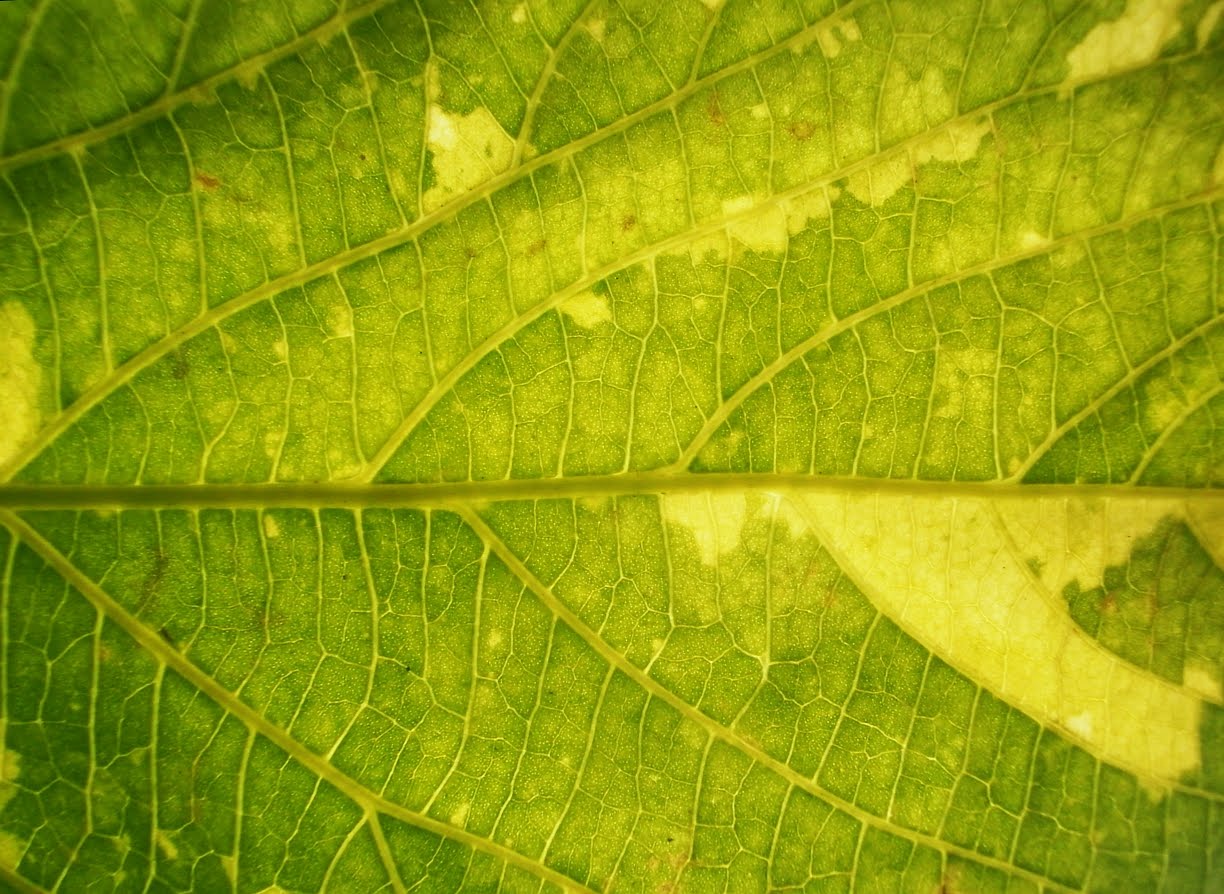
Acalypha wilkesiana cv.

Polyscias scutellaria.

Ctenanthe lubbersiana. (This one is probably my favorite from the set.)

Stapelia gigantea, petal.

Begonia NOID.

Quercus sp., autumn.

-

1 I can appreciate the value of bringing the whole extended family together, because that part is actually kind of pleasant. (If you like your extended family, anyway.) I can appreciate doing something special to give everyone some kind of closure. But, well.
Let's say somebody steals your car, but leaves a note behind telling you that they stole your car for a really, really good reason, a reason they decline to provide any specifics about. And then let's say that everyone you talked to about how your car was stolen immediately reacts with oh, that's too bad, but I'm sure they had a good reason for taking it, and well, you'll probably see the car again sometime, like on the street or something, right?, and how about we drone some songs at 1/4 speed about how awesome your car thief was: whaddya say? And you're all like, but I don't really want to sing about how awesome the car thief is, 'cause the fucker, you know, stole my car, and they're like but you have to sing, everybody's going to be expecting you to sing, if you don't sing then people are going to be upset.
This is what religious funeral services feel like to me, except more so, because people are more valuable than cars.
2 So in a roundabout way, I suppose the funeral was successful in making me feel less bad about the loss. Though I don't think that's how funerals are supposed to achieve that feeling.


Thursday, November 10, 2011

Walkaways Part 16: The Walkawayening, plus one new plant

Just assorted plants that were interesting but left on the shelf. This covers at least a couple months, possibly longer: I had a photo-backlog problem for a lot of the summer and fall.

Acalypha wilkesiana 'Beyond Paradise.'

This would actually have been cheap, unlike almost everything else on the list, but I managed to realize before buying it that I had no spot in the house for a fast-growing plant that needed sun. And, you know, once you have that realization, it takes all the fun out of buying the plant.

Aglaonema NOID.

I don't think I've ever met an Aglaonema I didn't like. (I'm not even sure it's possible.) So this one is on the wish list.

Alocasia 'Loco.'

The variety name wasn't on the plant at the store, but that's what I think it is, based on some internet searching. It's become weirdly common here, all at once -- I'd never seen it before a couple months ago, and then suddenly it was everywhere. I passed it up because, you know, Alocasia = spider mites, and also because I kind of think it's ugly, but it's ugly in an interesting way, at least.

Begonia rex-cultorum NOID (possibly 'Fireworks?').

Never of any serious interest -- I don't intend to buy another rex begonia unless/until I have a dedicated terrarium or greenhouse or something to put them in. And even then, I probably won't bother. But pretty.

Calathea 'Corona.'

Way too big, therefore also way too expensive. Also it's not the best specimen (some burnt margins and scars and stuff, if you look close), and it didn't photograph that well either. But I'm getting dangerously close to buying another Calathea, because I've had my C. makoyana for a year and a half and it hasn't died (probably more a matter of luck than skill). I should probably fight that impulse, though if I found a nice Calathea ornata cheap somewhere, I'd have a hard time resisting.

Hoya NOID.

I don't think I've ever seen a Hoya for sale before that was this loaded with blooms. No ID, though. (Any guesses? UPDATE: Lee, in comments, suggests Hoya nummularioides, which looks like a match from the Google image search results. Thanks!) The flowers were very fragrant, though I didn't entirely like the smell.

Hoya NOID, close-up.

Same plant as above, in the hopes that showing a tighter shot of the flowers would lead to more/better ID guesses.

Kalanchoe tigrina?

Of interest primarily because I've been seeing it forever without knowing what, exactly, it is. I still don't know what it is, but at least I've finally come up with a guess. I would never buy it, because of the aforementioned lighting problems and the fact that about 85% of my experiences with genus Kalanchoe have been bad. Mostly because of lighting. I think.

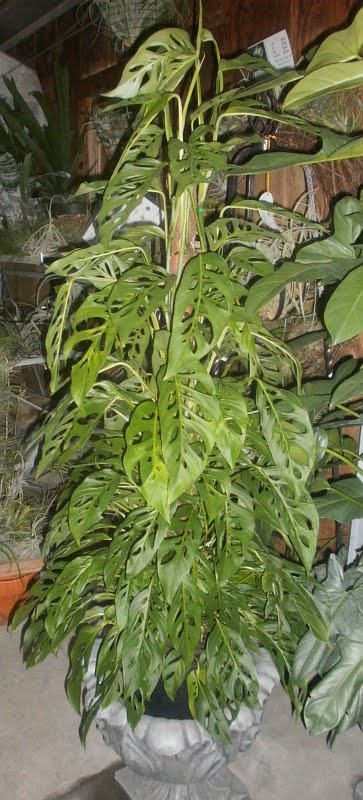
Monstera adansonii.

I'm not particularly into M. adansonii, but this is an impressively large one.

Neoregelia NOID.

Apparently, this particular variety needs an insane amount of light to maintain its color. This is an old picture, but the plants are still for sale: they've just turned green and are nowhere near as interesting now. This is in the ex-job's greenhouse, which seemed plenty bright when I worked there, so supplying enough light for good color indoors must involve banks of 50 kW lasers or something.

Philodendron bipennifolium.

I had a P. bipennifolium once, and it didn't do well, likely due to inadequate light and humidity. (It didn't actually say what the problem was.) I love the leaf shape, so maybe someday I'll be able to try again.

Not with this particular specimen, though. I didn't check the tag, but I'm sure it must have been like $14,000 or something.

Sansevieria trifasciata 'Bantel's Sensation.'

Didn't need to get this, 'cause I have one (it's been up and down and up again, but it's still alive and producing new growth; currently we're on the upswing), but I was impressed with the size. The only adjustments to this photo were cropping and coloring, but I think it looks more like a real Sansevieria trifasciata when vertically compressed:

Sansevieria trifasciata 'Bantel's Sensation,' 328 x 700 px size. (The above is 328 x 1000 px.)


Schefflera actinophylla NOID.

The last plant I passed up is this yellow Schefflera actinophylla at the ex-job. They told me the cultivar name more than once, but I've forgotten, and I couldn't find it on-line. (I found plenty of names under which people are marketing yellow or chartreuse Schefflera actinophyllas, just not the name they were using for this particular plant. I'm pretty sure I'd recognize it if I saw it again.) I like chartreuse/yellow plants, but again, no money, no room, no light. So I left it.

The one plant I have bought since the last new plants post may be an error in judgment:

Peperomia rugosa.

A lot of the appeal was that I didn't know what it was. The stems looked a lot like those of a cane-type Begonia -- thick, watery, a bit translucent -- and the leaves were wrinkly in the manner of Peperomia caperata but thicker and slightly succulent-feeling, like with some Begonias. There was also a hint of Pilea mixed in there, from the deep grooves running the length of the leaf.

Initially, I assumed that it was probably hard to grow, and declined to buy it on those grounds. Then we went back to the same store a week later, and it looked the same, so I thought maybe this was a recommendation, or at least it was maybe less delicate than I'd originally thought. Also, when I bought it, I was kind of hoping it was an unusually exotic and symmetrical-leaved Begonia, even though I knew that was unlikely.

Of course it wasn't a Begonia. I asked at the UBC Indoor Plants forum, and they told me it was a Peperomia rugosa, which turned out to be correct, damn it. I sort of wish I could take it back, but so far, so good -- after thirteen days, it's only dropped a single leaf, so maybe it has more in common with Peperomias like obtusifolia and clusiifolia (which I do okay with) than with argyreia and caperata (not so much). Time will tell.


Monday, June 20, 2011

List: Houseplants Which Bloom More or Less Continuously

There aren't very many plants which will actually bloom year-round, but there are a few, and there are even more than that with long bloom periods that might as well be continuous bloomers. As always, whether or not you actually see continuous blooming from one of these plants in your home is going to depend on whether or not you're providing the care it needs.

It's a short list this time, because honestly, I had a lot of trouble coming up with much. (It's a valuable characteristic because not many plants have it.) So by all means, if you know of another plant that belongs on the list that I haven't included, leave a note in the comments.

Abutilon cvv. (pictured: 'Bella Pink') have their flaws, but reluctance to bloom isn't one of them. I have three of the 'Bella' series, and 'Bella Pink' is rarely without at least one bloom, 'Bella Vanilla' flowers nearly as often, and I haven't seen a flower out of 'Bella Red' in months and months. Don't know why.

We had Acalypha reptans most of the time when I worked at the garden center -- it wasn't an incredibly strong seller -- and I didn't like it very much, because it was messy, but I don't remember seeing them without flowers very often.

Anthurium cvv. (shown: NOID) I have personally had a single Anthurium plant in bloom for two years straight before. This is at least partly because Anthurium flowers are very long lived: two to three months, on many varieties.

I haven't personally grown a Bougainvillea (shown: NOID) indoors ever, but I'm told that they can bloom continuously in at least some circumstances, and people do grow them indoors, so I think they technically count.

Euphorbia milii (shown: NOID) does seem to go through occasional brief rest periods for me, but that might have more to do with our weather than with day length. Certainly it blooms a lot of the time even if it does take breaks occasionally.

Hoya lacunosa blooming happens in waves for me: it produces a bunch of flowers about a week after a watering, then takes a break for a week, then flowers again. It's the only Hoya I have that's actually been willing to flower for me, but does so really easily.

Justicia scheidweileri (also still known as Porphyrocoma pohliana and a few other things) seems to be blooming much harder for me now that the days are longer, but it's at least had visible bracts, if not the actual flowers, for most of the last year. It did take a short break in the winter.

Murraya paniculata is another wave-type bloomer, with flower buds appearing in huge numbers about a week after a watering, then opening, drying up, and falling off a few days later. The smell can sometimes be intense. This photo shows only the one flower, but this particular plant can easily produce 50 at a time; I'd apparently caught it at a bad moment.

My personal Saintpaulias (shown: NOID) -- with one exception -- are all ungrateful assholes who haven't bloomed in about four months now, and seem determined to make me furious with them. (The exception is a plant I've had for a long time, which has truly never been completely without flowers in at least a couple years.) See below for theories. But other people, not me, get them to bloom all the time.

Spathiphyllum cvv. (shown: NOID) do have something of a bloom season (roughly February to October), but in good conditions, they can form blooms at any time.


The only two on this list that I haven't tried to grow are the Acalypha and the Bougainvillea, so I can't really speak to how easy or difficult they might be. Of the others, my three recommends would be Anthurium cvv., Euphorbia milii, and Hoya lacunosa, with Abutilon as an honorable mention.1

Anthurium cvv. and I have been friends for a very long time now. I grow mine in a large, east-facing window, so they get morning sun, though the light is somewhat filtered by other plants. Soil choice is very important -- the plant in the photo above was killed by a badly-timed repotting into soil that was too heavy. (I recommend cutting a regular, good potting mix about 50-50 with coarse, unchopped sphagnum, though smaller plants in smaller pots can usually be potted into unamended potting mix.) It's been my experience that keeping them too wet is more likely to be fatal than letting them get too dry, though in an appropriate potting mix you have more leeway than you'd think. A lot of people say they need high humidity and warmth; I haven't found humidity to be that critical with the varieties I have, but temperature is still important -- mine are at about 70-75F / 21-24C, round the clock. They'll bloom without much fertilizer, but blooms are larger and more abundant when they're well-fed. Flowers are unscented.

I had my Euphorbia milii for over a year before figuring out how to convince it to bloom: it turned out to need more fertilizer and light than I was giving it. They're a little more difficult than the average succulent Euphorbia, in that they prefer to be a little wetter than you'd expect, but they're very tolerant of low humidity and fairly resistant to pests. (Mealybugs are always a problem.) The sap is poisonous, as is the case for most/all succulent Euphorbias: definitely avoid contact with eyes, keep away from children/pets, the usual drill. Flowers are unscented.

Hoya lacunosa isn't much to look at, but it flowers freely in bright light (mine didn't start to bloom until I had it almost touching a pair of fluorescent shop lights -- the leaves began to yellow and everything -- but once started, it's never really stopped, even though I moved it away from the shop lights ages ago), if kept well-fed. Some direct sun helps. The flowers have a strong pleasant scent, which to me smells like a florist's display case.

For the traditional anti-recommend, I'm torn between Saintpaulia and Bougainvillea, but I think I have to go with Saintpaulia.

Bougainvillea I mostly dislike because they get big and awkward to move around, plus they have large, sharp thorns. This is why I've never tried to grow one.

Saintpaulia and I, on the other hand, have tried over and over, and with a single exception, it's never gone well. Usually I wind up underwatering at some point and they die, but currently I think the problem might be cyclamen mites. All but one of my Saintpaulias stopped blooming a few months ago; several have been producing stunted, curled or twisted leaves; and one of the ones with the twisted leaves also has weird tan patches on the newest leaves. This could be an indication of cold damage, which a couple people have suggested to me by e-mail, and they were in the (cold) plant room all winter so that's plausible, but I moved all of them into the (warmer) living room a few weeks ago, and they're acting the same or getting worse. I'll try to get some photos up sometime this week, in hopes that someone can confirm or rule out the cyclamen mite theory.

This is not typical of most people's experiences with African violets, and it wasn't typical of my experiences until about February, but I'm finding it very hard to come up with anything nice to say about them at the moment.

Not pictured:
  • Begonia cvv. (wax begonias, maybe also Rieger begonias and non-stop begonias)? I saw wax begonias mentioned as constant bloomers on a website or two while I was writing this; I don't know if it's actually true when they're grown indoors.
  • Brugmansia cvv. (reader suggestion)
  • Codonanthe cvv. (some cvv.) (reader suggestion)
  • Columnea cvv. (some cvv.) (reader suggestion)
  • Episcia cvv., at least some cvv. (flame violet) My Episcia 'Coco' has been in nearly-constant bloom since I got it last summer. It's been under artificial light, so it's possible it's confused about what time of the year it is. None of my other Episcias are anywhere near as consistent as 'Coco' is, though.
  • Fuchsia cvv. (reader suggestion)
  • Hibiscus rosa-sinensis cvv. (tropical hibiscus) The ones we overwintered in the greenhouse at work were more or less constant bloomers, though they did slow down considerably in the winter. I'm presently finding it tough to say anything nice about Hibiscus as well. I almost decided not to try to overwinter them last year, because they'd gotten spider mites bad the year before, but I went ahead and saved them anyway. They didn't get mites, but large sections of both plants died; I should have gone with my first impulse and chucked them.
  • Hoya bella (reader suggestion)
  • Impatiens cvv. (some cvv.) (reader suggestion)
  • Kohleria cvv. (some? all?) Long bloom period but not, strictly speaking, ever-blooming. (reader suggestion)
  • Mammillaria rhodantha (reader suggestion)
  • Mandevilla cvv. Another one that bloomed continuously in the greenhouse at work, but might or might not in the home. They're so prone to spider mites that I would never bring one into my house on purpose, though.
  • Osmanthus fragrans (sweet olive) (reader suggestion)
  • Oxalis cvv. (some cvv.)? Another one I saw on websites but have no direct personal experience with. I know for certain that not all Oxalis varieties bloom continuously.
  • Pelargonium cvv. (geranium) Another one that bloomed continuously in the work greenhouse. I think most people either throw them out in the fall or bring them in and let them go dormant, so I'm not sure how practical of a suggestion this is, but it's at least technically feasible.
  • Psychopsis cvv. (an orchid) (reader suggestion)
  • Rosa cvv. (miniature roses) (reader suggestion)
  • Streptocarpus cvv. (cape primrose) If grown under artificial light. (reader suggestion)
-

1 Abutilon only gets an honorable mention because they're not without their difficulties. My plants, all three varieties, are extremely messy, dropping leaves and spent flowers more or less constantly, which is annoying. They grow fast enough to replace the leaves they're dropping, but still. They're also inclined to flop over, to an obnoxious degree: I could probably fix this by keeping a fan on them, or staking the stems, but for whatever reason(s), I haven't done that. I also haven't pruned them the way I should -- I don't know what way one should prune Abutilons, but whatever it is, I know I haven't done it -- which means they're floppy, asymmetrical plants that would accumulate a pile of debris underneath them if I didn't move them to water every 7-14 days. (Instead, they leave a trail of debris from the basement, where I keep them, up the stairs and into the plant room.)
They also are extremely intolerant of drought, prone to whitefly, do poorly in heat, and need bright light and a lot of fertilizer in order to bloom, so they're not the easiest plants. For all their flaws, though, they're still one of the best fits for the category, because they really will bloom year-round.
Around here, not all establishments carry Abutilons, and those that do tend to have only the 'Bella' types, and they're only available in the spring at the start of the outdoor gardening season, but it might be different where you live. They can also be ordered on-line from a number of different places, if you're looking for something variegated or whatever.


Wednesday, October 6, 2010

Walkaways Part 11

Just another random batch of stuff I didn't buy. Some of them are very cool, but wrong for me for one reason or another; some would have worked just fine, and I just couldn't justify it to myself because I was buying other stuff instead, or I was having a weird day, or something.

First up is the one that most impressed me.

Ananas lucidus. Ex-job. Don't remember the price.

In person, this is a tall, dark red/brown/black plant with a bit of white bloom on the backs of the leaves. It photographed badly, due to interference with other stuff in the background, and too much light, and the camera being just kind of generally bad at color reproduction. If I have a chance to take a better picture sometime, I will do so. But the point is, this is big and spiky and dark and very cool-looking, but way too big for the house, and buying it would almost certainly have taken more than half the money left in my checking account, so it stayed at the store.

Fruit of Ananas lucidus.


Cyanotis somaliensis. Reha Greenhouses. $5.

Cyanotis somaliensis has been stalking me, I think: I keep seeing it around, and almost buying it, but I haven't been able to convince myself I need one yet. Part of the problem is that I didn't know what it was until fairly recently; once I found out, that was a problem too, because my current Cyanotis, C. kewensis, has been . . . well, not difficult exactly, but sort of hard to communicate with.

But that's been resolved, more or less, so it's probably only a matter of time before I get a C. somaliensis.

Crested Euphorbia lactea grafted to E. drupifera. Ex-job. $25 or $30, probably.

I'm not really a big fan of grafted plants, and with one exception, I don't really care for crested plants either. So this one never had a chance. But I thought it was worth including here for the people who like them; I've seen lots of different color varieties, but I'd never seen one that was speckled like this.

Aglaonema NOID. It was 'Susie' something, or something-"Susie." Possibly it was "Susan," not "Susie." I don't know. It wasn't on the tag; somebody told me and then I half-forgot. Ex-job. $30.

Too much money, but I would have bought it otherwise. I like the red Ags, and this was small enough that I'm sure I could have squeezed it in somewhere.

Aloe dorotheae 'Sunset.' Reha Greenhouses. $7? $5? Something like that.

This was a size problem. I don't have a lot of full-sun spots in the house, and although it might not look it in the picture, this was a big plant. I didn't think I could find a spot big enough for it that also get enough light for the plant to stay red. Plus I was buying two and a half other Aloes already.

Acalypha wilkesiana NOID. Pierson's (Cedar Rapids). Didn't ask about price.

I suspect this is one of those plants that looks great in the store, but when you get it home and try to grow it gets all leggy and pale and needs to be pinched back every five seconds. (See: Iresine herbstii, Solenostemon scutellarioides.) It just has that look.

I was, therefore, not interested. But there's no denying that it looks great in the store.

Bryophyllum tubiflorum. Reha Greenhouses. $5.

I kind of want one of these, but it seemed like the sort of thing I could trade for, rather than buy. Not that $5 is a terrible price for a 4-inch plant, though. I hear the flowers are nice.

Monstera adansonii. Ex-job. $25? $30?

We had these at work when I first started, and although it was hard not to be impressed with the speed of growth, they got out of hand almost immediately. The distance between leaves (the internodal distance) is long, so you get lots of vine but not much leaf. Also, we had occasional problems with spider mites. And it's expensive. It just seemed like trouble.

NOID plant from Commelinaceae. Reha Greenhouses. $5.

I don't actually know what this is. I know it looks like a fuzzier, shorter version of purple heart (Tradescantia pallida), and maybe it actually is, but the lady there said it was something else. They had regular T. pallida there as well, and when the two were side by side, the T. pallida was much darker and smoother. They also had a hairier all-green version (which I think was Tradescantia sillamontana) and a less-hairy plant that looked identical to the above NOID, but was green on top and purple underneath. She didn't know what any of them were called, botanically, but said that the differences in coloration were intrinsic, not the result of getting different culture. This is the sort of thing I could possibly figure out on my own if I took an afternoon to Google, and I'll still do that if I have to, but I'm hoping that maybe someone will know without me having to go to that trouble.

I have no memory of the reasoning why I didn't buy it. It was probably that the two and a half Aloes were just cooler.