Showing posts with label Monstera. Show all posts

Thursday, July 10, 2014

Product Review: Ultimate Plant Cage, Ultimate Plant Clips, Ultimate Plant Stakes

DISCLOSURE: I was provided with the following products for review:
• Ultimate Plant Cage
• Ultimate Plant Clips
• Ultimate Plant Stakes
No other compensation was given. My understanding was that I was to provide a review of the stakes whether I liked them or not, but that I didn't necessarily have to acknowledge the clips and cage, which were sent along with the stakes. Though I'm acknowledging them anyway, because why the hell not.

The first thing to note is that the company that sells these products, Global Garden Friends, was unusually pleasant to communicate with, both when we were first discussing whether or not I would review their products, and later on when I had questions about the products while trying to draft the review. And that even remained the case when I delayed the review over and over for various reasons. This is probably not the sort of thing that's going to matter to you much as a consumer, but it was so novel to have a company treat me somewhat like a person that it seemed worth bringing up.

So here are my experiences with the three products I tried:


Ultimate Plant Cage

The cage didn't work particularly well for me, for reasons that I think are not the fault of the product. I only had one plant that I needed caged, a Monstera deliciosa, and it was already well-established, large, heavy, and contorted. (The reason I needed a cage was because it had gotten so large that it was no longer possible to do much of anything with it, including moving it to the tub to water, so sprawly and awkward it had become.) This is how it's supposed to work:


Which seems nice and straightforward, but I couldn't even get the base assembled around the bottom of the plant, because of the tangle of stems and aerial roots and so forth. The pot was not much larger than the ring in the first place, so I was trying to gather up the stems in the middle and build the ring around them, but when I finished building the ring and released the plant to move on to the next stage of the assembly process, the weight of the stems pulled the ring apart. This happened over and over until I gave up.

So I don't feel like I can fairly evaluate the cage. This isn't the cage's fault; it's the plant's fault, for being so heavy, and having already grown without a support for so long. I will likely have to restart the Monstera in question from cuttings soon, so if/when this happens, I'll start it in the cage and see how much better that works. So there may be a follow-up review at some point in the next year.


Ultimate Plant Clips

I had some troubles with these too, some of them the fault of the product and some not. There is an upper limit to how large of a stem they'll hold. If you attempt something bigger in diameter than that,1 the clips won't close around the stem. Or they'll close but then pop back open after a couple seconds. Aside from the size limitations, they work fine, and as the website notes, they can be attached one-handed, while you use your other hand to hold things in the right position or whatever.

I still wouldn't buy these myself, mostly because of the cost. You can get 20 clips for $5, which doesn't sound bad, but I can get a whole skein of acrylic yarn for $3, which is enough to tie stems to objects all day long and still have enough yarn left over to knit six pairs of baby booties. There's nothing wrong with the clips, and if you like the look of them better than yarn then hey, go for it, but the product is solving problems that I don't actually have.


Ultimate Plant Stakes

On the other hand: stakes. I have problems with plants leaning. Sometimes that's because plants aren't growing that well, leading to weak stems, phototropism, and the like. Sometimes it's because they're growing too well, and a small, weak base is trying to support a large, heavy top. Some plants just want to lean over after they grow for a while, even if everything's perfect. So stakes are a thing that I sometimes need and use, and I've tried a lot of different things.

With that said, the bar is set pretty low on what an object needs to do in order to function as a plant stake. Mostly it just needs to be capable of verticality and strong enough not to bend under the weight of the plant. So how impressive is it, really, if a product can stand upright without bending? Not very. And yet, some things I've tried in the past haven't been up to the challenge.

Wood core with coconut fiber (?) wrapped around it, for plants that climb: basically worthless. Maybe worse than worthless.2
Wooden dowels: good, even if they do eventually rot.
Acrylic rods collected from the garbage of a former employer: never quite big and sturdy enough to support anything that actually needed support.3 A thicker-diameter rod would probably have worked fine, but I'd guess it would be unnecessarily expensive. Plus acrylic scratches really easily, so it wouldn't look transparent and shiny for very long.
Bamboo: depends on the diameter. Thick ones work well, thin ones don't.4 The thin greenish-blue dyed ones are awful and I have no idea how the companies producing and selling them stay in business.
Thin metal rod of unknown origin which is also somehow green: better than nothing, but too short for most of the plants that need support.

Wood dowels and (thick) bamboo are perfectly fine, and sometimes even blend in with the real stem, for woody plants like Coffea or Murraya. Wood and bamboo eventually rot, though usually by the time that happens, either the plant has become self-supporting and it doesn't matter that the stake has rotted, or it's time to move the plant to a bigger pot anyway, so you may as well change the stake too. That said, wooden dowels are pretty expensive to be using as stakes, and either you have to choose one that's really tall and let the plant catch up, or choose one that's the same height as the plant and let the plant overrun it. This is not, like, Hitler bad, or even root mealybug bad, but I've usually chosen the first option and then silently resented the bare top of the stake until the plant caught up or the stake needed replacing. So my favorite part about the Ultimate Plant Stakes is how easily their height can be adjusted.

The Ultimate Plant Stakes improve on other things I've tried in other ways: you should only have to buy them once, unlike wood or bamboo, they don't break or bend, and the price is in the same ballpark as comparable products like bamboo stakes and wood dowels, so I feel comfortable endorsing the product. They definitely work well for my Dracaena 'Limelight,'

The angle hides the lowest 3/4 of each stake somewhat, but they're there.


and although they don't get the Asplundia 'Jungle Drum' completely vertical, they're more effective than anything else I've tried.5

A single stake, as packaged, is only useful for plants with stems from about 12 to 48 inches (30-122 cm) tall. Shorter than 12 inches and the stakes are overkill; taller than 48 inches and the top of the plant remains free to flop about. The stakes come in packages of six, though, and it's possible to use more than one stake at a time to get something taller than that. Each stake consists of an outer tube, an inner stake, and a white plastic cap. If you remove the cap and stagger the outer tubes and inner stakes, you can go higher than that. I don't know how much higher you can usefully go, but I managed to stake the length of my 60-inch (152 cm) tall Ficus lyrata by using three stakes together, so the useful range is at least 60 inches.6

The stake is mostly not visible here either, but you can see the bottom fifth of it to the right of the stems.

So to summarize:

Ultimate Plant Cage: testing incomplete, due to lack of fair test cases.
Ultimate Plant Clips: I don't object to them, but I don't really see the point.
Ultimate Plant Stakes: endorsed, and even kind of enthusiastic about, for plants within the useful height range.

-

1 The company's site says the clips will hold stems up to 1/2 inch in diameter, but I found the effective maximum stem diameter was a little bigger than that, about 3/4 inch (1.9 cm), when used along with the Ultimate Plant Stakes. This is large enough for most vining plants (though, again, if your problem is a Monstera then you're out of luck), but may or may not be adequate for upright woody plants like Dracaena, Yucca, older Ficuses, Asplundia, Dieffenbachia, etc. So measure the diameter of the stems first.
I tried, just for shiggles, to see whether it was possible to link multiple clips together to make a multi-clip with a larger diameter, but that didn't work.
It's probably worth pointing out that this is a good thing in some respects -- you don't have to worry about the clip strangling a stem as it grows, because the clip will pop open once the stem gets big enough to pop it. I don't know how often that problem actually arises, but I'm willing to accept this as a good quality for plant clips to have because the website says it is.
2 I've used those before with Monstera deliciosa, and I think maybe also Syngonium podophyllum. Coir doesn't actually hold water for shit when it's in a thin layer around a wood core, so the roots don't anchor themselves in it, and the stakes I've used had short, wide bases and were easily pulled over when I tied the plant to them. So I'm not a fan. I've seen similar stakes that had sort of a plastic mesh over a layer of sphagnum, with a solid (wood? plastic?) core at the center of that: it seems like those might be more effective for clinging aerial roots to use as support, but I've never actually tried one. And they seemed to have the same problem with bases. Nothing is going to hold up a heavy vining plant unless you can anchor it solidly in the soil.
3 They make very good dibblers, though. And I do a lot of dibbling, so it was worth keeping them.
4 It should probably also be noted that I have never experienced, or heard of anyone experiencing, bamboo stakes on a plant kept indoors leading to "hives" of insects of any kind, nor any insects at all, as the ad copy on the Ultimate Plant Stakes suggests.
5 The Asplundia is sort of an impossible case all around -- the part of the stem at the soil line is fairly narrow and weak, so the plant is both top-heavy and unstable. It's also difficult to get stakes very close to the stem, because the leaves are so broad and numerous that it's impossible to place a stake anywhere without it poking through a leaf. It still has a slight lean, and required two of the Ultimate Plant Stakes to get that far, but this is the most verticality it's managed in years.


6 Though it should probably be noted that stakes which are extended in this way don't stand up well in 16 mph (kph) winds with gusts of 25 mph (kph), as I discovered while trying to get a photo of the Ficus lyrata for this post. This is probably not relevant to you, since you probably don't have 16 mph winds in your home (or if you do, you probably have bigger worries than keeping your houseplants upright), but it may be relevant if you're trying to stake something outdoors.


Thursday, November 10, 2011

Walkaways Part 16: The Walkawayening, plus one new plant

Just assorted plants that were interesting but left on the shelf. This covers at least a couple months, possibly longer: I had a photo-backlog problem for a lot of the summer and fall.

Acalypha wilkesiana 'Beyond Paradise.'

This would actually have been cheap, unlike almost everything else on the list, but I managed to realize before buying it that I had no spot in the house for a fast-growing plant that needed sun. And, you know, once you have that realization, it takes all the fun out of buying the plant.

Aglaonema NOID.

I don't think I've ever met an Aglaonema I didn't like. (I'm not even sure it's possible.) So this one is on the wish list.

Alocasia 'Loco.'

The variety name wasn't on the plant at the store, but that's what I think it is, based on some internet searching. It's become weirdly common here, all at once -- I'd never seen it before a couple months ago, and then suddenly it was everywhere. I passed it up because, you know, Alocasia = spider mites, and also because I kind of think it's ugly, but it's ugly in an interesting way, at least.

Begonia rex-cultorum NOID (possibly 'Fireworks?').

Never of any serious interest -- I don't intend to buy another rex begonia unless/until I have a dedicated terrarium or greenhouse or something to put them in. And even then, I probably won't bother. But pretty.

Calathea 'Corona.'

Way too big, therefore also way too expensive. Also it's not the best specimen (some burnt margins and scars and stuff, if you look close), and it didn't photograph that well either. But I'm getting dangerously close to buying another Calathea, because I've had my C. makoyana for a year and a half and it hasn't died (probably more a matter of luck than skill). I should probably fight that impulse, though if I found a nice Calathea ornata cheap somewhere, I'd have a hard time resisting.

Hoya NOID.

I don't think I've ever seen a Hoya for sale before that was this loaded with blooms. No ID, though. (Any guesses? UPDATE: Lee, in comments, suggests Hoya nummularioides, which looks like a match from the Google image search results. Thanks!) The flowers were very fragrant, though I didn't entirely like the smell.

Hoya NOID, close-up.

Same plant as above, in the hopes that showing a tighter shot of the flowers would lead to more/better ID guesses.

Kalanchoe tigrina?

Of interest primarily because I've been seeing it forever without knowing what, exactly, it is. I still don't know what it is, but at least I've finally come up with a guess. I would never buy it, because of the aforementioned lighting problems and the fact that about 85% of my experiences with genus Kalanchoe have been bad. Mostly because of lighting. I think.

Monstera adansonii.

I'm not particularly into M. adansonii, but this is an impressively large one.

Neoregelia NOID.

Apparently, this particular variety needs an insane amount of light to maintain its color. This is an old picture, but the plants are still for sale: they've just turned green and are nowhere near as interesting now. This is in the ex-job's greenhouse, which seemed plenty bright when I worked there, so supplying enough light for good color indoors must involve banks of 50 kW lasers or something.

Philodendron bipennifolium.

I had a P. bipennifolium once, and it didn't do well, likely due to inadequate light and humidity. (It didn't actually say what the problem was.) I love the leaf shape, so maybe someday I'll be able to try again.

Not with this particular specimen, though. I didn't check the tag, but I'm sure it must have been like $14,000 or something.

Sansevieria trifasciata 'Bantel's Sensation.'

Didn't need to get this, 'cause I have one (it's been up and down and up again, but it's still alive and producing new growth; currently we're on the upswing), but I was impressed with the size. The only adjustments to this photo were cropping and coloring, but I think it looks more like a real Sansevieria trifasciata when vertically compressed:

Sansevieria trifasciata 'Bantel's Sensation,' 328 x 700 px size. (The above is 328 x 1000 px.)


Schefflera actinophylla NOID.

The last plant I passed up is this yellow Schefflera actinophylla at the ex-job. They told me the cultivar name more than once, but I've forgotten, and I couldn't find it on-line. (I found plenty of names under which people are marketing yellow or chartreuse Schefflera actinophyllas, just not the name they were using for this particular plant. I'm pretty sure I'd recognize it if I saw it again.) I like chartreuse/yellow plants, but again, no money, no room, no light. So I left it.

The one plant I have bought since the last new plants post may be an error in judgment:

Peperomia rugosa.

A lot of the appeal was that I didn't know what it was. The stems looked a lot like those of a cane-type Begonia -- thick, watery, a bit translucent -- and the leaves were wrinkly in the manner of Peperomia caperata but thicker and slightly succulent-feeling, like with some Begonias. There was also a hint of Pilea mixed in there, from the deep grooves running the length of the leaf.

Initially, I assumed that it was probably hard to grow, and declined to buy it on those grounds. Then we went back to the same store a week later, and it looked the same, so I thought maybe this was a recommendation, or at least it was maybe less delicate than I'd originally thought. Also, when I bought it, I was kind of hoping it was an unusually exotic and symmetrical-leaved Begonia, even though I knew that was unlikely.

Of course it wasn't a Begonia. I asked at the UBC Indoor Plants forum, and they told me it was a Peperomia rugosa, which turned out to be correct, damn it. I sort of wish I could take it back, but so far, so good -- after thirteen days, it's only dropped a single leaf, so maybe it has more in common with Peperomias like obtusifolia and clusiifolia (which I do okay with) than with argyreia and caperata (not so much). Time will tell.


Sunday, October 9, 2011

Rumble Among the Jungle, Matches 2.9-2.12

Rules and Stuff
1) It's probably possible to vote more than once per poll, but please don't. If I believe that someone is voting repeatedly, I will throw out those results, repost the poll, and seriously question that person's priorities.
2) If you want to link to a poll on Twitter / Facebook / your blog / whatever and encourage your friends to come and pump up the support for your favorite plants, you are encouraged to do so.
3) You are also encouraged to leave comments on Rumble posts, if so moved.
4) All photos will enlarge if opened in a separate window/tab.
5) You can choose which plant is "best" according to whatever criteria you decide for yourself. My personal process is a bit convoluted.1
6) All polls will be open for three days.


Winners and losers for matches 1.57 to 1.60:

In match 1.57, Aeonium spp. defeated Aphelandra squarrosa, 71 to 28. I wasn't surprised by the winner, but I was surprised that it wasn't even close.
Tradescantia spathacea initially led match 1.58, but Euphorbia milii came from behind to win the battle, 67 to 33.

Aeonium spp. will face Euphorbia milii in match 2.29, on 14 October.

Match 1.59 was a real nail-biter, with each contender leading more than once, but Tillandsia spp. (air plants) was ahead when it counted, beating Philodendron bipinnatifidum and P. xanadu 52 to 46.
Dieffenbachia cvv. blew past Pilea cadierei to win match 1.60 by a score of 66 to 28.

Tillandsia spp. (air plants) and Dieffenbachia will battle to reach the third round on 14 October, in match 2.30.

Today's bouts:

Match 2.9
Phalaenopsis and Doritaenopsis cvv. (moth orchid) vs. Monstera deliciosa (swiss cheese philodendron)

(All unidentified Phalaenopsis cvv.)


Clockwise from top left: close-up of Monstera deliciosa leaf, M. deliciosa 'Cheesecake,' mature plant at the Quad City Botanical Gardens, M. deliciosa 'Cheesecake.'


Match 2.10
Sansevieria cylindrica (wisdom horns) vs. Araucaria heterophylla (norfolk island pine)

Clockwise from top: Sansevieria cylindrica, S. cylindrica flowers, cutesy braided S. cylindrica.


Top: young Araucaria heterophylla. Bottom: mature A. heterophylla.


Match 2.11
Dracaena marginata cvv. (madagascar dragon tree) vs. Cereus peruvianus (peruvian apple cactus)

(L-R:) Dracaena marginata, D. marginata 'Colorama,' D. marginata 'Bicolor.'


L-R: Cereus peruvianus monstrose, C. peruvianus, C. peruvianus 'Spiralis.'


Match 2.12
Hoya carnosa cvv. (wax plant) vs. Maranta leuconeura cvv. (prayer plant)

Clockwise from top left: Hoya carnosa 'Krimson Princess,' 'Chelsea,' all-green revert of 'Krimson Princess,' 'Krimson Queen.'


Top: Maranta leuconeura 'Marisela.' Bottom: M. leuconeura var. kerchoveana.


-

1 I'm deciding according to a hypothetical situation in which all of my houseplants are gone, as are all the other houseplants of the world, except for one producer/supplier/retailer. Said person is offering to restock me with one or the other of the plants in question but refuses to give me both. Which one would I choose?


Sunday, September 25, 2011

Rumble Among the Jungle, Matches 1.17-1.20

Rules and Stuff
1) It's probably possible to vote more than once per poll, but please don't. If I believe that someone is voting repeatedly, I will throw out those results, repost the poll, and seriously question that person's priorities.
2) If you want to link to a poll on Twitter / Facebook / your blog / whatever and encourage your friends to come and pump up the support for your favorite plants, you are encouraged to do so.
3) You are also encouraged to leave comments on Rumble posts, if so moved.
4) All photos will enlarge if opened in a separate window/tab.
5) You can choose which plant is "best" according to whatever criteria you decide for yourself. My personal process is a bit convoluted.1
6) All polls will be open for three days.


Match results, 1.1-1.4
Today we have the first set of official results to report, from matches 1.1-1.4. Winners advance to the second round; losers . . . slink quietly away in shame or something.

In match 1.1, Clivia miniata decisively defeated Kalanchoe tomentosa, 74-53.
Match 1.2 was remarkably close for the entire three days of voting; small Vriesea hybrids barely slipped past Peperomia obtusifolia cvv. with a score of 65 to 58.

Clivia miniata and small Vriesea hybrids will face one another in a couple weeks, in Match 2.1.

Ficus elastica narrowly lost match 1.3 to Cryptanthus cvv., 56-68, which surprised the hell out of me.
Finally, Tradescantia pallida made Yucca guatemalensis wish it had never been germinated in match 1.4, by a very decisive 81 to 39, which leaves me extremely disappointed with you people.

Cryptanthus cvv. will go up against Tradescantia pallida in match 2.2.

Now for today's matches:

Match 1.17
Phalaenopsis and Doritaenopsis cvv. (moth orchid) vs. Senecio rowleyanus and S. radicans (string of pearls / string of bananas)

(All unidentified Phalaenopsis cvv.)


Clockwise from top left: Senecio rowleyanus, poorly-photgraphed Senecio radicans, Senecio rowleyanus flower.


Match 1.18
Monstera deliciosa (swiss cheese philodendron) vs. Musa / Ensete cvv. (ornamental banana)

Clockwise from top left: close-up of Monstera deliciosa leaf, M. deliciosa 'Cheesecake,' mature plant at the Quad City Botanical Gardens, M. deliciosa 'Cheesecake.'


Lower left is Musa x 'Cheeka;' others are NOID Musa or Ensete cvv.


Match 1.19
Mammillaria cvv./spp. vs. Sansevieria cylindrica (wisdom horns)

Clockwise from top left: Mammillaria elongata 'Pink Nymph,' M. spinosissima, NOID, M. bombycina, NOID.


Clockwise from top: Sansevieria cylindrica, S. cylindrica flowers, cutesy braided S. cylindrica.


Match 1.20
Chamaedorea elegans (parlor palm) vs. Araucaria heterophylla (norfolk island pine)

(All Chamaedorea elegans.)


Top: young Araucaria heterophylla. Bottom: mature A. heterophylla.


-

1 I'm deciding according to a hypothetical situation in which all of my houseplants are gone, as are all the other houseplants of the world, except for one producer/supplier/retailer. Said person is offering to restock me with one or the other of the plants in question but refuses to give me both. Which one would I choose?


Friday, March 18, 2011

Random plant events: Assorted little things

I'm working on the Schefflera actinophylla profile, but it isn't done. Or close to done. I'll let you know. (UPDATE: Done!)

Meanwhile, I have a set of semi-recent random plant events; they're all noteworthy to me, but none of them seemed quite substantial enough to warrant its own post.


First up, one of the two very tall Cereus peruvianus plants (photo here) has decided to start growing again. I repotted them in October, which might be why. It could also be because the days have been getting longer (the one that's starting to grow is in the slightly brighter spot), or because I added fertilizer with trace nutrients just before the growth started. I don't know.

I have mixed feelings about this, since there's only just so much room left for them to grow, after which point I suppose I'll have to cut them back and start over. I've had them for seven years, so that will be quite the day.


When I was writing the Ananas comosus profile, I found a number of references to the leaves having spines along the margins, but my personal plant, an A. comosus 'Mongo,' has never had any. I assumed that was just a quirk of the cultivar, until a couple weeks ago.

They're not terribly intimidating marginal spines. In fact, they're pretty marginal marginal spines. But the plant remembers how to make them, I guess.


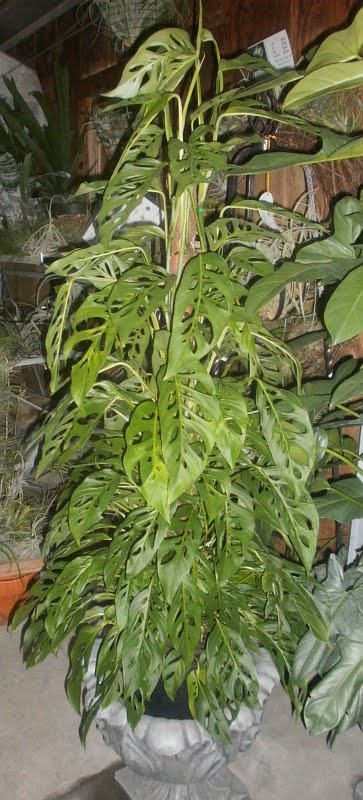
You're not going to think this is exciting at all, but -- I've had this Monstera for four and a half years, and only at the very beginning of its stay here has it ever grown split leaves. I've tried everything I could think of short of putting the plant outside (there's never been a good place to put it), but it's insisted on producing only smallish, unsplit leaves. Until now. Does this mean it's reconsidered, and is going to be making split leaves for a while? I wouldn't bet on it. But we're getting somewhere.


Finally, I'd started some Pedilanthus from cuttings about a year and a half ago, not long after we moved. By now, they're a respectable size, though some of them have been growing horizontally instead of vertically. (This seems to be on purpose, since they're well-rooted and get plenty of light. I have no idea what they're thinking.) This particular plant caught my eye when I was watering because, in the couple weeks since the previous watering, one of its branches has decided to revert to solid green.

The variegated variety is prettier, but I'm going to encourage and propagate this if I can anyway. I don't have a solid-green Pedilanthus yet.


Friday, December 3, 2010

The Quad City Botanical Center, Part 1 of However Many

As I mentioned a while ago, there's a Botanical Center in the Quad Cities, the "Quad City Botanical Center." (Whimsical!) Somehow I'd never heard of it before the husband told me about it this past summer. And I know you would expect me to be bouncing off the walls until we were able to visit, but I actually forgot about it for several months, and only remembered I knew about the place when the husband raised the subject a couple weeks ago.

Botanical gardens are strange mixes of things I like and things I don't. On the one hand: plants. Plants are good. But then there's the part where you don't get to take home the ones you like. Even if you offer to pay for them. It took an enormous amount of focus and self-control, for example, not to leave the QCBC with a couple of Begonia leaves. Also, I'm fairly convinced that I will die, or at least become gravely ill, if I do not very soon get a variegated Callisia fragrans like the ones they have there.

Variegated Callisia fragrans.

Botanical centers are also weird places for me because I have so many plants, and have seen so many others, that my perspective is very warped about what counts as a cool plant. A gigantic, healthy Monstera deliciosa like this one --

Monstera deliciosa, split-leaf philodendron.

leaves me kind of cold. You know, big whoop, I have three of those at home. (Not as big or as nice. Not by a long shot. But a plant I'm very familiar with, even so.) I'm not saying this is desirable. It's just, you know, over time, it takes weirder and rarer things to get me excited.

So I don't know whether my opinion on the place can, or even ought to, matter to anybody, but having said that, I was pleasantly surprised by the QCBC. Part of the good thing about botanical centers, as opposed to retail, is that retail is fairly homogenized. No matter where you go, you find more or less the same set of plants over and over, and ordering is constrained by what's available and what will sell (jade plants, peace lilies, Dracaena marginata, pothos, lucky bamboo) than what the person doing the ordering finds interesting. On the other hand, botanical gardens, like home gardens, can cater a little more specifically to an individual's tastes and whims, which I suggest is a Good Thing, even if you aren't the individual being catered to.

So my guess is that someone at the QCBC has a special fondness for shrimp plants (Pachystachys, Justicia), plants in the Maranta family (Calathea, Ctenanthe), and . . . well, I'm not sure what you'd call the third category. We'll get to it.

I saw at least three shrimp plants, but only two were identified.

Pachystachys lutea, lollipop plant.

I was familiar with P. lutea from the garden center where I used to work. We never had any that were that big, though, and I was never that impressed with them. I get the appeal more now.

The second shrimp plant was one I hadn't heard of before.

Pachystachys coccinea.

Pachystachys coccinea inflorescence, close-up.


It might impress you more if it had been blooming as heavily as the P. lutea, but you get the idea from the close-up, I'm sure.

The picture of the third shrimp didn't turn out well; I was having to fight screwy afternoon light, shaky hands, and a lens that kept trying to fog up. So maybe next time on that one.

The Marantaceae plants were mostly Calatheas, with just one Ctenanthe I remember --

Ctenanthe lubbersiana.

-- but they made up for it by including two Calatheas I'd never seen or heard of. The QCBC gets big, big points for C. majestica:

Calathea majestica.


though they lose some points for making me look up the ID. (ID signs were sort of inconsistently placed, and often covered by the plants they were supposed to identify, which I suppose is the sort of problem botanical-garden-type places would have a lot.) There was also a large, sort of plain NOID, which didn't photograph well:

Calathea NOID.

And another one I had to look up, which I think is Calathea 'Wilson['s?] Princep.'

Calathea 'Wilson['s?] Princep.'

Unfortunately, there weren't any very large specimens of 'Wilson Princep,' and the ones that did exist were in weird, hard-to-photograph locations underneath lots of other plants, so I'll have to try again on this photo, maybe.

The final group of plants I want to cover for this post are all commercial plants, things I mainly knew from ingredient lists. The QCBC had several of them. They weren't nearly as pretty as the shrimps and the Calatheas, but I at least have mental images for some of these plants that I didn't have before.

First up, annatto (Bixa orellana). I realized while there that I knew the word, but had no idea what annatto actually is, or is used for. (Probably you know already, but if you're like I was: it's both a spice and a yellow to orange food coloring, particularly common in cheese, says Wikipedia.) The plant itself wasn't terribly impressive, though with a lot of these plants, I have no idea whether the specimen at the QCBC was particularly large or healthy.

Bixa orellana, annatto.

They also had vanilla (Vanilla planifolia), coffee (Coffea arabica), and sapodilla (Manilara zapota, which used to produce the base for chewing gum: gum is now, wikiposedly, mostly produced from artificial polymers), which I didn't take pictures of: I have a Coffea, the Vanilla wasn't that impressive and anyway I've seen them before, and for some reason it didn't occur to me to take a picture of the Manilara, though I remember thinking about it. Supposedly they had allspice (Pimenta dioica), cardamom (Elettaria cardamomum) and bay (Laurus nobilis) too, though I don't remember seeing any of them.

I did get a picture of cacao (chocolate; Theobroma cacao), though I was a little let down; I expected more:

Theobroma cacao, cacao (chocolate) tree.

And the papaya (Carica papaya) was respectable, I guess. Only one I've ever seen in person, anyway.

Carica papaya, papaya.

Finally, they had a couple smallish ylang-ylang (Cananga odorata) plants. Fairly nondescript,

Canana odorata, ylang-ylang.

though there was one flower. (I think it may have dropped off the stem already, and just happened to catch in part of the plant, but if it was a dead flower, it still looked pretty. I couldn't detect a smell, which supports the dead-flower theory.)

Cananga odorata flower.

In the next couple posts, I'll take a look at the really big plants they had, some oddities which pleased me, and a few really impressive specimens of plants I already knew about. I'm tentatively planning Part 2 for 7 December, though that depends on me being able to write and sort pictures and etc. a bit more quickly than usual, so try not to be too disappointed with me if I make you wait a few days longer than that.