This last post (Part 1; Part 2) on the Quad City Botanical Center (QCBC) doesn't really have a lot of organization to it, unlike the other two. I'm just trying to cover the plants I think you'd want to know about that I hadn't already covered, basically.
The plant I found most interesting was one I hadn't heard of before:
Dichorisandra thyrsiflora is in the Commelinaceae, the family of such easy indoor plants as Tradescantia pallida and Callisia fragrans, and yet I'd never heard of it. That's probably because it's a little big for a houseplant:
and there could be cultural issues I'm not aware of besides. I mean, I would be surprised if it were particularly hard to grow indoors -- I can't think of anything else in the Commelinaceae that is -- but maybe.
Glasshouse Works does sell them, and claims they're easy to grow. Perhaps someday I'll try. The flowers are pretty impressive:
The camera continues to have difficulty reproducing certain blues: the flowers are more of a rich, dark blue-violet than the medium blue they show as in the photo.
I also saw a plant at the QCBC that I'd previously only encountered in a specialty website that sold plants for terrariums (I no longer remember which one):
I initially thought it was yet another Calathea, but a nearby sign identified it as Kaempferia pulchra, which is in the ginger family (Zingiberaceae). I've never seen anyone growing it as a houseplant, so I can only assume that it's exceptionally demanding. Or maybe it's exceptionally slow to propagate, making it not worth the effort. Something: there must be something wrong with it. But, hey, pretty.
I was also impressed with the "red tower ginger," Costus barbatus, though it looked like the blooming was over a while ago:
Still, though, it was a nice big plant, which is impressive enough all on its own.
The QCBC is very, very light on succulents, unfortunately. The only plant that was new to me was Euphorbia viguieri, which looks sort of like someone threw E. milii (thorns, flowers) and E. leuconeura (tuft of leaves at the top, longish, spoon-shaped leaves, narrow base that gets wider with height) together in a blender and split the difference between the two. It's not a very good picture, but that's okay, because it's not a very pretty plant:
Glasshouse Works sells those too.
There's one NOID that I'm particularly interested in: it was near the Carica papaya, and resembles it, but the leaflets are a lot narrower and more completely divided.
It's not impossible that it's just a Carica at a different stage of development, but I couldn't find any Carica leaves that looked like this in a Google image search. I also considered Schefflera, but couldn't find any of those that were particularly pointy except S. elegantissima (still better known as Dizygotheca elegantisisma), and these leaves should be much darker in color than S. elegantissima. (Cannabis sp. would be a possibility too, if not for the fact that, you know, it's not legal. Also I don't think Cannabis has leaflet margins that are that fancy.)
I know, it's one of those cases where looking more intently for an ID sign at the QCBC might have saved me a lot of trouble. But still. Any ideas?
UPDATE: Grower Jim identifies it in the comments as Jatropha multifida.
And while I'm asking: I'm pretty sure I've seen a bromeliad inflorescence like this recently on another blog (Garden Adventures? The Rainforest Garden?), but when I tried to find it again, I couldn't. I didn't remember seeing anything like it before, when I saw it at the QCBC, so wherever I saw it must have been fairly recent. The plant itself didn't look like anything special: I would have thought it a Guzmania if I'd seen it without flowers.
UPDATE: Both Grower Jim and Rainforest Gardener agree that it's probably an Aechmea, even without seeing one another's comments.
Finally, a NOID orchid in bloom. The QCBC didn't have very many orchids at all, and this was the only one I saw that was blooming, but the color impressed me.
I'm leaving a lot of photos unposted, of course, but they may show up at some point later on. Or I might go back later and take new, better pictures. I think you get the general idea of the place regardless. Considering that it's only an hour away and I'm in a small rural Iowa town, I think it's a remarkable place.
Even if they won't let you buy the plants.
Sunday, December 12, 2010
The Quad City Botanical Center, Part 3 of What Turns Out to be 3

Tuesday, December 7, 2010
The Quad City Botanical Center, Part 2 of However Many
This is the second post about our visit to the Quad City Botanical Center (henceforth QCBC) a few weeks ago. (Part 1) 
The tropical plants area of the QCBC is divided up in a way that makes it feel relatively small, but the pamphlet the husband picked up says it's 6444 square feet (599 square meters), and 70 feet (21.3 m) tall at its tallest point. So there's room, and somehow they've managed to get some very big plants in there, even though their website says they've only been around since 1998. (Presumably some of the plants were of pretty good size before they were planted.)
My favorite, naturally, was the Pandanus utilis.

I tried to take a picture that would show the spiral arrangement of leaves, to explain the common name "screw pine," but the sun was behind the plant, and there was only so much I could do. This was the best one I got:

Seeing this one at the QCBC made me even more determined to get a Pandanus utilis of my own someday, though. Not that I needed the push.
Odds are that more visitors are impressed by the coconut palm, Cocos nucifera, than the Pandanus. It was certainly much taller, if nothing else:

And it did, I admit, educate me a little as to how the coconuts are attached to the plant: I always thought they were held closer to the foliage than that. (You may have to open the picture in a separate window to see the coconuts.)
Not all the big, impressive plants were unfamiliar: the QCBC also has the largest Murraya paniculata I've ever seen. I can't imagine how overpowering the smell, when it's in full bloom. The people who clean the room must hate this plant. (My own makes a mess of the husband's office on a regular basis, and it's a tiny fraction of the size of this one.)

They also had a big, healthy Philodendron erubescens that was trying very hard to pull down the building:

I suspect there is a law that all botanical-garden-type places have to have at least one gigantic Alocasia or Colocasia somewhere.

I was surprised to find a Duranta at all (it's not a plant I think about a lot, or expect to see anywhere), but finding a really big, chartreuse one was a pleasant surprise:

No flowers on the Duranta, which is too bad. I want to smell one again sometime and see whether I still think it smells like cookies.
There were pothos plants climbing, literally, the walls (you can see some of them in the background of the pictures from Part 1), but this particular one got to the ceiling by climbing a support column.

I also saw a Syngonium podophyllum with mature leaves at the QCBC. I'd seen this before, but it'd been a long time:


The plant that most impressed me, though, of all the plants there, was their Caryota mitis (fishtail palm), which was not only enormous --

-- it was also flowering. Rather a lot.

The flowers aren't pretty, but apparently they don't have to be in order to work.
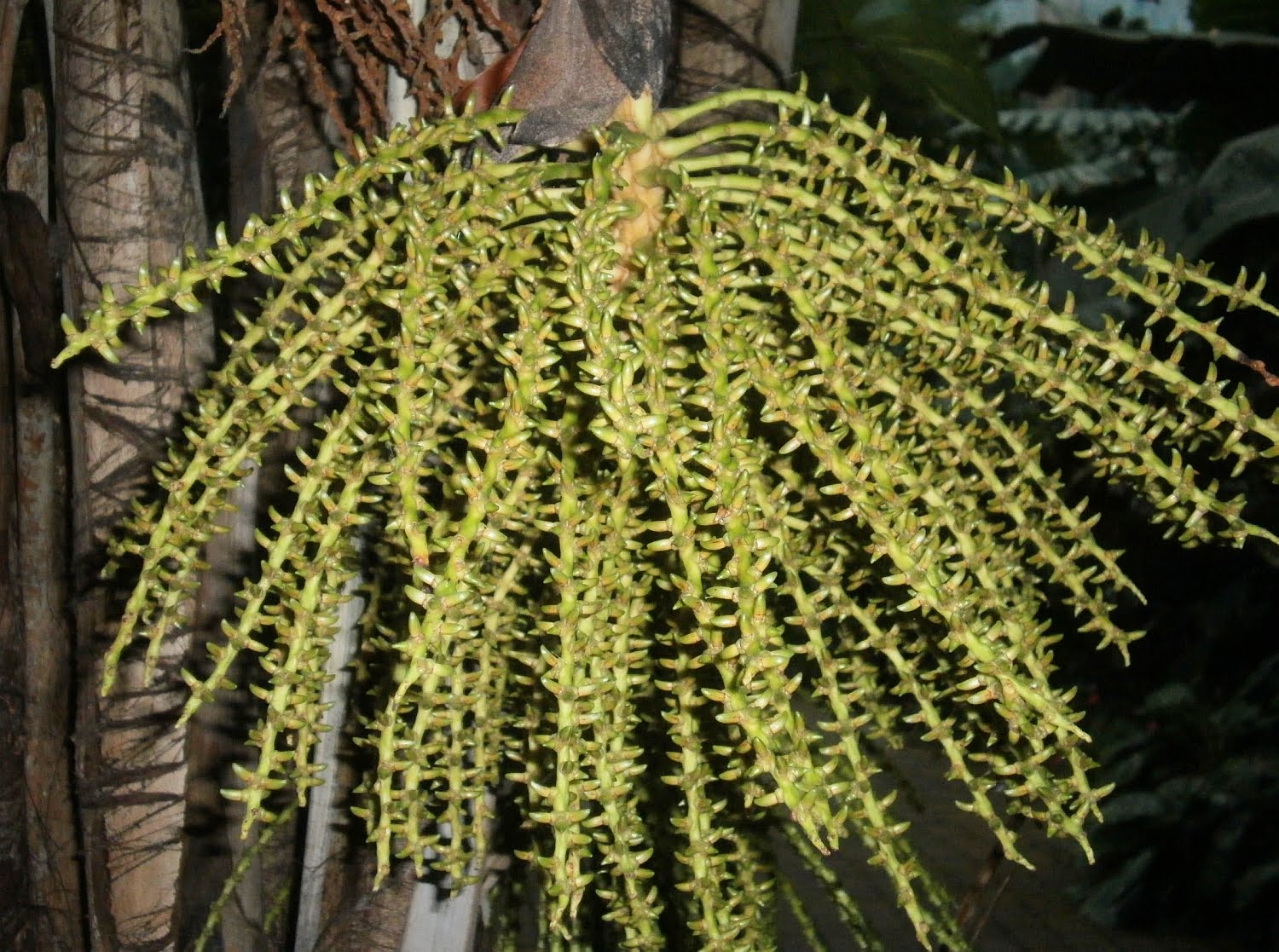
And this very new flower below looked like an octopus to me, which makes me like the species way, way more. I've never had good luck with C. mitis indoors (in my experience, it's hard to find one that's not buggy), but if they can grow octopi/-puses/-pods, then I think I need to rethink my position.

They also had a few other very large plants that I'm leaving out of the post because they didn't photograph well, including a Chorisa speciosa (silk floss tree) that nearly touched the ceiling and was dropping pink flowers on everything underneath it. I'd heard the name before, but it wasn't a plant I was familiar with at all. In person, it was maybe a little too huge and a little too far away for me to relate to, but still. Always nice to meet new folks.
There were also quite a few gigantic banana plants (Musa sp.), and a very large but badly lit Breynia disticha (snowbush, also sometimes Breynia nivosa). Maybe I'll get pictures of those the next time we go.
Friday, December 3, 2010
The Quad City Botanical Center, Part 1 of However Many
As I mentioned a while ago, there's a Botanical Center in the Quad Cities, the "Quad City Botanical Center." (Whimsical!) Somehow I'd never heard of it before the husband told me about it this past summer. And I know you would expect me to be bouncing off the walls until we were able to visit, but I actually forgot about it for several months, and only remembered I knew about the place when the husband raised the subject a couple weeks ago.
Botanical gardens are strange mixes of things I like and things I don't. On the one hand: plants. Plants are good. But then there's the part where you don't get to take home the ones you like. Even if you offer to pay for them. It took an enormous amount of focus and self-control, for example, not to leave the QCBC with a couple of Begonia leaves. Also, I'm fairly convinced that I will die, or at least become gravely ill, if I do not very soon get a variegated Callisia fragrans like the ones they have there.
Botanical centers are also weird places for me because I have so many plants, and have seen so many others, that my perspective is very warped about what counts as a cool plant. A gigantic, healthy Monstera deliciosa like this one --

leaves me kind of cold. You know, big whoop, I have three of those at home. (Not as big or as nice. Not by a long shot. But a plant I'm very familiar with, even so.) I'm not saying this is desirable. It's just, you know, over time, it takes weirder and rarer things to get me excited.
So I don't know whether my opinion on the place can, or even ought to, matter to anybody, but having said that, I was pleasantly surprised by the QCBC. Part of the good thing about botanical centers, as opposed to retail, is that retail is fairly homogenized. No matter where you go, you find more or less the same set of plants over and over, and ordering is constrained by what's available and what will sell (jade plants, peace lilies, Dracaena marginata, pothos, lucky bamboo) than what the person doing the ordering finds interesting. On the other hand, botanical gardens, like home gardens, can cater a little more specifically to an individual's tastes and whims, which I suggest is a Good Thing, even if you aren't the individual being catered to.
So my guess is that someone at the QCBC has a special fondness for shrimp plants (Pachystachys, Justicia), plants in the Maranta family (Calathea, Ctenanthe), and . . . well, I'm not sure what you'd call the third category. We'll get to it.
I saw at least three shrimp plants, but only two were identified.

I was familiar with P. lutea from the garden center where I used to work. We never had any that were that big, though, and I was never that impressed with them. I get the appeal more now.
The second shrimp plant was one I hadn't heard of before.


It might impress you more if it had been blooming as heavily as the P. lutea, but you get the idea from the close-up, I'm sure.
The picture of the third shrimp didn't turn out well; I was having to fight screwy afternoon light, shaky hands, and a lens that kept trying to fog up. So maybe next time on that one.
The Marantaceae plants were mostly Calatheas, with just one Ctenanthe I remember --

-- but they made up for it by including two Calatheas I'd never seen or heard of. The QCBC gets big, big points for C. majestica:


though they lose some points for making me look up the ID. (ID signs were sort of inconsistently placed, and often covered by the plants they were supposed to identify, which I suppose is the sort of problem botanical-garden-type places would have a lot.) There was also a large, sort of plain NOID, which didn't photograph well:

And another one I had to look up, which I think is Calathea 'Wilson['s?] Princep.'

Unfortunately, there weren't any very large specimens of 'Wilson Princep,' and the ones that did exist were in weird, hard-to-photograph locations underneath lots of other plants, so I'll have to try again on this photo, maybe.
The final group of plants I want to cover for this post are all commercial plants, things I mainly knew from ingredient lists. The QCBC had several of them. They weren't nearly as pretty as the shrimps and the Calatheas, but I at least have mental images for some of these plants that I didn't have before.
First up, annatto (Bixa orellana). I realized while there that I knew the word, but had no idea what annatto actually is, or is used for. (Probably you know already, but if you're like I was: it's both a spice and a yellow to orange food coloring, particularly common in cheese, says Wikipedia.) The plant itself wasn't terribly impressive, though with a lot of these plants, I have no idea whether the specimen at the QCBC was particularly large or healthy.

They also had vanilla (Vanilla planifolia), coffee (Coffea arabica), and sapodilla (Manilara zapota, which used to produce the base for chewing gum: gum is now, wikiposedly, mostly produced from artificial polymers), which I didn't take pictures of: I have a Coffea, the Vanilla wasn't that impressive and anyway I've seen them before, and for some reason it didn't occur to me to take a picture of the Manilara, though I remember thinking about it. Supposedly they had allspice (Pimenta dioica), cardamom (Elettaria cardamomum) and bay (Laurus nobilis) too, though I don't remember seeing any of them.
I did get a picture of cacao (chocolate; Theobroma cacao), though I was a little let down; I expected more:

And the papaya (Carica papaya) was respectable, I guess. Only one I've ever seen in person, anyway.

Finally, they had a couple smallish ylang-ylang (Cananga odorata) plants. Fairly nondescript,

though there was one flower. (I think it may have dropped off the stem already, and just happened to catch in part of the plant, but if it was a dead flower, it still looked pretty. I couldn't detect a smell, which supports the dead-flower theory.)

In the next couple posts, I'll take a look at the really big plants they had, some oddities which pleased me, and a few really impressive specimens of plants I already knew about. I'm tentatively planning Part 2 for 7 December, though that depends on me being able to write and sort pictures and etc. a bit more quickly than usual, so try not to be too disappointed with me if I make you wait a few days longer than that.


 Posts
Posts