The explanation and background for this post can be found here, at part 1. (Part 3) (Part 4) (Part 5)
What other never-available plants do houseplant books try to get me excited about?

I know Camellia cvv. (camellia) are still out there, because I see them pretty regularly on the blogs of outdoor gardeners from the southern U.S. Less clear is whether they're growable indoors. The books say yes, but I've never seen them sold as such, and they're popular enough outdoor plants that I'd think there'd be an indoor market for them if it was at all possible.
Why would the books tease us like this? As commenters suggested in Part 1, it probably has to do with changes in new home construction: less drafty, no unheated sunporches, that sort of thing. There could be other, Camellia-specific things going on as well, but I'd bet that warmer, more energy-efficient homes explain a lot.

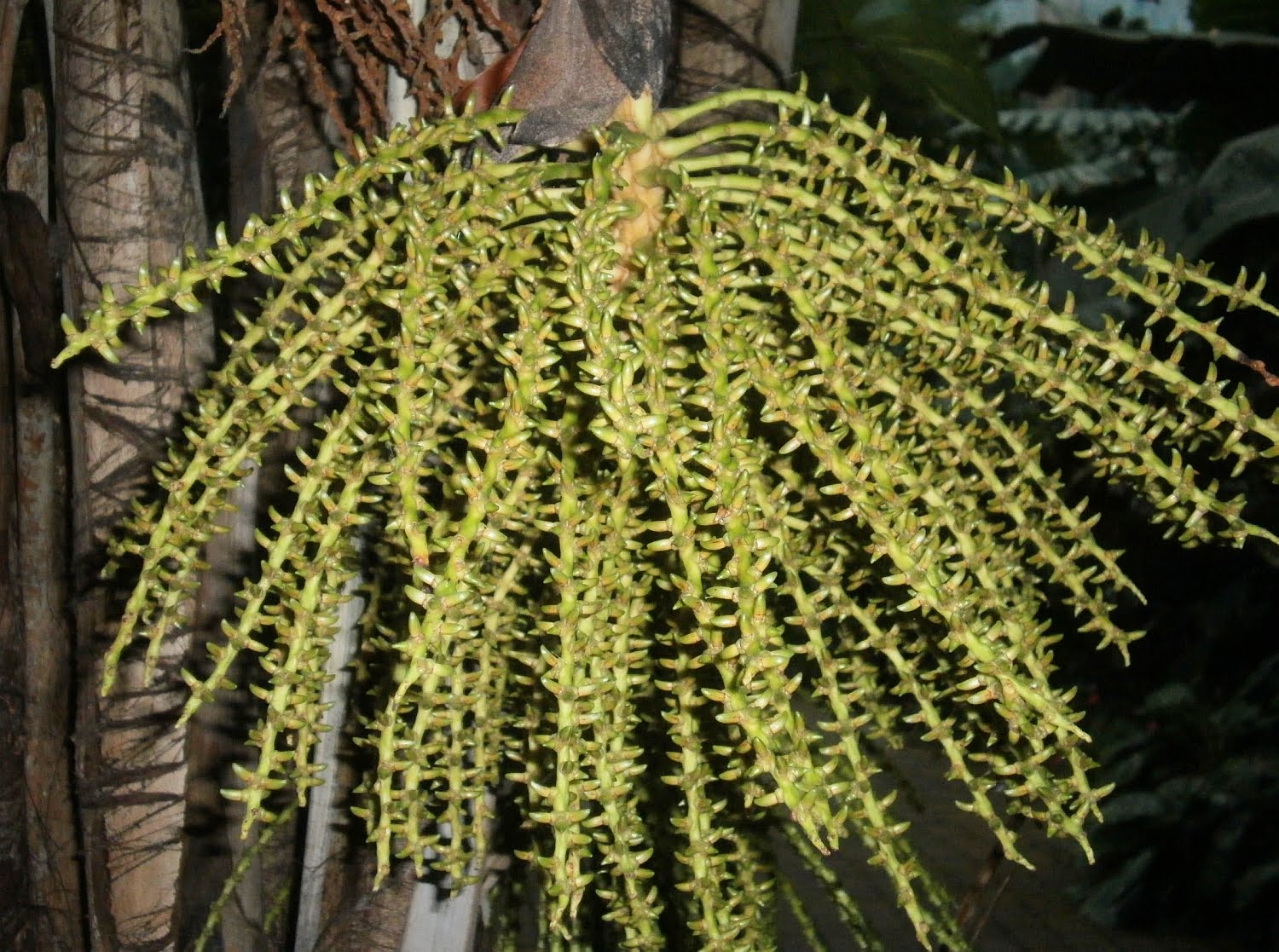
There are several things about Caryota mitis (fishtail palm) that don't work so great indoors. They can get to be enormous,1 they tend to be buggy (my first attempt ended abruptly due to scale; they're also appealing to spider mites), they're expensive when you do see one for sale,2 and they need a lot of water.
However, I don't think any of those things are the reason why I don't see them for sale that often: I think the reason is that people don't like the ragged tips on the leaflets. I mean, that is how Caryotas are naturally supposed to be, but I bet people assume something is wrong with the plant and move on.

I've never seen Cissus antarctica (kangaroo vine) in person, either for sale or in someone's home. Wikipedia provides a clue as to why: "It doesn't do well above 15°C, especially when exposed to central heating, which can cause the leaves to drop." It's not too hard to draw a line from warmer homes, to people having a tougher time growing them, to people buying fewer of them, to growers producing fewer of them, as with Camellia.
It's also probably relevant that C. antarctica isn't a particularly flashy plant. No variegation, no brightly-colored flowers, no fruit, not even a particularly interesting leaf shape (though I like it personally) or manageable growth habit.

Cobaea scandens (cup and saucer vine, cathedral bells) actually does have flashy flowers, and it's even weedy in New Zealand (according to Wikipedia), both things that ought to make it suitable for indoor cultivation. Also it is deliberately cultivated as an outdoor plant, so seeds are available. I mean, it's not like it's some super-rare thing that's only found in a seed bank in a single botanical garden somewhere. And yet, I'd never heard of until I bought the Kramer book a few weeks ago. Some of this, I'm sure, is just my natural adorable obliviousness asserting itself, but even so, it seems like a plant this unusual should be inescapable if it can be grown indoors at all.
A few of the comments at Davesgarden.com refer specifically to growing Cobaea as a houseplant. Some of the other comments mention it getting 20 feet (6.1 m) long outdoors, and being inclined to pull down large objects, so maybe that's the explanation? Another complaint is that there's a lot of foliage for not very many flowers, and that the flowers don't actually smell that great. All of which I will accept as an explanation until I find a better one.

I've never seen a Costus spp. (spiral ginger) for sale, though I always thought they looked interesting in pictures. Having seen some in person (at the Quad Cities Botanical Center), I'm less interested: I'd never realized how big they could get.3
I assume the size is the main problem, though finding out that they're related to gingers doesn't make me want a Costus much either.4 If they get burnt leaf tips even inside the humid, warm dome of the QCBC, there must be something touchy about them.

I have no actual memories of seeing Cyperus alternifolius (umbrella plant, umbrella palm, umbrella papyrus, umbrella grass, umbrella-ella-ella-eh-eh-eh) for sale anywhere, but at the same time, I'm pretty sure I've personally seen someone growing one indoors (about 15 years ago, granted), so they must be available somewhere. My impression is that they need a ton of water and are really prone to spider mites; if anyone can confirm or refute that, I encourage you to do so.

Eriobotrya japonica (loquat) leaves have a pleasant fuzzy texture, the plants grow slowly enough that they're not going to outgrow your windowsill immediately, and they're about average difficuly indoors. (I've had one for a couple years, due to the generosity of a PATSP reader, and aside from a brief and easily-corrected spell of spider mites, it's been fine.) So why are they not in stores? Couldn't tell you.
In theory, it's possible to get your own for free or mostly free, by buying a loquat and planting the seeds, so maybe there's no demand. (I don't actually see loquats for sale that often, but I don't spend a lot of time searching for them either. I'm sure I could find one if it were really important that I do so.) Or maybe they have some horrible characteristic that I haven't run into yet with my own plant.

Eucomis cvv. (pineapple lily) is certainly visually striking, and I know they're sold in containers somewhere, for indoor cultivation, because I've seen people asking about them on the UBC indoor plant forum. I suspect they probably need more light than I could provide, but that wouldn't apply to everybody around here, so there must be some other reason.

Fatsia japonica (Japanese aralia) isn't entirely unknown in Iowa -- the ex-job had them once before I started working there, and I've seen them at least a couple different times at Wallace's, in the Quad Cities. (The photo above was taken in Wallace's.) And I could be forgetting some occasions. But they're a lot rarer than the books would make you think. My own experience with them has been uniformly pretty negative: the one I had in 2009 lasted about six weeks before I found mealybugs on it and threw it away, and when I've looked at them since, I've generally found spider mites. Like with Camellia, Cissus antarctica, etc., I'm wondering if forced-air heating isn't in the process of driving them out of the houseplant trade.

I am completely unable to explain why I've never seen Geogenanthus poeppigii (seersucker plant, formerly G. undatus). Not even in a botanical garden. They were once widespread enough that all the books mentioned them, and they look neat enough that they would surely sell if offered. Hell, Geogenanthus is even in the Commelinaceae,5 so there's reason to think they could be produced in commercial quantities without a lot of effort. Also the sunporch theory wouldn't seem to apply; it's my understanding that Geogenanthus likes it warm.
Most sources that talk about G. poeppigii mention that it needs high humidity, so it's possible that it just doesn't do well enough for long enough in a store to be worth bringing in. But stores regularly carry any number of other plants that need high humidity and go downhill quickly without it: Calatheas, Selaginella, rex begonias, etc. Why is Geogenanthus special?
Again, this topic doesn't really lend itself to recommendations, though I can say Eriobotrya is fine indoors. The one I'd most like to try is Geogenanthus, even though I doubt it would do well for me.
Not pictured:
- Bougainvillea cvv. (bougainvillea): uncommon, but I see them occasionally in the independent garden centers.
- Bromelia spp./cvv. (bromeliad; no common name): never seen.
- Callistemon citrinus (syn. C. lanceolatus; crimson bottlebrush): I may have seen them occasionally as faux-bonsai; I'm not sure.6 Never a full-size plant.
- Campanula isophylla (Italian bellflower, star of Bethlehem): have never seen.
- Carissa macrocarpa (natal plum): have never seen.
- Catharanthus roseus (Madagascar periwinkle): routinely sold as an outdoor annual here, but I don't know anybody who's tried to keep one going indoors, nor would I ever attempt to do so myself, after seeing how much spider mites like them.
- Catopsis spp./cvv. (bromeliad; no common name): never seen.
- Chamaerops humilis / Livistonia spp. (European fan palm, Mediterranean fan palm; Chinese fan palm): rarely seen.
- Chirita / Primulina (chirita, primulina): have never seen. My personal plant died of unknown causes.
- Clerodendrum ugandense (blue butterfly bush, blue glory bower): once or twice at the ex-job.
- Crinodonna corsii (crinodonna, hybrid naked lady): have never seen?
- Crinum spp./cvv. (crinum lily): never seen, though I do know more than one person who's tried growing them indoors.
- Daphne odora (winter daphne): never seen.
- Dyckia spp./cvv. (dyckia): never seen in retail in Iowa. My first died more or less immediately; a second one is luckier so far.
- Eranthemum nervosum (blue sage): never seen, though I'm not sure I'd recognize it if I did.
- Euonymous spp./cvv. (spindle, spindle tree, euonymous): probably as an outdoor plant, but I don't shop for outdoor plants so I wouldn't know. I've never seen one sold as a houseplant, despite the books' collective insistence that this happens all the time.
- Faucaria spp. (tiger jaws): seen very occasionally.
- Ficus deltoidea (mistletoe fig, syn. F. diversifolia): rarely, if ever.7
- Freesia cvv. (freesia): very rarely, and so far only at the ex-job.
- Fuchsia cvv. (fuchsia): seasonally as an outdoor annual; I've never seen them sold as houseplants.
- Gelsemium sempervirens (Carolina jessamine, evening trumpetflower, woodbine): also never seen, but I don't know that I could recognize an unlabeled plant.
-
1 There are some pictures of a full-sized Caryota at this post, if you're interested.
2 (which has only happened to me a couple times in Eastern Iowa, both of them quite a while ago)
3 Sure, I know they probably don't all get as big as the one in the photo. But even the smallish plants in some of the Wikimedia Commons pictures are big enough that they're never going to be desktop or windowsill plants.
4 Costus is in the family Costaceae, while Alpinia, Kaempferia, and Zingiber are in the Zingiberaceae. Both the Costaceae and Zingiberaceae are in the same order, the Zingiberales.
I've tried growing Alpinia zerumbet and Zingiber malaysianum, and they did okay, but they clearly weren't that happy. One of the Alpinias got scale, which isn't its fault; the other Alpinia rotted out, which arguably is its fault; the Zingiber is still with us, though it died back dramatically one or two winters ago and has literally never been the same since. So the Zingiberaceae isn't a family I'm looking to explore right now.
5 Same family as Tradescantia pallida, Tradescantia spathacea, Tradescantia zebrina, Callisia fragrans, and Cyanotis kewensis. Of the group, only Cyanotis kewensis is at all difficult to grow or propagate, and it's not really that hard.
6 All the different species of faux-bonsai look pretty much the same to me, because they're all usually about 3/4 dead.
7 (There are a couple Ficuses I never completely identified from the ex-job, so it's possible this was one of them. I'm fairly certain I've not seen any for sale locally in the last three years.)
2 (which has only happened to me a couple times in Eastern Iowa, both of them quite a while ago)
3 Sure, I know they probably don't all get as big as the one in the photo. But even the smallish plants in some of the Wikimedia Commons pictures are big enough that they're never going to be desktop or windowsill plants.
4 Costus is in the family Costaceae, while Alpinia, Kaempferia, and Zingiber are in the Zingiberaceae. Both the Costaceae and Zingiberaceae are in the same order, the Zingiberales.
I've tried growing Alpinia zerumbet and Zingiber malaysianum, and they did okay, but they clearly weren't that happy. One of the Alpinias got scale, which isn't its fault; the other Alpinia rotted out, which arguably is its fault; the Zingiber is still with us, though it died back dramatically one or two winters ago and has literally never been the same since. So the Zingiberaceae isn't a family I'm looking to explore right now.
5 Same family as Tradescantia pallida, Tradescantia spathacea, Tradescantia zebrina, Callisia fragrans, and Cyanotis kewensis. Of the group, only Cyanotis kewensis is at all difficult to grow or propagate, and it's not really that hard.
6 All the different species of faux-bonsai look pretty much the same to me, because they're all usually about 3/4 dead.
7 (There are a couple Ficuses I never completely identified from the ex-job, so it's possible this was one of them. I'm fairly certain I've not seen any for sale locally in the last three years.)




 Posts
Posts