Friday, January 31, 2014

An Uncharacteristically Upbeat Post

Fungus

Anybody remember that Euphorbia fungus I've been having trouble with since forever? The one that makes the fuzzy white patches on Euphorbia, Pedilanthus, and Synadenium but not on anything else, and that doesn't go away after being sprayed with rubbing alcohol, peroxide, copper sulfate, or chlorothalonil? This stuff?


I think I may have figured out how to get rid of it. The secret might be strong sprays of tap water. Damaged leaves stay damaged, of course, but they don't grow new patches of fungus. I hadn't tried this previously, because usually the equation is fungus + water = more fungus. In fact, I'd been taking extra care not to get water on the affected plants. The only reason I ever tried spraying the plants with water was because I'd gotten so discouraged that I gave up on ever stopping it, so I figured I may as well make it worse so I could justify throwing the plants out.

Rain doesn't work, though: the fungus got worse on the plants that were outside last summer. Must be the chlorine?

The only plants that washing doesn't seem to be adequate for are the Pedilanthuses. Of the three I still have (P. tithymaloides, P. 'Silver Star,' and P. 'Jurassic Park 2'), 'Jurassic Park 2' seems to be cured, 'Silver Star' might or might not be -- it's hard to tell, because there was a lot of leaf damage, and the leaf damage is the same color as the fungus itself -- and P. tithymaloides is still having problems.


Hippeastrum

The Hippeastrum seedling I got three years ago from Kenneth Moore is 1) going to bloom, and 2) offsetting. I'm not sure I even knew that Hippeastrums made offsets before this; I never paid that much attention to the genus because I never thought I was going to have one.


The flower won't be anything terribly exotic; it's either 'Red Lion' x self or 'Red Lion' x 'Apple Blossom.' But it'll still be my first, which is special enough. And amaryllis blooms are pretty, even when they're ordinary.


Clivia

The rumors about Clivia are true. I'd started to think all the talk about Clivia offsets was some kind of elaborate prank aimed at me, to make me feel bad because mine weren't making any. But behold! (And it only took five and a half years!)


So this is a thing that can happen as well.


Araucaria

But the fun doesn't stop there! I also have an Araucaria seedling! (It's less blurry in person.)


Is it an interesting Araucaria seedling? Well no, not yet. But someday. The story is, I bought three seeds of A. bidwillii from seedman.com last September.1


I started them on 17 September 2013. I got a clear plastic jar (formerly a Costco bulk pretzel container), put in about 2 or 3 inches of damp soil, then set the seeds on top, then added another inch of soil and sealed the top.

In retrospect, I wish I had used vermiculite, because there's a raging fungus gnat problem in the container now. Washing the seeds first might have been a good idea as well, since I've had bugs come in with previous seedman.com purchases. (Only springtails, but if washing might have prevented that, then washing would have been a good idea.) But in any case. They usually take 1-2 months to germinate, but can take up to 18 months to germinate, I've heard, so this may be a long-term dirt-filled pretzel jar.

And here's a bonus picture of my first Araucaria bidwillii, from last September:


In that photo, it's about six and a half years old, plus however old it was when I bought it.2

The advice I see on-line says I should move the seedling to its own pot as soon as it's large enough to be handled.3 I'm not sure how large that is, but the current plan is to give it its own pot once it starts growing some true leaves: currently it's just a short, bumpy stick. If that sounds wrong to anybody, please leave a comment. For that matter, leave a comment if it sounds right, too.


Coffea

Finally, I've seen the first germination from this year's round of Coffea seedlings:


That took a little less than two months to sprout. For this one, I used soil instead of vermiculite, and I didn't soak it in water for 24 hours after harvest, so I hadn't been sure it would do anything. But it seems the pre-drying soak is optional, and it doesn't matter tremendously what you try to germinate them in. For the moment, it's just this one pot, the six seedlings from last year's batch, and the parent plant (which is doing terribly and I don't know why4) but I started a pretzel container full of vermiculite and seeds5 on January 15, and have two more batches of seeds to sow (95 seeds next week, and 205 seeds in early March), so this is just a harbinger of the coming Coffea stampede.

Bonus picture of the remaining plants from last year's crop:


-

1 $5.95 plus shipping. That was the same order as the Strelitzia junceas (5 seeds for $2.95; previously), and I also got seeds of Calathea lutea (10/$3.95). Both Strelitzia and Calathea are supposed to be irregular germinators, but it may be time to give up on the Calatheas: they take a lot of space that could be going to Anthurium seedlings, and so far none of the ten have done anything. I can be pretty patient when it comes to waiting for plants to do things, so I'm not planning to throw them out immediately, but . . . well, they should start thinking about germinating, if they know what's good for them.
2 There is not a lot of information available about how fast A. bidwillii grows once it's germinated, but based on this picture from Wikimedia Commons, I'm guessing mine was barely more than a year old when I bought it. My earliest photo is from October 2007, ten months after the purchase, when it looked like:


Best guess: the plant is now between 7 1/2 and 8 1/2 years old.
3 For example: " As soon as they are large enough to handle, prick the seedlings out into individual pots. The plants have a rather sparse root system and are best placed in their final positions as soon as possible." (From here.) The part about the roots seems correct, at least:

4 My best guesses: cold (it's in the plant room, on the floor, and the plant room floor has been very chilly, several times, because of the periodic blasts of cold this winter), dry (it dries out a lot faster than it used to, and probably needs a larger pot), and maybe hot, dry air (the only place big enough to put it is also pretty close to the plant room heater). There's a second plant in the pot, maybe half the size of the big one, and it seems to be doing fine, though, so none of the explanations completely make sense.
5 And I do mean full: 149 seeds. The pretzel jars aren't huge -- about 8-10 inches / 20-25 cm in diameter? -- so the seeds are packed in there pretty tightly.


Tuesday, January 28, 2014

Question for the Hive Mind: a new bug

I did not ask for a new bug. And if I had, I would have been asking for a new bug to replace the scale, not a new bug to add to the scale, much like Huey Lewis wanted a new drug to replace the problematic drugs he had previously tried, not because he wanted more variety in his drug use.1 And yet.

The problem is that I don't actually know what new bug I have, nor how to make it go away. So I'm asking y'all for thoughts.

Relevant details:

It seems exclusively interested in Aglaonemas, and only two or three varieties of Aglaonema to boot.2

It looks basically like household dust. In fact, it looks so much like household dust that I've been assuming for quite a while that that's what it was.

The overall orange/red tint to the photo is because of the light source I was using, and is not the actual leaf color.

The dust hypothesis didn't actually make that much sense, because it was only ever on certain specific leaves, and was sometimes accompanied by weird brown-orange discoloration at the leaf margins.

When I tried to find an unaffected leaf for comparison purposes, I noticed that all the leaves seem to be doing this to some degree or another, but I think the picture above gives the general idea. They all eventually wind up looking like the leaf on the left, but are supposed to look more like the leaf on the right.

I don't know why the margins would be discolored, though, as the bugs seem pretty evenly distributed across the whole upper surface of the leaves.

There were also frequently sticky droplets of something or another. The droplets didn't alarm me terribly, because a lot of my Aglaonema varieties produce sticky droplets on the outside of the spathes when they produce flowers, and I first noticed the "dust" as the first affected plant was flowering. I'm still not 100% convinced that the droplets are related to the bugs, actually.

It doesn't seem to be particularly harming the plants, aside from the marginal discoloration, and the margin thing has really only been going on with 'Emerald Bay.'

So why do I think there's even a problem? Because I checked the leaves out with the microscope. As usual, getting decent photos with the microscope is nearly impossible, so forgive the quality, but you can see a couple mite-like things in the center of this photo, a relatively in-focus third one just above and barely to the right of those, and pieces of blurrier ones here and there around the periphery of the photo.


Which, it looks like an arthropod, not an insect: blurry though the picture is, it's pretty clear that they're holding four legs in front of the body, and either one or two pairs behind it. Plus there's that overall tick-/ mite-shape going on.

Obviously there are many, many species of mite, but the only ones I know of that make a habit of attacking houseplants are the two-spotted spider mite and the cyclamen mite, and I don't think these are either of those two species. Under the microscope, spider mites are 1) much larger, 2) yellowish and opaque, instead of translucent white, 3) inclined to stay mostly on the underside of leaves (these mites are almost 100% on the upper leaf surface), 4) detectable by the visible webbing they create, and 5) will move while you're looking at them under the microscope. I've never directly observed cyclamen mites under the microscope, but the pictures that come up in Google are of rounder, smoother creatures with stubbier legs. Cyclamen mites mostly look like white jellybeans, as far as I can tell, which these do not.

It's conceivable that I'm actually seeing the dead skins left after the mites molted.3 That's happened before, with the deep-sea crab/skeleton/spider/ghost things (probably actually aphids) I talk about at the end of this post, and would explain the translucent whiteness and lack of movement. I am also willing to entertain the possibility that my Aglaonemas are being haunted by the ghosts of deceased spider mites, because that likewise explains the translucent whiteness and makes about as much sense as anything else.

Of course I've Googled. There's plenty out there about spider mites and Aglaonemas, but nothing about any other kinds of mite.

So far, I've tried imidacloprid (when I was putting imidacloprid in all the plants), which definitely did not get rid of the infestation, and wiping the leaves with rubbing alcohol and a paper towel, which I did too recently to know about its effectiveness. (My guess: yeah, it'll probably work, but I'm going to have to do it several more times.)

So what about it? Anybody seen anything like this before? Have any suggestions for what I could do to find out what I've got, or how to make them go away? Suggestions for dealing with spider mite ghosts are especially welcome, since Google is as silent on the topic as you'd expect.

-

1 Side note: it's a little peculiar that he's asking for "one that makes me feel like I feel when I'm with you." 'Cause, you know, if you've got that in drug form, then you don't actually need the girl anymore, right? I mean, wouldn't it make more sense to just spend a lot of time with her, since she already exists and makes him feel exactly like he feels when he's with her, rather than asking the world's chemists to go to the trouble of inventing a whole new drug with these super-specific effects? I think about these things. Maybe Huey Lewis should too.
2 Almost all of it has been on 'Emerald Bay,' which is in my office. Also affected: 'Golden Bay,' 'Diamond Bay,' and 'Brilliant,' all of which are in the living room. 'Gold Dust,' which sits right next to 'Emerald Bay,' and has been for quite a while, doesn't seem to have the problem at all, though.
3 If you're into video of spider mites running around and molting -- and who among us isn't? -- check this out:


Sunday, January 26, 2014

Pretty (?) picture: "Cirro. Lion King"

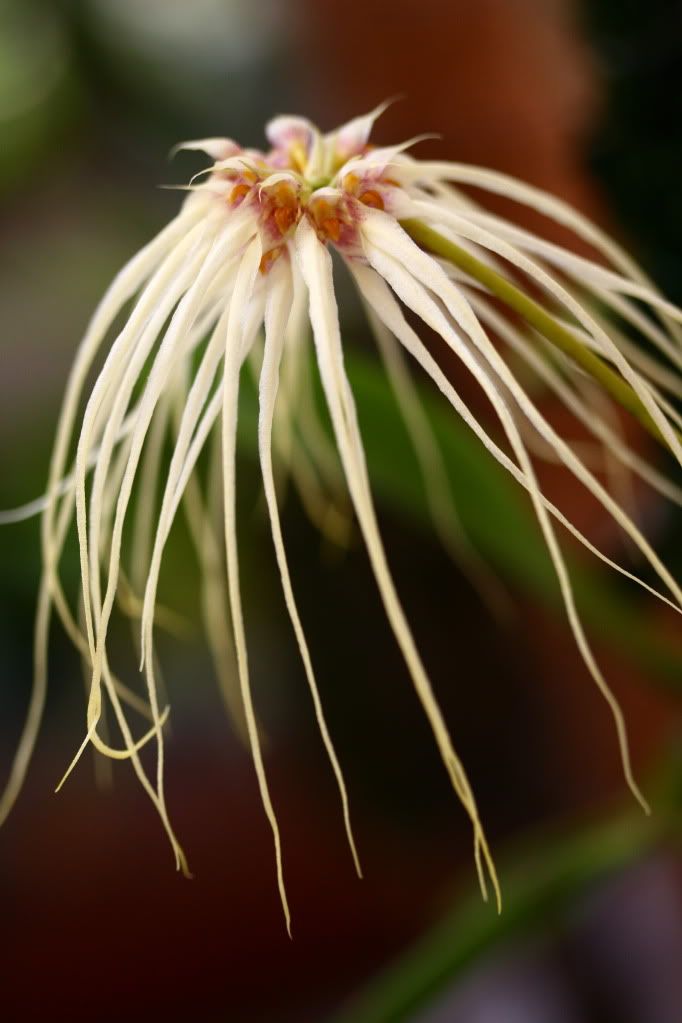
I don't know what this one actually is. "Cirro." doesn't appear to be a standard orchid genus abbreviation, so that's not helpful. There does exist a Cirrhopetalum Lion King, which under normal circumstances you'd think that obviously that's the plant, but that plant's flowers don't look much like this one's flowers. There's also a Bulbophyllum Lion King, which might be the same thing as the Cirrhopetalum Lion King, as the petals are similarly long and weird (picture), the genus Cirrhopetalum was apparently recently separated from Bulbophyllum, and orchid categorization is such a mess that I've come to think of the names as little more than random stabs in the dark anyway.

But the fact still remains that the flowers on this plant are only vaguely like those on Cirrhopetalum Lion King, so even if that's the intended ID, I'm not sure it's right.

But then again, using Google image search to try to make this determination is probably also a mistake, as Google image search is frequently also not much better than random stabs in the dark.

So I dunno. Open to guesses from readers on this one.


Tuesday, January 21, 2014

Pretty picture: Dendrobium Aussie's Chip


Dendrobium Aussie's Chip = Dendrobium aberrans x Dendrobium atroviolaceum


Friday, January 17, 2014

More Anthurium seedling updates

It's been a while since the last Anthurium update, and it's January besides, so let's look at some flowers. (Admittedly, they're going to look a lot like the same two or three flowers, over and over. Only so much I can do about that. And besides, it's January: you can't afford to be too picky.)

The Anthurium Report: since September, there have been confirmed flowers or flower buds on twenty-one different seedlings. Nineteen of those have flowers or buds at the moment, most of which look a lot like 'Gemini,' with pinkish-red spathes and contrasting yellow or white spadices. This is because 'Gemini' and 'White Gemini' (a white-flowering sport of 'Gemini') were the seed parents for 5/6 of the seedlings: they're just more fertile than the other varieties I've got. Even within that uniformity, though, some of the seedlings are managing to distinguish themselves in one way or another.


The Sexiest Man Alive (#276, "Zach Religious")


The standout seedling from the last couple months has been Zach. The spathe was really pale when the bud first formed, leading me to think that maybe he was going to be the first white-blooming seedling from 'White Gemini,' but then the edges turned pinkish, and gradually the whole thing turned light pink. Initially the spadix was yellow --


-- but that, too, has darkened with age, to the point where now the spathe and spadix pretty much match.


Also I think Zach may be pregnant; the spadix is looking a bit lumpy in the latest pictures. That would be nice; he's looking like a pretty decent plant overall. Decent foliage and everything. Though it's maybe a problem that I don't know who donated the pollen, because I've tried to cross-pollinate without writing down what I was doing. Shame on me.


In any case, Zach is a notable seedling that I expect to be spending a lot more time with.


The Pioneer (#059, "Bijoux Tuit")


Bijoux was the first seedling to bloom, and she hasn't stopped cranking out the flowers.


They're still prone to crack at the edges as they age, but now they're waiting for a month or two before they crack, and not cracking as badly, so maybe this is a cultural problem I'll eventually figure out. (I suspect it's drought stress.)


Oh Please Oh Please Oh Please (#035, "Alyssa Edwards")


The specialness doesn't maybe show up as well in the photo as it might, but Alyssa has a really pretty purple-pink bud at the moment. If it darkens a little as it develops, like most of them do, the flower will be fantastic. If not, we'll have to settle for merely pretty.


Damn It, Bob. You Had ONE Job. (#076, "Bob Humbug")


Bob has aborted yet another bud. I've lost track of how many times this has happened now, but it's at least four since September. There's another bud developing, as you can see, but the remains of the last bud to abort is in that picture too (down and to the right of the current bud, between the stem of the main plant and the sucker). Lovely though Bob's foliage is, I've pretty much given up on him producing any flowers. It's a toss-up whether Bob has the most appropriate name, or merely the second-most appropriate name (after Bijoux Tuit).


. . . But What I Really Want to do is Direct (#002, "Alexis Mateo")


Alexis has yet to make a flower bud, but what she does have is this striking new foliage. Several of the seedlings produce new leaves that are reddish, or red-brown, but Alexis is unusual in that the leaves have a deeper color, are larger at maturity, and seem less prone to cracking or distorting during development.

I don't have a good handle on exactly how many of the Anthurium seedlings have red-brown new foliage, because the plants take breaks between growing new leaves (so at any given moment, only a fraction of the plants that can make neat leaves are actually doing it). I'd guess about 20-30%, overall, have non-green new growth. It's a nice trait.


I'm Trying Very Hard Not To Get Excited (#118, "Elijah Sturdabowtit")


Elijah comes from 'Orange Hot,' and so far has a similar color, but Anthurium spathes (sometimes) change color as they develop, and there's another level of uncertainty introduced by my camera, which often just makes up colors when it's taking pictures in fluorescent light. This was as close as I could get to the true color, though I think the reality is slightly less obviously orange than this.

It's also important to note that 'Orange Hot' doesn't have such a great color in the first place. It's different, certainly: outside the usual Anthurium range of pink to red. I just don't actually like it: it's not quite orange, not quite pink, and a bit too light and washed-out to be appealing. The hope is that Elijah's pollen parent, whoever that was, will have a moderating influence on the color somehow. It'll be very exciting if Elijah ends up with a nicer color than 'Orange Hot.'


An Illegible Message (#209, "Muffy Stopheles")


Muffy is one of two seedlings (the other being #053, "Aaron Watershow") that I was pretty sure were producing buds, sure enough that I recorded them as such on the spreadsheet, only to find no sign of a bud the next time I looked. I've spent a lot of time studying this picture, and I honestly can't tell if that's a bud or a cataphyll; the weirdest part is the white thing sticking out of the top, looking sort of like the Loch Ness Monster blowing a raspberry. That's not normal for flower buds, certainly. But it's not typical of cataphylls either. So who knows what Muffy was trying to say here.


Well Hello, Sawyer. (#245, "Sawyer Ad")


Rowr.


More rowr. The true color, if you're wondering, is closer to the first photo than the second.


Nooooooooooooo! (#046, "Aurora Boreanaz")


I got so excited when I saw Aurora making buds. Not only does she have one of my favorite names (shoutout to the A.V. Club commenter from whom I stole borrowed the name), her mother is the NOID purple-bloomer that I desperately want to mix into the gene pool as much as I possibly can. However, I'm losing hope pretty quickly. One bud has already died in development; this one's not dead, but it doesn't look good.


Oh! Well. That's . . . Different. (#235, "Rowan DeBoate")


The main point of interest about Rowan, who like Zach started out very pale, is how she looked when the spathe first opened: dark spadix, light spathe. I think Rowan is the only seedling to do this so far; usually it's the reverse. Over time, spathe and spadix have converged on the same fairly boring medium-pink, but that was a striking-looking flower when it first opened. (Notice I said "striking-looking" and not "attractive:" I thought it was noteworthy, but I didn't really like it. The photo is a little better-looking than it was in person.)


Another Failure (#247, "Selma Carr")


I suppose there's an argument to be made that without some of the seedlings dropping buds, I wouldn't be appreciating the ones that hold on to them nearly as much.


And I suppose having failures is part of the point, too: you can't breed ever-better varieties of a plant without throwing the worse ones away. But this was still a bummer.


Betty Goes Legit (#058, "Betty Larsony")


Betty is basically a 'Gemini' clone, maybe a little redder, and nothing all that special. This is nevertheless noteworthy, because it's a bud that's actually a bud (she fooled me with a brightly-colored cataphyll once), and it's actually developing (she teased me with a bud and then aborted it once as well).


Slow the Fuck Down, Deena (#108, "Deena Sequins")


The slightly-purplish red that was initially so appealing has more or less gone away. Deena still has a distinctly different color than most of the 'Gemini' lookalikes, but it's gotten less interesting. Perhaps more importantly, she's impatient. In the photo above, there's one opened flower, one bud almost ready to open (right center), and one bud just beginning to poke out from the plant's base (bottom center). This is great, except that as with Bijoux, she's making flowers too fast, and they're cracking. Deena has potential, but only if she can be convinced to pace herself a little.


The Sweetheart (#126, "Erin Dirtylondry")


Erin is another medium pink, in the same general color neighborhood as Zach and Rowan, but I felt this picture was too nice to leave out.


Like Zach and Rowan, Erin's spathe was initially very pale.


Sorry, I'm on My Break (#238, "Rudy Day")

Rudy is presently taking a vacation from blooming, but promises to get back to it shortly.


Maybe He's Just Shy (#243, "Sal Monella")


Sal is doing fine, and thanks you for asking. My main concern about Sal is that his flower stalks all seem a lot shorter than those of the other seedlings, and shorter than the petioles on his leaves, and I don't know if this is cultural or genetic. It doesn't seem very commercially viable, in any case, though the flowers themselves are a nice, solid red, and not prone to cracking.


The Next Big Thing (#234, "Ross Koz")


Ross first caught my attention a couple weeks ago, when I saw how big and perfect his newest leaf was. And not just big and perfect, but oddly-shaped. Most Anthuriums grown for their flowers have leaves that are heart-shaped, as seen here on "Rudy Day." A minority have oval / lens-shaped leaves, like "Deena Sequins." Ross's leaves are closer to hearts than to ovals, but the points on the heart are unusually angular: less a heart than an arrowhead. It's hard to explain, and I don't think the photos illustrate it particularly well, so you might just have to trust me on the unusualness. In any case, I thought that was kind of neat, and made a note of it, and then a week or two later, there was a flower bud too.


At this point, the bud doesn't look especially interesting -- another 'Gemini,' ho hum -- but if the flowers are nice at all, Ross will be important to future breeding plans.

I should maybe also point out that the same variation between heart-shaped and oval occurs among the spathes. This makes sense, because spathes are just modified leaves.


Also-Rans:

Dave Trading (#282) continues to bloom, after an early aborted bud, though the spadix on the last one was sort of misshapen and weird. I'm thinking maybe Dave is just kind of a weirdo.


Peaches Christ (#026) currently has a bud in development along with an old open flower; the spathe is plain red and the spadix is yellow. It seems to be resistant to cracking, but the thrips seem to like it a lot, so I'm not sure Peaches is a winner.


Anne Pursand (#283) is also medium pink so far; the first bloom hasn't completely opened yet.


Russ Teanale (#239) has a really pretty light-pink bud at the moment, which would be his first. I'm expecting something like Zach and Erin. If I paid better attention, I could tell you whether the triangular shape of this bud means the spathe will be heart-shaped when open, but I don't, so that's just a hunch.


Carson Trucks (#085) is pink with maybe a hint of purple. Still a bud at the moment, but pretty close to opening, so we'll know more in a couple months. If I'm right about the triangular buds being hearts, then the cigar-shaped buds like this would be ovals, probably.


Wanda Reulthemal (#271) looks like a medium-pink so far. Pretty close to opening.


Sunday, January 12, 2014

Pretty picture: Cattleya amethystoglossa

Still with the itching. Petroleum jelly is the most effective thing I've tried so far, though 1) it's still not that effective, and 2) it's not entirely comfortable by itself. At this point, my spirit is basically broken, w/r/t the itching, and I don't expect to find an actual fix for the problem.

So, on to the orchid. This is a nice one.


Friday, January 10, 2014

Random plant event: Homalomena 'Perma Press'

If you've ever had an idle moment to wonder whether Homalomena cuttings could be propagated by rooting them in water but then didn't actually try doing it because you're a busy person and you have more important stuff to do (and most things are more important than rooting Homalomena cuttings: you made the right choice), the answer is a qualified yes:


The back story here is that my Homalomena 'Perma Press' had gotten very tall and floppy, plus it's never been a particularly full-looking plant because it's been stuck inside in less-than-ideal conditions for most of its life. So I finally got fed up with it and cut the tops off the two long stems. I didn't want to just throw them out, especially since I didn't know if the stumps would resprout, so I put them in water, and voila.

The stumps are capable of resprouting, as it happens, though that doesn't necessarily mean that they'll always do so:


The ultimate plan is to stick these rooted tops back in the pot with the original plant, in hopes of getting a more presentable specimen. The transition from water to soil is hard for a lot of plants, but aroids (with the exception of Epipremnum aureum) usually handle it well, so I'm optimistic. I should probably do this sooner rather than later, because the roots are getting longer, and I'm not maintaining a high water level in the vase very well.


Wednesday, January 8, 2014

Random plant event: Neoregelia ampullacea 'Dark Star'

It wasn't long ago that this plant surprised me by beginning to produce an offset, something I intended to blog about but apparently never got around to.


N. ampullacea 'Dark Star' is one of those plants I've had forever (since October 2008) that have just never gotten the signal to do much. It's grown a new rosette of leaves a couple times, the first time being in August 2009, and it's lost a rosette once, which I didn't bother to record. But it's always been more or less the same size, growing new leaves occasionally, but not in any hurry or anything. So the offset was interesting, but I figured it just predicted the death of one of the old rosettes of leaves.

It turns out that yes, that's probably what it predicted, but at least I'll get flowers first. Neoregelia flowers (previously) (previouslier) are one of those flowers that I think are actually prettier and more interesting before they open, so I'm happy to have gotten to see them while still buds: usually the whole process happens too fast to catch.

Sharp-eyed readers will also notice that my thrips problem is still ongoing, as of 18 December when this photo was taken: it's one of my better thrips pictures, actually, and I didn't even see it until I had uploaded the pictures to the computer and was flipping through them to decide which one to use for the post. S/He's more or less directly to the right of the tip of the largest flower bud, and directly up from the tip of the flower bud in the lower right. More detail is visible in the full-size view of the photo.

By the rules of bromeliads, this means that the rosette of leaves which is blooming will have a period of time in which to produce new rosettes, after which point it will die, so the whole thing is very good-news-bad-news, but that's plants for you.