Monday, June 14, 2010

Pretty pictures: Lilium cvv.

So it's Lilium season again. A couple of the Hemerocallis (day lilies) are beginning to bloom too, but mostly what I've been noticing are the Asiatics. Which would be hard to ignore even if I wanted to. (It's possible that some of these are not Asiatic lilies, but lilies of some other type. I don't claim to be a lily Ph.D.) I'm especially fond of the red and white NOID, first in line below.

Whoever owns the rights to the "Tiny" series of lilies has got to be making a damned fortune. By the way.

Lilium NOID.


Lilium NOID.


Lilium 'Tiny Athlete.'


Lilium NOID.


Lilium NOID.


Lilium 'Tiny Bee.'


Lilium 'Tiny Ghost.'


Lilium NOID.


Lilium NOID.


Lilium 'Tiny Sensation.'


Lilium 'Tiny Sensation.'


Lilium NOID.


Lilium NOID.


Lilium 'Pink Pixie.'


Sunday, June 13, 2010

List: Houseplants With Brown or Partly Brown Leaves

Brown is a pretty unusual color for a living plant, though it's such a common color for dead ones that one wonders why more living plants don't try it, for the camouflage.

This is a particularly tough category, so some of these are a stretch, and others aren't a stretch but the pictures don't show it well. If anybody has some recommendations for brown-leaved plants that I've left out, I'd be happy to hear them.

Alworthia 'Black Gem.'

Cryptanthus cvv. (some cvv.)

Cyanotis kewensis.

Kalanchoe orgyalis.

Kalanchoe tomentosa 'Chocolate Soldier.'

Lithops sp.

Philodendron 'Prince of Orange.'

Pilea 'Moon Valley.'

Solenostemon scutellarioides 'Tilt a Whirl.'

Vriesea splendens.

I have varying levels of experience with the above set of plants, so my recommendations may be less reliable than usual, just so you know. The three of the above I would recommend most strongly would be Alworthia 'Black Gem,' Philodendron 'Prince of Orange,' and Vriesea splendens. None of them are particularly good in low-light situations, but that's true of everything on the list.

My favorite is the Alworthia: I've had one (and then, later, several) for a long time, and I can't recall them ever being any trouble. The brown color doesn't develop without pretty intense light, but even when they're just green, they're good plants.

Second favorite would have to be Vriesea splendens, which is maybe not the brownest of the plants on the list, but it's also pretty easy to grow. Easier than its reputation would have you believe, anyway.

Third would be Philodendron 'Prince of Orange,' which is not, technically, a plant I've grown, but I've had the related plants 'Moonlight' and 'Autumn,' and those have both (eventually) become well-behaved citizens of the plant collection. Light was apparently the main issue, though temperature might have been a problem also. 'Autumn' was all but brought back from the dead, i.e., it was restarted from cuttings, and 'Moonlight' has always been pretty-well behaved, but it turned into a rock star when moved to the plant room about a year ago. (Fertilizer, it turns out, is also helpful. I should do a fertilizer post sometime.) I have no reason to think 'Prince of Orange' is significantly worse than the others. The brown coloration is very temporary, and happens somewhere during the leaves' transitions from orange (brand new) to green (old), but if you're not too picky about the definition of "brown," it's in there.

The anti-recommend probably ought to be Lithops spp., but I've been hard on Lithops lately and feel bad going after it a second time. So instead, I will un-recommend Solenostemon scutellarioides 'Tilt-a-Whirl.' I managed to keep a number of coleus indoors over the winter, even propagating them as I went, but even with lots of artificial light, I was unable to keep them from getting leggy and hideous on me (particularly 'Splish Splash'). Though they can be overwintered indoors, and extremely motivated persons can grow them under lights year-round, I don't recommend bringing them inside if there's any chance of growing them outside.

Not pictured:

Calathea makoyana, a little
Codiaeum variegatum, some cvv.
some Episcia cvv.
some Gasteria cvv.
some Kohleria cvv. (thanks, Andrew!)
some Pelargonium x hortorum cvv.
Philodendron 'Autumn' (in the same way as for 'Prince of Orange')
Pilea involucrata 'Norfolk' (?)
Polyscias scutellaria, a little bit
Sansevieria kirkii var. pulchra 'Coppertone' (thanks, Karen!)
Zamia furfuracea (in high light)
Zingiber malaysianum (under certain viewing conditions)


Saturday, June 12, 2010

Saturday morning Sheba and/or Nina picture


Aside from Sheba not vomiting on last Saturday's trip to Iowa City, and a new cricket delivery for Nina, not a lot has happened here in the last week, as far as the pets are concerned. Sheba not vomiting is, of course, wonderful news, and the gaps between pukes seem to be getting longer, so we're pleased about that.

Nina's cricket delivery is directly relevant only to Nina, who was more or less kicked out of her sleeping Vriesea because the crickets are currently sleeping in all of the spots. I expect that some vacancies will appear in the next couple weeks, though. They always do.


Friday, June 11, 2010

Pretty picture: Aeschynanthus speciosus

This sort of goes along with yesterday's post. My Aeschynanthus is flowering a little late, compared to what I'd expect. Not that there wouldn't necessarily be flowers on them in June, normally, but this is the first set of flowers -- I'd think the last flowers would be the ones showing up now. Instead it looks like two sets of buds will follow, perhaps more, so this could still be blooming in July. Which, just so you understand the seriousness -- in the past, I've seen them start in December and continue through March. They were still blooming in May, in the greenhouse, when we sold the last of them, so I don't know how long they would have kept on. Maybe I'm not familiar enough with the blooming period for goldfish plants, and this is all totally normal. But starting to bloom in late May (it's taken a while for me to get the picture up) is still pretty different from starting to bloom in December.


It could be that it would have started blooming in December, except I repotted it, and it's taken until late May to recover enough to bloom again. It could be that I'm insufficiently familiar with the blooming period for goldfish plants and this is all totally normal.

In any case: they're good plants. Unlike certain other gesneriads which will remain nameless.

They know who they are.


Thursday, June 10, 2010

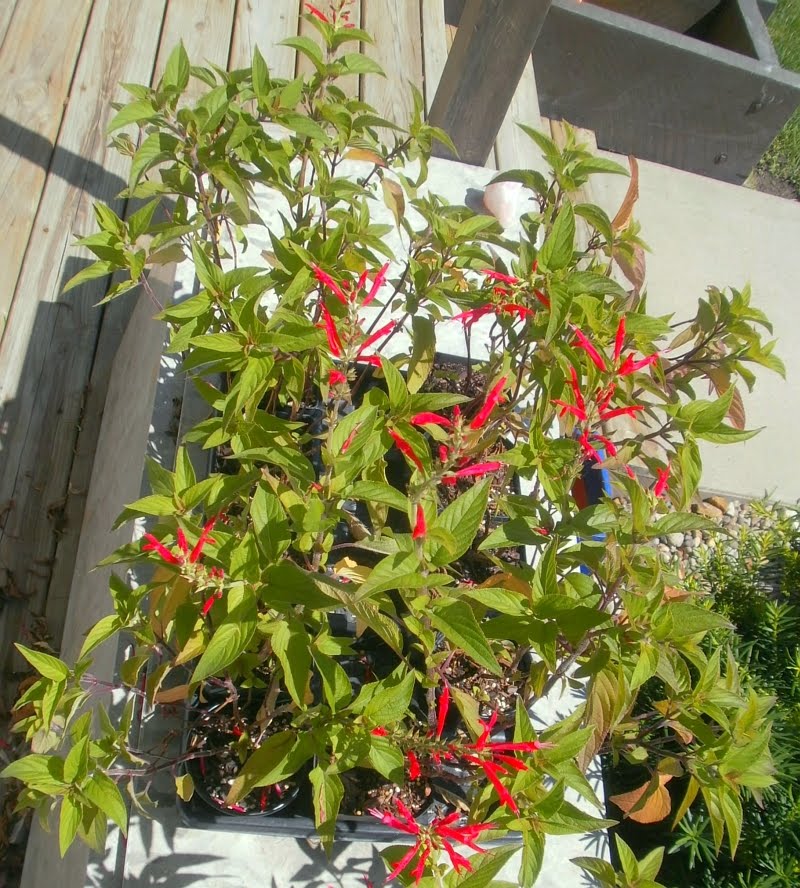
Random plant event: Salvia elegans


I was sort of under the impression that Salvia elegans bloomed at the end of the summer or beginning of fall, and if overwintered in a greenhouse or indoors, maybe sporadically through the winter as well. But these plants, grown from cuttings over last fall and winter, have been blooming more and more and more since about the beginning of May. I enjoy it, but it also confuses me. Was everything I've been told about pineapple sage wrong? Perhaps they've been thrown off by the overwintering?

Still no hummingbird sightings, by the way. Not that I spend a lot of time watching for them, but even so.


Still like the plant. More than ever, actually: unlike coleus, which does great for me outside but sputters along miserably inside, Salvia elegans seems to like me no matter where I grow it. A few lucky duckies have even been planted in the back yard; I'm looking forward to seeing how big they can get by fall.


Wednesday, June 9, 2010

Pretty picture: Collierara Apple Blossom


Collierara is a multigeneric hybrid in the Cattleya Alliance.1 Three of the genera involved, Brassavola, Cattleya, and Laelia, are pretty ordinary -- everything has them in it -- but then there's a new one: Caularthron, which sounds less like a flower and more like someone from Greek mythology. Good old star-eyed Caularthron, people would say. Shame about that thing with Poseidon.

Judging from the pictures that come up when one searches Caularthron, I'm guessing that's where the pointier, more angular aspect of Collierara (compared to, say, Brassolaeliocattleya) comes from.

Anyway. I'm extremely fond of this one, more for the shape than the color, though the color is very nice too. I think I might even want one.

-


1 Or should it be, "Cattleya alliance?" When I capitalize "alliance" I feel like I'm writing a report for history class about World War II or something.


Tuesday, June 8, 2010

Random plant event: Lycopersicon esculentum

On Sunday morning when I came home from walking Sheba, I found these at the back door.


What we have is thirteen tagged, ziplocked tomato seedlings, which is already pretty impressive, but then also there was a separate ziplock baggie containing xeroxes of six seed packages, so I know that I have Cherokee Purple, Mortgage Lifter (Halladay's), Tommy Toe, Green Grape, Eva Purple Ball, and German Pink tomatoes.

I'm pretty sure these came from one of the other plant nuts in town,1 Cathie, who has her own blog, and who I gave some plants to about three weeks ago (sold some, just gave others). She found PATSP, she says, because she was looking for information about some plant or another, and discovered that we lived in the same town, and naturally we wound up talking.

I've also met a couple other plant people in town; the local flower shop and I have sold one another various things. I met a couple about a block away when I noticed a bunch of pots and flats in their garbage, too. Went up to the house with Sheba and asked if they were throwing the pots and stuff out, and whether they'd mind if I just took them instead. Not only did they not mind, but they opened the garage to give me a bunch more.2

So I'm kind of remembering what it's like to live in a small town, I guess. I grew up in a really tiny place (~150 people), where asking for someone's garbage . . . well, actually I don't recall anybody ever asking for someone else's garbage. I don't even remember seeing anybody else's garbage: everybody burned it in the back yard or drove it to the dump. But if somebody had wanted someone else's garbage, it probably would have been fine. And as for sneaking around people's homes to leave them tomato plants, well, I actually did do that, kinda. My main childhood memory of lilacs (Syringa vulgaris) is of going along with my mother when I was maybe four or five years old, to sneak into a neighbor's house and leave a giant vase full of lilacs on their table. I don't remember who it was, or why, but this sort of thing happened, then.

Horrible, horrible things happened there too, no doubt. I mean, it's not like it was paradise on earth. I'm just saying that although we both sort of miss Iowa City sometimes, living in a small town has a lot to recommend it as well. It's dark enough at night to see the stars. We don't wake up at 2 AM because a drunk college student is screaming "I'M TWENTY-ONE!!!! I'M TWENTY-ONE!!!!" outside of our bedroom window over and over for fifteen minutes.3 There's enough space to keep a dog. Sometimes tomato plants appear out of nowhere. This isn't so bad.

-


1 (Judging by the gardens I see, walking Sheba, there are several, though it's harder to tell when it comes to houseplants.)
2 Also: I keep meaning to take a picture of their backyard tomato garden for y'all; it kind of radiates competence.
3 And then she struggled up the incline up to our building, laid on the grass, and then rolled down the hill to the sidewalk. Followed, if memory serves, by more shouting of her age. It didn't seem, at the time, like she was telling anybody in particular -- like, it wasn't that there was someone in our building who needed to know she was twenty-one. It seemed more like she just wanted the whole world to know, and our building was where her legs stopped carrying her forward, so she just kept telling us.


Monday, June 7, 2010

Pretty pictures: Alstroemeria cvv.


I was sort of shocked to see these for sale at Lowe's in Cedar Rapids (red one) and Coralville (orange one), because . . . well, because I really love Alstroemerias as cut flowers (I have some particularly vivid positive memories involving them, plus they last a remarkably long time.), and it seemed like surely if people were growing them around here, I would have seen and noticed them a long time ago.


The other peculiar thing is that they must be selling them as annuals. A bit of random poking around at davesgarden.com turned up one variety that was supposedly hardy in zone 5b, and a half-dozen others that were only hardy to zone 7. Which, I don't know, if they were cheap enough and the flowers lasted as long as the grocery-store bunches of flowers, I could see it being worth the money to buy Alstroemerias every year. But I'm still kind of surprised. Anybody know if there truly are zone-5-hardy Alstroemerias out there? As it is I'm inclined to think davesgarden.com was mistaken.