The term "Manic Pixie Dream Girl" was coined by Onion reviewer Nathan Rabin, who defines her thusly in his review of the 2005 movie Elizabethtown:
. . . that bubbly, shallow cinematic creature that exists solely in the fevered imaginations of sensitive writer-directors to teach broodingly soulful young men to embrace life and its infinite mysteries and adventures.
A much longer and mildly unsafe for work explanation is here (just keep the closed-captioning on and you'll be fine):
I kind of understood the character type already, but I figured I should dig deeper if I were going to write about it, so I watched three of the movies listed in the YouTube video above, to get a better handle on the trope: Joe Vs. the Volcano,1 Elizabethtown, and Garden State. (I have thoughts about these movies, which I want to write about, but the thoughts aren't especially relevant to Fittonias, so I'm going to stick them in a footnote. That way you can read them or not, according to your level of interest.2) One thing that is relevant to the plant is that MPDGs have a tendency to die or disappear when the protagonist's need for them ends (though that doesn't happen in the three movies I watched). Bear this in mind as you read on.
Fittonias (common names: mosaic plant, nerve plant) resemble Manic Pixie Dream Girls in the following ways:
They're small, cute (one might say pixieish) plants, usually no taller than six inches (15 cm). They're also kind of manic-colored (if "manic" can be a color): the leaves are green or dark green, with a netting of veins in white, pink or red. Fittonias also tend to be fast-growing, which is obviously a bit manic as well. Depending on the variety, the leaves may be either oval or diamond-shaped, and will have smooth or scalloped (crenate) margins. They also tend to die by the end of the movie, so to speak: they're not the easiest houseplants.

MPDGs also often have an unsettling, mildly criminal side which occasionally verges on actual mental illness. I was surprised to find out that this also applies to Fittonia: among the claims I found while researching is that Fittonia was used by the Machiguenga people of southeastern Peru as a hallucinogen, for some unknown period until they happened upon a plant that was a better one. (The only specific description of the hallucinations is that Fittonia produces "visions of eyeballs." Not much of a description, but I suppose one detail is better than none.)3 And it's not just another pretty, hallucinogenic face: it can also be brewed into a tea for headache, muscle pains, or cases of difficult or painful urination. (Does it work? The Kofan and Siona-Secoya tribes in Ecuador think it does. I wouldn't personally be willing to take their word for it, but that's the claim.)
Will buying a Fittonia teach you to embrace life again, living it to the fullest? Are despondent men who have lost their joie de vivre more inclined to buy Fittonias than other plants? I suspect not, on both counts,4 but it certainly has that cheerful, perky, impulse-buy look to it.
So how do you keep your Fittonia alive, then?
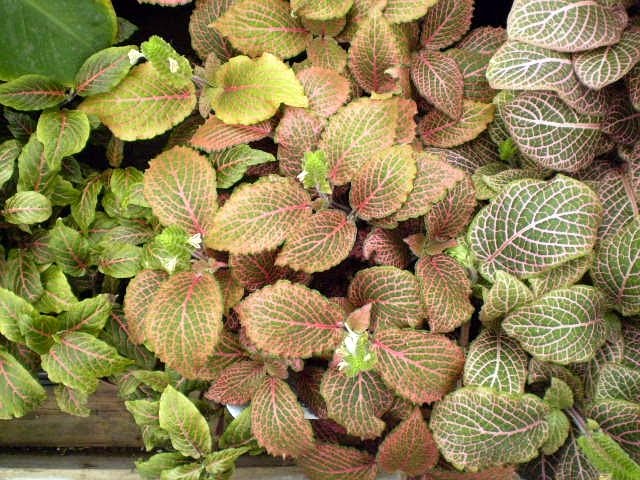
LIGHT: In its natural habitat, Fittonia grows in the understory of tropical forests, so it doesn't expect to receive a lot of light. Some people strongly warn against having a Fittonia sitting in direct sun; I'm not sure it's all that bad (the ones at work were in full sun, after all, and they always did fine as long as we remembered to water them). My Fittonias have been happy with artificial light, so I haven't seen a need to move them around a lot.
In any case, Fittonias are comfortable with a fairly wide range of light levels. Too much allegedly leads to smaller new growth; too little light and the new growth is weak, pale, and stretched. The sweet spot is -- as for most indoor plants -- bright indirect light, filtered sun, or bright artificial light. A little direct sun in winter is probably okay also.

WATER: You probably already know that tropical forests tend to be wet, so you won't be surprised to find out that Fittonias need to be kept moist. They're much less flexible about this than they are about light. Plants that are too dry droop, then collapse, much like peace lilies. Also like peace lilies, a wilted plant that's watered promptly will pop back up again and look no worse for the experience, though prolonged drought is another story.
Too much water can also be a problem, alas. Don't let your Fittonia stand in its drainage water, and don't keep the plant constantly sopping wet. If you do, you risk rotting the roots.
Soil is not usually much of a concern; any potting mix for container plants should work fine, though the composition of your potting soil will determine how often you need to water. Even the peaty mixes used by the growers are acceptable: peat holds water, which is usually bad for potted plants indoors, but my larger plant has been in a very peaty mix since I bought it, and is fine. Peatier mixes may be more dangerous if you're inclined to overwater, but I'm (usually) not.

HUMIDITY: This is the other big problem people run into. So long as you provide high humidity, warmth, and don't let the plant dry out to the point of wilting too often, it'll forgive anything else you do to it,5 but if you have dry air, a drafty home, or a tendency to space off when it comes to watering, the gods themselves will not be able to save your plant. You've been warned.
Contrary to the prevailing advice about humidity, I don't think misting or pebble trays are very useful. I mean, try 'em if you want, but if you urgently need to grow a Fittonia in a dry home, my first, second, and third recommendations would be to plant it in a terrarium. If that's not an option, I'd say place it among your other houseplants6 -- the transpiration from the other plants will keep the humidity higher for the whole group, at least in the immediate vicinity. Some rooms (kitchen, bathroom) tend to be more humid than others, too, though that is somewhat a function of lifestyle; not everybody's bathroom is going to be humid enough for a Fittonia even if some people's might be.
In really desperate circumstances, you could cover the plant with a clear glass vase or bell jar or whatever, though that's so close to being a terrarium that really you should just go ahead and plant it in a terrarium.

TEMPERATURE: There is widespread agreement that Fittonias shouldn't be exposed to temperatures below 60F/16C. (Too much heat isn't good for them, either: don't go above about 85F/29C if you can help it.)
PESTS: Few common plant pests seem to like Fittonias. My theory is that this is because hallucinating eyeballs is a much scarier thing when you have compound eyes. I don't think nerve plants are immune to pests (because nothing is -- even artificial plants can get fungus), but I can't say I've ever seen one with a serious infestation of anything.
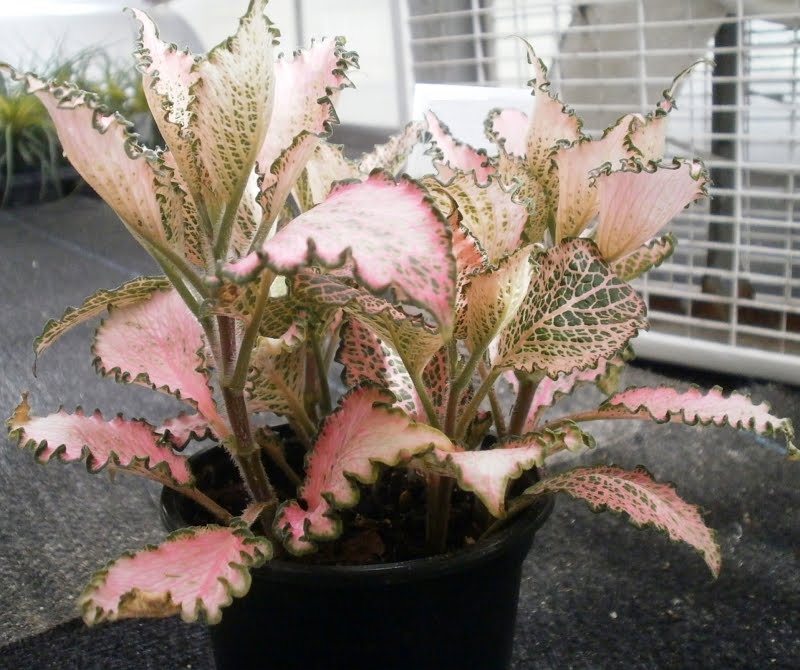
What Fittonias do get are bacterial and viral diseases. The main bacterial problem is Xanthomonas campestris, which causes black or brown spots on leaves (or sometimes along margins or along veins). X. campestris can infect a lot of different plants, but Fittonias seem to be special favorites. There's not really a cure; if you have a plant you think is infected, you should probably get a second opinion (from me -- not that I'm an expert on bacterial infections or anything -- the brilliant and stunningly attractive PATSP commentariat, Garden Web, davesgarden.com, local university extension office, a garden center near you that you trust, etc.), and if they confirm it, then you should destroy the plant. Be aware, though, that black or brown leaf margins can also be a sign of low humidity or too-frequent drought: if keeping the plant in wetter air and soil makes the problem worse, then it's probably X. campestris, and if keeping the plant wetter makes the problem go away, then it was probably the care you were giving it.
Other bacteria cause root rot in plants that are too wet. Not really a cure for that either, though with root rot, you can at least start over from cuttings. (See PROPAGATION)
There is also at least one virus (Bidens Mottle Virus), which causes distorted, stunted, yellowing leaves. (Black and white image of affected Fittonia leaves here.) No cure here but the fire. Or the garbage can, as it were. (Don't throw BDV-afflicted plants into compost heaps: BDV can infect a lot of other plants as well, including Zinnias, lettuce, Ageratum, fava beans, and bishop's weed. You don't want to spread it.)

Also, considering the care requirements and the peaty potting mix growers typically use, fungus gnats are common Fittonia hitchhikers. They don't really hurt the plants, but a lot of people find fungus gnats annoying,7 so you've been warned. See the above link for recommendations on how to get rid of fungus gnats.
PROPAGATION: Propagation is said to be easy, though I've had trouble with it personally. I've tried starting cuttings directly in damp soil, with 0% success in one variety and about 30% in the other. (My error may have been failing to cover the cuttings with plastic to keep the humidity high while rooting was taking place.) Cuttings are also supposed to root in water, though I've heard otherwise from Derek of Plantgasm, and haven't tried it personally. Older plants will root along the stem ("self-layering") if they grow over moist soil, forming clumps which can be divided, though I suspect that's not that common in indoor, non-terrarium plants.

FEEDING: I have basically no information to go on here; nobody really talks about it. I assume regular feeding, year-round, with a houseplant fertilizer mixed according to package directions (or at reduced strength with every watering, which is what I personally do) will work.
GROOMING: Fittonias will flower, and the flower spikes have an interesting shape --

-- but are less ornamental than the leaves, so people usually remove them when the spikes start to form. The actual flowers are pale yellow to off-white, and appear one or two at a time. I have no clue what the seeds look like.
Repotting is different from most indoor plants, too: nerve plants have a relatively shallow root system, so too large of a container will lead to rot. One might cut off an inch or two (2-5 cm) from the bottom of the root ball, and a half-inch to an inch (1-2 cm) from the sides, and then replace the plant in the same pot with a layer of new soil surrounding the old root ball is probably the way to go, if you think repotting is necessary; I'd say you're probably better off restarting an older Fittonia from cuttings than trying to keep it going in a new pot.

I have long been confused about the proper species name for cultivated Fittonias; I learned it first as F. verschaffeltii, then saw the same plant called F. argyroneura, and now I'm seeing the name F. albivenis.8 As best as I can tell, F. albivenis is in fact the correct name at the moment. It's the only species name GRIN acknowledges; Plant List includes albivenis and another species, F. gigantea.9
The many, many cultivars are apparently the result of sports and natural variation, not hybridization, which I kind of expected: there are more characteristics than species. All the Exotic Angel hybrids' patents say they were mutations of older, non-patented varieties, which I assume is also the case for the other cultivars out there. Why would Fittonia albivenis bother throwing out that many sports? My guess: it was feeling insufficiently unique, and trying to do something nobody'd ever done before.
Selected References:
Though I didn't find it until I was almost finished writing, and it has nothing to do with plants whatsoever, I really must recommend this post (Death of a Manic Pixie) by Phoebe North. It addresses why the MPDG is a problematic trope for real girls to have to contend with, and is an interesting read besides.
Botany.com (general care)
Gardenstew.com (responses to a question about general care, some of which are a little questionable. Also the page contains multiple animated .gifs and ads, which are annoying)
GRIN (alternate common names, natural range)
Davesgarden.com (list of all cvv. known to davesgarden.com)
Fittonia production guide -- University of Florida (wholesale production, emphasis on common problems like bacterial and fungal infections and their treatment)
Jaycjayc.com (thorough indoor and outdoor care advice)
Manu.montana.com (about headache treatments used by indigenous peoples worldwide; Fittonia gets a couple paragraphs)
Nparks.gov.sg (mostly worthwhile for the photos of different varieties; also some minimal care info that may or may not apply to indoor growers)
HEAR.org (brief note indicating that Fittonia has been introduced to the Galapagos Islands; it's apparently not behaving invasively so far, though)
TV Tropes (elaboration on the definition for, and many, many examples of, Manic Pixie Dream Girls in various media)
-
Photo credits: all mine except the one from Plantgasm.
1 Which I already owned. (On VHS, even!)
2
A) I kinda disagree with the inclusion of Joe Vs. the Volcano (1990). In JVTV, Meg Ryan plays three characters. The first embraces life and its mysteries, etc., way less than the depressed Tom Hanks character does, and isn't especially manic, either. The second is quirky and manic, but barely on-screen, and has very little influence on Joe (Hanks), plus she gets at least one monologue that's very specifically about her personal life, art, relation to family, etc., which is all the more significant because she's in such a tiny part of the movie. The third is not especially quirky or manic, spends a significant chunk of the movie unconscious, talks a fair amount about her interior life and relationships when not unconscious, and just doesn't seem to fit the MPDG trope at all. (Joe's part of the plot, where he goes from being a depressed hypochondriac to a fun-loving, life-embracing guy, in fact does match the MPDG trope, but I'd posit that JVTV is an MPDG movie without any MPDGs.)
B) Garden State (2004) and Elizabethtown (2005), on the other hand, are not only good examples of the trope, they're almost exactly the same movie. In both cases, there's a dude (Zach Braff; Orlando Bloom) who's in bad shape (overmedicated; suicidal). One of his parents (mother; father) dies, he has to go to (New Jersey; Elizabethtown, KY) to make arrangements related to the death, and in the process he meets (Natalie Portman; Kirsten Dunst), who is extremely outgoing and quirky, so he eventually falls in love, whereupon he learns to enjoy life and stop being so overmedicated/suicidal.
C) The husband and I disagreed about which was the better movie: I preferred Garden State, despite not liking Zach Braff at all; the husband favored Elizabethtown, possibly because he hates Zach Braff more than I do and couldn't get past that. Elizabethtown looked promising at first, but the jokes and plotting were, I thought, really lazy. I mean, I saw most of the plot developments coming, and anything that was a surprise wasn't particularly funny or interesting. (Though Paula Deen had a cameo that I thought was mildly clever, which says nice things about whoever was in charge of casting Elizabethtown, I guess.) and by the end of the movie I was so excited about the fact that the movie was finally ending that I cannot tell you whether Orlando Bloom and Kirsten Dunst end the movie as a couple or not.
D) One thing I found disturbing and/or irresponsible about Garden State is that it is implied that if you're on psychiatric medications of some kind and are not entirely happy with your life, the way to fix your life is to stop taking the meds. Which is all the weirder because Zach Braff, who wrote and directed the movie, has publicly admitted to having obsessive-compulsive disorder, and his mother is a clinical psychologist, so you'd think he'd be more sensitive to the implications.
The movie does sort of tell you that there was never anything wrong with Braff's character in the first place, but it'd be easy to miss, because of course he's clearly acting like there is something wrong with him for a lot of the movie.
3 The original source of this claim appears to be this page, which looks like the work of a sober and scientifically-minded person, so it could be true. Certainly the leaves look like they ought to be hallucinogenic.

At the same time, though, I have no idea whether anything ever happens, if anything does ever happen how much you have to use, whether it's only hallucinogenic in combination with other substances (as one of the answers on this page suggests) or whether there are side effects (the Machiguenga stopped using it for a reason, after all). And anyway, if you want to look at eyeballs, there are more convenient and less risky ways of doing that. (Mirrors and Google image searches being the two I can come up with off the top of my head.) And odds are, even if you do manage to get something to happen, it's going to be anticlimactic. I mean, if tripping on Fittonia tea was really as awesome as all that, you would probably have heard about it before now, no? So there's really not much to recommend Fittonia experimentation.
More importantly, any recently-purchased plant could contain systemic pesticides, or pesticide residues on the leaf surfaces, and you don't want to be ingesting those on purpose. A one-time pesticide-and-hallucinogen tea isn't likely to kill you, but why tempt fate? So if you must try it out -- and I know there has to be at least one person out there saying oh, yes, I must, I must -- at least wait two or three months after your purchase, to give any pesticides time to break down and wash away.
I'd argue more strenuously against Fittonia experimentation, but they aren't considered toxic, so I doubt you can do any serious damage to yourself by eating them unless you're eating entire plants several times a month.
4 (If you're despondent enough, of course, you're probably not buying any plants.)
5 Within reason. Like, they're probably not going to bounce back from being frozen in a block of ice or watered with gasoline. They're more resilient than their reputation would suggest, though, is my point. Herselfshouseplants.com agrees with me on this.
6 And if you don't have other houseplants, obviously you should go buy several. I have some ideas about which ones. I also have ideas about which ones you should avoid.
7 (I'm not one of them.)
8 Not only me -- at least one other person is frustrated with it too.
9 F. gigantea sounds interesting: it allegedly grows to two feet (0.6 m) tall and has muddy green/purple/red leaves; there's a picture here, though it's from the top down, so you can't tell how tall the plants are. (Here's another picture, of a younger plant.) It's unclear to me whether F. gigantea is in the horticultural trade at all, either as itself or as hybrids with F. albivenis.


 Posts