Saturday, November 14, 2015

Pretty picture: Phragmipedium Peruflora's Spirit

This is a nice Phragmipedium, I guess. It photographed okay.


The most interesting thing about it, to my mind, is that it's a half-sibling of the Phragmipedium I don't talk about. (They share a common ancestor in Phrag. Eric Young.)

Phragmipedium Peruflora's Spirit = Phragmipedium kovachii x Phragmipedium Eric Young (Ref.)


Thursday, November 12, 2015

Anthurium no. 0406 "Tricia Nullmaritch"

I was so excited about Tricia. And then she opened her spathe, and . . . I was so disappointed with Tricia.


The color's good. That's what I was excited about. And the outside of the bud looked very clean and unscarred, so I figured the thrips were leaving her more or less alone. But they were not.


Worse, the bloom is pretty tiny, compared to the plant overall. This seems to be a thing lately -- 0544 "Ida Claire Warren," 0147 "Denise O. Denefew," 0589 "Hetty King," 0331 "Elvis Herselvis," 0532 "Amber Alert," Tricia, and the yet-unblogged 0408 "Tex Messich" have all had unusually tiny blooms.


There are some connections between them, the main one being that Ida, Amber, Tricia, and Tex were all potted up around the same time, and live near one another, in a group of four flats with particularly bad thrips problems. An environmental influence (like, I don't know, colder temperatures, or drier air) that caused one to produce small blooms would likely affect the others as well. Genetics may play a role as well; about 70% of the seedlings on those flats are from seedling groups BF or BH (including Ida, Amber, Tricia, and Tex). Nothing ties all seven together, though. Maybe it's coincidence. Maybe they all had the same terrible pollen parent. Maybe the thrips are doing something.1 Maybe I'm drawing connections where there aren't any and Tricia's not actually that bad. Certainly I've seen leaves this bad and worse on most of the other six plants:

Note: the dust on the leaf is just vermiculite powder from the predatory mites, not a raging spider mite infestation.

So I'm not sure what to do with Tricia. The colors are nice, but not unique.2 Thrips scarring on leaves is something I've seen seedlings more or less grow out of before, and it's not that bad to begin with, but bloom size changes a lot less: if she's producing tiny blooms now, there's a good chance she'll produce tiny (or at least small) blooms forever. So Tricia's fate is, for now, up in the air, though I lean slightly toward throwing her out. We'll see.

-

1 Q: What "something" could the thrips be doing, Mr. S.?
A: Oh, you know. Shooting the plants up with heroin. Witchcraft (?). Predatory lending. That kind of thing.
2
Seedlings with coloration similar to 0406 "Tricia Nullmaritch," clockwise from top left: 0035 "Alyssa Edwards," 0231 "Rhea Listick," 0259 "Tasha Salad," 0234 "Ross Koz."


Tuesday, November 10, 2015

Schlumbergera seedling no. 018

Surprisingly, 018A put on a burst of speed at the end and overtook 082A "Strawberry Madeleine," being the first of my seedlings to bloom this year and also the first previously-unbloomed seedling this year. Which almost makes up for the fact that it's another orange.


Not that I expected anything else: the majority of last year's seedlings bloomed orange, and 018A was working with the same gene pool as the rest of them, so orange was always the most likely color.

This makes name selection challenging, though: I'd expected that TinEye would have lots of new photos available for name inspiration1 -- it has been a good six months since I'd used it last, and I thought people were still posting photos to Flickr -- but I got a lot of the same pictures I'd grown tired of last year. So I may need to come up with additional methods of seedling-naming. For now, though, we'll take what TinEye gives us, and fumble around until something happens.

The possible-names list was initially 36 names long, which I narrowed to 9 that were interesting enough to consider. From first to last rejected:2

Stoic would have had more potential if I didn't already have a "Stoked." (023A) Not the same word, and very different meanings, but too similar in sound.


Similarly, I'm amused by the name Evil Carrot, and the corresponding picture, but I already have 031A "Baby Carrots."

Superpower appealed at first, but it's both a little too generic (which superpower? whose superpower?) and oversells the seedling. I mean, 018A is nice, but superpowered it ain't.

Santa Cruz Couch is a slightly weird mental image. I could see maybe eventually being content with this, if I couldn't come up with anything better. On the other hand, part of my brain is screaming but Santa Cruz probably has all kinds of couches; surely they're not all orange. What's so Santa-Cruzy about this particular color? So nope.


Cartrain is the pseudonym of a British artist who Wikipedia says works mainly in "graffiti art"3 and photography (especially of abandoned buildings). Can't say the art does much for me (there's a Flickr photo group: check him out for yourself), but he's done a couple things that I kind of like, including stealing a box of pencils from Damien Hirst's installation Pharmacy in 2009, when he (Cartrain) was 17. It's tough to find a complete account of the whole business (this is pretty good), but it upset a great many people and was a big deal at the time. He was even charged with art theft to the tune of £500,000, though the charges were eventually dropped.4 I actually like some of Hirst's work,5 but he also was I guess suing Cartrain at some point because Cartrain was incorporating photos of For the Love of God in his collages or whatever, which I'm just a simple country farmer here but I don't see how that hurts Hirst at all. And then the pencil theft happened after. I feel like civilization can probably handle it if Damien Hirst gets his nose tweaked every so often. And if Damien Hirst can't, perhaps he could warm himself at a fireplace full of burning money for half an hour and see whether that helps.

That said, it's a little weird to name a seedling after an actual person, especially a young actual person, who has a lot of time to do something horrible.6 So we'll pass on Cartrain.

Whew. That got out of hand.

Youth Garage comes from my attempts to translate the text in the photo: Google renders "tejo" in Portuguese as "Talus," which is a particular bone in the ankle, but I didn't know that initially so I concluded that Google had given me gibberish. So I tried to translate "tejo" in other languages, and when I entered "tejo" twice on two different lines, Google guessed that I was looking for an Esperanto translation, resulting in "youth garage."

The story is fun, and the mental image is interesting (a garage with a maximum age limit? a garage for storing youths?), but it doesn't quite work for me.


There's potential with Warchalk. It's an interesting word, with a weird history behind it: it means the practice of drawing symbols in public places to indicate that there's an open WiFi network around, sort of like hobo signs, and was formed by analogy to wardriving (driving around, looking for WiFi networks), which itself comes from wardialing (dialing phone numbers in search of computers, servers, fax machines, etc. which can be hacked into).7

I like learning new things about the world and how it works, and I like the word, but I guess I'm just not feeling this as a seedling name. Perhaps if the bloom were chalkier, somehow.

Seal Admiration's photo is a sign instructing people not to upset Hawaiian monk seals when watching them (no loud noises, don't get too close, etc.). "Admire Seals From a Distance" is funny to me -- maybe it's the wording, "admire," as opposed to something more neutral like "view." In any case, it's really only amusing in context, if you know that it's about people looking at wild animals, and it's also sort of confusing, since "seal" in English refers to a lot of things, only some of which are pinnipeds. So I think maybe it doesn't work as a name here, just because the words don't communicate the idea very effectively on their own.


Which leaves, finally, Nudibranch. I was initially inclined to rule it out, on the grounds that it sounds vaguely dirty ("nudie") and it'd be an unfamiliar word to most people.8 But the more I thought about it, the more I thought it was actually kind of perfect. Not only are they great animals, nudibranchs often come in Schlumbergera-compatible colors, and they occasionally even vaguely resemble Schlumbergera blooms.

So there you go. 018A "Nudibranch."

-

1 Those of you who are new as of this year: TinEye Labs has a site on-line where you can enter up to five HTML color codes, and their relative proportions, and then it will give you page after page of public Flickr photos that contain those colors in those proportions. (More or less.) So I get the pictures of my blooms, identify five representative colors, stick those into TinEye, then look through the search results for anything that suggests a name -- subject matter, location, text in the image, tags, title.
In this particular case, the colors were fad6ca, e79a7f, db5c2a, c33818, and bd260b, and I used the proportions 5-7-39-44-5. Those five colors, in those five amounts, gives you an image like this:


And here is the link to the TinEye results.
Once I have enough possible names, I sift through them until one of two things happens: either one name starts to feel like the proper name for the flower in question, or the process prompts me to come up with something of my own, which may or may not be related to any of the photos I was looking at.
The Schlumbergera seedling posts wind up being mostly about coming up with names for them because, well, what else is there to talk about? I have what I feel is a pretty comprehensive plant profile about Schlumbergera already, they all need identical care, the color is usually orange, so what's left to think about? Coming up with a name.
2 And I should probably note that although I'm including the Flickr links that TinEye provided, some of the links may go to a 404 not found page. I don't know why this would be and don't really want to think about it.
3 (this strikes me as a weird phrasing even though I know exactly what it means)
4 Possibly because someone realized that it was absurd to say that a completely replaceable box of pencils was worth £500,000?
5 I couldn't hope to summarize the criticisms of his work. I haven't read that many of them, and I'm not part of the art world so I probably wouldn't understand the criticisms even if I did read them. But the stuff I have bothered to read suggests that he's hit a point where he's so famous and so successful that rich people will buy anything he makes, however dumb, so he's stopped trying, and what little effort he does make is going toward perpetuating the Damien Hirst brand, rather than making actual art. Which is not hard to believe, looking at the fucking spot paintings. I mean Jesus Christ, steal another idea already.
In any case, I think The Physical Impossibility of Death in the Mind of Someone Living is fantastic (mostly because as a very small child I was fascinated by sharks, and I still kind of am. As a statement about mortality, or whatever, I could give a shit, but as a cool thing: well, yes, it is a cool thing. And obviously if I could have a dead tiger shark in a glass and steel case in the living room I would jump at the chance. And then I would put plants on top of the case.).
And For the Love of God is certainly art. As is Laura Keeble's response to it.
Love Lost is old enough that it's hard to find a decent photo, but I found it inspiring as, again, a cool thing. (When I first heard about it and saw a couple small crappy online photos, I then spent a while trying to smash up a Barbie Volkswagen Beetle and put it into a 20-gallon aquarium with some guppies and Corydoras catfish. The idea was to have a miniature underwater crashed car, like Barbie'd gone over the side of the cliff into the river or something. Sadly, it never looked quite right, and once I decided my vision would never be realized, I threw the car out and did boring gravel with boring fake plants just like all the other boring aquariums I've ever had. But Damien Hirst is responsible for me making the attempt in the first place.)
6 It's my hypothesis that if Phil Collen or Laurie Anderson were especially awful human beings, we would probably know by now. This is not always a valid assumption, as we all know (<-- SERIOUS TRIGGER WARNING for rape and general human awfulness: I'm not usually that upset by stuff I read, and I wouldn't say I was upset by that either, exactly, but I was really preoccupied by that article for a couple days after I read it, in a way that was unpleasant), but I'm willing to gamble on Collen and Anderson.
7 The ultimate etymology appears to be the movie WarGames, which introduced a lot of people to the practice, hence the "war-" prefix.
8 If this is you: it's pronounced "NEW-di-brank," not the more straightforward "new-di-BRANCH." This is why the plural is "nudibranchs," three syllables, rather than "nudibranches" with four, even though other words ending in -ch get -es plurals (churches, marches, torches).


Sunday, November 8, 2015

Pretty picture: Cattleya walkeriana

This is your last white orchid until March, because of what happened last time I scheduled white orchids during the winter.


I wasn't watching out for very light pastels, though, and I'm not in control of what the Anthuriums and Schlumbergeras might do, so don't let down your guard. White blooms could still strike at any moment.


I don't have a lot to say about C. walkeriana; the most striking thing about it was that the blooms were pretty big. I guess I like their shape, though, now that I think about it.


Saturday, November 7, 2015

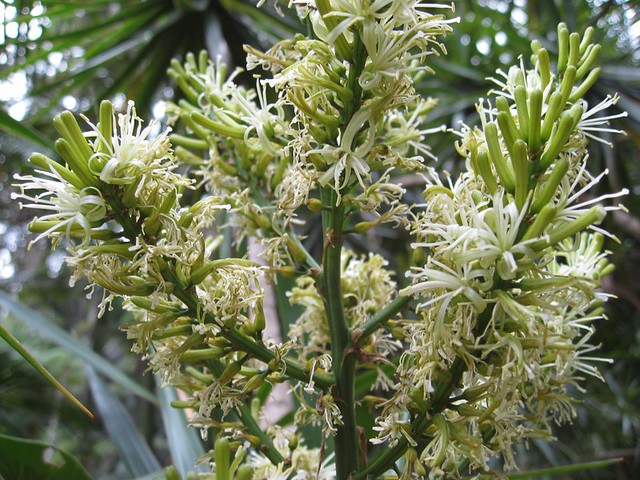
Random plant event: Dracaena 'Indonesian Tracker'

The husband's office was a magical place this summer and fall, apparently: the Polyscias fruticosa bloomed for the first time in June; the Anthurium schlechtendalii bloomed in October, and now the Dracaena 'Indonesian Tracker' in November.1 I had no reason to think that any of them would ever bloom, so it's neat that they all have, and downright peculiar that they did so within a few months of one another.


There is, of course, a smell. It's definitely an improvement on the vinegar / garbage can smell of the Anthurium,2 which is lucky for us, since it's also really strong. It's a bit like I remember the Dracaena surculosa flowers smelling, though some of that might be because the flowers look a lot the same and my brain is lazy.3 I described D. surculosa as smelling like an intense generic floral smell, with maybe a note of a chemical/solvent-type thing in there.

I would describe the smell of 'Indonesian Tracker' similarly, up to a point: the solvent/chemical note is still there. In fact, in the early afternoon, it's all that's there, and it's not pleasant. But a heavy floral scent takes over pretty shortly thereafter. I couldn't figure out specifically what it smells like. It's sort of especially hard to figure out in this case, because I only get about ten seconds to try to name it before my nose adapts and I can't smell it anymore, plus I can only identify a few flowers by scent in the first place so my vocabulary's pretty limited,4 and worst of all, it changes during the course of the night, but it reminds me a little of the Murraya paniculata in the early evening, and of carnations in the late evening.


There's also a sweet note to the fragrance -- on Halloween night when the flowers first began to open, I was working in my office and kept getting distracted by a new smell that was definitely not the Hoya lacunosa,5 something that brought to mind white birthday cake. This is hard to detect when closer to the flowers, because the floral smell overwhelms it, but it seems to be the component that travels the best. The only thing I can think of that smells at all similar to this part is Duranta.

I don't know much about 'Indonesian Tracker.' Asiatica Nursery (where I bought my plant, in 2008) presented it as a Dracaena hybrid, but they've since gone out of business, so I can't ask them about it. Logee's sells 'Indonesian Tracker,' and their information page for 'Indonesian Tracker' also identifies it as a hybrid but doesn't go any further than that. I'd really like to know what it's a hybrid of, but nobody seems to know or care, and searching the internet mostly brings up people selling it or my own posts mentioning it. No patent, even. So I'll guess D. fragrans (for the long leaves, upright habit, and sweet-smelling blooms) x D. surculosa (for the spots and whorls of leaves): if you stretched a D. surculosa leaf out to D. fragrans length, and the spots stretched along with it, you'd get something that resembled 'Indonesian Tracker.' I doubt that's correct, but it's my guess.


As a houseplant, it's a little underwhelming, in the usual Dracaena ways: it gets leggy over time, it gets taller but not wider. That sort of thing. I wouldn't say it's bad, though. I mean, if nothing else, it's very easy, and it grows so slowly that you'll have it for a few years before the legginess becomes a problem.

With some Dracaenas, the appearance of flowers would mean that the stem is about to branch; I suppose we'll find out if 'Indonesian Tracker' is one of those.

-

1 Technically October: the first blooms opened on Halloween night.
2 I don't remember there being a smell with the Polyscias.
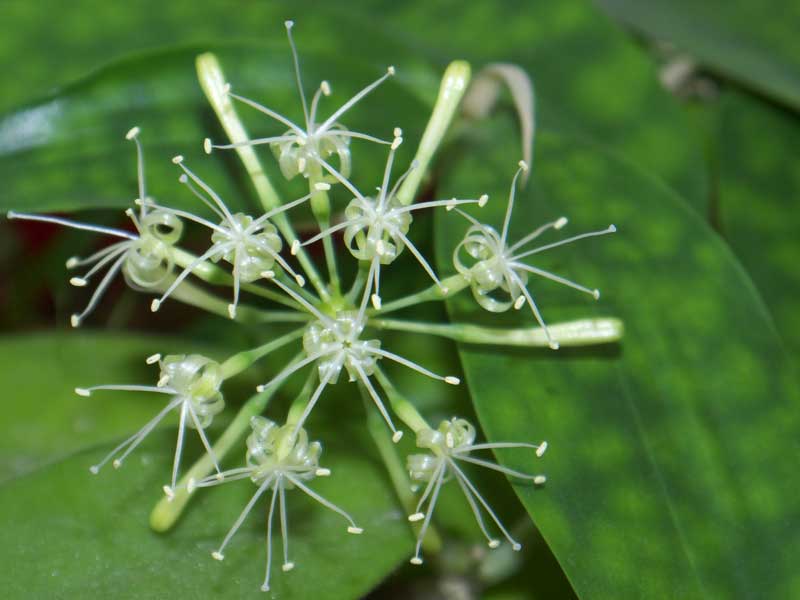
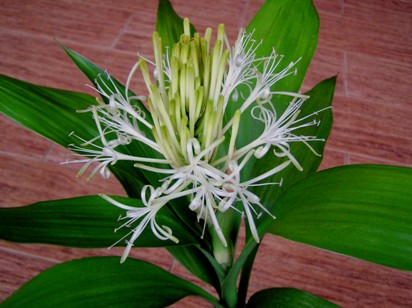
3 Dracaena flowers all look like this to some degree or another. The color varies slightly, but the basic construction is similar: long, narrow white petals, with equally long white stamens and one (?) pistil in the center. (Examples:
Dracaena marginata, Dracaena fragrans, Dracaena surculosa var. punctata, Dracaena sanderiana, Dracaena thalioides.)
Also very similar: Sansevieria flowers. (e.g.) Sansevieria and Dracaena are pretty closely related -- part of the subfamily Nolinoideae, along with Aspidistras (whose flowers look nothing like this) and Beaucarnea (ditto except for being approximately the same color) -- so this shouldn't surprise me as much as it does.
4 I can sort of imagine the smells of Gardenia, marigolds, roses, lilacs, lily-of-the-valley, geraniums, petunias, peonies, Sansevieria, chrysanthemums, Eucharis, carnations, and Murraya paniculata, at least well enough to decide whether something smells like them. I can't really conjure up jasmine, hyacinths, tuberose, lilies, iris, heliotropes, lavender, alyssum, freesias, orange blossoms, or sweet peas, though I'm certain I've smelled all of them at one time or another.
5 (which is what's usually responsible for pleasant smells that suddenly appear after dark)


Friday, November 6, 2015

Anthurium no. 0532 "Amber Alert"

Perhaps I should stop naming Anthurium seedlings "Amber."


I mean, okay, "Amber Alert" is better than 0558 "Amber Waves," to be sure. If nothing else, she appears to have a functional spadix, and the color is smoother and prettier. But the peduncle is unusually short, like that of 0335 "Donna Fanuday",1


the leaves have lots of small blemishes,


and the plant overall has very few leaves and looks sort of unfinished.


I suppose that last point could be a good sign -- Amber wants to bloom so badly she'll start doing it before she's grown many leaves! -- but whether she's going to be a heavy bloomer or not, I'm not impressed with this Amber either. She has a bud at the moment, so I'll let her finish doing whatever she's going to do before making a final decision, but it'll have to be one hell of a second bloom if she wants to stay.

Speaking of second blooms:

I said I would give 0416 "Holy McGrail" a chance to make a second bloom, the theory being that maybe it would be better than the first. And this is what she came up with:


It's a larger bloom than the first one, I think, and it's not torn like the first one, but it actually has more thrips damage, and the color is both boring and poorly executed, so as soon as I have time to deal with the paperwork, Holy's out of here.

EDIT: I've added two new pages to the blog, Anthurium seedling gallery and Schlumbergera seedling gallery. They're mostly there for my own convenience, to save me time when I need to talk about multiple seedlings at once by collecting basic information about the seedlings and the posts about them into a single location, but I didn't see any reason not to make them public, so there you go. Just in case you have a crisis that can only be solved by looking at a ton of Anthurium and Schlumbergera photos or something.

-

1 I was undecided about Donna in her introduction post, but I have decided since that she's worth keeping. The second peduncle was taller, the thrips mostly seem to leave her alone, and the foliage is nice. Granted, I can still change my mind. But I think Donna's okay.


Wednesday, November 4, 2015

Anthurium no. 0333 "Isaiah Littleprayer"

A bit of an emotional roller coaster with this one. The bud was a bit purple, which excited me so much that I moved Isaiah up to a 6-inch pot before seeing the finished bloom. And then the bloom eventually did open, and it was underwhelmingly red.


I'd been expecting a color closer to that of 0386 "Violet Chachki," given the color of the bud. It was also a pretty small bloom. So then I was upset with myself for having wasted a 6-inch spot on such an ordinary seedling.

But. A couple days later, it actually had gotten a little more purple.1


And I noticed that the spadix had gotten a little more purple as well. Purple enough to look sort of familiar. Where had I seen that combination of pale yellow and pale purple before? Eventually it hit me: 'Krypton!'

('Krypton')

For some reason, 'Krypton' has been a difficult seed parent. It blooms sporadically. When it does bloom, it's difficult to pollinate. When pollinated, it doesn't produce many seeds. When it does produce seeds, they tend not to germinate, and the seeds that do germinate tend to either die or remain small. I don't have numbers for the number of blooms, seed production, and germination; I just know that I've been frustrated by this for a long time.2

But Isaiah changes things a little. I'd suspected for a while that even if 'Krypton' was difficult to pollinate, it was still at least producing pollen. This is the first indication I've gotten that that could be correct.3

Not that 'Krypton' is so special that its genes need to be preserved at all cost -- it's fine, but it doesn't bloom a lot, and the blooms are small -- I'm just more likely to see unusual things if I have a larger genetic pool to play around with. So this is encouraging.4

As far as Isaiah goes, his leaves and overall shape are decent: a little leaf damage from thrips or whatever here and there, but it's fine. The spathe itself is surprisingly blemish-free.


So. Given the opportunity to do it all over again, I'd probably still move Isaiah up to a 6-inch pot. He's a keeper. And as I get used to him, I'm finding him easier to appreciate. Everything's worked out fine. But I really should stop moving plants up before they've even bloomed.

-

1 Some of the difference between the photos is due to my not getting exactly the same color balance, which is pretty obvious when you compare the backgrounds. The color change really did happen, though.
2 I can tell you that I've only ever managed to pot up seven seedlings from 'Krypton,' only three of which survive, and only one survivor (0599 "Butta") has been robust enough to move to a 4-inch pot. And "Butta" is actually the smallest 4-inch plant in its flat.
3 (Isaiah's seed parent, incidentally, is the NOID red. He's a sibling of 0334 "Jean Poole," who is so much larger and oranger that I'm guessing they're only half-siblings. Though Jean's spadix is also a little on the purple side, so you never know.)
4 It's still probably the case that 'Gemini,' 'White Gemini,' and the NOID red make up the bulk of the seedlings' genes: they're all extraordinarily good at catching pollen, and the NOID red is also good at shedding pollen. I don't have hard data on it, because I don't know who the pollen parents are for my seedlings, but I would estimate that 'Gemini,' 'White Gemini,' and the NOID red combined have probably contributed 75% of the seedlings' genes, with the remaining 25% from 'Orange Hot,' the NOID purple, 'Pandola,' 'Krypton,' 'Peppermint Gemini,' 'Joli,' the NOID green/pink, 'Midori,' NOID pink, NOID red-violet, and 'Red Hot' combined.


Monday, November 2, 2015

Pretty picture: Paphiopedilum Keyeshill

This one's a nice, dignified, respectable-type Paphiopedilum. Nothing too out of the ordinary, though the petals (or are these sepals? I can never remember. . . .) are maybe a little narrower than usual for a paph.


Also noteworthy: Winston Churchill sure gets around, doesn't he?

Paphiopedilum Keyeshill = Paphiopedilum Carl Keyes x Paphiopedilum Winston Churchill (Ref.)

Winston Churchill and his offspring previously: 2012, 2013, 2015