Friday, May 27, 2016

Unfinished business: Polyscias fruticosa

So I told you a while back that the plant collection had done one thing that made me happy during the previous three months or so. This is that thing.1

A quick recap of the Polyscias saga so far:

At the end of last May, both my original Polyscias fruticosa and the plant I started from a cutting of it bloomed. I tried to pollinate the flowers, not knowing if it was self-fertile, and got berries. Started the seeds from those berries on vermiculite in late September. To my surprise, the seeds began to germinate in mid-October, and the first seed leaves were visible in early November.

And then I stopped blogging about them, but they continued to do things. Eventually it started to become a problem to keep the vermiculite moistened, so I potted up the sturdiest-looking eleven seedlings on 12 January.

I hadn't been very optimistic about the seedlings. I've never actually done this before with Polyscias, and it's not like I really need more of them. I thought the best case scenario was that I'd get five or six that I could sell at the consignment store or on Craigslist or something, ideally before they got huge.

Instead, all eleven survived. Here they are on 3 February, looking a little yellow:


In March, with all eleven still intact, it started to become apparent that something unexpected was happening. They were starting to diverge in appearance a little. Young leaves aren't necessarily representative of mature foliage, but it got my attention. 11 March:


By April, it was clear that something was up. As each new leaf appeared, the seedlings weren't all converging on a standard "Polyscias fruticosa" form like I'd expected: instead they were getting more and more distinct from one another in leaf shape, size, amount of branching, etc. And I started to get a little excited. 4 April:


By late April, it was official. Not only were they consistently different in appearance from one another, but they were distinct enough that some of the plants were individually recognizable.

Here are shots of individual leaves2 from the eleven seedlings, arranged in order of decreasing fluffiness.3

Seedling 01

Seedling 04

Seedling 05

Seedling 03

Seedling 08

Seedling 06

Seedling 11

Seedling 07

Seedling 02

Seedling 09

Seedling 10

The appearance of the individual seedlings sort of logically follows from the appearance of the leaves, so I'm not sure I actually need to show you the entire plants, but I guess in the interest of completeness, and because I have comments about a few of them, I may as well. Same order:

Seedling 01

Seedling 01 is a monster. The leaves keep getting bigger and more complicated. It's also one of the taller seedlings, though I realize you can't tell that from the photo very well, because of the angle. The veining is also a lot more prominent than on most of the other seedlings, which doesn't mean a lot, but gives the leaves a sort of striped appearance close-up. Which is sort of attractive.


Seedling 04

Seedling 04 is also producing really substantial, three-dimensional leaves, and since this photo was taken, it's also started to branch. (I think technically you can see the beginnings of the branches in this photo, down low on the stem, but they're more obvious now.)


Seedling 05


Seedling 03


Seedling 08

Seedling 08 is also very distinctive because of how narrow all the leaflets are. I don't find it especially appealing, but I can pick it out of the crowd: 08's the one that looks like a tangled mess. It's possible that it will have some redeeming feature, like being unusually durable or whatever.


Seedling 06


Seedling 11


Seedling 07


Seedling 02

Seedling 02 is either my favorite or second-favorite, along with seedling 01. Doesn't actually look that much like holly, but it nevertheless makes me think of holly.


Seedling 09

It's pulling out of it now, it looks like, but seedling 09 is the only one that's ever seemed to struggle at all; I'm not sure exactly what's wrong with it, but all the leaves suddenly developed yellow-brown spots, more or less evenly-spaced, and the leaf in front, the really yellow one, dropped off. I'm assuming that I overwatered; the spots are plausibly edema.4
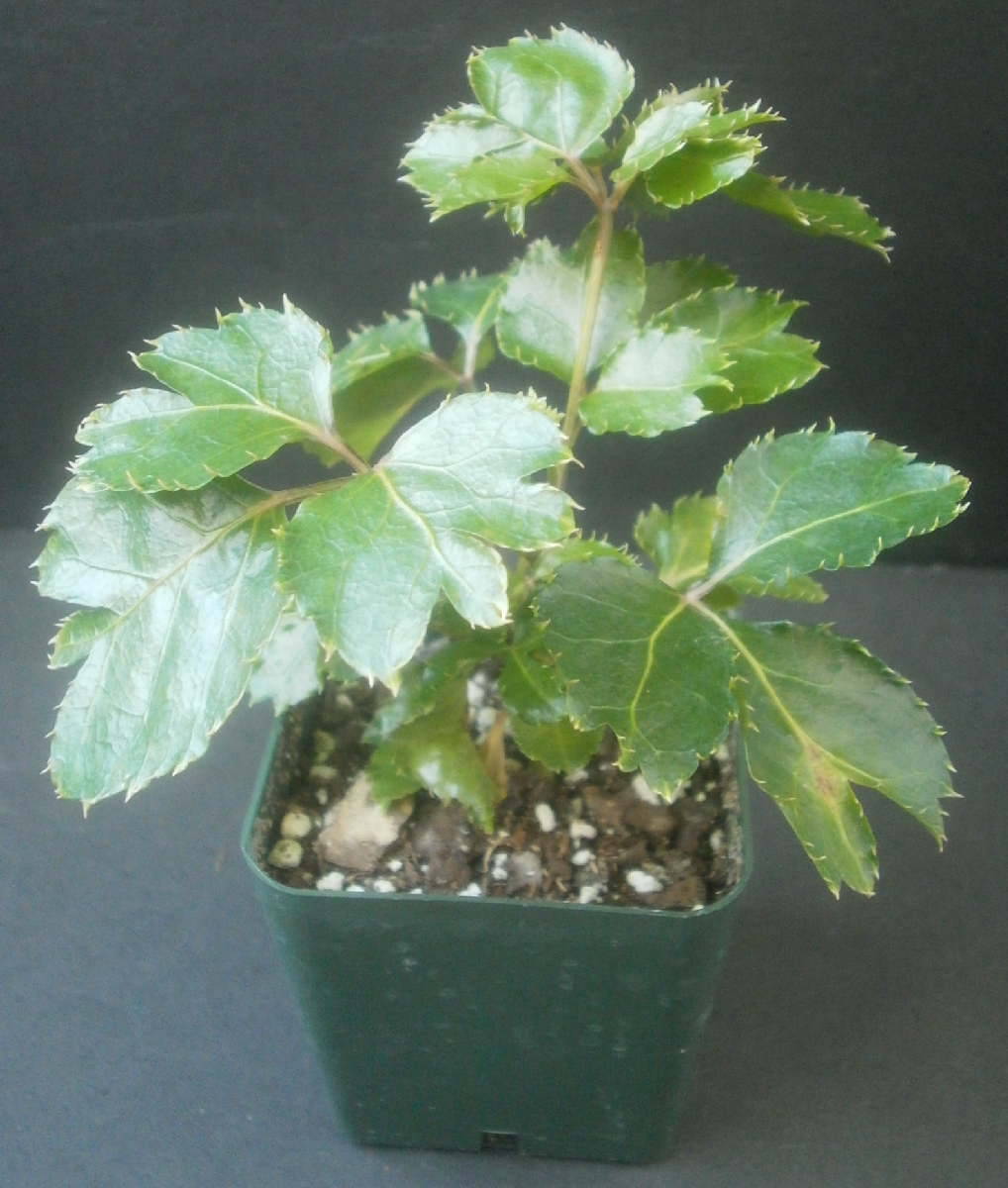

Seedling 10

Seedling 10 is very short but also very thick: one of the first seedlings to start branching. The two things appear to be related. It's like there's only so much vertical growth possible, so the ones that branch tend to be short, and the ones that don't branch wind up tall. Which makes sense, though seedling 04 is both tall and branching, so it's maybe not a firm rule.

So . . . how to explain this, then. I'd never had any reason to suspect that my plant was anything other than a regular old Polyscias fruticosa, and yet a wild-type species plant, crossed with itself, shouldn't give offspring this varied, should it?

It's possible that my parent plant is a hybrid -- I don't know for sure that Polyscias species can hybridize with one another, but I don't know that they can't, and there are other species in cultivation,5 so surely someone has tried before. Searching for "polyscias hybrid" turns up pages where both words appear, but the sites all appear to be using "hybrid" interchangeably with "cultivar" or "variety;" there's no "_______ is a hybrid between P. _____ and P. ______" anywhere.

It's also possible that maybe P. fruticosa produces a lot of sports and/or is naturally variable, like Rhynchostylis gigantea, and all of them have the potential to produce variable offspring. In any case, I'm surprised, don't know how this happened, and am finding it kind of a fun puzzle.

As to whether any of them might be special enough to try to propagate on a larger scale, or patent, or whatever, well, it's still really early. They're only eight months old, and haven't even broken my heart yet,6 so let's don't go counting chickens. But I'm really interested in seedlings 01 and 02, especially 02, and I think I can safely assume that they'd propagate true from cuttings, so . . . maybe someday.

-

1 I'm also pleased to be able to report that there have been a couple other things: first, the previously-mentioned Anthurium seedling 0805 Triana Hill has opened a first bloom, and it actually is pleasant, as I had hoped. (Not wildly different from anything we've ever seen before, granted -- very similar to 0097 Colin Ambulance -- but still pretty and unusual.)
Second, the Neofinetia has bloomed again, which is less earthshaking this year than last, but I appreciate it anyway.
2 Whichever leaf was largest and newest, for each seedling.
3 A technical term. I don't have a fluffimeter (fluh-FIM-i-ter; prounouncing it "FLUF-ee-ME-ter" alerts people that you're not a real scientist) here, so I'm estimating from appearance.
(I should probably say approximate decreasing fluffiness.)
4 The spots don't show well in the photo because of the angle I had to shoot from, but I feel confident in ruling out scale or thrips, and the only thing I've seen anywhere that looked at all like this is edema. And the soil was very wet.
It took me a while to trust that the seedlings didn't have to be kept wet all the time; since they were coming from a very damp germination container, I figured they wouldn't be able to dry out at all, so I was watering a lot. Even so, seedling 09 is the only one that ever complained about it, and I've been watering more cautiously and normally since. It's replaced the dropped leaf already, and then some.
5 (The other two used as houseplants are P. guilfoylei, formerly balfouriana, and P. scutellaria; another three or so are commonly cultivated outdoors, according to Wikipedia.)
6 They will. Let's not kid ourselves. The Anthuriums have, the Schlumbergeras have. I suppose the Coffea and Spathiphyllum seedlings haven't done it yet, but only because they can't: I'm not especially emotionally invested in either group.


Thursday, May 26, 2016

Anthurium no. 0228 "Hoku Mama Swamp"

So the actual plant here isn't that unusual, but the more I see the name "Hoku Mama Swamp," the more I love it. She's a faux queen (a female performance artist who uses the style conventions associated with drag queens, i.e. a female female impersonator; other faux queens whose names you've seen before are Holy McGrail and Ms. Lucia Love.).

I initially had some trouble accepting the idea of faux queens (where's the challenge in a woman looking like a woman?), but am totally on board now, because I'm seeing the whole thing as a set of conventions, the way someone is recognizable as a clown if they do enough things that signify "clown:" white makeup with an exaggerated red grin, red nose, baggy and colorful clothing, floppy shoes, etc. Queens do queeny things instead of clowny things, but it's the same kind of deal: if the wig, clothing, makeup, and so forth all add up to "queen," the actual original gender of the performer isn't really relevant. (If it looks like a duck, and quacks like a duck, etc.) It's not any more remarkable that someone can do drag-queen things and wind up looking like a drag queen any more than it's remarkable that someone can wear a black-and-white striped shirt, white gloves, black pants, paint their face white, and look like a mime. So I welcome the faux queens, personally.

That having been said, I think Hoku's name is more interesting than she is, at least of the things I found of hers on YouTube. Liked some of them, didn't like others. (Here is one of the videos that worked for me, despite the low quality recording. It starts slow, too, so if you're bored, try skipping ahead a couple minutes and see if you like that any better.)

Similarly, I generally approve of Hoku the seedling, though there are definitely some things she could be doing better. The bloom color is red / white, which is boring but well-executed.


Her most notable feature is her size: both the individual leaves and the plant as a whole are gigantic. No offsetting, which is sort of a problem. Not crazy about the internodal distance either, though considering how old she is (sow date: 5 May 2012), she's not sprawling.


The foliage isn't perfect, but it's one of the better seedlings for resisting scale and thrips damage. Top 10% or so, anyway.


The biggest challenge the leaves face, I think, is mechanical damage -- plants with large leaves on long petioles easily get caught on things and tangled in other plants, sometimes resulting in injuries. And injuries accumulate over time, so.


I want to keep Hoku, but I'm not sure about her long-term prospects. She's badly underpotted already, as you can see from the whole-plant photo, and as she becomes more and more rootbound, the soil's going to dry out faster and faster. I don't have room to move any more plants up to 6-inch (15 cm) pots, though, and even if I did, she'd take up a disproportionate amount of room. It's hard to justify using that much space for a seedling that's just another red / white.

On the other hand, she's at least a nice red / white. And I wouldn't mind keeping some big-leaf, thrips-/scale-resistance genes handy. So I imagine her fate depends on how much space I can find in the basement in the next few months.


Tuesday, May 24, 2016

Schlumbergera seedling no. 075

Just one more Schlumbergera after this one, and then we're free of them for a few months.1 So let's hurry up and get this sucker named.


I don't know how typical it's going to be, since this is another late-blooming seedling that only made one bloom before retiring for the season, but the shape is the only unusual characteristic of this seedling's flower. Front petals strongly reflexed; back petals partly reflexed and partly not: either this photo was early, and the bloom just hadn't opened all the way yet, or this is the Schlumbergera equivalent of a mullet ("business in the front, party in the back"). And I would consider Mullet as a name, because it would be easy and I could quickly move on to some other post, but ew. No.2 So I will dig deeper.

There's a sort of overall triangular shape to the bloom, at least in the below photo, so maybe we could do something with orange triangles? Slow-Moving Vehicle, perhaps? It's a little long, I guess.3 And maybe implies not very many flowers?4

Image searches for "orange pointy" were dominated by high heels and manicures; "orange spiky" was dominated by other plants, in particular kiwanos, which wasn't especially useful. Though one always enjoys the opportunity to think about kiwanos.

So I guess it's time to look at the lists of emergency and previously-considered names.

Ever since I considered Francis S for 114A Gallant Fox, I've toyed with the idea of naming the seedlings after specific people from my life, in a way that preserves anonymity for them and plausible deniability for me.5 I'd even kind of done it already, without intending it at the time. (Stoked, as a word, is very strongly associated with a particular person I knew about 25 years ago. Blood Frenzy and Strawberry Madeleine also refer to specific people on some level or another, the former more overtly than the latter.) So I've been thinking about that, and I made a list of people, and I've been adding name ideas to go with the people as I thought of them. Of the few name options that fit the person perfectly and will definitely get used at some point or another,6 the one that I think matches this particular seedling best is Pushover. With enough imagination, one could even imagine the petals as a row of dominoes in the process of falling from right to left:


So I'm thinking this one will be Pushover.

-

1 Oh, and, for anyone left in suspense, the last major branch on 'Caribbean Dancer' fell off too, on the 19th or 20th of May. When they decide they're done, they're done.


2 As a midwesterner of a certain age, I have to say that I don't feel like mullets are always unattractive. At the same time, for any specific individual, a mullet is unlikely to be the best hairstyle option available.
3 The seedling names range in length from 20 characters (082A Strawberry Madeleine) to 4 characters (027A Kiln, 090A Lola); Slow-Moving Vehicle comes in at 19.
4 Which might be accurate, of course. Can't know until next year.
5 If done properly, this would also mean that the people so honored wouldn't actually recognize that they were being honored, or they might suspect if they happened to find out, but couldn't be sure. Which, frankly, appeals to me as well. I suppose this implies that it's not so much about recognizing them, the individual people, and more about celebrating the particular historical me that was connected to them, and if true then that's kinda egotistical, but I'm going ahead with the plan anyway.
6 Assertive, Pushover, I'm Really Sorry (I suppose in one way or another I'm Really Sorry works for all the honorees, but it's especially appropriate for one person, and I didn't say it when I should have.) Good Daddy, Perturbed, and Francis S.


Sunday, May 22, 2016

Pretty picture: Phalaenopsis Salu Peoker x Harlequin

Not a lot to say about this one.


The tag was typoed,


but that's orchid show tags for you.

I'm not crazy about the blooms. I don't mind the pattern: I might even sort of like the pattern. But the color combination doesn't really work for me.


Phalaenopsis Salu Peoker = Phalaenopsis Yellow Peoker x Phalaenopsis Golden Sun (Ref.)

Phalaenopsis Harlequin = Phalaenopsis Rosita x Phalaenopsis Grace Palm (Ref.)


Friday, May 20, 2016

Anthurium no. 0263 "Leo Long"

Leo's from an older batch of seeds, seedling group AS (seed parent 'White Gemini;' sown 5 May 2012). AS has given us both some of the best seedlings to date (0231 Rhea Listick, 0234 Ross Koz, 0239 Russ Teanale) and some mediocre to bad ones (0218 Noah Fence, 0232 Rhoda Badcek, 0244 Sara Problem), so I wasn't sure how hopeful to be. From the single bloom to date, it looks like he's closer to the good seedlings than the bad:


Good enough to promote to a 6-inch pot, anyway. The leaves are interesting,

(This is also a particularly good example of one of the five types of venation the seedlings produce: "fishbone."1

The plant as a whole is okay; there's plenty of suckering,


though I'd be happier with more consistent petiole length, and you can see a little bit of thrips damage here and there.

No real question about whether to keep Leo: I've already told you I moved him to a 6-inch pot. The single bloom to date has been cross-pollinated. We'll see what comes of it.2

-

1 They're my own categories, and I'm still working out how to think about foliage: it's perfectly clear to me that the leaves vary from seedling to seedling, and that the veining is part of the reason they look different, but actually assigning the individual seedlings to distinct categories is tougher than you would think.
Anthurium seedlings produce different leaves as they reach maturity, and it's not always obvious when a seedling has switched from juvenile to mature leaves; also plenty of seedlings have characteristics of more than one category. Leaves look different in different photos, too, and thrips damage can twist leaves so badly that it becomes basically impossible to determine what kind of leaves a plant is trying to make. So nothing about this is exact or particularly scientific. With all those caveats in place, here are some of the more extreme examples of the five types I've identified:

In "flat" venation, the only very prominent vein is the midvein (sometimes also there's a vein running on either side of the midvein that's about the same thickness), and even the midvein is narrow compared to the midveins on other seedlings' leaves. It's also usually the same color as the rest of the leaf, though occasionally they're slightly red. "Flat" leaves are rarely literally flat; they often fold along the midvein, or cup around where the petiole attaches to the leaf. And the flatness is not really the point: the point is that the midvein is relatively narrow, and doesn't stand out.
Juvenile leaves are almost always flat.
Flat seems to be most common with descendants of the NOID red, though the NOID red-violet, 'Red Hot,' and the NOID purple all have leaves closer to flat than to any of the other categories, and a number of other parents lean toward flatness. (The parents are harder to fit into specific foliage categories than the seedlings, so a lot of them have aspects of more than one category.)

("Flat" leaves, clockwise from top left: 0346 Lois Carmen DiNominatre, 0365 Murray Hill, 0597 Raven, 0380 Ewan Watarmi)

"Star" venation has a thicker midvein, as well as one or two pairs of thick, large veins which radiate out from a single point. Usually the veins are also lighter than the rest of the leaf, and the areas between the large veins are fairly smooth, without much visible veining.
This is the most common type among the parents: 'Gemini,' 'White Gemini,' 'Peppermint Gemini,' 'Pandola,' 'Joli,' and 'Krypton' are all stars; consequently, star veining is useless for trying to guess at pollen parentage. I mean, none of the types of veining are ever conclusive, but star is even less helpful than usual.

("Star" leaves, clockwise from top left: 0095 Clarice Fullhartz, 0206 Marcia Dimes, 0467 Regina Fong, 0245 Sawyer Ad)

"Lizard," on the other hand, is uncommon: it's more or less like flat except that all the secondary veins are wider and slightly sunken, giving the leaf a pebbled texture that I think resembles lizard skin or alligator skin. The leaves are usually thicker and heavier with lizards, too.
No parent variety is solidly a lizard. The NOID red, 'Gemini,' and 'White Gemini' all have lizardy tendencies, though. The most common spathe color is red, though there's one pink lizard, 0275 Yvette Horizon. Lizard is my favorite kind of venation, though I think that's more because I like the heavier weight of the leaves than because I care about the pattern itself.

("Lizard" leaves, clockwise from top left: 0072 Beth Rowe, 0076 Bob Humbug, 0203 Anna Mae Hemensouz, 0275 Yvette Horizon)

"Quilted" is like "star:" the midvein and one or two pairs of other large veins all radiate from a single point. The difference is that with "quilted," there are visible veins dividing up the different sections created by the main veins, and within those different sections, the veins are slightly sunken relative to the rest of the leaf, giving a quilted appearance. Hence the name.
The NOID pink, 'Florida,' 'Orange Hot,' and NOID green-pink all have some degree of quilting going on; it seems to be particularly common with orangish seedlings. (Oh yeah -- I'm now wondering whether 'Florida' might not have pollinated some of the seedlings after all. I'll have to explain some other time.)

("Quilted" leaves, clockwise from top left: 0171 Genevieve La Difference, 0317 Dred, 0328 Polly Esther Blend, 0408 Tex Messich)

Last, "fishbone" venation resembles "flat" in that the only prominent vein is the midrib, but there are also small but easily visible secondary veins running parallel to one another to each side of the midrib.
This isn't the main texture for any of the parent plants, but the NOID pink, NOID green-pink, NOID purple, and 'White Gemini' all have some inclination toward fishbone veining. No particular color preferences for fishbone seedlings that I'm aware of.

("Fishbone" leaves, clockwise from top left: 0005 Chad Michaels, 0228 Hoku Mama Swamp, 0263 Leo Long, 0276 Zach Religious)

I think the same basic pattern of veins (a midvein, three pairs of primary veins coming from the petiole, etc.) is present regardless of the seedling, and the differences are mainly a matter of which are most visible (because they're a different color, thickened, or slightly raised or lowered): they're not so drastically different from one another that I'd expect everybody (or anybody, really) to notice, but it's relevant to me, because it still makes a difference in how the plant as a whole looks.
As spathes are modified leaves, it's also possible that the leaf venation has subtle effects on how the spathes look. I haven't checked that out yet.
2 Though we're getting enough plants in bloom at once that targeted, specific crosses are, or soon will be, a possibility.
I've held off targeted crosses partly because I like the randomizing that comes from trying to pollinate with pollen from multiple plants at once, but it sure looks like there have been a few cases where the pollen parent was the same for a whole seedling group anyway, e.g. the AZ and BA seedling groups all came out dark red / yellow, and BF and BH have produced a lot of small and shitty pink or red blooms. If I'm going to get the same bloom over and over again anyway, I suppose I may as well know what cross produced it.


Wednesday, May 18, 2016

Anthurium no. 1038 "Adlai Lowe"

I swear that was the name 1038 got assigned forever ago; I didn't change it to fit this bloom. I just got really lucky, because the bloom is literally very close to the soil line, and also it's about as tiny and inconspicuous as an Anthurium bloom can possibly be.


Adlai is also noteworthy for blooming while in a 3-inch pot; it's not the first seedling to try (that'd be 0835 Brenda Dharling), but it's the first one to succeed (Brenda's first bud aborted).1 If you call this "succeeding." It still hasn't unfurled its spathe all the way yet (because it physically can't), so it's maybe cheating a little bit to count this as a completed bloom.

In any case. I appreciated the enthusiasm, if not the results, so I moved Adlai up to a 4-inch pot in early April, and we'll see what he does with that. I don't expect the bloom to be especially exciting -- I mean, we can see that the spathe is red, so unless the spadix is bioluminescent or metallic or something it's not going to be anything we haven't seen before -- but it's earned the chance to try again, I feel.

The foliage is pretty typical, if on the small side:


The plant as a whole is unremarkable as well, though some of that's because there's so little plant there to remark on.2 I mostly wanted to include this photo so you'd have more context for the size of the spathe:

(The sides of the pot are 2 in. / 5 cm long.)

Oh, and I suppose I should mention that if you count this as a bloom, Adlai is, technically, the first second-generation seedling to bloom. If you're holding out for a more traditional F2 inflorescence (visible to the naked eye, possessing a peduncle and a visible spadix, etc.), you'll have to wait until mid-June. Though that one's disappointing as well, in a different way.3 So far, the full list of attempted blooms from the F2s is:

The ones that are now dead because of scale
0687 Pauline Pantsdown: pink?, daughter of 0273 Wes Coast (pink / pink)
0654 Rosie Cheeks: no color recorded,4 daughter of 0276 Zach Religious (pink / orange)

The ones that aborted buds and haven't tried again yet
0721 Chandelier Divine Brown: red or pink-red, daughter of 0005 Chad Michaels (dark red / green)
0799 Hope Sandreams: pink-red, daughter of 0108 Deena Sequins (red / purple)

The ones that are still in progress
0805 Triana Hill: light pink or maybe peach?, daughter of 0234 Ross Koz (purple-pink / yellow)5
0694 Brad Romance: light pink?, son of 0005 Chad Michaels (dark red / green)6
0698 Landon Cider: red, son of 0005 Chad Michaels (dark red / green)
0855 The Very Miss Dusty O: light pink or pink, daughter of 0234 Ross Koz (purple-pink / yellow)
0811 Alma Children: red, daughter of 0234 Ross Koz (purple-pink / yellow)

Completed (more or less)
0716 Herbie Hind: pink / orange, son of 0239 Russ Teanale (pink / yellow)
1038 Adlai Lowe: red / ?, son of 0234 Ross Koz (purple-pink / yellow)

If I were heavily invested in the idea of getting pretty blooms from the seedlings, I suppose Adlai would be yet another disappointment to add to the list, but I'm less interested in seeing pretty blooms and more interested in seeing something new. And this is certainly new. Plus the bloom is surprisingly long-lived, considering its odd circumstances: at least two and a half months now, and it looks the same as ever. So Adlai gets to hang around for a while. Obviously he's no good for breeding if all the blooms turn out like this, but I'm betting that they won't.

-

1 A couple others have also tried, to varying degrees of success:
1232 Fiona St. James was felled by scale (what else) a month after I saw her bud, and didn't get a chance to complete it. It's not like me to throw out a plant that had a bud on it, especially one that had never bloomed before, so I assume what happened is that she dropped the bud and then got scale, but I don't actually have that information written down so it's just a guess.
0855 The Very Miss Dusty O [sic; the temptation to correct it to "The Very Dusty Miss O" every time I type it is nearly overwhelming] has a bud in progress now, though she may not get the chance to finish either; I saw scale on her the last time I watered. Tried to wipe it off, remove leaves that had visible insects on them, etc., but I don't know that that's actually ever worked so there's really no reason to think it will this time.
2 It's gotten bigger since the move to a 4-inch pot, but not in any sort of meaningful way. More leaves, larger leaves, but they look the same and it's not that big of a difference.
3 (Look at 0716 Herbie Hind on the Anthurium seedling gallery, if you don't mind Anthurium seedling spoilers.)
4 (I'm guessing that the bud dried up and died before I could take its picture.)
5 Considering how things have been going lately, I'm trying not to get my hopes up, but Triana looks like our best bet for a nice F2 seedling at the moment: the bud is decent-sized, there are a reasonable number of suckers, and she's relatively low on thrips damage.
6 Brad might also have potential. Though his bud is significantly smaller, it's a similar color to Triana's, and his foliage is large and less scarred. We'll see.


Tuesday, May 17, 2016

Pretty picture: Miltoniopsis Evergreen Premier

It's possible that there were other Miltoniopsis present at the show, but this is the only one I remember seeing, and the only one I got photos of. Evergreen Premier is as disgustingly cheerful as all the other Miltoniopsis; the most unusual thing about it is probably the yellow in the center, which we've only seen a couple times before.


I can't confirm that the plant was identified correctly. The only on-line source I could find with any picture of an "Evergreen Premier" was seattleorchid.com, but neither the genus nor the photos match in that case. The genus name may or may not be relevant -- the International Orchid Registry lists Miltonia as a synonym for this plant -- but the photo still seems relevant. Feels to me like either that one, or this one, has to be misidentified, though I suppose it's also possible that we're looking at different clones from the same grex.


Miltoniopsis Evergreen Premier = Miltoniopsis Limelight x Miltoniopsis Lilac Time (Ref.)

In unrelated news, a couple of comments about the previous post:

I did start, or try to start, cuttings from the 'Caribbean Dancer' that imploded. (Nine pots' worth, at nine or ten cuttings per pot, because I expect a lot of them to fail.) The one branch that survived the implosion remains intact, which I wasn't expecting, but I'm not sure it matters long-term: it seems too heavy to be able to hold itself up even if it's fine, and there are some indications that its lower segments are rotting, just like on the other branches, and the rot is just slower in this particular case.

There are indications that the Aloe variegata with root rot might have at least a small root system in place now. It doesn't come out of the soil if I pull on it gently, at least. Since I've had pretty crappy luck with Aloes w/r/t scale,1 I may decide to throw it out anyway -- and I probably ought to2 -- but the decision is still up in the air for the moment.

It's certainly possible that the potting soil for the Beaucarnea recurvata held water too well; I think I probably mixed in some "aquatic soil" / bits of fired clay when I up-potted it, but I don't remember for sure, and obviously the plant isn't around to ask anymore. I also have a hazy memory of it being in a spot where water was draining directly into the pot from overhead when I first put it outside, but I moved it out of the way once I noticed, and it grew fine for two or three months afterward. Doesn't mean that wasn't still the problem, but cause and effect are difficult to disentangle in cases like this.

-

1 And although I had forgotten about it, my records tell me that I threw out an A. variegata in October 2013 because of scale, so I know the species isn't immune.
2 I've toyed with the idea of throwing out all the plants, infested or not, that come from genera that the scale seem to like: Agave, Aloe, Haworthia, Gasterworthia, whatever Yuccas I can bear to part with. Haven't done it yet. Maybe won't. I mean, the most obvious solution here is to throw a bunch of plants out, and if I'm doing that, then the plants I should throw out should be the ones I expect to make me unhappy later. But it's hard to punish plants for crimes they haven't committed yet.
An alternate plan is/was to throw out every plant that is not currently delightful: all the plants I've been hanging onto in the hopes that they'd turn themselves around and look nice again, all the plants that I know will eventually look shitty in the future because that's just how that plant's habit is or whatever, all the plants where I've ever thought to myself, oh, I should probably just throw that one out. Same problem with that plan, though.